Complete Guide to Mito Castle: A Thorough Explanation of History, Highlights, and Restored Architecture
Located in Mito City, Ibaraki Prefecture, Mito Castle is a famous castle that served as the residence of the Mito Tokugawa family, one of the three main branches of the Tokugawa clan, protecting a strategic point in eastern Japan for approximately 260 years. It boasts one of the largest scales among castles in Japan built entirely of earth without any stone walls. The Otemon Gate and the Ninomaru Corner Turret were restored between 2020 and 2021, attracting attention as a new tourist spot.
History of Mito Castle: From the Heian Period to the Present
Construction by the Baba Clan (Late Heian Period to Early Kamakura Period)
The history of Mito Castle dates back to the late 12th to early 13th centuries. It is believed to have begun when Baba Kojiro Sukemoto, a samurai from Hitachi Province, built a residence on the eastern end of a long, east-west oriented plateau between the Naka River and Lake Senba. The castle from this period was called “Baba Castle,” and it is believed that the residence was located near the present-day main keep.
It was a natural stronghold surrounded by water on three sides, and its location at a crucial point for land and water transport made it function as a central base for regional control.
The Edo Clan Era (Kamakura Period to Muromachi Period)
From the mid-Kamakura period onward, the Edo clan, who drove out the Baba clan, made Mito Castle their residence. During the Edo clan’s rule, the castle was expanded, and the second bailey was built. It is believed that during this period, the present-day main keep was developed as the inner castle, and the second bailey as the residences of senior retainers.
The Edo clan ruled Mito for approximately 200 years, forming the basic structure of the castle.
Rule by the Satake Clan (Sengoku Period to Early Edo Period)
At the end of the Sengoku period, the Satake clan, who unified Hitachi Province, brought Mito Castle under their control. Satake Yoshinobu entered Mito Castle in 1590 and undertook extensive renovations. During the Satake clan’s rule, the castle was further expanded, and the third bailey was also developed.
However, in 1602, Satake Yoshinobu was ordered to relocate to Akita in Dewa Province, and had to leave Mito Castle.
As the Residence of the Mito Tokugawa Family (Edo Period)
In 1609, Tokugawa Yorifusa, the eleventh son of Tokugawa Ieyasu, was granted Mito, making it the residence of the Mito Tokugawa family with a domain of 250,000 koku (later 350,000 koku). From then until the Meiji Restoration, for 11 generations, it served as an important base, one of the three main Tokugawa branches, keeping a watchful eye on the various domains of the Tohoku region.
After entering the castle, Yorifusa began a major renovation. However, despite being the residence of one of the three main branches of the Tokugawa family, Mito Castle was characterized by its simpler construction compared to Nagoya Castle of the Owari Domain and Wakayama Castle of the Kishu Domain. This is thought to be because the Mito Domain, as the “Deputy Shogun of the Realm,” supported the Edo Shogunate, and its lord often resided in Edo.
The Turmoil of the Late Edo Period and the Abandonment of the Castle (Late Edo Period to Meiji Era)
During the late Edo period, the Mito Domain became one of the centers of the Sonno Joi (Revere the Emperor, Expel the Barbarians) movement. The 9th lord, Tokugawa Nariaki, established the Kodokan school and devoted himself to the education of his samurai. However, the domain was divided into conservative and reformist factions, leading to internal conflicts such as the Tenguto Rebellion.
After the Meiji Restoration, Mito Castle was abandoned due to the abolition of the feudal domains and establishment of prefectures. A fire in 1872 destroyed major buildings such as the three-story turret, and the castle site was subsequently used as school grounds.
Restoration Project from Showa to Reiwa
In 1945, during the Mito air raid, almost all of the remaining buildings, except for the Yakuimon Gate, were destroyed. After the war, the Mito Castle site was developed as an educational district, and even today, Mito First High School and Ibaraki University are located there.
From 2018, the restoration and development project of the Mito Castle site began in earnest, and the Otemon Gate was restored in 2020, followed by the Ninomaru Corner Turret in 2021. These restorations allow us to imagine the former appearance of Mito Castle.
Characteristics of Mito Castle: One of Japan’s Largest Earthen Castles
Construction Using Earthen Embankments Without Stone Walls
The most distinctive feature of Mito Castle is that it was built using only earthen embankments, without any stone walls. This is an unusual structure for a castle of one of the Tokugawa Three Houses, and it is believed that there were geological and economic reasons for this.
The Mito Plateau is covered with Kanto loam, making it difficult to obtain high-quality stone. Furthermore, the Mito Domain, due to its role in supporting the Edo Shogunate, tended to allocate its budget to educational policies rather than military spending, and therefore did not construct a castle with stone walls.
The earthen ramparts reach heights of over 10 meters in some places, making them among the largest earthen castles in Japan. Even today, well-preserved earthen ramparts can be seen around the dry moat of the third bailey.
Concentric Layout
Mito Castle is characterized by its “concentric” layout, where the main bailey, second bailey, and third bailey are aligned in a straight line from east to west. The three baileys are arranged in a continuous pattern on a long, narrow plateau stretching approximately 2 kilometers from east to west.
Each bailey is separated by massive dry moats and trenches. The large trench separating the main bailey and the second bailey reaches a depth of nearly 20 meters and now carries the JR Joban Line. The moat separating the second and third baileys is now National Route 50, allowing visitors to appreciate the depth of the moat in its heyday.
The Three-Story Turret that Served as a Main Keep
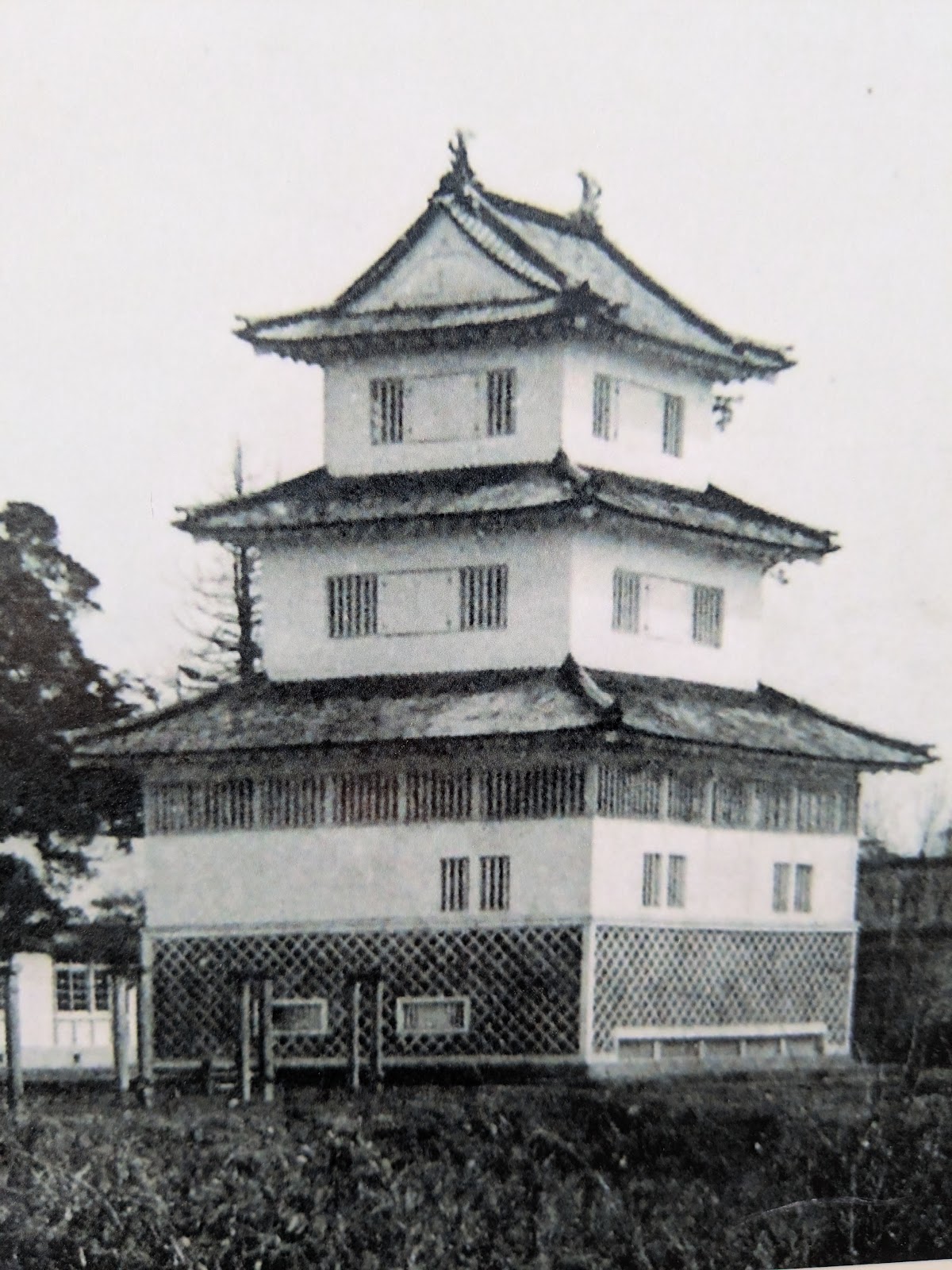
Although Mito Castle never had a main keep, the Three-Story Turret built in the main bailey served as a substitute. This three-story turret, with its hip-and-gable roof, was a beloved symbol of Mito and a familiar landmark to the city’s residents.
The Three-Story Turret was destroyed in a fire in 1872 (Meiji 5), but old photographs and drawings remain, allowing us to understand its appearance. Currently, the restoration of the Three-Story Turret is being considered.
Highlights of Mito Castle Ruins: Restored Architecture and Existing Remains
Otemon Gate (Restored)
Completed in February 2020 (Reiwa 2), the Otemon Gate was the most prestigious gate of Mito Castle. It functioned as the main gate of the third bailey and boasts one of the largest scales among castle gates attached to earthworks in Japan. The Otemon Gate is a masugata gate consisting of a double structure of a Korean-style gate and a turret gate. The turret gate is two stories high, with a total floor area of approximately 280 square meters. The restoration was based on Edo-period drawings and archaeological excavation findings, and constructed using traditional wooden construction methods.
The interior of the Otemon Gate is open to the public, where visitors can view exhibits introducing the history of Mito Castle and the restoration process (free of charge). From the second floor, you can enjoy a panoramic view of the San-no-maru area and experience the atmosphere of the castle town in its heyday.
Ninomaru Corner Turret (Restoration)
The Ninomaru Corner Turret, which opened to the public in June 2021, is a two-story turret that once stood at the southwest corner of the Ninomaru area. Like the Otemon Gate, it was restored based on Edo-period drawings and archaeological excavation findings.
The interior of the turret serves as an exhibition space, displaying materials related to the history of Mito Castle and the Mito Tokugawa family. From the second floor, you can enjoy a panoramic view of the area around the second bailey, and truly appreciate the height of the earthworks and the depth of the moat.
Admission is free, and the museum is open from 9:00 AM to 5:00 PM (last entry at 4:30 PM). It is closed on Mondays (or the following day if Monday is a public holiday) and during the New Year holidays.
Yakui Gate (Existing)
The Yakui Gate, the only remaining structure of Mito Castle, is believed to have been the main gate at the bridge of the main bailey. It is a valuable historical structure that preserves the architectural style of the early Edo period and is designated as an Ibaraki Prefecture cultural property.
It has now been relocated to the grounds of Mito Daiichi High School, and its exterior can be viewed on school days. As a castle gate in the Yakui Gate style, it is an important structure for understanding Edo period architectural techniques, including the positional relationship between the main pillars and supporting pillars, and the shape of the roof.
Sugiyama Gate and Sakumachi Sakashita Gate
The Mito Castle ruins also contain the reconstructed Sugiyama Gate and Sakumachi Sakashita Gate. These gates were restored in the Heisei era, recreating the atmosphere of the castle in its heyday.
The Sugiyama Gate is located on the north side of the second bailey and served as an entrance to the Nakagawa River. The Sakumachi Sakashita Gate is located on the south side of the third bailey and served as an entrance to Lake Senba. Both gates are free to visit.
Dry Moats and Earthworks
The greatest highlight of Mito Castle is the massive dry moats and earthworks that still exist. The dry moat of the third bailey, in particular, is well-preserved, with many of the original remains intact. The moat is over 10 meters deep, and including the earthworks on both sides, the elevation difference reaches nearly 20 meters.
The moat separating the second and third baileys is now National Route 50, but the height of the earthworks remaining on both sides of the road allows us to imagine the scale of the moat in its heyday. The large moat separating the main keep and the second bailey now carries the JR Joban Line, and from the platform of Mito Station, you can look up at the earthen rampart that rises like a cliff.
Kodokan: A domain school built in the third bailey of Mito Castle
Japan’s largest domain school
The Kodokan was a domain school established in 1841 by the 9th lord of the domain, Tokugawa Nariaki, and was an educational institution that could be called a comprehensive university of the Edo period. It taught a wide range of subjects, including Confucianism, martial arts, medicine, astronomy, and Dutch studies, and functioned as the center of Mito studies.
The site covers approximately 8 hectares, making it the largest domain school in Japan. The main hall, Shizendo hall, and main gate, among other late Edo period buildings, still exist and are designated as important national cultural properties. Furthermore, the entire Kodokan Park is designated as a special national historic site.
Points of Interest During Your Visit
At the Kodokan’s main hall, you can see the “Seiseki-no-ma” (main lecture room) where the feudal lord gave lectures, and the “Shoyaku Kaisho” (office where samurai studied). The Shizendo was the residence of Tokugawa Nariaki after his retirement, and during the turbulent Bakumatsu period, the last shogun, Tokugawa Yoshinobu, also lived here in seclusion.
The garden is known for its plum blossoms, with approximately 800 plum trees of about 60 varieties. The “Mito Plum Blossom Festival” is held from late February to early March, attracting many tourists.
Opening hours are from 9:00 AM to 5:00 PM (until 4:30 PM from October to February). Admission is 400 yen for adults and 200 yen for elementary and junior high school students.
Kairakuen Garden: One of Japan’s Three Great Gardens
A Garden Built Together with the Kodokan
Kairakuen Garden is a Japanese garden built by Tokugawa Nariaki together with the Kodokan, and is counted as one of Japan’s three great gardens, along with Kenrokuen Garden in Kanazawa and Korakuen Garden in Okayama. While the Kodokan was a place for learning “literature,” Kairakuen Garden was positioned as a place for training “martial arts” and resting mind and body.
The name “Kairakuen” originates from a passage in Mencius, “The ancients enjoyed themselves together with the people, therefore they were able to enjoy themselves,” and embodies the meaning of a place where everyone, regardless of social status, can enjoy themselves together.
A Famous Spot for Plum Blossoms
Kairakuen Garden is nationally famous as a spot for plum blossoms, with approximately 3,000 plum trees of about 100 varieties planted there. Early-blooming, mid-blooming, and late-blooming varieties are planted separately, allowing visitors to enjoy the plum blossoms for an extended period from mid-February to late March.
Every year from mid-February to late March, the “Mito Plum Blossom Festival” is held, attracting over one million visitors. The garden is also illuminated at night, creating a magical atmosphere.
Other Attractions
Besides the plum blossoms, Kairakuen Garden offers many other attractions, including the Kobuntei Pavilion, Togyokusen Spring, and the Moso Bamboo Grove. The Kobuntei Pavilion is a two-story, three-tiered building designed by Tokugawa Nariaki himself, and visitors can tour the interior (for a fee). From the third floor, you can enjoy a panoramic view of Lake Senba and the city of Mito.
The garden is open from 6:00 AM to 7:00 PM (until 5:00 PM from October to February), and admission is generally free (there is a fee for the Kobuntei Pavilion).
Access and Tourist Information for Mito Castle
Access Methods
Access by Train
- Approximately 8 minutes on foot from the North Exit of Mito Station on the JR Joban Line to reach the Otemon Gate.
- Approximately 5 minutes on foot from Mito Station to Kodokan.
- Approximately 20 minutes on foot or 10 minutes by bus from Mito Station to Kairakuen Garden.
Access by Car
- Approximately 20 minutes from Mito IC on the Joban Expressway.
- Approximately 20 minutes from Ibaraki-machi Higashi IC on the Kita-Kanto Expressway.
- Paid parking is available around the Mito Castle ruins (dedicated parking is available at Kodokan and Kairakuen Garden).
Volunteer Guides
Free guided tours by volunteer guides are available at Mito Castle ruins, Kodokan, and Kairakuen Garden. Reservations are required and can be made through the Mito City Tourism Association. Guided tours allow for a deeper understanding of the historical background and highlights.
Sales of Castle Stamps
Mito Castle stamps are sold at the Otemon Gate and the reception desk of the Kodokan. In addition to the regular version, seasonal and special editions are also issued, making them popular souvenirs of castle visits. Prices range from approximately 300 to 500 yen.
Nearby Tourist Attractions
The following tourist attractions are located near the Mito Castle ruins:
- Ibaraki Prefectural Museum of History: A museum introducing the history and culture of Ibaraki Prefecture
- Mito Art Tower: A multi-purpose cultural facility where you can enjoy contemporary art, theater, and music
- Senba Lake: A lake with a circumference of approximately 3 kilometers, where you can enjoy strolling and boating
- Mito Toshogu Shrine: A shrine dedicated to Tokugawa Ieyasu, and a nationally designated Important Cultural Property
Cultural Property Designation and Preservation Status of Mito Castle
National Historic Site Designation
The Mito Castle ruins were designated a national historic site in 2017. From the late 12th century to the Meiji era, the castle grounds underwent repeated expansions as the castle lords changed hands, including the Baba, Edo, Satake, and Tokugawa clans. As a castle site spanning the medieval and early modern periods, it holds considerable historical significance.
In particular, as a large-scale castle built on earthen ramparts rather than stone walls, it occupies an important position in the history of Japanese castles, and its preservation and utilization are being promoted.
Future Restoration Plans
Following the restoration of the Otemon Gate and the Ninomaru Corner Turret, Mito City plans to continue developing the Mito Castle site. The restoration of the Gosankai Turret is also being considered; if realized, this symbol of Mito Castle will be revived after approximately 150 years.
Furthermore, efforts are being made to improve the facilities for tourists, including the development of the area around the San-no-maru dry moat and the provision of multilingual information signs.
Summary: Experience the Charm of Mito Castle
Mito Castle is a castle characterized by its simple construction without stone walls, despite being the residence of one of the three Tokugawa branches. However, its massive earthworks and dry moats are among the largest in Japan, making it a masterpiece that embodies the pinnacle of earthen castle construction techniques.
Thanks to the restoration project in the Reiwa era, the main gate and the corner turret of the second bailey have been revived, allowing visitors to imagine its former glory. Furthermore, visiting Mito Castle in conjunction with the Kodokan and Kairakuen Garden allows you to experience the spirit of “both literary and martial arts” that the Mito Tokugawa family strived for.
Mito Castle boasts a long history dating back to the Heian period and was the center of the Sonno Joi (Revere the Emperor, Expel the Barbarians) movement at the end of the Edo period. Please visit Mito to experience its history and culture. A beautiful landscape where nature in all four seasons harmonizes with historical buildings awaits you.

-800x450.png)