Utsubuki Castle (Kurayoshi City, Tottori Prefecture) Complete Guide | History, Structure, Highlights, and Access Information
Utsubuki Castle is a mountain castle built on Mount Utsubuki (elevation 204 meters) in the heart of Kurayoshi City, Tottori Prefecture. From the Muromachi period to the Sengoku period, it played a crucial role as the political and military center of Hoki Province for approximately 200 years. After flourishing as the shugo (provincial governor) residence of the Yamana clan, its rulers changed hands to the Nanjo and Mori clans, and eventually, Utsubuki Castle was abandoned. However, many remains still exist today, conveying the history of Kurayoshi.
This article comprehensively introduces information about Utsubuki Castle, including its detailed history from construction to abandonment, its structure and defensive systems as a mountain castle, highlights of the remains that can be seen on-site, and access information and nearby tourist spots for those actually visiting.
History of Utsubuki Castle | From the Yamana Clan to the Mori Clan’s Rule
Construction and the Yamana Clan’s Period as a Provincial Governor
Utsubuki Castle was built during the Nanboku-cho period and the early Muromachi period. While there are various theories regarding the exact construction date, it is generally believed to have been built sometime between the Enbun era (1356-1361) and the Oan era (1368-1375).
Yamana Moroyoshi, the eldest son of Yamana Tokiuji, the provincial governor of Hoki Province, built Utsubuki Castle to move the provincial governor’s residence from its previous residence, Tauchi Castle. Although Mount Utsubuki is not particularly high at an elevation of 204 meters, it was a strategically important location overlooking the Kurayoshi Plain and controlled transportation in the Tenjin River basin.
The Yamana clan, as a powerful daimyo under the Muromachi Shogunate, wielded such influence at its peak that it was known as “Lord of Six-tenths.” Utsubuki Castle served as the Yamana clan’s base for controlling Hoki Province, and was used for approximately 200 years. The castle town developed with the construction of residences belonging to their retainers.
The Turmoil of the Sengoku Period and the Era of the Nanjo Clan
As the Muromachi period transitioned into the Sengoku period, the Yamana clan’s power declined. By the mid-16th century, local lords rose to prominence within Hoki Province, and Utsubuki Castle became a stage for complex power struggles.
Around the Eiroku era (1558-1570), the Nanjo clan, a powerful local lord in Hoki Province, gained control of the area around Kurayoshi, including Utsubuki Castle. The Nanjo clan was based at Ueshijo Castle, but Utsubuki Castle functioned as an important base for controlling the Kurayoshi Plain.
Initially, the Nanjo clan belonged to the Amago clan, but after the Amago clan’s downfall, they became subordinate to the Mori clan, striving to survive amidst the complex political situation of the Sengoku period. It is believed that during this period, Utsubuki Castle underwent reinforcement and renovation of its defensive facilities in response to the rising military tensions.
Mori Clan Rule and Castle Abandonment
Entering the Tensho era (1573-1593), the influence of the Mori clan, who became the dominant power in the Chugoku region, extended to Hoki Province. The Nanjo clan wavered between the Mori and Oda clans, but ultimately came under the complete control of the Mori clan during Toyotomi Hideyoshi’s unification of Japan.
In 1580 (Tensho 8), Utsubuki Castle, along with Ueshijo Castle, is believed to have fallen to an attack by the Mori clan. Following the Battle of Sekigahara (1600), Hoki Province became the territory of the Ikeda clan of the Tottori Domain.
In the Edo period, Utsubuki Castle was officially abandoned due to the One Castle Per Province Decree (1615). Although it lost its function as a castle, Mount Utsubuki and its foothills continued to maintain their importance as the spiritual center of Kurayoshi town and as a place of worship. The history of Utsubuki Castle as a castle town greatly influenced the formation of the current Kurayoshi city center.
Structure of Utsubuki Castle | Layout and Defensive System of a Mountain Castle
Overall Layout
Utsubuki Castle is a typical medieval mountain castle, centered on the summit of Mount Utsubuki, with multiple baileys (kuruwa) arranged along the ridges and slopes. It features a three-dimensional defensive structure utilizing the elevation difference from the 204-meter-high summit to the foothills.
The castle area extends approximately 400 meters east-west and 300 meters north-south, and each of the main bailey groups has its own unique name. This suggests that as the ruling power shifted from the Yamana clan to the Nanjo clan and then to the Mori clan, important facilities were repeatedly relocated, expanded, and remodeled.
The main enclosure, the heart of the castle, is located at the mountaintop, from which the second and third enclosures are arranged radially along the ridge. Each enclosure is demarcated by moats and earthworks, designed to function as an independent defensive unit.
Layout of Major Enclosures and Facilities
The main enclosure (honmaru) is located at the highest point of the mountaintop, measuring approximately 40 meters east-west and 30 meters north-south. It is believed that the lord’s residence and important military facilities were located here. Even today, a flat terrain remains, and traces of earthworks can be seen around it.
Several second enclosures are arranged around the main enclosure, each serving as a defensive base against attacks from different directions. The northern and eastern enclosures, in particular, are large in scale and designed to accommodate a large number of soldiers.
On the mountainside, a series of terraced enclosures, including the Third Enclosure and Lower Enclosure, form a multi-layered defensive system designed to progressively prevent enemy advances. These enclosures are strategically positioned along the main approach route to the summit, allowing for flanking attacks against besieging forces.
Characteristics of Defensive Structures
A notable feature of Utsubuki Castle’s defensive system is the extensive use of ditches. These trenches, dug to cut across the ridgeline, not only hindered enemy advances but also separated the enclosures, enhancing their independence. Several clearly defined trenches, several meters deep, can be seen at the site.
Earthworks were also constructed throughout the castle, raising the edges of the enclosures to improve defensive capabilities. Some of these earthworks still remain, reaching a height of 2-3 meters, providing valuable insights into the castle-building techniques of the time.
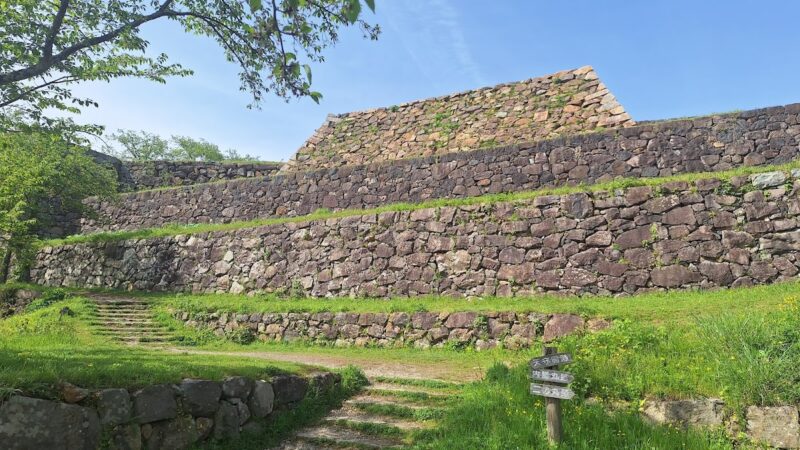
Interestingly, Utsubuki Castle shows limited use of stone walls. This indicates that the castle was built before the widespread introduction of stone wall construction techniques. However, within some parts of the castle grounds, stonework constructed from natural stones and foundation structures using stone have been confirmed, suggesting that stone materials were partially used as time progressed.
Ascent Route and Gates
The main ascent route to Utsubuki Castle is thought to be the main approach road extending from the southwest side of the mountain. This road is still maintained as a hiking trail today, continuing to the summit while retaining traces of its original appearance.
Key points along the ascent route were gates (koguchi, castle gates), designed to stop enemy incursions. Stonework and earthen ramparts were placed around the gates, creating narrow passages that enhanced defensive effectiveness.
As the ascent route approaches the summit, it becomes steeper, requiring movement through a network of baileys. This complex route imposed a significant psychological and physical burden on the attacking force.
Remains of Utsubuki Castle | Highlights You Can See on Site
Preservation of Enclosures and Earthworks
The greatest highlight of Utsubuki Castle is its well-preserved group of enclosures and earthworks. Even more than 400 years after its abandonment, the main enclosures, including the main keep, remain as clearly defined flat areas, allowing visitors to experience the structure of a medieval mountain castle.
The earthworks surrounding the main keep are particularly well-preserved on the north and east sides, with continuous mounds exceeding 2 meters in height. Standing on these earthworks, one can imagine the castle’s soldiers who stood guard and defended the area.
The second and third enclosures also maintain their respective scales and shapes, helping to understand the overall layout of the castle. The elevation differences between the enclosures are also clear, making these valuable remains that allow you to experience a three-dimensional defensive structure.
Moats and Cut Ridges
One of the most impressive remains of Utsubuki Castle is the massive moat that cuts across the ridge. The ridges extending east and west from the main enclosure are lined with multiple trenches, some nearly 5 meters deep from the bottom.
Both sides of the trenches are steep cliffs (artificially carved steep slopes), making it extremely difficult for enemy soldiers to climb. Visitors to the site will be overwhelmed by the scale of these trenches and cliffs.
The large trench on the east side of the main enclosure is particularly well-known as a representative structure of Utsubuki Castle. With a V-shaped cross-section over 10 meters wide and 4-5 meters deep, it demonstrates the high level of civil engineering technology of medieval mountain castles.
Traces of Stonework and Stone Material Use
While no full-scale stone walls are found at Utsubuki Castle, some stonework using natural stones remains along the edges of the enclosures and around the entrance gates. These were likely added during later renovations and provide clues to the castle’s transformation.
In one corner of the main enclosure, flat stones, believed to be foundation stones, are arranged, suggesting that a building once stood here. A depression believed to be the site of a well also remains, offering glimpses into life within the castle.
Views and Strategic Location
One of the greatest attractions of Utsubuki Castle is the magnificent view from the mountaintop. From the main enclosure, one can see the entire city of Kurayoshi, the flow of the Tenjin River, and the surrounding mountains. This view was extremely important for the castle lord and soldiers conducting surveillance activities at the time.
On clear days, one can even see the Sea of Japan and Mount Daisen in the distance, giving a real sense of Utsubuki Castle’s geographical location in the center of Hoki Province. This strategic location is precisely why the Yamana clan established their shugo (provincial governor’s) residence here, and it was a key factor in its continued function as an important base for approximately 200 years.
Access and Visiting Information for Utsubuki Castle
Basic Information
Location: Nakanomachi, Kurayoshi City, Tottori Prefecture (Utsubuki Mountain)
Elevation: 204 meters
Castle Type: Mountain Castle
Construction Period: Enbun-Oan period (circa 1356-1375)
Main Lords: Yamana clan, Nanjo clan
Remains: Enclosures, earthworks, moats, stone walls
Designation: Kurayoshi City Designated Historic Site
Transportation Access
Using Public Transportation:
- Approximately 15 minutes by local bus from JR San’in Main Line “Kurayoshi Station,” get off at “Akagawara/Shirakabe Dozo” bus stop, then approximately 10 minutes on foot to the trailhead.
- Approximately 10 minutes by taxi from Kurayoshi Station to the trailhead.
Using a Car:
- Approximately 15 minutes from San’in Expressway “Kurayoshi Nishi IC”
- Approximately 5 minutes from Kurayoshi city center to Utsubuki Park parking lot
- Utsubuki Park parking lot (free) is available
Ascent Route and Estimated Time
The most common starting point for climbing Utsubuki Castle is Utsubuki Park. Several hiking trails are maintained within the park, allowing you to choose according to your fitness level and purpose.
Standard Route (Main Entrance):
Utsubuki Park Parking Lot → Trailhead → Second Enclosure → Main Enclosure
Estimated Time: Approximately 30-40 minutes ascent, approximately 20-30 minutes descent
Difficulty: Intermediate (steep slopes included)
While the hiking trails are generally well-maintained, there are steep slopes and uneven terrain characteristic of mountain castles, so comfortable shoes and clothing are essential. Particular caution is needed during and after rain, as the trails can become slippery.
Notes for Visitors
- Season: Spring (cherry blossom season) and autumn (autumn foliage season) are especially recommended, but insect repellent is necessary in summer.
- Clothing: Long-sleeved shirt and long pants, trekking shoes or athletic shoes are recommended.
- Items to Bring: Drinking water, towel, insect repellent spray (in summer), work gloves (when observing the ruins).
- Estimated Time Required: Expect 1.5 to 2 hours from ascent to descent.
- Toilets: Available within Utsubuki Park (not at the summit).
Points for Visiting
Here are some points for effectively visiting Utsubuki Castle.
- Obtain a site plan in advance: Bringing a site plan, available from the Kurayoshi City Tourist Information Center or castle-related websites, will deepen your understanding of the remains.
- Consider the layout of the baileys: Walking while considering the defensive system each bailey formed will give you a better overall view of the castle.
- Observe the moats: The large moat is a must-see. Descending to the bottom and looking up at the cliffs on both sides will give you a real sense of its scale and defensive power.
- Enjoy the view: The 360-degree view from the main bailey is essential for understanding the importance of the castle’s location.
- Photography: We recommend taking photographs to document the remains, such as the earthworks, moats, and panoramic views of the baileys.
Tourist Spots Around Utsubuki Castle
Here are some tourist spots in Kurayoshi City that you might want to visit before or after your visit to Utsubuki Castle.
Utsubuki Park
Located at the foot of Utsubuki Castle, Utsubuki Park is one of the most famous cherry blossom viewing spots in the San’in region, selected as one of “Japan’s Top 100 Cherry Blossom Viewing Spots.” In spring, approximately 4,000 Somei Yoshino cherry trees bloom, attracting many visitors. It is also known as a famous spot for azaleas, with approximately 40,000 azaleas coloring the hillside from late April to early May.
Walking paths are maintained within the park, allowing visitors to enjoy the changing seasons while strolling. Taking a relaxing break in the park before or after visiting Utsubuki Castle is highly recommended.
Kurayoshi White-Walled Storehouse District
The townscape of Kurayoshi, which developed as a castle town of Utsubuki Castle, is still preserved today as the “White-Walled Storehouse District.” The rows of white plaster-walled storehouses with red Sekishu tiles along the Tamagawa River create a beautiful landscape that strongly retains the atmosphere of the Edo and Meiji periods.
This area, designated as an Important Preservation District for Groups of Traditional Buildings, is dotted with cafes, general stores, and galleries housed in renovated townhouses, allowing visitors to enjoy historical walks and shopping simultaneously. Visiting after learning about the history of Utsubuki Castle will deepen your understanding of the development of the castle town.
Kurayoshi Museum & Kurayoshi Historical and Folk Museum
These facilities are recommended for learning about the history and culture of Kurayoshi City. The Kurayoshi Museum exhibits materials related to Utsubuki Castle and the Yamana clan, providing a more detailed understanding of the castle’s historical background.
The Kurayoshi Historical and Folk Museum features exhibits on the development of Kurayoshi as a castle town and the history of Hoki Province, allowing you to understand the role Utsubuki Castle played within the context of local history.
Hase-dera Temple (Kurayoshi)
Located on the slopes of Mount Utsubuki, Hase-dera Temple is an ancient temple where large votive paintings have been offered since ancient times. It is known for housing a votive painting of a white horse, said to have been painted by the Heian period artist Kose Kanaoka.
Located on the same mountain as Utsubuki Castle, this temple had a deep connection to the castle and was a place of worship for the castle lord and soldiers. Visiting it during a visit to Utsubuki Castle allows you to feel the connection between the castle and the local spiritual culture.
Misasa Onsen
Located about 20 minutes by car southeast of Kurayoshi City, Misasa Onsen boasts one of the world’s highest radon concentrations. It’s perfect for relaxing after a tiring visit to Utsubuki Castle, and offers plenty of day-trip bathing facilities.
The hot spring town has many attractions, including Misasa Bridge and riverside baths, making it a popular spot for tourists to combine with Kurayoshi sightseeing.
Utsubuki Castle and the Hoki Province Castle Network
Understanding Utsubuki Castle requires knowing its relationship to surrounding castles.
Relationship with Tanouchi Castle
Tanouchi Castle, where Yamana Moriyoshi established his shugo (provincial governor) residence before building Utsubuki Castle, was located about 5 kilometers northwest of Kurayoshi City. The relocation from Tanouchi Castle to Utsubuki Castle was not merely a change of residence, but a strategic decision to move the base of operations for governing Hoki Province to a more central location closer to the plains.
Tanouchi Castle, located in a mountainous area, offered excellent defenses, but was disadvantageous in terms of managing the territory and transportation. Utsubuki Castle, while maintaining defensive capabilities, offered easy access to the Kurayoshi Plain and the Tenjin River basin, making it a more suitable location for a shugo (provincial governor) residence.
Coordination with Hagoromoishi Castle
During the Nanjo clan’s era, Hagoromoishi Castle was the main castle, while Utsubuki Castle served as a subsidiary castle. Hagoromoishi Castle is located southeast of Kurayoshi City, in what is now Yurihama Town, Tohaku District, approximately 10 kilometers from Utsubuki Castle.
The two castles were located in a position where visual communication was possible, and it is believed that information was transmitted using signal fires and other means. While Hagoromoishi Castle served as a defensive stronghold in the mountainous region, Utsubuki Castle played a different role, serving as a control center in the plains.
Castles of Hoki Province
Many other medieval castles were built in Hoki Province. While Yonago Castle in Yonago City and Tottori Castle in Tottori City later developed into early modern castles, Utsubuki Castle remained a medieval mountain castle until its abandonment, thus retaining much of its original appearance.
These castles tell the story of the complex Sengoku period, a time when shugo daimyo and local lords vied for power within the single region of Hoki Province. Utsubuki Castle, as a central figure, occupies an important position in the history of Hoki Province.
Cultural Value and Preservation Activities of Utsubuki Castle
Value as a Historical Site
Utsubuki Castle possesses high academic value as a typical example of a mountain castle from the Muromachi period to the Sengoku period. This castle, which functioned as a provincial governor’s residence for approximately 200 years, is rare nationwide and a valuable historical site for studying medieval political and military history.
The remains are well-preserved, with basic elements such as baileys, earthworks, and moats clearly visible, making it an excellent teaching tool for learning about the structure of medieval mountain castles. It is also important to note that it provides insight into the construction methods using civil engineering techniques, which differ from the extensive use of stone walls in early modern castles.
Regional Historical Identity
Utsubuki Castle is the core of Kurayoshi City’s historical identity. The current Kurayoshi city center developed as a castle town around Utsubuki Castle, and many remnants of the castle town era can be seen in the town layout and place names.
The historical townscape, including the white-walled storehouses, was also formed thanks to the development of the castle town centered around Utsubuki Castle. The historical continuity connecting the castle, the castle town, and the modern city across time is a major attraction of Kurayoshi.
Efforts for Preservation and Utilization
In Kurayoshi City, efforts are underway to preserve and utilize the ruins of Utsubuki Castle. Improvements to hiking trails and the installation of information boards have created an environment that is easily accessible and safe for the general public.
Local history enthusiasts and castle researchers are actively conducting surveys and research, accumulating new discoveries and knowledge. Furthermore, its use as a tourist resource is progressing, making it an important pillar of historical tourism in Kurayoshi City.
In the future, multifaceted preservation and utilization measures are expected, including detailed explanations of the remains through further academic research, information dissemination using digital technology, and integration into educational programs.
The Significance of Visiting Utsubuki Castle
Visiting Utsubuki Castle is more than simply seeing an old castle ruin. It is a valuable opportunity to experience Japanese history from the Muromachi period to the Sengoku period, trace the footsteps of warlords such as the Yamana and Nanjo clans, and learn how people in the Middle Ages utilized the terrain to build and defend castles.
Standing on the 204-meter-high summit and overlooking the Kurayoshi Plain, you will see the same view as the castle lord of approximately 600 years ago. Within that panorama, you can discover the history of Hoki Province, the medieval history of Japan, and the regional narrative that continues to the present day.
While Utsubuki Castle lacks the ornate elements of stone walls and keeps, its simple remains, constructed of earth and wood, represent the very origins of Japanese castle history. Only those who actually visit the site, walk the steps, and see it with their own eyes can truly understand and appreciate its essential value.
When visiting Kurayoshi City in Tottori Prefecture, be sure to climb Utsubuki Castle and experience the charm of a medieval mountain castle and the history of Hoki Province. The beautiful nature of Utsubuki Park, the charming townscape of white-walled storehouses, and the historical remains of Utsubuki Castle will surely make your trip unforgettable.