A Complete Guide to the History and Highlights of Tauchi Castle (Kurayoshi City, Tottori Prefecture) | The Full Picture of the Yamana Clan’s Guardian Residence
What is Tauchi Castle?
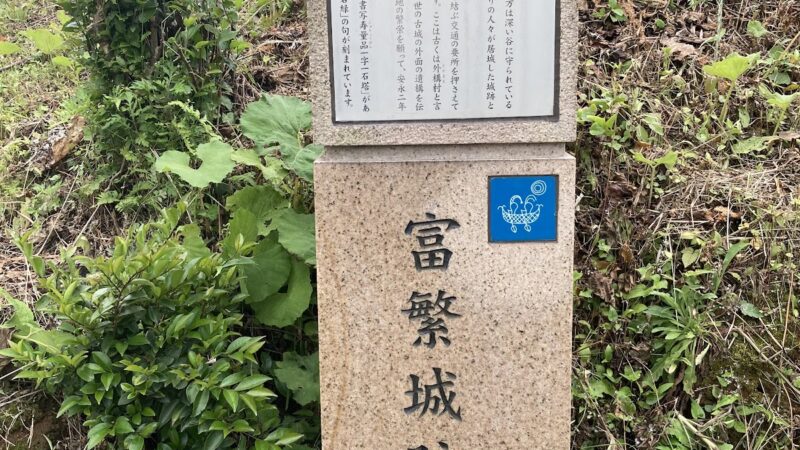
Tauchi Castle (Tauchi-jo) is a medieval mountain castle located in Iwajo, Kurayoshi City, Tottori Prefecture. Also known as Ganjo, it was built on the summit of Butsuishiyama Mountain, 58 meters above sea level. From the Nanboku-cho period to the Muromachi period, it functioned as an important base as the guardian residence of Hoki Province, and flourished as the center of the Yamana clan’s rule over Hoki.
Located on the western hillside where the Tenjin River and Kogamo River merge, this castle, built at a strategic point controlling both water and land routes, occupies an important position in the history of medieval Japanese castles. Even today, several bailey remains, including the main keep, remain on the mountaintop, and remnants such as earthworks and moats can be seen.
History of Tanouchi Castle
Construction History and Yamana Tokiuji
Tanouchi Castle is believed to have been built in Kenmu 4 (1337) or during the Kōkoku era (1340-1346). The builder was Yamana Tokiuji, the lord of Yamana Castle in Kōzuke Province (present-day Gunma Prefecture).
Yamana Tokiuji distinguished himself by serving Ashikaga Takauji and was appointed governor of Hōki Province in Kenmu 4. He built Tanouchi Castle on Butsuishiyama, a strategic point in the Tenjin River basin, as his base of operations for governing Hōki Province, and established it as his governor’s residence. The Yamana clan became a powerful force, holding the governorship of 11 of the 66 provinces of Japan, earning them the nickname “Rokubun-ichi-dono” (Lord of Six-tenths). Tanouchi Castle was a crucial base for their control of western Japan.
The Prosperity of Mirukasenge
With the construction of Tanouchi Castle, a castle town called “Mirukasenge” formed below the castle. This name expresses the prosperity of the area, with as many as a thousand houses. Mirukasenge flourished greatly as a trading hub utilizing the Tenjin River’s water transport, and as the political and economic center of Hoki Province.
It is believed that merchants and artisans gathered in the castle town, forming a vibrant city centered around the provincial governor’s office. This prosperity lasted for approximately 200 years, but came to a tragic end during the Tenbun era.
The Great Tenbun Flood and the Destruction of the Castle Town
In Tenbun 13 (1544), a great disaster struck Tanouchi Castle and Mirukasenge. The Tenjin River and Kogamo River floods caused catastrophic damage to the once-prosperous castle town, with almost everything being washed away.
This great flood marked a significant turning point in the history of the Kurayoshi region. The destruction of Mihisenken significantly reduced the functionality of Tanouchi Castle, effectively ending its role as a provincial governor’s residence. Subsequently, the Yamana clan’s base moved to Utsubukiyama Castle.
Relocation to Utsubukiyama Castle and the End of Tanouchi Castle
After the great flood, the Yamana clan built a new castle on Utsubukiyama, near the center of Kurayoshi. Utsubukiyama Castle was higher in elevation than Tanouchi Castle (204 meters above sea level) and functioned as a more formidable mountain castle. The castle town of Utsubukiyama Castle is the origin of the present-day Kurayoshi city center.
Although Tanouchi Castle subsequently disappeared from the forefront of history, it left an important mark on the region’s history as the first base of the Yamana clan’s rule in Hoki Province, and along with the memory of the prosperous castle town of Mihisenken.
Structure of Tanouchi Castle
Location and Topographical Features
Tanouchi Castle was built on Butsuishiyama, an isolated hill with an elevation of 58 meters and a relative height of approximately 45 meters. It is located west of the confluence of the Tenjin River and the Kogamo River, occupying a strategically important position overlooking both rivers.
The eastern side of the castle hill faces the Kogamo River and has a steep terrain, forming a natural defensive line. On this eastern slope is the Tanouchi Shrine, said to have been built in 837 by Yamana Tokiuji as a place of prayer for the peace of the country, and it can still be visited today.
Layout and Remains
The layout of Tanouchi Castle is centered around the summit of Butsuishiyama. There is a flat area on the summit that is thought to have been used as the Honmaru (main enclosure), and this was the core of the castle.
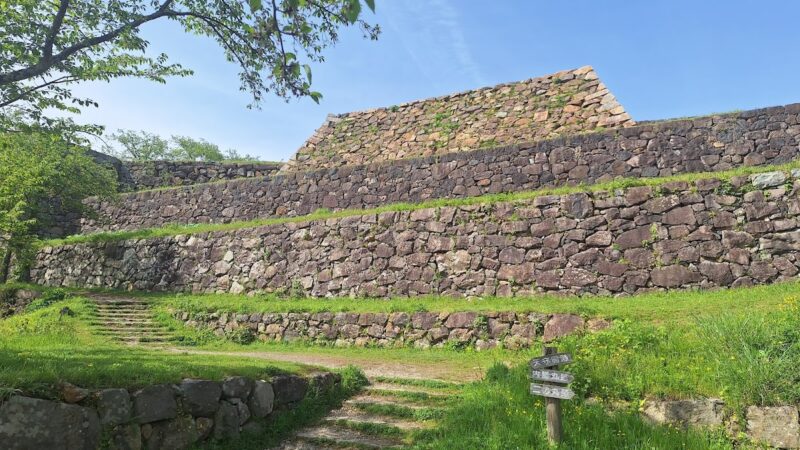
Along the ridge from the Honmaru on the summit, several flat areas thought to be Kuruwa (enclosures) can be seen. These enclosures are skillfully arranged, utilizing the mountainous terrain, and exhibit a typical structure of a medieval mountain castle.
The main remains that can be confirmed today include the following:
- Kuruwa (enclosures): Multiple flat areas are arranged in a stepped pattern.
- Dorui (earthen ramparts): Remains of earthen embankments built as defensive structures are still present.
- Horikiri (moat): Traces of a defensive structure cutting across the ridge can be seen.
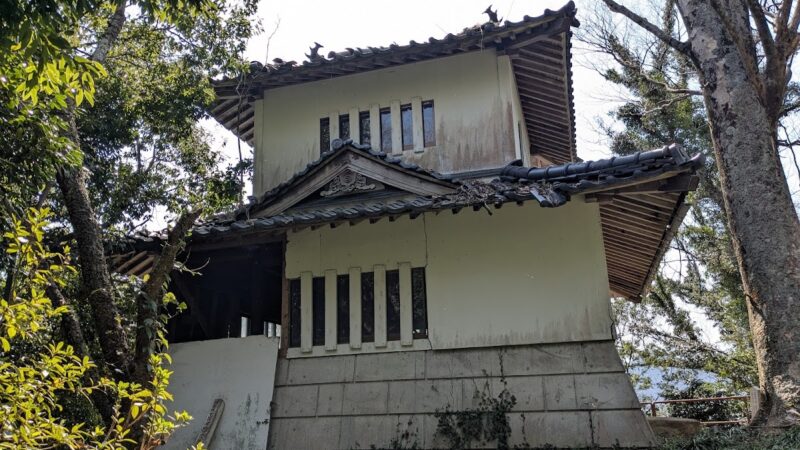
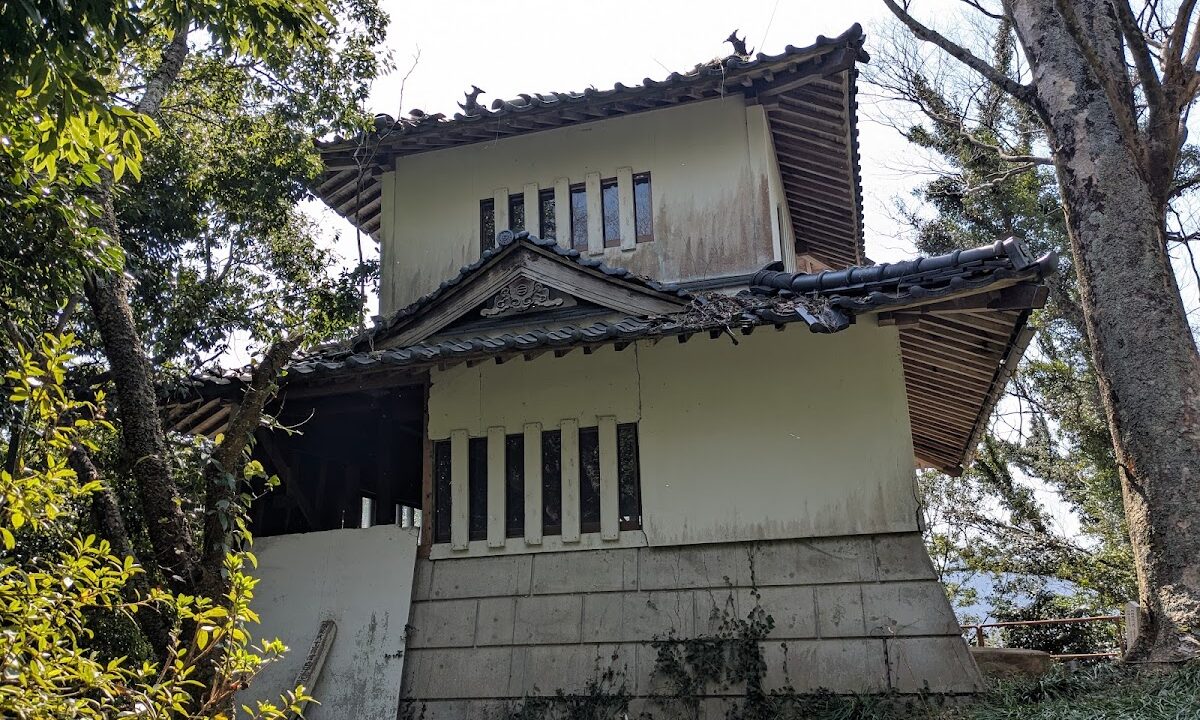
Some documents mention the existence of a mock keep, but this was built later as a regional symbol, and there is no evidence that a historical keep ever existed.
Defensive System
The defensive system of Tanouchi Castle made maximum use of the steep natural terrain. The steep eastern slope facing the Kogamo River was difficult to attack and served as the main defensive line.
By constructing moats along the ridge, enemy incursion routes were limited, strengthening the defenses. Furthermore, the arrangement of multiple enclosures in a stepped pattern created a multi-layered defensive structure, allowing for defense even if one enclosure was breached.
Highlights of Tanouchi Castle
View from the Main Enclosure
The greatest highlight of Tanouchi Castle is the view from the main enclosure. From the mountaintop at an altitude of 58 meters, you can see the confluence of the Tenjin River and the Kogamo River, and the Kurayoshi Plain. You can imagine the scene of Yamana Tokiuji ruling Hoki Province from this location while gazing at the present-day Kurayoshi city.
On a clear day, you can even see Mount Daisen in the distance, making it an excellent spot to experience the geographical features of Hoki Province.
Enclosure Remains and Earthworks
The enclosure remains scattered along the ridge from the mountaintop are valuable historical sites for understanding the structure of medieval mountain castles. In particular, in areas where the earthworks are well-preserved, you can get a real sense of the scale of the defensive facilities at the time.
The differences in elevation between enclosures and the height of the earthworks reveal the castle’s construction techniques and defensive ingenuity, making it a fascinating subject for castle enthusiasts to explore.
Tanouchi Shrine
Located on the eastern slope of Shiroyama (Castle Mountain), Tanouchi Shrine is a historic shrine said to have been built by Yamana Tokiuji in 837 AD (Kenmu 4). Founded as a place of prayer for the peace of the land, it is believed to have functioned in conjunction with Tanouchi Castle.
Even today, it is a shrine that attracts local devotion, and visiting it in conjunction with a visit to Tanouchi Castle will allow you to experience its history more deeply.
Traces of Mihisenken
While the concrete remains of the once-flooded castle town of Mihisenken were lost in the Tenbun Great Flood, traces can still be found in the current topography and place names.
The flat area around the confluence of the Tenjin River and the Kogamo River is estimated to be the former location of the castle town. When visiting the site, imagining the thousand houses that once stood on this vast plain will evoke a sense of historical romance.
Access and Visiting Information for Tanouchi Castle
Location
- Address: Iwajo, Kurayoshi City, Tottori Prefecture
- Former Province: Hoki Province
Access Methods
Using Public Transportation:
- Approximately 15 minutes by local bus from JR San’in Main Line “Kurayoshi Station”
- Approximately 10-15 minutes on foot from the bus stop to the castle entrance
Using a Car:
- Approximately 10 minutes from San’in Expressway “Kurayoshi Nishi IC”
- Parking space is limited, so please be careful not to park on the street.
Precautions for Visiting the Castle
Tanouchi Castle is a medieval mountain castle and is not a well-maintained tourist facility. Please note the following points when visiting:
- Clothing: Wear comfortable clothing and non-slip shoes.
- Season: In summer, vegetation grows thickly, making it difficult to see the remains. Visiting from autumn to spring is recommended.
- Safety: There are steep slopes and areas prone to landslides, so please be very careful of your footing.
- Estimated Time: If you plan to thoroughly explore the castle from start to finish, allow approximately 1.5 to 2 hours.
- Equipment: It is recommended to bring drinking water, a towel, and insect repellent.
Nearby Tourist Spots
When visiting Tanouchi Castle, we recommend also visiting other historical spots in Kurayoshi City:
- Utsubuki Castle Ruins: The residence of the Yamana clan, who succeeded Tanouchi Castle.
- Kurayoshi White-Walled Storehouse District: A preservation district for important traditional buildings, preserving the townscape from the Edo period to the early Showa period.
- Red Tiles: A group of tourist facilities utilizing Kurayoshi’s historical buildings.
- Kurayoshi Museum: A facility where you can learn about the history and culture of Kurayoshi.
Historical Significance of Tanouchi Castle
Symbol of the Yamana Clan’s Rule in Hoki Province
Tanouchi Castle holds significant historical importance as the first base of operations for the Yamana clan, a powerful shugo daimyo (provincial governor) of the Muromachi Shogunate, in Hoki Province. Built by Yamana Tokiuji, this castle served as a political hub connecting the central government with local administration and embodied the authority of the Muromachi Shogunate in Hoki Province.
Value in Medieval Castle Research
Tanouchi Castle retains many characteristics of mountain castles from the Nanboku-cho period to the early Muromachi period, making it a valuable example for studying the development process of medieval castles. Its layout, utilizing natural terrain, and defensive structures such as earthworks and moats provide important evidence of the castle-building techniques of this era.
Importance in Regional History
The history of Tanouchi Castle and Mihisenken is essential for understanding the medieval history of the Kurayoshi region. The historical development of the city’s destruction due to the Tenbun Great Flood and the subsequent relocation of its functions to Utsubuki Castle occupies an important position in regional history research as a valuable example demonstrating the influence of the natural environment on urban development.
Historical Connections Between Tanouchi Castle and Kurayoshi
It is no exaggeration to say that the history of present-day Kurayoshi City began with the era of Tanouchi Castle. The Yamana clan established the governor’s residence of Hoki Province at Tanouchi Castle, leading to the region’s development as a political and economic center.
After the Tenbun Great Flood, the base moved to Utsubuki Castle, forming the foundation of the present-day Kurayoshi city center. In other words, the history of Tanouchi Castle is an indispensable prehistory for understanding the origins of modern Kurayoshi City.
When walking around Kurayoshi City, being aware of the historical flow from Tanouchi Castle to Utsubuki Castle will give the town’s landscape and topography a deeper meaning.
Summary
Tanouchi Castle is a valuable medieval mountain castle site remaining in Kurayoshi City, Tottori Prefecture. Built in 1337 by Yamana Tokiuji, Tanouchi Castle served as the governor’s residence of Hoki Province for approximately 200 years. It boasted a thriving castle town known as “Mihisenken,” but the town was destroyed by a great flood in 1544, after which the base of operations was moved to Utsubuki Castle.
Even today, remnants such as the main keep, baileys, and earthworks remain on the summit of Butsuishiyama Mountain, allowing visitors to experience the structure of a medieval mountain castle. From the 58-meter-high summit, one can enjoy a panoramic view of the Kurayoshi Plain, reliving the perspective of the former Yamana clan.
The history of Tanouchi Castle encompasses diverse historical themes, including the Yamana clan’s rule over Hoki, the formation of medieval cities, and the relationship between natural disasters and urban transformation, making it an important case study for learning about medieval Japanese history. When visiting Kurayoshi, be sure to visit this historic mountain castle and reflect on the medieval period of Hoki Province.