Ueda Castle (Ueda City, Nagano Prefecture) Complete Guide | History, Highlights, and Access Information for this Impregnable Castle
Located in Ueda City, Nagano Prefecture, Ueda Castle was built by the renowned Sengoku period general Sanada Masayuki. It gained worldwide fame as an “impregnable castle” after twice repelling large Tokugawa armies. Currently maintained as Ueda Castle Ruins Park, it is a representative tourist spot in Shinshu Ueda, preserving the atmosphere of the past with its surviving West Turret (dating back to the Edo period), reconstructed turrets, and the East Tiger Gate.
This article comprehensively covers all the information you need to know before visiting Ueda Castle, including its detailed history, architectural features, highlights, surrounding tourist information, and access methods.
The History of Ueda Castle | From Sanada Masayuki to the Matsudaira Clan
Construction by Sanada Masayuki (Tensho 11, 1583)
The history of Ueda Castle begins in Tensho 11 (1583) when Sanada Masayuki started construction. It was designed as a flatland castle, cleverly utilizing the cliff of a terrace overlooking the Amagafuchi River, a tributary of the Chikuma River, almost in the center of the Ueda Basin. After the fall of the Takeda clan, Masayuki needed to establish a new base in this area to survive between the two major powers, Tokugawa Ieyasu and Hojo Ujinao.
The Sanada clan originally had their base at the Sanada Clan Residence in Chiisagata District, Shinano Province, but judging that a more defensible castle was necessary, they began construction of Ueda Castle, taking advantage of the natural fortifications of the Chikuma River. This castle was designed from the outset with a confrontation with the Tokugawa clan in mind, and various ingenious features were incorporated to allow a small force to face a large army. ### The First Battle of Ueda (Tensho 13, 1585)
Just two years after its construction, in Tensho 13 (1585), Ueda Castle faced its first major test. Tokugawa Ieyasu refused to tolerate Sanada Masayuki’s defection and dispatched a massive army of approximately 7,000 men. In contrast, Masayuki’s forces numbered only about 2,000.
Masayuki compensated for the overwhelming numerical disadvantage with strategy and the advantage of the terrain. He employed a tactic of luring the Tokugawa army deep into the castle, trapping them in narrow areas, and then launching a coordinated attack. Furthermore, he successfully used the terrain of the Chikuma River floodplain to confuse the Tokugawa army. In this battle, the Tokugawa army suffered over 1,300 casualties and was forced to retreat. This victory made the names of Ueda Castle and Sanada Masayuki known throughout Japan.
The Second Battle of Ueda (Keicho 5, 1600)
As a prelude to the Battle of Sekigahara, the Second Battle of Ueda erupted in Keicho 5 (1600). A massive army of approximately 38,000 men led by Tokugawa Hidetada advanced on Ueda Castle, defended by Sanada Masayuki and his son Nobushige (Yukimura) with only about 3,000 men.
Masayuki once again outmaneuvered the Tokugawa army with his clever tactics. He repeatedly lured the enemy into the town below the castle and then retreated, delaying the Tokugawa advance. As a result, Hidetada’s army wasted time capturing Ueda Castle, suffering a major blunder by missing the main battle of Sekigahara. This battle, in which he held back tens of thousands of soldiers with only a few thousand, solidified Sanada Masayuki’s reputation as a military strategist.
Demolition after the Battle of Sekigahara and the Dispossession of the Sanada Clan
After the Western Army’s defeat at the Battle of Sekigahara, Tokugawa Ieyasu exiled Sanada Masayuki and his son Nobushige to Kudoyama in Kii Province and ordered the complete demolition of Ueda Castle. The keep and turrets were destroyed, the moats filled in, and other measures were taken to completely render the castle non-functional, ensuring they could never again defy the Tokugawa. At this time, Ueda Castle temporarily disappeared from the historical stage.
Restoration by the Sengoku Clan (Kan’ei Era, 1620s)
In 1622 (Genna 8), Sengoku Tadamasa, lord of Komoro Castle, became the lord of the Ueda Domain with a 50,000 koku stipend. The Sengoku clan was granted permission by the Tokugawa shogunate to rebuild Ueda Castle, and began the restoration project during the Kan’ei era (1620s).
However, this restoration did not replicate the scale of the castle during the Sanada era. The main keep was not rebuilt, and the castle was reduced in size to focus on the main enclosure and the second enclosure. Nevertheless, the Sengoku clan constructed a group of turrets, including the West Turret, and the East Tiger Gate, restoring the castle’s appearance. The West Turret, now designated a Nagano Prefecture Treasure, is a valuable structure built during this restoration period by the Sengoku clan.
The Matsudaira Clan’s Era and the End of the Edo Period
In 1741, when the Sengoku clan was transferred to Izushi in Tajima Province, Matsudaira Tadaaki was appointed from Kuwana in Ise Province with a 70,000 koku stipend. From then until the Meiji Restoration, the Matsudaira clan (Fujii Matsudaira family) ruled the Ueda Domain for seven generations.
The Matsudaira era was relatively peaceful, with the encouragement of learning and reforms to the domain’s administration. In particular, the Matsudaira clan focused on educational policies, establishing the domain school “Meirindo” and striving to promote education. During this period, Ueda Castle served more as the administrative and cultural center of the domain than as a military base.
Architectural Features and Layout of Ueda Castle
Location as a Flatland Castle and Utilization of Topography
Ueda Castle is a typical flatland castle, utilizing the cliff of the river terrace facing the Amagafuchi, a tributary of the Chikuma River, as a natural defensive line. Protected by the cliffs of the Chikuma River to the north, attackers could only approach from limited directions.
This topographical advantage was the primary reason why a small force could repel a large army. Sanada Masayuki thoroughly understood the terrain and implemented a design philosophy that compensated for numerical disadvantage by positioning the castle in a location where it was difficult for attackers to deploy their forces.
Structure of the Main Enclosure and Second Enclosure
The layout of Ueda Castle is relatively simple, with the main enclosure (Honmaru) surrounded by the second enclosure (Ninmaru). During the Sanada period, a third bailey is believed to have existed, but during the reconstruction by the Sengoku clan, it was reduced in size to focus on the main bailey and the second bailey.
The main bailey measures approximately 180 meters east-west and 140 meters north-south, adopting the typical form of a modern castle with turrets at the four corners. There are two entrances (koguchi): the eastern koguchi and the western koguchi. The eastern koguchi, in particular, was considered important as the main entrance.
Characteristics of the Stone Walls and the Sanada Stone
The stone walls of Ueda Castle were constructed using a technique that combines rough-hewn stonework and fitted stonework. In particular, the “Sanada Stone” located to the right of the eastern koguchi turret gate is a massive stone, approximately 2.5 meters high and 3 meters wide, and is a symbolic feature of Ueda Castle.
While there is a tradition that this Sanada Stone was placed during the time of Sanada Masayuki, it has also been suggested that it may have been brought in during the reconstruction by the Sengoku clan. In any case, this is a valuable historical site demonstrating the high level of technical skill required to transport and install these massive stones.
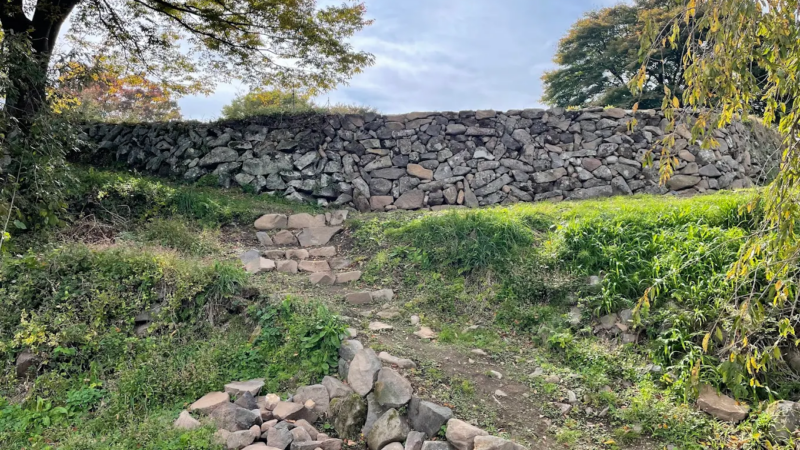
A characteristic of the entire stone wall is that the northern side, facing the Chikuma River, utilizes the cliff face as is, resulting in a smaller scale of stone wall compared to the other three sides. This is also a manifestation of a design that maximized the use of the terrain.
Moats and Water Supply
The moats of Ueda Castle functioned as water moats, drawing water from the Chikuma River. Deep moats were dug, particularly on the east and south sides, making it difficult for attackers to approach.
Although much of the moat was filled in during the castle’s demolition after the Battle of Sekigahara, some were re-excavated during the reconstruction by the Sengoku clan. Even today, traces of the moats remain around the main keep, allowing us to imagine the defensive system of the time.
Highlights of Ueda Castle | Existing Structures and Restored Facilities
West Turret (Nagano Prefecture Treasure)
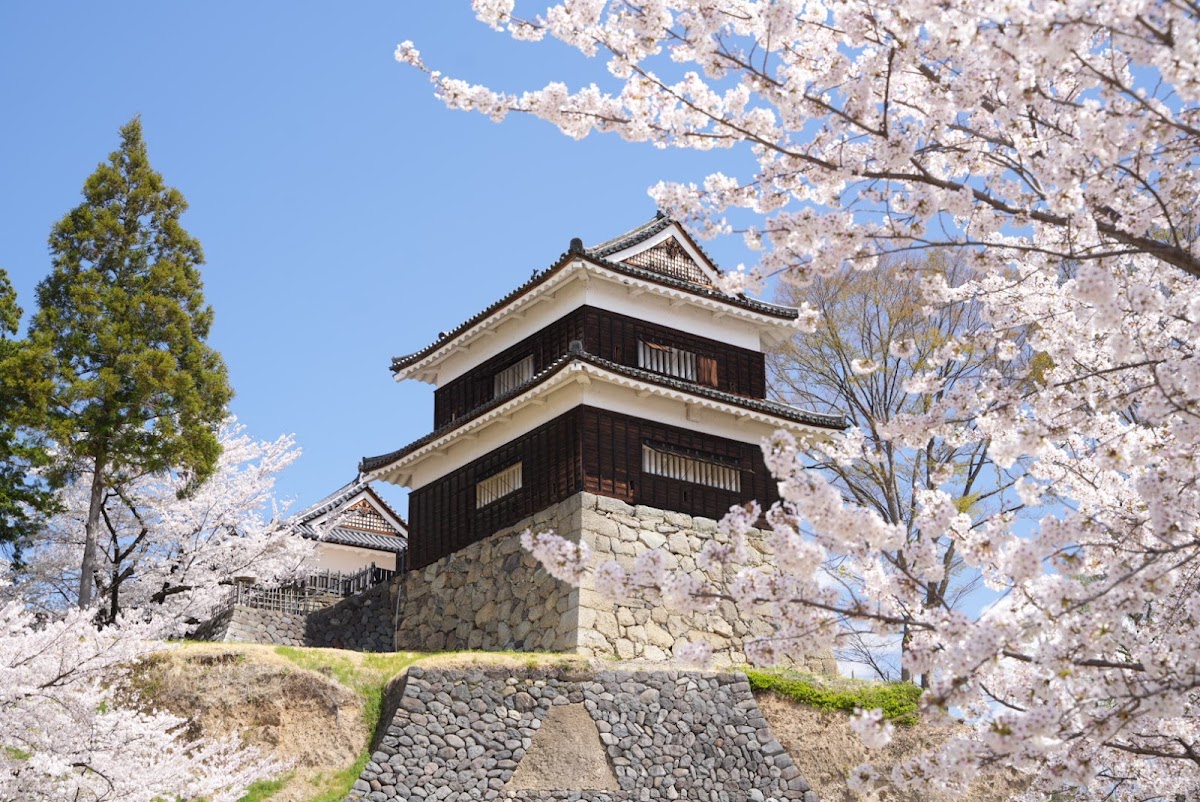
The West Turret is the only structure at Ueda Castle that has survived from the Edo period. Built by the Sengoku clan during the Kan’ei era (1620s), this turret is located on the west side of the main enclosure and has a two-story, two-tiered structure.
The West Turret, along with the South and North Turrets, is designated as a Nagano Prefecture Treasure and is a must-see spot when visiting Ueda Castle. While the interior is usually closed to the public, it may be possible to view it during special exhibition periods. The contrast between the white walls and black wooden siding is beautiful, making it an excellent photo spot, especially during cherry blossom and autumn foliage seasons.
South and North Turrets (Restored Structures)
The South and North Turrets are restored structures from 1949. They are located at the southeast and northeast corners of the main enclosure, respectively, forming a defensive line protecting the eastern side of the enclosure along with the East Tiger Gate.
These turrets, like the West Turret, have a two-story, two-tiered structure, and their interiors are used as exhibition spaces. The museum displays materials related to the Sanada, Sengoku, and Matsudaira clans, as well as armor, swords, and other weapons, and a reconstructed model of the castle, allowing visitors to learn about the history of Ueda Castle.
From inside the turret, you can enjoy a panoramic view of Ueda Castle Ruins Park and the city of Ueda, experiencing the scenery that the former lords of the castle must have seen. Especially during the spring cherry blossom festival, the sea of cherry blossoms viewed from the turret is breathtaking.
East Tiger Gate Turret (Reconstructed Structure)
Reconstructed in 1994, the East Tiger Gate Turret is an important structure serving as the main entrance to Ueda Castle. It is a Korean-style turret gate, and together with the earthen walls on either side, it provides a strong defense for the entrance to the main keep.
Upon passing through this turret gate, you will immediately see the Sanada Stone on your right. High stone walls are built on both sides of the gate, creating an intimidating effect on attackers. Furthermore, the gate’s structure itself is designed with defense in mind, and various features designed to prevent enemy intrusion can be seen throughout.
At night, it is sometimes illuminated, allowing visitors to enjoy a magical atmosphere. The illuminations during the cherry blossom festival and autumn foliage season, in particular, attract many tourists.
Sanada Stone
The Sanada Stone, incorporated into the stone wall to the right of the East Tiger Gate Tower, is a massive stone that symbolizes Ueda Castle. It is approximately 2.5 meters high, 3 meters wide, and is estimated to weigh several tons.
Various legends surround this stone, including the anecdote that Sanada Masayuki carried it there overnight, and the legend that moving it would cause the castle to collapse. While it is more likely that it was actually placed there during the reconstruction by the Sengoku clan, its sheer size and presence overwhelm visitors.
The area in front of the Sanada Stone is a popular spot for commemorative photos, and many tourists take pictures there.
Main Enclosure Site and Earthworks
The current site of the main enclosure has been developed into a plaza, serving as a place of relaxation for citizens. Traces of earthworks remain around the main enclosure, allowing visitors to experience the scale of the former castle.
Within the main enclosure stands the Sanada Shrine, dedicated to the Sanada, Sengoku, and Matsudaira clans. It is believed to bring good fortune and victory, attracting many worshippers. Its popularity has increased, especially since the broadcast of the historical drama “Sanada Maru,” as a place associated with Sanada Yukimura.
Moat Remains and Earthen Bridge
Part of the moat surrounding the main enclosure still remains, allowing visitors to imagine the defensive system of the time. The southern moat, in particular, is relatively well-preserved, and its depth and width allow for estimation of its original scale.
The earthen bridge crossing the moat has also been restored, allowing visitors to experience the former route to the castle. From the earthen bridge, one can appreciate the depth of the moat and imagine the difficulty of sieges.
Seasons and Ways to Enjoy Ueda Castle Ruins Park
Spring Cherry Blossom Festival
Ueda Castle Ruins Park is a famous cherry blossom viewing spot, selected as one of “Japan’s Top 100 Cherry Blossom Viewing Spots.” Approximately 1,000 cherry trees are planted in the park, allowing visitors to enjoy various varieties such as Somei Yoshino and weeping cherry trees.
Every year from early to mid-April, the “Ueda Castle Senbonzakura Festival” is held, featuring nighttime illuminations. The collaboration of the illuminated turrets and cherry blossoms is fantastic, attracting many visitors from within and outside the prefecture.
Various events are held during the cherry blossom festival, including stalls selling local specialties and performances of traditional arts.
Summer Greenery and Festivals
Early summer at Ueda Castle Ruins Park is beautiful with fresh greenery, making it an ideal season for strolling. The shade of the trees is cool, and it is a popular jogging and walking course for locals.
In late July, the “Ueda Wasshoi” summer festival is held, with various events taking place around Ueda Castle Ruins Park.
Autumn Foliage
Ueda Castle Ruins Park is also known as a famous spot for autumn foliage. The zelkova, ginkgo, and maple trees change color, creating a magnificent contrast with the turrets and stone walls.
The best time to visit is especially from early to mid-November, and the “Ueda Castle Autumn Foliage Festival” is sometimes held during this period. Nighttime illuminations are also held, allowing visitors to enjoy a different, more magical atmosphere than during the day.
Winter Snowscape
In winter, Ueda Castle is covered in snow, displaying a serene beauty. The snow-covered turrets and stone walls have a picturesque, almost ink-painting-like appearance.
While there are fewer tourists compared to other seasons, you can enjoy a leisurely stroll. Reflecting on the history of the Sengoku period in the crisp winter air is a delightful experience.
Deepening Your Understanding of Ueda Castle at Ueda City Museum
The Ueda City Museum is located within the Ueda Castle Ruins Park, offering a deeper look into the history of Ueda Castle and the Ueda region.
Permanent Exhibition Contents
The museum’s permanent exhibition broadly covers the history of the Sanada clan, the Sengoku and Matsudaira clans, and even the folk culture of the Ueda region.
Exhibits include materials related to Sanada Masayuki and Sanada Nobushige (Yukimura), details of the Battle of Ueda, models and drawings showing the castle’s transformation, and weapons and armor. The exhibit explaining the tactics of the Battle of Ueda is particularly helpful to view before visiting the castle, as it enhances understanding of its relationship to the actual terrain.
Special and Temporary Exhibitions
The Ueda City Museum regularly holds special and temporary exhibitions, offering in-depth exhibits on various themes. Special exhibitions related to the Sanada clan are especially popular, sometimes featuring valuable materials gathered from across Japan.
Opening Hours
The Ueda City Museum is located on the site of the main keep within Ueda Castle Ruins Park. A combined ticket including admission to the turret is also available. For the latest information on opening hours, closing days, and admission fees, we recommend checking the Ueda City official website.
Tourist Attractions in Ueda Castle Town
When visiting Ueda Castle, we recommend exploring the surrounding castle town as well. Ueda Castle Town retains the atmosphere of the Edo period, with numerous historical buildings scattered throughout.
Yanagimachi
Located south of Ueda Castle, Yanagimachi is a historical townscape where former samurai residences and merchant houses remain. White-walled storehouses and townhouses with lattice doors line the streets, conveying the atmosphere of an Edo-period castle town.
Yanagimachi is dotted with shops selling traditional crafts, cafes and galleries housed in renovated old houses, making it a pleasant place to stroll. In particular, the “Yanagimachi-ya” tourist exchange facility offers exhibits on Ueda silk and opportunities to learn about the local history.
Yanagimachi, located south of Ueda Castle, is a historical townscape where you can learn about local history. ### Hokkoku Kaido Road
The Hokkoku Kaido Road, which passes through the castle town of Ueda, was an important route connecting Edo (Tokyo) and the Hokuriku region during the Edo period. Even today, parts of the old townscape remain, allowing visitors to experience the atmosphere of history.
Bessho Onsen
Located in the southeastern part of Ueda City, Bessho Onsen is a historic hot spring resort, sometimes called “Shinshu’s Kamakura.” It’s about a 30-minute drive from Ueda Castle, making it possible to combine sightseeing and hot springs in your itinerary.
Bessho Onsen boasts many valuable cultural assets, including Anraku-ji Temple, known for its National Treasure octagonal three-story pagoda, and Joraku-ji Temple’s three-story pagoda, an Important Cultural Property.
Access to Ueda Castle
Access by Train
The nearest station to Ueda Castle is Ueda Station, served by JR, Shinano Railway, and Ueda Electric Railway.
From Tokyo
- Approximately 1 hour 30 minutes from Tokyo Station to Ueda Station via the Hokuriku Shinkansen
- Approximately 12 minutes on foot (approx. 1 km) from Ueda Station to Ueda Castle Ruins Park
From Nagoya
- Approximately 2 hours from Nagoya Station to Shiojiri Station via the JR Chuo Main Line
- Approximately 1 hour 30 minutes from Shiojiri Station to Ueda Station via the JR Shinonoi Line and Matsumoto Station
From Nagano
- Approximately 30 minutes from Nagano Station to Ueda Station via the Shinano Railway
From Ueda Station to Ueda Castle Ruins Park, you can also use buses or taxis in addition to walking.
Access by Bus
From Ueda Station’s Castle Exit (West Exit), the Ueda Bus city loop bus “Gurutto Ueda Maru” operates. Get off at the “Ueda Castle Ruins Park Entrance” bus stop, and it’s a short walk from there. Buses run every 30 minutes.
Access by Car
Using the Expressway
- Approximately 15 minutes (approx. 6 km) from the Ueda-Sugadaira IC on the Joshinetsu Expressway
- Approximately 1 hour via National Route 18 from the Okaya IC on the Chuo Expressway
Parking Information
There are several parking lots around Ueda Castle Ruins Park.
- Ueda Castle Ruins Park Parking Lot: 88 spaces for regular cars (free, however, it is charged during the cherry blossom festival)
- Ueda Castle Ruins Park North Tourist Parking Lot: Approximately 100 spaces for regular cars (free)
- Municipal Central Parking Lot: A paid parking lot near Ueda Station
During periods when congestion is expected, such as the cherry blossom festival and autumn foliage season, early arrival is recommended. Temporary parking lots may also be opened.
Estimated Time Required for Sightseeing
For a stroll around Ueda Castle Ruins Park, including a visit to the interior of the turrets, allow approximately 1 hour 30 minutes to 2 hours. If you plan to thoroughly visit the Ueda City Museum, you will need an additional hour or so.
If you plan to explore the castle town and include a visit to Bessho Onsen, we recommend allocating half a day to a full day.
Ueda Castle Admission Fees and Opening Hours
Admission Fees for Turrets and Museum
Admission Fees for Turrets (South Turret, North Turret, East Tiger Gate Turret)
- General: 300 yen
- High school students and above: 200 yen
- Elementary and junior high school students: 100 yen
Admission Fees for Ueda City Museum
- General: 300 yen
- High school students and above: 200 yen
- Elementary and junior high school students: 100 yen
Combined Ticket (Turrets + Museum)
- General: 500 yen
- High school students and above: 300 yen
- Elementary and junior high school students: 150 yen
*Prices are subject to change, so please check the latest information on the Ueda City official website before your visit.
Opening Hours and Closing Days
Opening Hours
- April to November: 8:30 AM to 5:00 PM (Last entry 4:30 PM)
- December to March: 8:00 AM to 5:00 PM (Last entry 4:30 PM)
Closing Days
- Wednesdays (or the following day if Wednesday is a public holiday)
- New Year’s Holidays (December 29th to January 3rd)
*During special periods such as the Cherry Blossom Festival, opening hours may be extended or the museum may be open every day.
Park Usage
Ueda Castle Ruins Park itself is free to explore. Even without entering the turrets or museum, you can enjoy the sights such as the stone walls, moats, and Sanada Stone.
Best Season and Attire for Visiting Ueda Castle
Recommended Time to Visit
Ueda Castle has beauty in every season, but the following times are especially recommended.
Spring (Early to Mid-April)
This is the peak season for tourists, as it’s the time when cherry blossoms bloom. You can also enjoy cherry blossom festivals and illuminations. However, it gets crowded, so visiting early in the morning or on weekdays is recommended.
Autumn (Early to Mid-November)
The autumn foliage is beautiful, and it’s relatively less crowded, allowing for a leisurely stroll. The weather is mild, making it ideal for sightseeing.
Early Summer (May to June)
The fresh greenery is beautiful, and the weather is pleasant. There are relatively few tourists, allowing for a peaceful visit.
Clothing and Items to Bring
Ueda Castle Ruins Park has undulating terrain with many stone paths and stairs, so comfortable walking shoes are recommended. Especially when climbing the turrets, there are steep stairs, so sneakers are suitable.
Nagano Prefecture is at a high altitude, so even in summer, mornings and evenings are cool, and winters are severely cold. Please prepare clothing appropriate for the season.
- Spring/Autumn: A light jacket is recommended.
- Summer: The sun is strong, so wear a hat and sunscreen.
- Winter: Take thorough precautions against the cold.
Gourmet Information Around Ueda Castle
Ueda City boasts a wealth of attractive gourmet options, including Shinshu soba noodles, local sake, and regional cuisine.
Shinshu Soba Noodles
The area around Ueda City is known for producing high-quality soba noodles. Many soba restaurants are located around Ueda Castle, where you can enjoy soba noodles that are freshly ground, freshly made, and freshly boiled.
Misuzu Candy
Misuzu candy, a representative confection of Ueda City, is a traditional Japanese sweet made by solidifying fruit with agar. It can be purchased at Ueda Station and tourist facilities.
Delicious Sauce Yakitori
Delicious sauce yakitori, a local specialty of Ueda City, is grilled chicken skewers served with a special garlic-based sauce. It is served at many izakayas (Japanese pubs) in the city.
Local Sake
There are several sake breweries around Ueda City, producing high-quality Japanese sake. There are also brands named after the Sanada clan, such as “Sanada Rokumonsen,” making them perfect souvenirs.
Summary: Ueda Castle – A Famous Castle Where History and Nature Harmonize
Ueda Castle in Ueda City, Nagano Prefecture, is a magnificent castle that left a brilliant mark on the history of Japanese castles, as an impregnable fortress created by the strategic brilliance of Sanada Masayuki. Its history of repelling the large Tokugawa army in two battles of Ueda conveys the romance of the Sengoku period.
The current Ueda Castle Ruins Park offers many attractions, including the West Turret, which has existed since the Edo period, reconstructed turrets, and the massive Sanada Stone. The beauty of the four seasons—cherry blossoms in spring, lush greenery in summer, autumn leaves, and snowscapes in winter—is also one of its charms.
Learn about history at the Ueda City Museum, stroll through the castle town, and enjoy the flavors of Shinshu. Sightseeing centered around Ueda Castle offers a fulfilling experience that can be enjoyed not only by history buffs but by people of all ages.
Its excellent accessibility, just about 1 hour and 30 minutes from Tokyo by Hokuriku Shinkansen, is also a major draw. Various plans are possible, from weekend getaways to trips combined with other tourist destinations in Nagano Prefecture.
The history of Ueda Castle, shaped by the interplay of the courage and strategy of the Sanada clan, the passion for restoration of the Sengoku clan, and the cultural promotion of the Matsudaira clan, will deeply impress visitors. Be sure to visit this impregnable castle and experience the romance of the Sengoku period and the natural beauty of Shinshu.