Complete Guide to the History and Highlights of Saku Uchiyama Castle | A Thorough Explanation of the Mountain Castle in Saku City, Nagano Prefecture
What is Saku Uchiyama Castle?
Saku Uchiyama Castle is a medieval mountain castle located in Uchiyama, Saku City, Nagano Prefecture. Also known as “Uchiyama Castle,” it is a typical Shinano mountain castle built on a mountaintop approximately 860 meters above sea level, and many remains still exist today.
During the Sengoku period, the Saku region was the front line of the power struggle between the Takeda and Uesugi clans, and the mountain castles built in this area functioned as important military bases. Uchiyama Castle is one such example, a valuable historical site that tells the history of the Saku region.
The castle is approximately 170 meters high and features a highly defensible structure that utilizes the steep terrain. Currently, hiking trails are maintained, making it a hidden gem visited by castle enthusiasts and history buffs.
History of Saku Uchiyama Castle
Background and Period of Construction
The exact date of construction of Saku Uchiyama Castle is unknown, as there are no clear records. However, based on the castle’s structure and location, it is estimated to have been built during the mid-Sengoku period, probably between the late 15th and early 16th centuries.
At that time, the Saku region was a battleground for powerful clans in Shinano Province, with fierce struggles for control of the area. Uchiyama is located in the eastern part of the Saku Plain and was a strategic point controlling the transportation route to Joshu (Gunma Prefecture). Therefore, the construction of a mountain castle in this location was strategically important.
Lords and Changes
Detailed records regarding the lords of Saku Uchiyama Castle are also limited. Based on local traditions and the history of the surrounding area, it is highly likely that the castle lord was a local lord of the Saku region.
Shinano Province during the Sengoku period was the stage for Takeda Shingen’s invasion of the province. The Takeda clan began their expansion into the Saku region in earnest in the 1540s, and starting with the Battle of Unno-daira in 1541, they successively captured various castles in Saku. It is believed that Uchiyama Castle also came under the control of the Takeda clan during this process.
During the Takeda clan’s rule of Shinano Province, they often renovated and utilized existing mountain castles, and it is possible that Uchiyama Castle also incorporated Takeda-style castle-building techniques. Some suggest that traces of such renovations can be seen in the remains, such as stone walls and earthworks.
After the fall of the Takeda clan in 1582, Shinano came under the control of Oda Nobunaga, but the situation became chaotic after the Honnoji Incident. Subsequently, Tokugawa Ieyasu began to conquer the Saku region, and many mountain castles were used as military bases. It is possible that Uchiyama Castle was also used in some form during this period, but the details are unknown.
With the arrival of the Edo period, a time of peace prevailed, and the military value of mountain castles diminished, leading to the abandonment of Uchiyama Castle.
Structure and Layout of Sakuuchiyama Castle
Overall Structure
Sakuuchiyama Castle is a mountain castle with a main enclosure at the summit of a mountain 860 meters above sea level, and multiple enclosures arranged along the ridge. It makes maximum use of the steep terrain with a relative height of 170 meters, creating a robust structure that combines natural fortifications with artificial defensive structures.
The castle grounds extend approximately 300 meters east-west and 200 meters north-south, with more than 10 enclosures of varying sizes confirmed around the main enclosure. Each enclosure is demarcated by earthworks and trenches, demonstrating ingenuity in preventing enemy intrusion.
Characteristics of the Main Enclosure
The main enclosure is located at the highest point of the castle and measures approximately 40 meters east-west and 30 meters north-south. Earthworks surround it, and the earthworks on the north and west sides are particularly well-preserved, exceeding 2 meters in height.
The interior of the main enclosure is leveled, and flat areas believed to be the remains of buildings can be observed. It is presumed that the lord’s residence and command post were located here. From the main enclosure, one could see the entire Saku Plain, indicating an excellent location for monitoring surrounding movements.
Stone Walls and Strikes
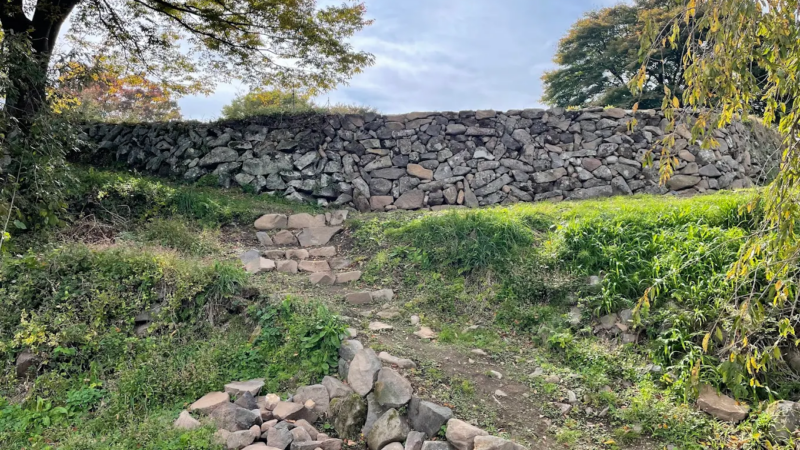
A distinctive feature of Saku Uchiyama Castle is its stone walls (stone masonry). Stone walls constructed from natural stones remain around the main enclosure and in some of the other enclosures, enhancing the castle’s defensive capabilities.
While there is debate as to whether these stone walls are the result of later renovations or are original to the castle, it has been suggested that they may have been built under the control of the Takeda clan. The Takeda clan excelled in stonework techniques and carried out castle renovations using stone walls throughout Shinano Province.
Although small in scale, the stone walls are valuable historical remains as examples of stone usage in mountain castles.
Moats and Vertical Ditches
Moats are important defensive features of a castle. At Uchiyama Castle, a large moat was constructed behind the main enclosure (to the north), preventing enemy incursions along the ridge. This moat is approximately 8 meters wide and 4 meters deep, and is still clearly visible today.
Furthermore, multiple vertical moats were dug into the slope, a measure taken to prevent attacks from the flanks. These vertical moats hindered the movement of enemy soldiers climbing the slope and also served to drain rainwater.
Layout of Enclosures
Around the main enclosure, several other enclosures, such as the second and third enclosures, are arranged in a stepped pattern. Each enclosure functions as an independent defensive unit, allowing for gradual resistance even when the main enclosure was attacked.
The group of enclosures on the east side, in particular, is relatively large and is thought to have been used as a troop encampment and a storage area for supplies. Depressions believed to be the remains of wells have been found in some of the enclosures, indicating evidence of securing a water source in preparation for a siege.
Ascent Route
The current ascent route is likely to follow the route of the original main approach (the front entrance route). The structure, which involves ascending a steep slope and passing through several enclosures to reach the main enclosure, was one of the measures taken to make enemy intrusion difficult.
It is presumed that a rear entrance route also existed, but it cannot be clearly confirmed today.
Highlights of Saku Uchiyama Castle
Castle Notes (Highlights)
Here are the main highlights when visiting Saku Uchiyama Castle.
1. Earthworks of the Main Enclosure
The earthworks surrounding the main enclosure are one of the best-preserved remains of Uchiyama Castle. The earthworks on the north side, in particular, are high, allowing you to appreciate the castle-building techniques of the Sengoku period. Walking on top of the earthworks will allow you to experience the perspective of the castle’s soldiers at the time.
2. Large Moat
The large moat behind the main enclosure is a key defensive feature of Uchiyama Castle. The scale of the deeply dug moat is impressive, demonstrating how meticulously the defenses of the mountain castle were planned.
3. Remains of Stone Walls
The stone walls remaining in various locations are skillfully constructed from natural stones, making them valuable for understanding the development of stonework techniques. The moss-covered stonework evokes a sense of history.
4. Views
The view from the main enclosure is magnificent, offering a panoramic view of the Saku Plain. On a clear day, you can even see the Yatsugatake mountain range and Mount Asama, giving you a real sense of why a castle was built in this location.
5. Arrangement of Enclosures
The arrangement of multiple enclosures in a stepped fashion is a typical example of a multi-enclosure mountain castle and holds academic value. You can understand the overall structure of the castle by visiting each enclosure.
Photography Tips
Saku Uchiyama Castle is a mountain castle surrounded by nature, making it ideal for photography that combines the seasonal scenery with the castle remains.
- Spring: The contrast between the fresh greenery and the earthworks is beautiful.
- Summer: The group of fortifications enveloped in deep green is mystical.
- Autumn: The combination of autumn leaves and stonework creates a spectacular view.
- Winter: The snow-covered ruins are fantastic.
The view of the Saku Plain from the main enclosure is especially beautiful in the morning light, making an early morning visit highly recommended.
Points to Note When Visiting
Saku Uchiyama Castle is a mountain castle, so certain preparations and precautions are necessary when visiting.
Clothing and Equipment
- Trekking shoes or hiking boots are essential.
- Wear long sleeves and long pants to avoid skin exposure (protection from plants and insects).
- Always carry drinking water.
- Prepare a hat and sunscreen in summer, and warm clothing in winter.
Dangerous Areas
- Proceed cautiously as there are steep slopes and areas with uneven footing.
- Avoid visiting during or after rain, as it is slippery and dangerous.
- Visiting in groups is safer than visiting alone.
Natural Environment
- Carry something that makes noise, such as a bell, as it is a habitat for bears and other wild animals.
- Beware of bees and venomous snakes.
- Always take your trash with you.
Estimated Time Required
- Allow approximately 30-40 minutes one way from the entrance to the main keep, 30-40 minutes for sightseeing inside the castle, and 20-30 minutes for descending. A total of about 2 hours is recommended.
Access Information
Location
Shiroshita, Uchiyama, Saku City, Nagano Prefecture
Access by Car
From Tokyo
- Approximately 25 minutes from the Joshinetsu Expressway “Saku IC”
- Approximately 20 minutes from the Chubu Odan Expressway “Saku Minami IC”
From Nagano City
- Approximately 1 hour via the Joshinetsu Expressway “Saku IC”
Take National Route 254 and head towards the Uchiyama area. There are a few parking spaces near the castle entrance, but the road is narrow in some places, so please drive carefully.
Access by Public Transportation
JR Koumi Line
- Get off at JR Koumi Line “Nakagomi Station,” then approximately 15 minutes by taxi
- Or get off at “Usuda Station,” then approximately 10 minutes by taxi
Access by public transportation is somewhat inconvenient, so renting a car is recommended.
Parking
There is a simple parking area near the castle entrance, but it is not a properly maintained parking lot. Please be considerate and avoid obstructing the passage of other vehicles.
Nearby Tourist Information
Other Castles in Saku City
Besides Uchiyama Castle, Saku City has many other castle ruins, allowing visitors to enjoy castle touring.
Ryūoka Castle Goryōkaku
One of only two Goryōkaku (square-shaped fortifications) in Japan, it is designated as a national historic site. Built in the late Edo period, it is a Western-style castle, offering a completely different style from Uchiyama Castle. It is about a 20-minute drive from Uchiyama Castle, and visiting both is recommended.
Hiraga Castle
A mountain castle located in Hiraga, Saku City, it played an important role in Takeda Shingen’s invasion of Shinano Province. Like Uchiyama Castle, it is a medieval mountain castle, and comparing them will deepen your understanding.
Inariyama Castle
A castle used by Takeda Shingen as a lodging castle during his invasion of Shinano Province. Following the Honnō-ji Incident, Tokugawa Ieyasu ordered Matsudaira Ietada to renovate the castle, making it a historical site that tells the story of the turbulent Sengoku period.
Banno Castle
A flatland castle near the center of Saku City, it was the residence of the powerful Banno clan of Saku. Although now a residential area, some remains, such as earthworks, still exist.
Saku City Tourist Attractions
Saku City Museum of Modern Art
This museum houses works by artists such as Yui Ichiji and Hirayama Ikuo. Enjoy art appreciation between castle tours.
Saku Carp
Saku City is famous for its carp dishes. Many carp restaurants in the city offer local specialties such as carp sashimi and carp stew.
Sakudaira Highway Oasis “Parada”
A complex facility accessible from both the highway and local roads, where you can purchase local specialty products.
Shinkai Sansha Shrine
This ancient shrine features a three-story pagoda designated as a National Important Cultural Property. It’s a spot where you can experience the history and culture of the Saku region.
Nearby Hot Springs
To soothe your fatigue from touring the castles, nearby hot spring facilities are recommended.
Saku Hotel
A hot spring hotel located in Saku City, offering day-use bathing.
Happo no Yu
A day-use hot spring facility in the Mochizuki area of Saku City, where you can enjoy views of the Yatsugatake Mountains from the open-air bath.
Nunobiki Onsen
A hot spring in Komoro City, about a 30-minute drive from Uchiyama Castle. Its open-air bath with a spectacular view overlooking the Chikuma River is popular.
Mountain Castle Culture of the Saku Region
Saku Mountain Castles
Numerous mountain castles remain in the Saku region of Nagano Prefecture. According to a survey by the Saku Regional Union, more than 30 castle ruins have been identified in Saku City alone, and including surrounding municipalities such as Komoro City and Sakuho Town, the number is estimated to exceed 100.
Many of these mountain castles have unknown histories, lords, and construction dates, but they are being protected and researched as valuable legacies that tell the story of the region’s history. Materials such as hand-drawn watercolors (digitized) by Takeo Miyasaka introduce the castles’ appearance in their heyday.
Geographical Characteristics of Saku
The Saku region is located in the eastern part of Nagano Prefecture and is a plateau area surrounded by mountains such as Mt. Asama, Mt. Yatsugatake, Mt. Tateshina, and Mt. Arafune. The elevation is generally 700-800 meters, and it is characterized by a cool climate and a high percentage of sunny days.
The Saku Plain, through which the Chikuma River (upper reaches of the Shinano River) flows, has long been a transportation hub, and major highways such as the Nakasendo and Koshu Kaido passed through it. Therefore, during the Sengoku period (Warring States period), it became a militarily important region, and many mountain castles were built there.
Castle Culture of Shinano
Shinano (Nagano Prefecture) was a region where many daimyo (feudal lords) such as the Takeda, Uesugi, Oda, and Tokugawa clans vied for supremacy during the Sengoku period. As a result, mountain castles were built throughout the region, and a unique castle culture developed.
Shinano’s mountain castles are characterized by their high defensive capabilities, utilizing the steep terrain, and civil engineering techniques such as earthworks, trenches, and vertical moats were highly developed. Furthermore, under the rule of the Takeda clan, stonework techniques were introduced, leading to the evolution of even more robust castles.
Sakuuchiyama Castle is positioned as one of the castles built and developed within this Shinano castle culture.
Significance of Visiting Sakuuchiyama Castle
As a Place for Historical Learning
Sakuuchiyama Castle is a valuable resource for learning about the history of Shinano during the Sengoku period. Visiting castle ruins and seeing the remains firsthand allows for a more tangible understanding of history than what can be gained from textbooks alone.
In particular, observing the structure and defensive measures of a mountain castle firsthand is extremely beneficial for understanding the strategies and technologies of the time. The answers to why the castle was built in this location and how enemy incursions were prevented become clear through actual walking.
Interacting with Nature
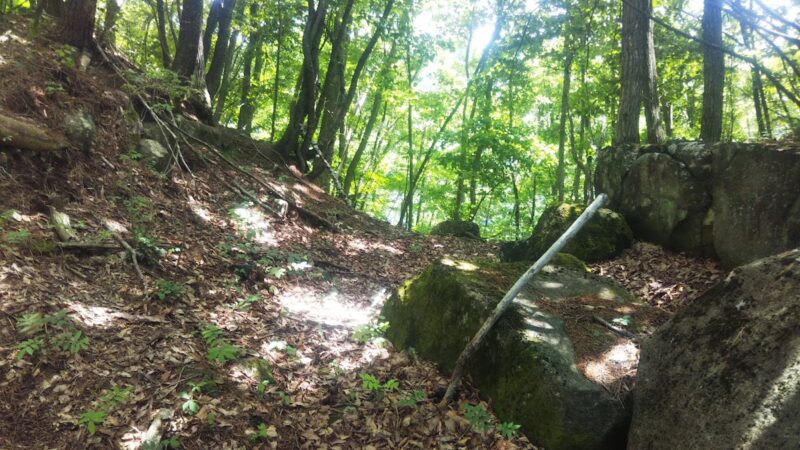
Climbing to Uchiyama Castle can also be enjoyed as a light hike. Walking along the castle path surrounded by forest, breathing in the fresh air while exploring history, is a unique charm of mountain castles.
It is a valuable place where you can enjoy both history and nature while experiencing the changing seasons.
Preservation of Local Historical Heritage
Regional mountain castles like Saku Uchiyama Castle receive less attention compared to famous castles, and preservation efforts are insufficient. However, these castle ruins are valuable legacies that convey the history of the region and are worth preserving for future generations.
An increase in visitors will raise awareness of the region’s historical heritage and lead to the promotion of conservation activities. By being mindful of proper etiquette during visits, each of us can contribute to the preservation of historical heritage.
History and Culture of Saku City
Overview of Saku City
Saku City is a city with a population of approximately 100,000 located in the eastern part of Nagano Prefecture. The current Saku City was formed in 2005 through the merger of the former Saku City, Usuda Town, Asashina Village, and Mochizuki Town.
It has Sakudaira Station on the Hokuriku Shinkansen (Nagano Shinkansen), providing excellent access from Tokyo in about 1 hour and 15 minutes. Furthermore, the Joshinetsu Expressway and Chubu Odan Expressway pass through it, making it a transportation hub connecting the Tokyo metropolitan area and the Chubu region.
History of Saku
The history of the Saku region is ancient, with numerous Jomon period ruins having been discovered. In ancient times, it was incorporated into the Ritsuryo system as “Saku District,” and in the Middle Ages, local lords such as the Saku, Banno, and Oi clans held sway over the area.
During the Sengoku period, it became a battleground during Takeda Shingen’s invasion of Shinano Province, and many battles were fought there. During the Edo period, it developed as a post town on the Nakasendo road, and the Iwamurada Domain was established there.
Since the Meiji era, it has developed mainly around silk production and agriculture, and today it is known as a production area for highland vegetables and as a highland city close to the Tokyo metropolitan area.
Culture of Saku
The Saku region has fostered a unique culture.
Saku Carp
Saku City is known for its thriving carp farming, and “Saku Carp” is famous throughout Japan. Carp dishes are a popular local cuisine of Saku.
Saku Folk Songs
Folk songs such as “Saku Grass Horse Race” have been passed down and are sung at local festivals.
Highland Culture
Taking advantage of the cool climate, a unique highland culture has developed, including the cultivation of highland vegetables and the development of resort areas.
Summary
Saku Uchiyama Castle is a mountain castle from the Sengoku period remaining in Saku City, Nagano Prefecture, and is a valuable historical site that conveys the history of Shinano. Built on a mountaintop at an altitude of 860 meters, the castle retains well-preserved remains such as earthworks, moats, and stone walls, making it an important resource for understanding the structure of medieval mountain castles.
While some preparation and caution are necessary for a visit, the sense of history gained from actually walking the castle ruins is priceless. The view from the main enclosure is magnificent, and you will be able to experience why a castle was built in this location.
Besides Uchiyama Castle, Saku City has many other castle ruins, such as Tatsuoka Castle, Hiraga Castle, and Inariyama Castle, allowing visitors to enjoy castle hopping. Furthermore, there are abundant tourist resources such as local cuisine including Saku carp and hot springs.
A visit to Saku Uchiyama Castle offers multifaceted significance, including historical learning, interaction with nature, and contributing to the preservation of local historical heritage. When you visit Saku City in Nagano Prefecture, be sure to visit this hidden gem of a castle. It will be a valuable experience that allows you to feel the spirit of the Sengoku period.