Naomine Castle (Niigata Prefecture): A Complete Guide to its History and Highlights | A Strategic Base Supporting Uesugi Kenshin’s Kanto Campaign
Naomine Castle (also known as Noumine Castle), towering over the Yasuzuka Ward of Joetsu City, Niigata Prefecture, is a mountain castle that functioned as an important military base in Echigo Province from the medieval period to the Sengoku period. Built on a 344-meter-high mountain, this castle, with its robust structure skillfully utilizing the natural terrain and its strategic location overlooking the Mikuni Kaido road, played an indispensable role in Uesugi Kenshin’s Kanto campaign.
This article will introduce the charm of this historic mountain castle in its entirety, from its historical background and the characteristics of its layout to the current state of its remains and how to access it.
Basic Information on Naomine Castle
Naomine Castle is a medieval mountain castle located in Yasuzuka Ward, Joetsu City, Niigata Prefecture, and is also known as Noumine Castle or Naomine Castle. The castle was built on Shiroyama Mountain, which is 344 meters above sea level, with a relative height of approximately 230 meters from the base. The steep terrain provides a natural defensive wall.
Currently, it is protected as a Niigata Prefecture designated historical site, and a forest road has been built to near the summit, making the castle ruins relatively easy to access. From the summit, you can enjoy a panoramic view of Joetsu city and the surrounding mountains, allowing you to experience what the former castle lords saw from this location.
Location and Geographical Characteristics
Naomine Castle is located approximately 3 kilometers southwest of the center of Yasuzuka Ward in Joetsu City, built on a strategically important site overlooking the Mikuni Kaido (present-day National Route 253). This road was an important transportation route connecting Echigo Province to Kozuke Province (present-day Gunma Prefecture), a major artery linking Kanto and Echigo.
Shiroyama Mountain is situated on a ridge extending north and south, and its complex layout utilizes the ridges branching out in all directions. The eastern side has a relatively gentle slope, but the western and southern sides are steep cliffs, making maximum use of the natural terrain.
History of Naomine Castle
Founding during the Nanboku-cho Period
There are various theories regarding the founding of Naomine Castle, but the most widely accepted theory is that it was built during the Nanboku-cho period (1335-1392) by Kazama Shinano-no-kami Nobuaki, a general of the Southern Court. During this period, Echigo Province was fiercely divided between the Southern and Northern Court forces, and Naomine Castle is thought to have functioned as an important base for the Southern Court.
Kazama Shinano-no-kami Nobuaki was known as a prominent general of the Southern Court and a central figure in the Southern Court’s forces in this region. Built in a rugged mountainous area, Naomine Castle is presumed to have served as a defensive base against attacks from the Northern Court and as a political center for governing the surrounding region.
Growing Importance During the Sengoku Period
With the arrival of the Sengoku period, Naomine Castle came under the control of the Uesugi clan, a powerful daimyo of Echigo Province, and was positioned as an important subsidiary castle of Kasugayama Castle. Especially during the time of Uesugi Kenshin, it played an extremely important role as a relay point during his campaigns in the Kanto region.
Uesugi Kenshin is said to have made 13 campaigns in the Kanto region throughout his life, and the shortest route from Kasugayama Castle to Kanto was via the Mikuni Pass. Naomine Castle was located on this route, and it is said that Kenshin often stayed at this castle on the first day of his Kanto campaigns. In other words, Naomine Castle was an indispensable “connecting castle” linking Kasugayama Castle and Kanto, both militarily and logistically.
Successive Castle Lords and Guard Commanders
During the Sengoku period, senior retainers of the Uesugi clan were stationed at Naomine Castle as guard commanders. The following individuals are recorded as castle lords and guard commanders:
Yoshida Hidetada: A samurai who served Uesugi Kenshin and was the commander of Naomine Castle. The Yoshida clan is known as a hereditary vassal of the Uesugi family.
Takemata Kiyotsuna: A member of the Takemata clan, considered one of the Four Heavenly Kings of the Uesugi clan, and was responsible for the defense of Naomine Castle.
Nagao Iga-no-kami: A samurai of the Nagao clan, recorded as a commander of Naomine Castle.
Higuchi Soemon Kanetoyo: Known as the biological father of Naoe Kanetsugu, he served as the lord of Naomine Castle. Higuchi Kanetoyo was active as a close confidant of Uesugi Kagekatsu, and his son, Naoe Kanetsugu, later wielded great power as a chief retainer of the Uesugi family. Kanetoyo’s position as lord of Naomine Castle speaks to the castle’s importance.
The Otate Rebellion and the Fall of Naomine Castle
In 1578, following the sudden death of Uesugi Kenshin, the Otate Rebellion erupted between Uesugi Kagekatsu and Uesugi Kagetora (of Hojo lineage) over his succession. This civil war became a large-scale conflict that divided Echigo Province in two, and Naomine Castle was caught in the middle of it.
At the beginning of the Otate Rebellion, Naomine Castle was defended by Yoshimasu Hoki-no-kami, a general on Kagetora’s side. Kagekatsu’s side recognized that Naomine Castle was a crucial strategic point controlling a vital route to the Kanto region and needed to capture it quickly.
After a fierce battle, Naomine Castle fell under Kagekatsu’s relentless attack and subsequently came under his control. This battle played a strategic role in cutting off Kagetora’s supply lines to the Kanto region, contributing to Kagekatsu’s victory in the Otate Rebellion.
The Abandonment of the Castle and its Aftermath
Even after the Otate Rebellion, Naomine Castle continued to function as a branch castle of the Uesugi clan. However, when Uesugi Kagekatsu was transferred to Aizu in 1598, the strategic importance of Naomine Castle declined. Subsequently, influenced by the Edo Shogunate’s “One Castle Per Province” decree, it is believed that Naomine Castle was abandoned.
While historical records are scarce and many aspects of the exact date of its abandonment remain unclear, it is believed to have lost its function as a castle by the early 17th century at the latest. Since then, the castle ruins have gradually returned to nature over many years, yet the remains of its former glory are preserved in good condition to this day.
The Layout and Remains of Naomine Castle
Overall Layout Structure
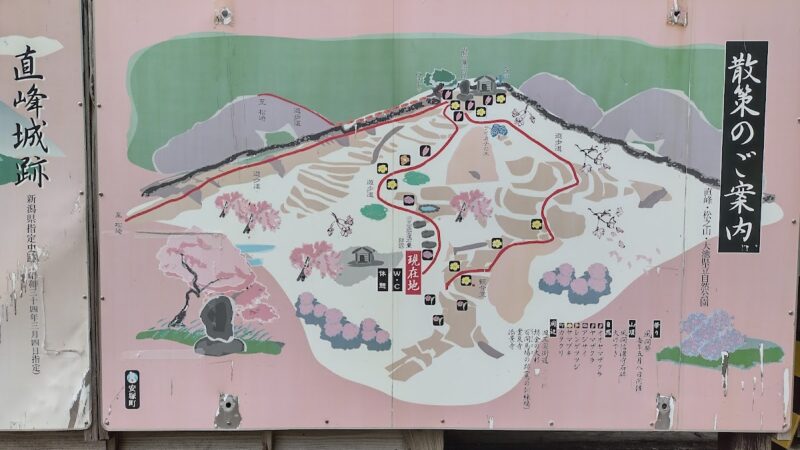
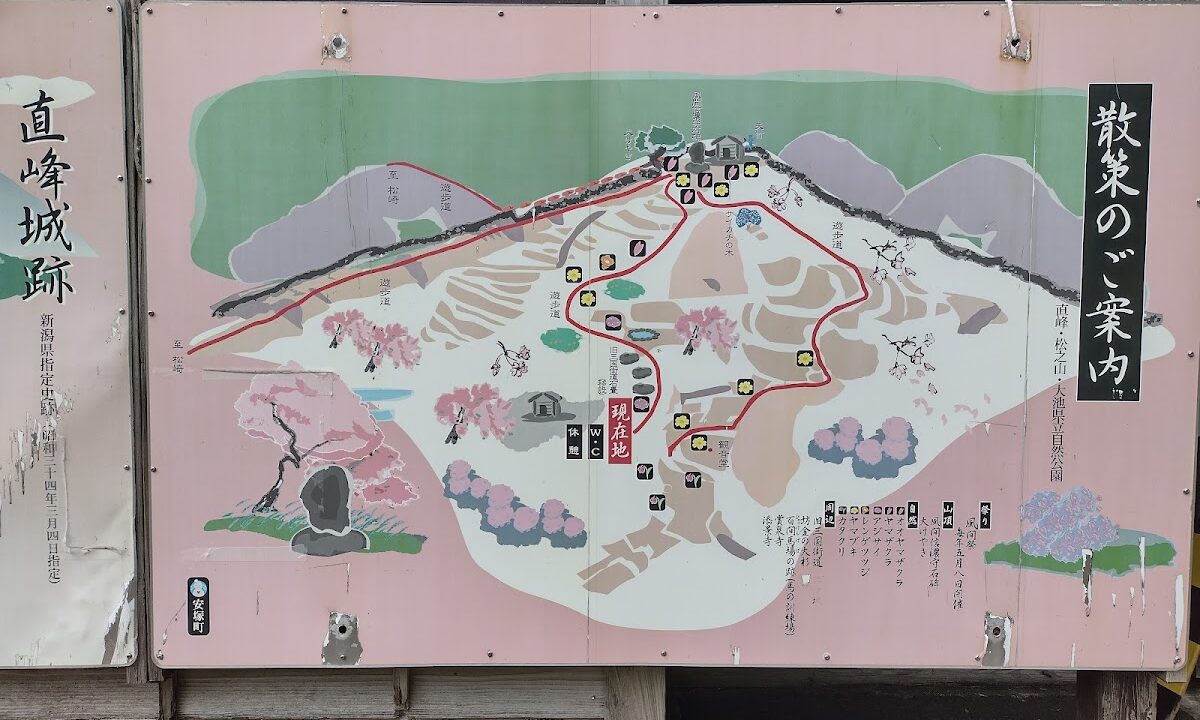
Naomine Castle is a typical medieval mountain castle with a complex layout utilizing the ridges extending in all directions from its 344-meter-high summit. The structure consists of multiple baileys arranged in a stepped pattern around the main enclosure, each separated by dry moats and earthworks.
Ridges extend from the main enclosure at the mountaintop in the north, east, south, and west directions, with defensive structures positioned along the middle of each ridge. This structure makes it a strong castle capable of responding to attacks from any direction with multiple lines of defense.
Main Enclosure (Honmaru)
The main enclosure, located at the mountaintop, is the central part of the castle and is believed to have housed the lord’s residence and command post. Even today, a clear flat area remains, and traces of earthworks can be seen around it.
The view from the main enclosure is magnificent, with the Joetsu Plain to the east, mountains to the west, and on some days, the Sea of Japan visible to the north. This excellent view played an important role as a surveillance function for detecting enemy movements early.
Enclosures
Various large and small enclosures are arranged around the main enclosure. These enclosures are thought to have been used as soldier garrisons, supply storage areas, or defensive positions during battle.
In particular, a series of enclosures can be seen on the eastern ridge, indicating an intention for multiple layers of defense against incursions from the main road. Each enclosure is clearly demarcated by steep slopes, exhibiting a typical structure of a medieval mountain castle.
Dry Moats and Trenches
A particularly noteworthy defensive feature of Naomine Castle is the dry moats and trenches located throughout the site. The trenches, dug across the ridges, served to prevent enemy incursions and clearly demarcate the castle grounds.
Especially on the northern and eastern ridges, multiple trenches are arranged in succession, creating a structure that would thwart attackers in several stages. Some of these trenches reach depths of several meters, demonstrating the advanced castle-building techniques of the time.
Earthworks
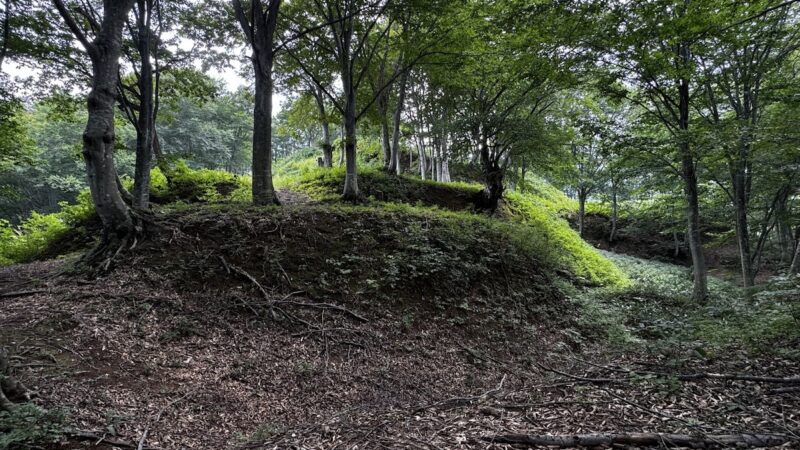
Earthworks were built along the edges of the enclosures, enhancing their defensive capabilities. These earthworks protected against enemy arrows and firearms, and also made it difficult to see inside the enclosures from the outside.
Even today, clear traces of earthworks remain, mainly around the main enclosure, with mounds of earth approximately 1-2 meters high.
Entrance (Koguchi)
The entrance (koguchi) to the castle also features a structure that prioritizes defense. Instead of a straight line, it is curved, demonstrating a design intended to make enemy intrusion difficult.
The entrance to the main enclosure is located on the east side and functioned as the final checkpoint from the approach road to the main enclosure. Traces of earthworks and stone walls can be seen around the entrance, indicating that defenses were heavily emphasized.
Related Castles to Naomine Castle
Relationship with Kasugayama Castle
Naomine Castle was positioned as an important branch castle of Kasugayama Castle, the base of the Uesugi clan. The route from Kasugayama Castle through Naomine Castle to Mikuni Pass was a major route during the Kanto campaign, and there was a close military and political relationship between the two castles.
The distance from Kasugayama Castle to Naomine Castle is approximately 20 kilometers, a reasonable distance for a one-day journey considering the marching speed of the time. Records indicating that Uesugi Kenshin stayed at Naomine Castle during his Kanto campaign support this distance and geographical relationship.
Cooperation with Mushikawa Castle
Mushikawa Castle is located approximately 5 kilometers northeast of Naomine Castle, and it is believed that the two castles cooperated in the defense of the region. Mushikawa Castle also functioned as a branch castle of the Uesugi clan, forming a defensive network along the Mikuni Kaido road together with Naomine Castle.
It is possible that a beacon tower was installed between the two castles, suggesting a system for rapidly transmitting information via beacon fire in emergencies.
Other Branch Castle Network
It is believed that several small forts and outposts were positioned around Naomine Castle. These complemented the defenses of Naomine Castle, forming a network for monitoring and defending a wider area.
In the Uesugi clan’s territorial management, such a network of branch castles was extremely important, and a hierarchical castle system, with Kasugayama Castle at its apex, spread throughout Echigo Province.
Highlights and Current Status of Naomine Castle
Preservation Status
Naomine Castle ruins are protected as a Niigata Prefecture designated historical site, and the remains are relatively well-preserved. Although more than 400 years have passed since the castle’s abandonment, the main baileys, moats, and earthworks remain clearly visible, making it a valuable site for understanding the structure of medieval mountain castles.
In recent years, local preservation societies and the government have been carrying out maintenance activities, including improving the access roads and installing information boards. However, as the castle ruins are located in a natural mountain forest, appropriate equipment and caution are necessary when visiting.
Access Road and Time Required
Naomine Castle can be accessed by car from the foot of the mountain via a forest road, reaching near the summit. From the end of the forest road to the main bailey, it takes approximately 15-20 minutes on foot.
If you climb to the castle on foot from the foot of the mountain, the hiking trail is well-maintained and takes about 40 to 60 minutes. Along the way, you can observe the remains of baileys and moats, and climbing on foot is recommended for understanding the overall structure of the castle.
Views and Scenery
The view from the main bailey at the summit is one of the greatest highlights of Naomine Castle. On a clear day, you can see the entire Joetsu Plain, the Sea of Japan, and the Myoko mountain range.
This view is not merely scenic; it allows you to imagine what the castle lords of the Sengoku period monitored and what strategies they devised from this location. You can also appreciate the castle’s strategic importance by experiencing its position overlooking the Mikuni Kaido road.
Seasonal Charms
Naomine Castle ruins have different charms in each of the four seasons. Spring is beautiful with fresh greenery, summer is enveloped in deep green, autumn colors the mountain with colorful foliage, and winter the outline of the castle ruins emerges from the snowy landscape.
The autumn foliage season, in particular, offers a magnificent view of the castle ruins and the surrounding nature, attracting many history buffs and hiking enthusiasts. However, in winter, snow can make access difficult, so caution is advised when planning your visit.
Access and Visiting Information
Access by Car
Access from the Hokuriku Expressway: From the Joetsu Interchange, take National Route 253 towards Yasuzuka for approximately 30 minutes. From the Yasuzuka town area, take the forest road for approximately 15 minutes to near the summit. The forest road has narrow sections, so careful driving is necessary.
There is parking space for several cars at the end of the forest road. However, the forest road may be closed during winter or in bad weather, so it is recommended to check in advance.
Access by Public Transportation
Train: The nearest station is Mushikawa-Ōsugi Station on the JR Shin’etsu Main Line and Hokuetsu Express Hokuhoku Line. From the station, it takes approximately 1 hour 30 minutes to 2 hours on foot to reach the castle ruins entrance. Bus: Buses run from Joetsu city to Yasuzuka, but the number of buses is limited, so it’s important to check the timetable in advance.
If using public transportation, it’s recommended to plan your trip with plenty of time to spare.
Points to Note When Visiting
- Clothing and Equipment: As it is a mountain castle, comfortable walking shoes and clothing are essential. Insect repellent is necessary in summer, and warm clothing is necessary in winter.
- Drinking Water: There are no vending machines around the castle ruins, so please bring your own drinking water.
- Toilets: There are no toilet facilities at the castle ruins. It is recommended to use the facilities in Yasuzuka town beforehand.
- Weather: The ground can be slippery in rainy weather, so visiting on a sunny day is preferable.
- Bear Precautions: As it is a mountainous area, it is recommended to carry a bear bell or similar device.
Estimated Visiting Time
For a visit to the castle ruins, please allow approximately 30 minutes if you only want to explore the main enclosure area, or 1 hour 30 minutes to 2 hours if you want to thoroughly explore the entire site. Taking photographs or closely observing the remains will require additional time.
Things to Know Before Visiting Naomine Castle
Nearby Tourist Facilities
When visiting Naomine Castle ruins, visiting nearby historical and cultural facilities will allow you to gain a deeper understanding of the region’s history.
Yasuzuka Cupid Valley: Known as a ski resort, this facility offers outdoor activities during the summer. It’s about a 20-minute drive from Naomine Castle.
Joetsu City Buried Cultural Properties Center: This center features exhibits on the history and archaeology of Joetsu City, and also houses materials related to Naomine Castle.
Kasugayama Castle Ruins: Visiting Kasugayama Castle, the base of Uesugi Kenshin, along with Naomine Castle will allow you to gain a deeper understanding of the Uesugi clan’s castle network. It’s about a 40-minute drive from Naomine Castle.
Local Food and Specialty Products
The Yasuzuka district of Joetsu City is known as a heavy snowfall area, and this environment has fostered a unique food culture. When you visit, be sure to enjoy the local cuisine.
Snow-Aged Foods: Vegetables and sake aged in a natural refrigerator using snow (“yukimuro”) are characterized by their mellow flavor.
Sasa Sushi: A local dish of the Joetsu region, sushi wrapped in bamboo leaves has a simple yet profound flavor.
Local Sake: The Joetsu region is known as a sake-producing area, and many breweries produce high-quality sake.
Photography Tips
The Naomine Castle Ruins are also an attractive subject for photography. Keeping the following points in mind will help you take impressive photos.
View from the Main Enclosure: The view is particularly beautiful in the early morning and evening when the light is obscured, allowing you to take landscape photos with the Joetsu Plain and the Sea of Japan in the background.
Cross-section of the moat: Photographing from an angle that emphasizes the depth and shape of the moat as a defensive structure conveys the castle’s strength.
Lines of the earthworks: Emphasizing the lines of the earthworks surrounding the baileys expresses the structural beauty of the castle.
Autumn foliage season: Photographs combining autumn foliage with the castle ruins evoke a sense of harmony between history and nature.
Current status and challenges of Naomine Castle research
Limitations of historical sources
Primary sources concerning Naomine Castle are limited, and many aspects of the castle’s detailed history remain unclear. Further research is needed, particularly regarding its founding period during the Nanboku-cho period and the specific changes in the castle’s structure during the Sengoku period.
While fragmentary descriptions exist in documents such as the “Uesugi Family Documents” and “Uesugi Chronicle,” detailed records specifically for Naomine Castle are scarce, requiring an approach that combines archaeological investigation and historical source research.
Results of Archaeological Excavations
Past archaeological excavations have yielded artifacts such as ceramic fragments and iron products, providing valuable information about the period of use of the castle and the lifestyle of its inhabitants. However, large-scale excavations have not been conducted, and the full extent of the underground structures remains unclear.
Future planned excavations may provide more detailed information about the history and structure of Naomine Castle.
Efforts for Preservation and Utilization
Local efforts are ongoing to preserve and utilize the Naomine Castle ruins. Regular mowing, maintenance of the access roads, and installation of information boards are being carried out to create a safe environment for visitors.
Furthermore, the site is also used as a place for local history education, with local history lessons for elementary and junior high school students and tours for history enthusiasts being held.
Summary
Naomine Castle was a mountain castle that functioned as an important military base in Echigo Province from the Nanboku-cho period to the Sengoku period. The robust structure, utilizing the rugged terrain at an altitude of 344 meters, is a highly valuable example of a typical medieval mountain castle.
Particularly during the time of Uesugi Kenshin, it played a strategically important role as a “connecting castle” during his campaigns in the Kanto region, becoming a key point in the military network linking Kasugayama Castle and Kanto. The fact that Higuchi Kanetoyo, the real father of Naoe Kanetsugu, served as the castle lord also speaks to its importance.
Currently, the castle ruins are protected as a Niigata Prefecture designated historical site, and the remains such as baileys, moats, and earthworks are well-preserved. The view from the mountaintop is magnificent, allowing visitors to relive the perspective of the castle lords of the Sengoku period.
Visiting the Naomine Castle ruins is not simply about viewing historical remains; it is a valuable opportunity to learn about the history of Echigo Province during the Sengoku period, the Uesugi clan’s territorial management, and the construction techniques of medieval mountain castles. When visiting Joetsu City, be sure to visit this historic mountain castle. The remains and views that await you after climbing the steep mountain path will surely be an unforgettable experience.
Naomine Castle is an attractive spot not only for history buffs but also for mountain climbing enthusiasts and photography lovers. The scenery, a blend of nature in every season and historical remains, continues to deeply impress visitors.