Takai Castle (Kaizuka City, Osaka Prefecture) Complete Guide | History from Negoro Clan Base to Fall and On-site Visit Information
What is Takai Castle?
Takai Castle (Takai-jo) is a castle from the late Sengoku period located in Nagoshi, Kaizuka City, Osaka Prefecture. Also known as “Izumi Takai Castle,” it functioned as an important military base for the Negoro clan in Izumi Province. Currently, the castle site has been developed into a children’s park, and most of the original remains have been lost. However, information boards have been installed, conveying the turbulent history of the Sengoku period.
Takai Castle is located in the central part of the Izumi Plain facing Osaka Bay. It is a flatland castle built on the boundary between a gentle slope from the river flowing west of the Chikagi River and the flat land. Its location was chosen as a base for attacking Kishiwada Castle and as a strategic point for maintaining the Negoro clan’s sphere of influence.
History of Takai Castle
Background of Construction and the Negoro-shu
Takai Castle first appears on the historical stage just before Toyotomi Hideyoshi’s “Kishu Campaign” in 1585. The Negoro-shu were a group of warrior monks based in Kii Province (present-day Wakayama Prefecture), possessing a powerful musketeer unit and known as a major military force during the Sengoku period.
After the death of Oda Nobunaga, the Negoro-shu deepened their conflict with Toyotomi Hideyoshi. To counter Hideyoshi’s moves to unify Japan, the Negoro-shu allied with the Saika-shu to secure military bases in Izumi Province. As part of this effort, it is believed that they renovated and fortified Takai Tenjin Shrine, developing it into Takai Castle.
The purpose of Takai Castle’s construction was clear: it served as an auxiliary fort for attacking Kishiwada Castle, an important base for Hashiba (Toyotomi) Hideyoshi. A tsukejō (attached castle) refers to a temporary military base built near an enemy castle when attempting to capture it. The Negoro clan attempted to increase pressure on Kishiwada Castle from Takai Castle.
The Kii Campaign and Siege of 1585
In March 1585, Toyotomi Hideyoshi led a large army to launch an invasion of Kii Province to subdue the Negoro and Saika clans. This campaign was one of the important military operations in Hideyoshi’s unification of Japan.
As Hideyoshi’s forces advanced into Kii Province, two generals, Gyōsakyō and Kumatori Dainagon, defended Takai Castle with approximately 200 peasant soldiers. Yukisato Kumatori Dainagon was a powerful commander of the Negoro clan, and they resolved to resist Hideyoshi’s army, making Takai Castle their last stronghold.
Hideyoshi ordered Fukushima Masanori, one of his powerful generals, to capture Takai Castle. Fukushima Masanori was a brave warrior later known as one of the Seven Spears of Shizugatake. Masanori’s forces surrounded Takai Castle and a fierce siege ensued.
The Negoro clan and peasant soldiers fought bravely, but due to the overwhelming difference in troop numbers and Hideyoshi’s organized attack, Takai Castle fell. After the castle’s fall, the Negoro clan’s power rapidly declined, and Hideyoshi’s conquest of Kishu was a success. The fall of Takai Castle became one of the events symbolizing the end of the Negoro clan.
Takai Castle After its Fall
After Takai Castle fell, it lost its function as a castle. Following the successful conquest of Kishu, the threat of the Negoro clan was eliminated, and Izumi Province was fully incorporated under Hideyoshi’s control. It is believed that Takai Castle lost its strategic value and was abandoned.
From the Edo period onward, the land of Takai Castle was used for farmland and residential areas, and the castle’s remains gradually disappeared. Modernization after the Meiji era, and urban development after World War II, further accelerated the loss of the remains. Currently, only slight topographical undulations and place names remaining on old maps can be used to imagine the castle’s former existence.
Structure and Layout of Takai Castle
Location and Topography
Takai Castle is a flatland castle built on a plain in Nagoshi, Kaizuka City, Osaka Prefecture. It was constructed utilizing the topography at the boundary between the gentle slope from the Kinoki River flowing to the west and the flat land. This location had the advantage of being able to use the river as a natural moat.
The area surrounding the castle is part of the Izumi Plain, and the terrain is relatively flat. While flatland castles like this are less defensively strong than mountain castles, they have the advantage of easier supply lines and troop assembly. It is believed that the Negoro clan chose Takai Castle as a base for their attack on Kishiwada Castle partly because of this high mobility.
Castle Scale and Structure
Although detailed layouts (castle blueprints) of Takai Castle do not exist, it is presumed to have been a relatively small castle, given that it was a fortified outpost built in a short period of time. Records indicate that Takai Tenjin Shrine was renovated into a castle, suggesting a high probability that an existing religious facility was repurposed as a military base.
Outposted castles from the late Sengoku period typically consisted of simple defensive structures such as earthworks, moats, and fences. Takai Castle is similarly presumed to have had an earthworks, moats, and wooden fences. Permanent structures such as stone walls were likely not included in a castle built in such a short period.
Remaining Structures
Unfortunately, very few remains of Takai Castle exist today. The castle ruins have been developed into a children’s park, and residential development has progressed, so traces of earthworks and moats are no longer visible from the surface.
Some researchers and castle enthusiasts have attempted to estimate the former castle grounds based on slight topographical undulations and the layout of surrounding old residences. However, no clear remains have been confirmed, and it is currently recorded as a “disappearing ruin.”
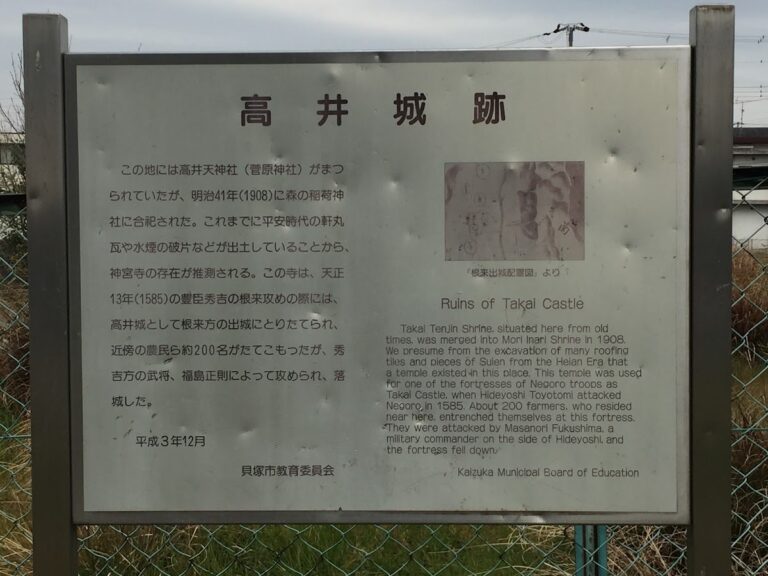
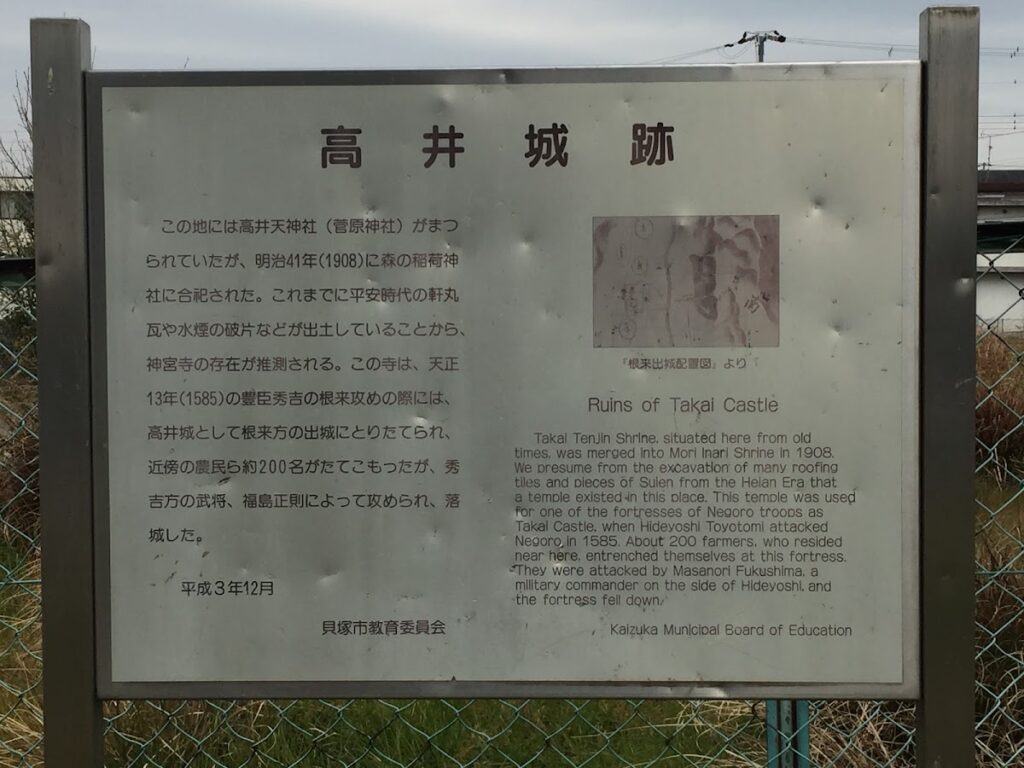
Within the park, there is an information board explaining the history of Takai Castle, allowing visitors to learn about the history of battles that once took place on this site.
Highlights and Notes on Takai Castle
Information Board and Historical Explanation
The biggest highlight when visiting the Takai Castle ruins is the information board installed in the children’s park. This board provides detailed explanations of the history of Takai Castle, its relationship with the Negoro clan, its battles during the Kishu campaign, and the siege by Fukushima Masanori.
The information boards are valuable historical documents that pass on the region’s history to future generations, making them a must-see for castle enthusiasts and history buffs. Photography is permitted, so we recommend taking photos to commemorate your visit.
Observing the Surrounding Topography
Although the remains are lost, observing the surrounding topography allows us to imagine the castle’s location at the time. Estimating the castle’s defensive lines and boundaries from the flow of the Kinokigawa River, slight undulations, and the layout of surrounding roads is one way to enjoy visiting castles.
In particular, the view towards the Kinokigawa River provides clues to imagining the perspective the Negoro clan had at the time. Furthermore, confirming the direction of Kishiwada Castle will help us understand why Takai Castle was chosen as an attack base.
Relationship with Takai Tenjin Shrine
Takai Castle is believed to have been built by renovating Takai Tenjin Shrine. By examining the current location of Takai Tenjin Shrine and the arrangement of surrounding religious facilities, we can consider the relationship between the castle and religious facilities at the time.
During the Sengoku period (Warring States period), it was not uncommon for temples and shrines to be used as military bases. Religious facilities, situated on high ground and possessing large precincts, offered ideal conditions for defensive positions.
Current Status as a Children’s Park
Currently, the Takai Castle ruins have been developed into a local children’s park, serving as a place of relaxation for local residents. There are playground equipment and open spaces, and children can be seen playing there. The sight of this former battlefield being used as a peaceful park is a symbolic representation of the changing times.
The park is kept clean, allowing visitors to enjoy their visit. However, it is important to be considerate of other park users and to observe quietly.
Access to Takai Castle
Access by Public Transportation
When visiting Takai Castle ruins by public transportation, the nearest stations are Kaizuka Station on the Nankai Main Line or Kaizuka Station on the Mizuma Railway.
Access from Kaizuka Station on the Nankai Main Line:
- Approximately 15-20 minutes on foot from Kaizuka Station on the Nankai Main Line.
- Exit the station and head southeast, passing through the residential area towards the Nagoshi district.
- There are few signs, so it is recommended to check the location in advance using a map app.
By Bus:
- It is also possible to take the Mizuma Railway bus from Kaizuka Station, but the number of buses is limited, so it is necessary to check the timetable in advance.
- It is a few minutes’ walk from the nearest bus stop.
Access by Car and Parking
If you are coming by car, the nearest interchanges are the Kaizuka IC on the Hanshin Expressway Route 4 Wangan Line or the Kaizuka IC on the Hanwa Expressway.
Parking Information:
- There is no dedicated parking lot at Takai Castle Ruins (Children’s Park).
- The surrounding roads are residential streets; street parking should be avoided.
- We recommend using nearby coin-operated parking lots or parking in a paid parking lot near Kaizuka Station and walking to the site.
Car Navigation Settings:
- Search for “Nagoe, Kaizuka City, Osaka Prefecture”.
- For more accurate directions, setting the destination to “Takai Tenjin Shrine” or a nearby address would be better.
Points to Note When Visiting
- The castle ruins are used as a children’s park, so please be considerate and avoid disturbing children’s play.
- Photography is permitted around the information boards, but please respect the privacy of park users.
- Since very few remains are left, we recommend visiting with the mindset of using your historical imagination.
- There is little shade in the summer, so it is a good idea to bring a hat and drinks.
Nearby Tourist Spots and Related Historical Sites
Kishiwada Castle
Located approximately 5km northwest of Takai Castle, Kishiwada Castle was an important fortress that Takai Castle targeted for attack. The castle tower has now been restored and is open to the public as a museum. When visiting Takai Castle, we highly recommend also visiting Kishiwada Castle to understand the relationship between the two castles.
Kishiwada Castle served as the central castle of Izumi Province and housed the Kishiwada Domain’s administrative office throughout the Edo period. With its beautiful gardens and extensive exhibits, it’s a popular tourist spot attracting many visitors.
Kaizuka Terauchi-cho
Located within walking distance of Kaizuka Station, Kaizuka Terauchi-cho is a temple town that developed around Gansenji Temple, preserving its Edo-period streetscape. It’s a historically valuable site for understanding the region’s history from the Sengoku period to the Edo period.
Gansenji Temple was a Jodo Shinshu Buddhist temple with deep ties to Ishiyama Honganji Temple. Old townhouses remain in the temple town, allowing visitors to enjoy a historical atmosphere.
Nishiki-no-hama Beach
Nishiki-no-hama Beach, stretching along the coastline of Kaizuka City, is a beautiful sandy beach approximately 1 km long. After exploring the historical sites, refreshing yourself by the sea is highly recommended. It’s bustling with beachgoers during the summer.
Mt. Izumi-Katsuragi
Located in the southeastern part of Kaizuka City, Mt. Izumi-Katsuragi is an 858m-high mountain, home to a beech forest that is the southernmost limit of its kind on Honshu and designated a natural monument. Hiking trails are well-maintained, allowing you to enjoy nature while experiencing the topography of Izumi Province, a historical stage.
Negoro-ji Temple (Wakayama Prefecture)
Negoro-ji Temple, the base of the Negoro clan, which had deep ties to Takai Castle, is located in Iwade City, Wakayama Prefecture. It’s about a 40-minute drive from Kaizuka City. Consider visiting Negoro-ji Temple to gain a deeper understanding of the Negoro clan’s history and culture.
Negoro-ji Temple houses many cultural assets, including the National Treasure Great Pagoda, and tells the story of the Negoro clan’s rise and fall.
Historical Significance of Takai Castle and the Negoro-shu
What were the Negoro-shu?
The Negoro-shu were a group of warrior monks centered around Negoro-ji Temple in Kii Province (present-day Wakayama Prefecture). They developed into a powerful military organization from the Muromachi period to the Sengoku period. They excelled particularly in the manufacture and use of firearms, producing high-quality matchlock guns known as “Negoro muskets.”
The Negoro-shu were not merely a religious group, but a major force possessing both economic and military power. They repeatedly formed alliances and clashed with Sengoku daimyo, significantly influencing the political situation in the Kinai region.
Conflict with Toyotomi Hideyoshi
Initially, the Negoro-shu had a cooperative relationship with Oda Nobunaga, but after the Honno-ji Incident, their relationship with Toyotomi Hideyoshi deteriorated. Hideyoshi’s movement for national unification threatened the Negoro-shu’s autonomy and independence, making conflict between the two inevitable.
The Kishu Campaign of 1585 was a large-scale military operation by Hideyoshi aimed at completely subduing the Negoro clan. The Battle of Takai Castle is positioned as part of this campaign.
Historical Significance of the Battle of Takai Castle
Although the Battle of Takai Castle was a small-scale battle, it holds historical significance as a symbol of the Negoro clan’s resistance. The siege by approximately 200 men, including Yukisakyo and Kumatori Dainagon, was the last stand against Hideyoshi’s overwhelming army.
After this battle, Negoro-ji Temple was burned down, and the Negoro clan was annihilated. The fall of Takai Castle can be considered one of the events symbolizing the end of religious power in the Sengoku period.
Military Achievements of Fukushima Masanori
Fukushima Masanori, who captured Takai Castle, further increased Hideyoshi’s trust in him due to this military achievement. Masanori was later counted as one of the “Seven Spears of Shizugatake” for his exploits in the Battle of Shizugatake, and distinguished himself in the Battle of Sekigahara on the Eastern Army’s side, eventually becoming the lord of the Aki Hiroshima Domain.
The capture of Takai Castle was a crucial battle in Masanori’s military career and is recorded as an example of his bravery and command ability.
Current Status and Future Challenges of Takai Castle Research
Limitations of Historical Sources
Historical sources concerning Takai Castle are limited, and much of the detailed information regarding its construction period, castle structure, and the course of battle relies on speculation. While military chronicles such as the *Taikoki* describe the conquest of Kishu, specific descriptions of Takai Castle are scarce, posing a challenge for researchers.
The Need for Archaeological Investigation
Currently, no full-scale archaeological excavations are being conducted at the Takai Castle site. Large-scale excavations are difficult due to ongoing residential development, but even limited investigations are expected to confirm remains and discover artifacts. If emergency archaeological excavations are conducted in the future, perhaps in conjunction with development projects, the true nature of Takai Castle may become clearer.
Position in Local History Research
Takai Castle is an important historical site for understanding the Sengoku period history of Kaizuka City and the Izumi region. Research activities by local history societies and history enthusiasts are ongoing, and the discovery of new historical materials and advancements in interpretation are expected.
Increasing local residents’ interest in history and promoting the preservation and utilization of historical sites contributes to the formation of regional identity.
Efforts for Preservation and Utilization
Given the current situation where most of the remains have been lost, the main preservation activities are the installation of information boards and the dissemination of information. The Kaizuka City Board of Education and local cultural property protection organizations are conducting awareness campaigns, and efforts to pass on the history of Takai Castle to future generations continue.
Virtual reconstruction using digital technology and on-site historical experiences using AR applications are also worth considering as future utilization methods.
Summary: The Significance of Visiting Takai Castle
Takai Castle (Kaizuka City, Osaka Prefecture), although its remains have been lost, is a valuable historical site that conveys the turbulent history of the late Sengoku period. As the stage for historical events such as the last resistance of the Negoro clan, Toyotomi Hideyoshi’s conquest of Kishu, and the military achievements of Fukushima Masanori, it is a place worth visiting for castle enthusiasts and history buffs.
Visiting the site allows you to experience the atmosphere and topography of the land in a way that cannot be obtained from historical documents or photographs alone. Furthermore, visiting nearby Kishiwada Castle, Kaizuka Terauchi-cho, and Negoro-ji Temple in conjunction with Takai Castle will provide a more comprehensive understanding of the history of Izumi and Kii provinces during the Sengoku period.
Takai Castle ruins are not a flashy tourist spot, but it is a place where visitors can quietly reflect on history and contemplate the lives of the people of that time, leaving them with a profound sense of awe. If you have the opportunity to visit southern Osaka Prefecture, please be sure to visit Takai Castle ruins.