Sayama Jinya (Osaka Prefecture) Complete Guide | A Thorough Explanation of the Hojo Clan’s History and Existing Remains
What is Sayama Jinya?
Sayama Jinya was a fortified residence located in Ikejiri Village and Handa Village, Tannan District, Kawachi Province (present-day Sayama 3-4 Chome and 2-Chome, Osakasayama City, Osaka Prefecture). It functioned as the administrative center of the Sayama Domain.
After the defeat of the prestigious Later Hojo clan in Toyotomi Hideyoshi’s Odawara campaign, they were pardoned and continued to exist as a small domain of just over 10,000 koku until the Meiji Restoration. It is a fortified residence with a rare history nationwide. Although the area is now being developed into residential land, a stone monument and explanatory plaque have been erected, and the relocated gate remains.
Basic Information on Sayama Jinya
Location: 3-chome, Sayama, Osakasayama City, Osaka Prefecture
Former Province: Kawachi Province
Common Name/Alternate Name: Kawachi Sayama Jinya
Classification/Structure: Jinya (fortified residence)
Keep Structure: None (as it is a Jinya)
Builder: Hojo Ujinobu
Year of Construction: Genna 2 (1616)
Lord: Hojo clan (Later Hojo clan)
Year of Abandonment: After the Meiji Restoration
Designated Cultural Property: None (however, a relocated gate still exists)
History of Sayama Jinya
Relocation of the Hojo Clan from Kanto
In Tensho 18 (1590), Hojo Ujinao, the 5th head of the Later Hojo clan and ruler of Kanto, was defeated in the Odawara campaign by Toyotomi Hideyoshi. Most of the family members were ordered to commit seppuku (ritual suicide), but the young head of the family, Ujinao, was ordered to confine himself to Mount Koya, and his uncle, Hojo Ujinori, followed suit.
In 1594, when Ujinao died of illness at Mount Koya, Ujinori was granted 4,000 koku in Tannan District of Kawachi Province and Otori District of Izumi Province through the mediation of Tokugawa Ieyasu. This marked the beginning of the Sayama Domain.
In the Battle of Sekigahara in 1600, Ujinori sided with the Eastern Army, and for his service, his stipend was increased by 6,000 koku, making him a daimyo with a total of 10,000 koku. At this time, Ujinori’s son, Hojo Ujimori, inherited the family headship.
Construction and Development of the Jinya (Fortified Residence)
In 1616, during the time of the second lord, Hojo Ujinobu, a formal Jinya was established in Sayama. The Sayama Jinya (feudal lord’s residence) was divided into an upper residence and a lower residence. The upper residence housed the lord’s mansion, while the lower residence contained the residences of retainers and other facilities.
Although the Sayama Jinya was the residence of a small domain with a 10,000 koku (unit of rice production) yield, it carried the history of the prestigious Hojo clan and survived throughout the Edo period. The successive lords were also responsible for managing Sayama Pond, known as the oldest reservoir in Japan, contributing to local flood control projects.
The Meiji Restoration and the End of the Jinya
With the Meiji Restoration, the Sayama Domain, like other small domains, was subject to the abolition of the feudal system and the establishment of prefectures. The Jinya lost its function as a domain office, and many of its buildings were dismantled or burned down. However, a part of the Jinya gate was relocated and remains today at the Nishi Honganji branch temple in Sakai City.
Structure and Remains of the Sayama Jinya
Layout of the Upper Residence
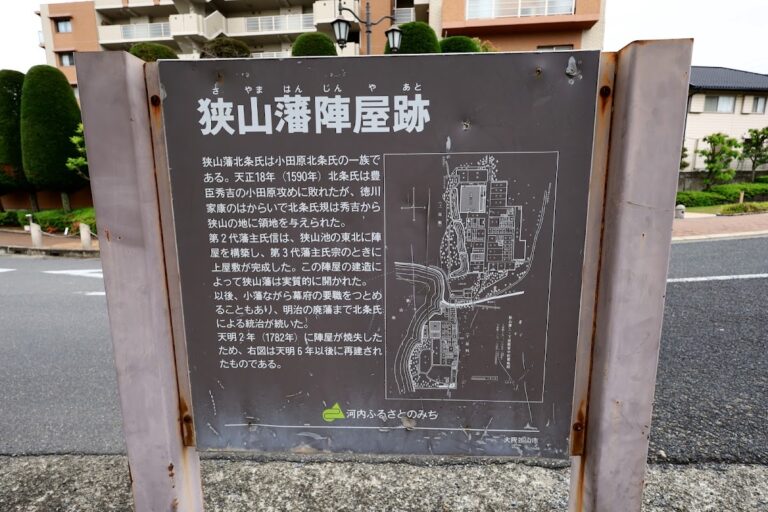
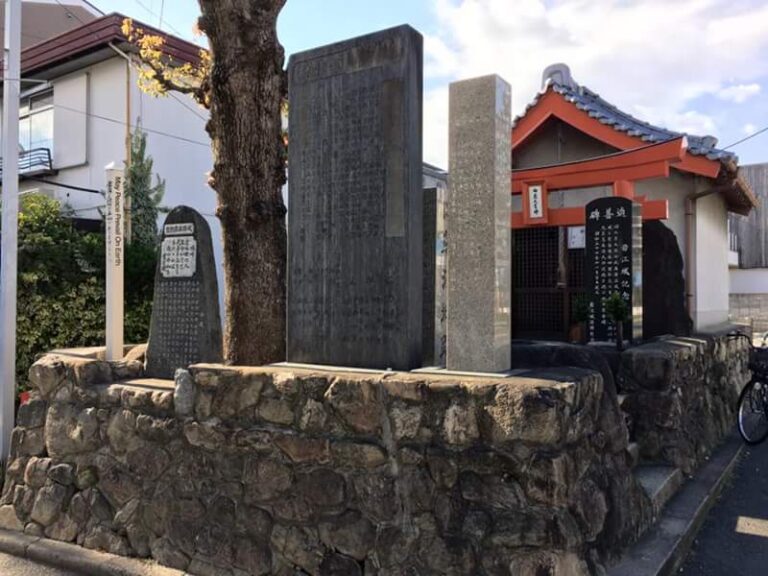
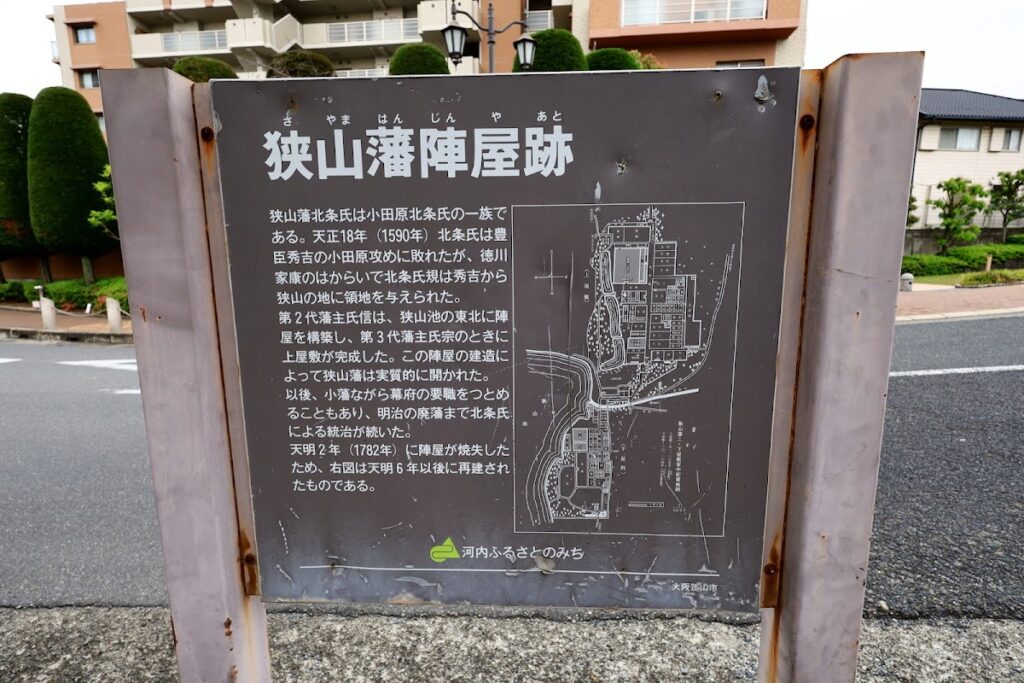
The upper residence was located in what is now Sayama 3-4 chome, Osakasayama City. It is believed that the lord’s residence was at the center, surrounded by buildings for administrative affairs and gardens. Currently, a stone monument and explanatory sign marking the “Sayama Domain Jinya Site” are located at the site of the main residence, allowing visitors to imagine what it was like in the past.
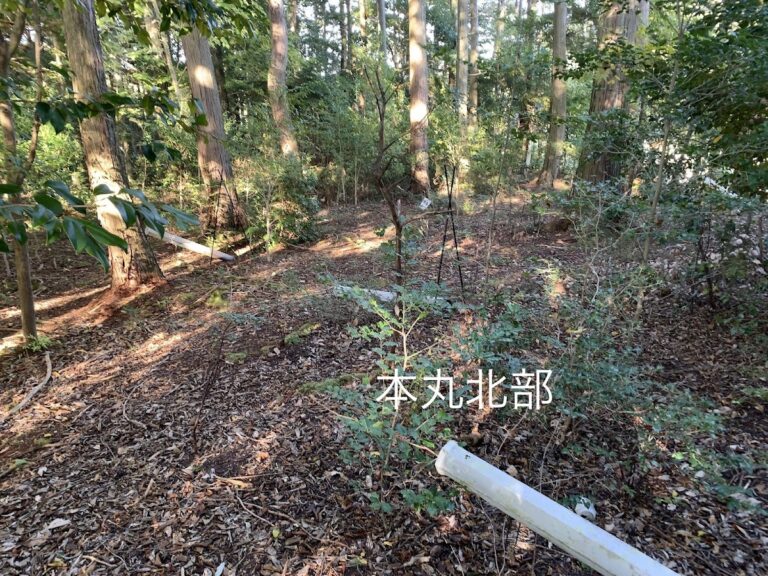
Although the buildings themselves no longer exist, the roads and layout are relatively well-preserved, giving a sense of the atmosphere of an Edo-period jinya town. Archaeological excavations have also been conducted, and Edo-period remains have been confirmed at the northern end of the jinya site.
Current Status of the Lower Residence
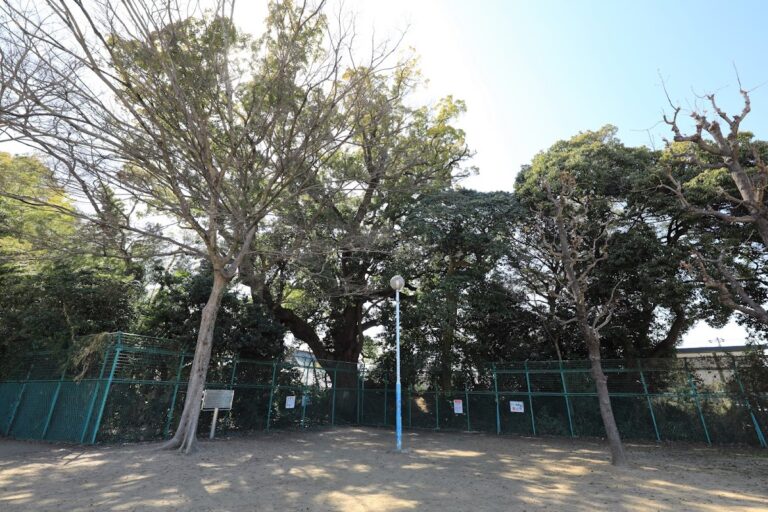
The lower residence is located in what is now Sayama 2-chome, Osakasayama City, and is currently maintained as a park. While it was the site of residences for retainers and warehouses, no particularly notable remains remain. However, it is open to the public as a park and serves as a place of relaxation for the community.
Existence of a Relocated Gate
As a valuable relic of the Sayama Jinya, a gate that was relocated to the Nishi Honganji Betsuin (Kita Mido) in Sakai City still exists. This relocated gate is said to have been either the front or back gate of the jinya (fortified residence), and is a valuable cultural asset that preserves the architectural style of Edo-period jinya.
The gate’s structure is a wooden Yakui-mon style, exhibiting the sturdy and robust characteristics of samurai architecture. When visiting the Sayama Jinya, we highly recommend also visiting the Nishi Honganji branch temple in Sakai City and viewing this relocated gate.
Stone Monument and Information Board
A stone monument inscribed with “Sayama Domain Jinya Site” stands at the site of the main residence, and next to it is a detailed information board. The board details the history of the Sayama Domain, the lineage of the Hojo clan, and the layout of the jinya, which will help deepen your understanding when visiting the site.
Although the stone monument is relatively new, it is an important landmark that conveys the history of the region to future generations. While the surrounding area is residential, you can use this monument as a landmark to find the jinya site.
The Hojo Clan and the Successive Lords of the Sayama Domain
First Lord: Hojo Ujinori
Hojo Ujinori was the younger brother of Hojo Ujimasa, the fourth head of the Later Hojo clan, and the uncle of Ujinao, the fifth head. After the Siege of Odawara, he and Ujinao went into seclusion at Mount Koya, but after Ujinao’s death, he was granted 4,000 koku in Kawachi Province through the mediation of Tokugawa Ieyasu.
He sided with the Eastern Army in the Battle of Sekigahara and, for his achievements, became a daimyo with 10,000 koku. Although Ujinori himself died before establishing a fortified residence in Sayama, he is important as the person who laid the foundation for the Sayama Domain.
Second Lord: Hojo Ujinobu
Hojo Ujinobu was Ujinori’s son, and in 1616 (Genna 2), he officially established a fortified residence in Sayama. The construction of the jinya (fortified residence) was Ujinobu’s greatest achievement, and thereafter, this site became the Hojo clan’s castle.
Ujinobu also managed Sayama Pond, contributing to the region’s flood control efforts. Sayama Pond is known as the oldest reservoir in Japan, and its maintenance was an important responsibility of the domain.
Genealogy of Successive Domain Lords
The Sayama Domain was ruled by the Hojo clan until the Meiji Restoration. Although a small domain of 10,000 koku, it is noteworthy that they continued to uphold the lineage of the prestigious Hojo clan. Successive lords are said to have prioritized frugality and austerity, implementing benevolent policies that put the lives of their people first.
After the Meiji Restoration, the last lord was granted the title of nobility, and the Hojo clan’s name continues to this day.
Sayama Jinya and Surrounding Attractions
Sayama Pond
If you visit Sayama Jinya, Sayama Pond is a must-see. Sayama Pond is known as the oldest reservoir in Japan, and is said to have been constructed in 616 during the Asuka period. The lords of the Sayama domain were responsible for managing this pond for generations, and it had a deep connection to the domain’s headquarters.
Currently, the area around Sayama Pond is developed as a park, and the Sayama Pond Museum is located there. At the museum, you can learn in detail about the history of Sayama Pond and the flood control techniques used. In spring, cherry blossoms bloom, making it a place of relaxation for citizens.
Osaka Sayama City Local History Museum
The Osaka Sayama City Local History Museum exhibits materials related to the history of the Sayama domain and the Hojo clan. Models of the domain headquarters, ancient documents, and everyday items from the time are on display, allowing for a deeper understanding of the history of the Sayama domain headquarters.
The museum also regularly holds special exhibitions, making it a must-see spot for anyone interested in local history.
Nishi Honganji Branch Temple (Relocated Gate)
As mentioned above, the gate of the Sayama domain headquarters has been relocated to the Nishi Honganji Branch Temple in Sakai City. Sakai City is about a 30-minute train ride from Osakasayama City, making it a convenient place to visit in conjunction with the Jinya ruins.
Nishi Honganji Betsuin is a Jodo Shinshu Buddhist temple with many points of interest besides the relocated gate. While the gate is usually open to visitors, access may be restricted during temple events, so it’s recommended to check in advance.
Access Information
Access by Train
Nearest Station: Nankai Koya Line “Osakasayama-shi Station”
Travel Time from Station: Approximately 10 minutes on foot
Route: Exit the west exit of Osakasayama-shi Station and proceed straight west. The stone monument is located within the residential area of Sayama 3-chome.
The Nankai train takes approximately 30 minutes from Namba Station to Osakasayama-shi Station. Express and limited express trains do not stop at this station, so please use local trains.
Access by Car
Nearest Interchange: Hanwa Expressway “Sakai IC” or “Mihara Kita IC”
Travel Time from IC: Approximately 15 minutes
Parking: There is no dedicated parking lot. We recommend using nearby coin-operated parking lots or public parking lots (free) around Sayama Pond and walking from there.
Access by Bus
Nankai Bus operates from Osakasayama Station to various locations within the city, but walking from the station is the most convenient way to reach the Jinya Ruins.
Points to Note and Precautions for Visiting
Estimated Visit Time
Visiting the Sayama Jinya Ruins itself takes about 15-20 minutes. If you only want to check the stone monument and explanatory sign and stroll around the surrounding roads and areas, it will only take a short time.
However, if you also want to visit Sayama Pond, the local history museum, and the relocated gate, we recommend allocating about half a day.
Precautions for Visiting
The site of the main residence is currently a residential area. The area with the stone monument and explanatory sign resembles a small park, but since it’s surrounded by private residences, please be careful not to make noise or trespass on private property.
The site of the lower residence has been developed into a park and is open for free viewing. However, there are no particularly notable remains, so it may be difficult to feel a sense of historical atmosphere.
Regarding Photography
Photography of the stone monument and explanatory sign is permitted. However, please be considerate and avoid including nearby houses or residents in your photos. For photography of the relocated gate, please follow the rules of the Nishi Honganji branch temple.
Excavation and Research of the Sayama Jinya
Results of the Excavation
The Osaka Prefectural Board of Education conducted an excavation survey in conjunction with a traffic safety project on the Kawachinagano-Mihara Prefectural Road. This survey investigated the northern end of the Sayama Domain Jinya site, which existed throughout the Edo period, and unearthed building foundations and ceramic fragments.
The survey results have been compiled into a report titled “Sayama Domain Jinya Site,” providing valuable information about the specific structure of the Jinya and the lifestyle of its inhabitants. ### Future Preservation and Utilization
Osakasayama City is working to preserve and utilize the Sayama Jinya (fortified residence) site as a local historical heritage. The installation of explanatory signs and exhibits at the local history museum are part of this effort.
Further excavations and research may reveal more about the full scope of the fortified residence. It is hoped that this valuable historical heritage will be passed down to future generations with the cooperation of local residents and history enthusiasts.
Voices of Visitors to Sayama Jinya
History buffs and castle enthusiasts who have visited Sayama Jinya have commented, “Although there are hardly any remains left, you can feel the historical romance of the Hojo clan’s existence in this area until the Meiji era,” and “Although there are only stone monuments and explanatory signs, the layout of the surrounding roads retains traces of the past.”
On the other hand, some have said, “It would be easier to find if there were more signs,” and “It’s a shame that the relocated gate is in a separate location.” Indeed, the fortified residence site itself is in an inconspicuous location, so it is recommended to research the location carefully before visiting.
For those who enjoy visiting castles and fortified residences, the historical value of this site—a rare example nationwide of a Hojo clan fortified residence that was pardoned after the Siege of Odawara—is a major draw. While few remains exist, its historical significance is undeniable.
Summary
Sayama Jinya (Osaka Prefecture) is the site of a historic fortified residence where the prestigious Later Hojo clan of the Kanto region was pardoned after the Siege of Odawara and continued as a small domain of 10,000 koku until the Meiji Restoration. Although the area has been developed into residential land and few prominent remains exist, stone monuments, explanatory plaques, and a relocated gate remain, preserving the history of the Hojo clan.
It’s easily accessible, about a 10-minute walk from Osakasayama-shi Station on the Nankai Koya Line. Visiting it along with Sayama Pond (Japan’s oldest reservoir) and the local history museum will allow for a deeper understanding of the region’s history.
Despite the limited remains, Sayama Jinya holds significant historical value. When visiting southern Osaka, be sure to pay a visit.