Complete Guide to Sengokubori Castle (Osaka Prefecture) – A Thorough Explanation of the Fortress Ruins in Izumi Province Built by the Negoro Clan
What is Sengokubori Castle?
Sengokubori Castle (Sengokubori-jo) was a Japanese castle (mountain castle) located in the area stretching from Hashimoto to Nagoshi in Kaizuka City, Osaka Prefecture. Also known as “Imajo,” it was built on a hill called Sannojōyama, approximately 60 meters above sea level and 30 meters above ground level.
After the Ishiyama War, even after the end of the conflict between Ishiyama Honganji Temple and Oda Nobunaga, the Honganji clan continued to resist in cooperation with the Negoro and Saika clans. Sengokubori Castle is considered one of the 5 to 7 castles built in Izumi Province as a branch castle of Negoro-ji Temple, and is an important historical site symbolizing the conflict between religious forces and the unified government at the end of the Sengoku period.
History of Sengokubori Castle
Background of Construction
The exact construction date of Sengokubori Castle is unclear, but it is believed to have been built by the Negoro clan between 1583 and 1585.
Even after Ishiyama Honganji Temple was defeated by Oda Nobunaga in the Battle of Ishiyama (1570-1580), the Negoro-ji Temple and the Saika clan, based in Kii Province, continued to exist as independent forces. In 1583, Toyotomi Hideyoshi (then known as Hashiba Hideyoshi) stationed Nakamura Kazushi at Kishiwada Castle to contain the Negoro and Saika clans. To counter this, the Negoro clan built several branch castles in key locations in Izumi Province, and Sengokubori Castle was part of this defense network.
The Conquest of Kishu and the Battle of Sengokubori Castle
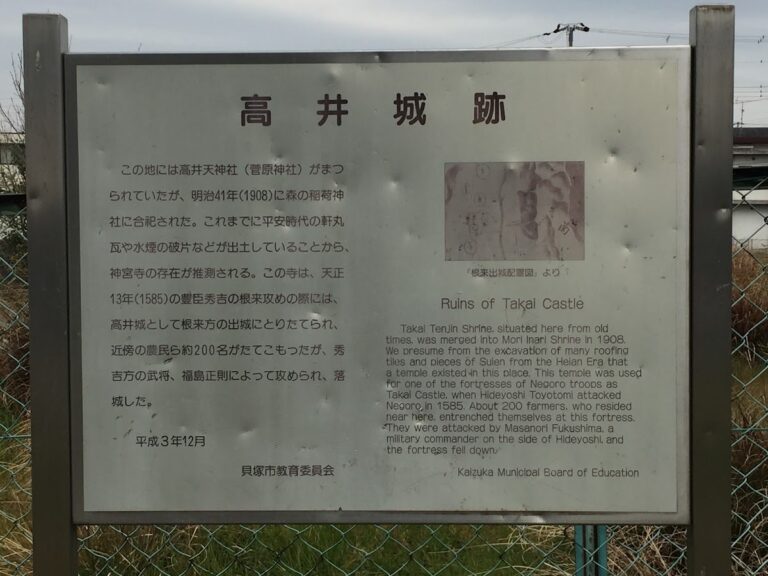
In March 1585 (Tensho 13), Toyotomi Hideyoshi intensified his campaign against Kishu, personally entering Kishiwada Castle to suppress the Negoro and Saika clans. At this time, Otani Sadaijin, the Negoro general, commanded the forces at Sengokubori Castle, where over a thousand men resisted.
Sengokubori Castle boasted a strong defense and did not easily fall to Hideyoshi’s army. However, during the battle, a flaming arrow fired by Tsutsui Junkei’s forces ignited gunpowder stored within the castle, causing a massive explosion. This explosion dealt a devastating blow to the castle’s defenses, and Sengokubori Castle is said to have fallen.
This dramatic fall is recorded as a symbolic event demonstrating the power of gunpowder, a new weapon, and its impact on the course of war.
Sengokubori Castle After its Fall
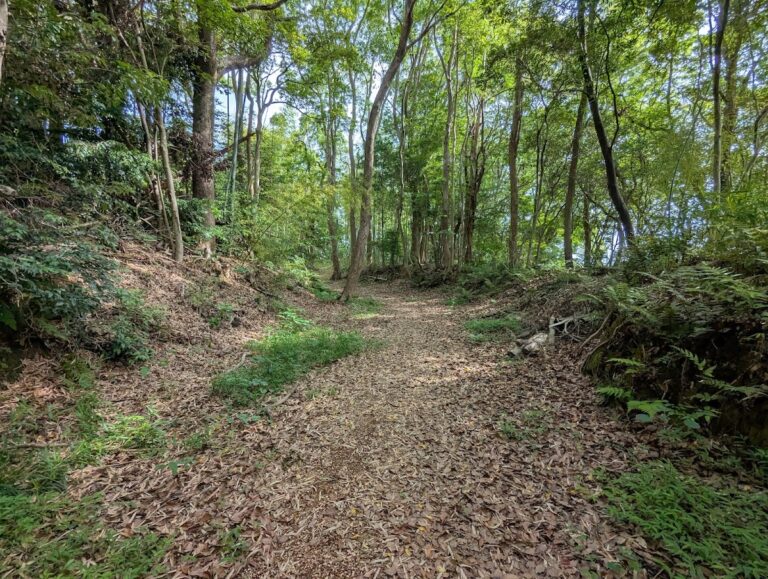
After the fall of Sengokubori Castle, the power of the Negoro clan rapidly declined, and Negoro-ji Temple was burned down by Hideyoshi. Sengokubori Castle was abandoned and never rebuilt. Currently, the site is a forest, with remnants that hint at its former glory remaining.
Structure and Layout of Sengokubori Castle
Castle Layout
Sengokubori Castle is classified as a hill castle (flatland castle), skillfully utilizing the natural terrain of Sannojōyama. Its location near the Chikagi River gave it a strategic position, allowing it to monitor both water and land routes.
The castle complex consists of multiple baileys (kuruwa) centered around the main enclosure, reflecting the castle-building techniques of the Negoro clan. Due to its nature as a hastily constructed fort built in a short period, it has few permanent structures such as stone walls, and its defensive features are primarily earthworks and dry moats.
Existing Remains
The following remains can still be seen at the Sengokubori Castle site:
Earthworks
Clear earthworks remain around the main enclosure, allowing us to see the defensive line of the time. The height varies depending on the location, but the best-preserved sections are over 1 meter high.
Dry Moats (Horizontal Moats)
Multiple dry moats, dug to demarcate the castle area, can be seen. Horizontal moats, in particular, played an important defensive role, demonstrating ingenuity in preventing enemy intrusion.
Earthen Bridges
Traces of earthen bridges used to cross the dry moats remain, providing clues to understanding the movement within the castle.
Enclosures
The topography of enclosures arranged in a stepped pattern around the main enclosure can be seen, suggesting a design that maximized the use of the limited area.
These remains represent a typical structure of a mountain castle from the late Sengoku period, making it a valuable historical site from the perspective of castle research.
Highlights of Sengokubori Castle
Main Enclosure (Honmaru)
The main enclosure, the central part of the castle, is located at the highest elevation, offering panoramic views of the surrounding area. From here, you can see the Izumi Plain and Osaka Bay, allowing you to experience the view the castle lord had at the time.
Defensive Features
The arrangement of the earthworks and dry moats shows the ingenuity of the Negoro clan, who sought to secure maximum defensive capabilities in a short period of time. The horizontal moats, in particular, restrict the enemy’s lateral movement, giving the defenders a significant advantage.
Understanding the Historical Background
When visiting Sengokubori Castle, understanding it not merely as a castle ruin, but within the historical context of the conflict between religious forces and the unified government after the Ishiyama War, the emergence of gunpowder as a new weapon, and the transition from the Sengoku period to the early modern period, will lead to a deeper appreciation.
Access Information
Access by Train
Nearest Station
The nearest station is Kaizuka Station on the Nankai Main Line.
It takes about 30-40 minutes to walk from the station to the Sengokubori Castle ruins. From the station, head northeast, passing through a residential area and into the woods. Since there are few signs along the way, it is recommended to check the route beforehand using a map app.
Access by Car
It’s about 10 minutes from the Kaizuka Interchange on the Hanshin Expressway Wangan Line. However, there is no dedicated parking lot around the castle ruins, so you will need to use nearby public facilities or paid parking lots.
Precautions When Visiting the Castle
- The castle ruins are located in a forest, and there are no well-maintained hiking trails.
- Depending on the season, vegetation may be overgrown, making it difficult to see the remains.
- There are slippery areas, so comfortable walking shoes such as trekking shoes are recommended.
- Don’t forget insect repellent in the summer.
- Avoid visiting alone; visiting in a group is safer.
Estimated Visit Time and Points to Note
Estimated Visit Time
To visit the Sengokubori Castle ruins, allow approximately 2-3 hours, including round-trip time from the station. Exploring the castle grounds and examining the remains should take about 30 minutes to 1 hour.
Best Season for Visiting
Spring (March-May) and autumn (October-November) are the best times to visit. During these periods, the weather is mild, vegetation is relatively sparse, and the remains are easier to observe.
Winter (December-February) also offers good visibility due to the withered vegetation, but cold weather precautions are necessary. During the summer months (June to September), the vegetation is lush, and the heat and insects make it more suitable for advanced photographers.
Photography Tips
- To emphasize the lines of the earthworks, shooting from an oblique angle is effective.
- For the dry moat, an angle looking up from the bottom of the moat is recommended to convey its depth.
- The view from the main enclosure, when photographed on a sunny day, beautifully captures the vast expanse of the Izumi Plain.
Related Historical Sites in the Surrounding Area
Kishiwada Castle
Kishiwada Castle, which served as the base for the attack on Sengokubori Castle, still has its keep restored and is located about 15 minutes by car from Kaizuka City. It is a historical castle where Toyotomi Hideyoshi established his headquarters for the subjugation of the Negoro and Saika clans. Visiting it together with Sengokubori Castle will give you a better understanding of the overall picture of the Kishu conquest.
Negoro-ji Temple
Negoro-ji Temple, the base of the Negoro clan who built Sengokubori Castle, is located in Iwade City, Wakayama Prefecture. Historical buildings, including the National Treasure Great Pagoda, remain, offering a deep understanding of the history and culture of the Negoro clan.
Kaizuka Gobo Gansenji Temple
Located in Kaizuka City, this Jodo Shinshu Buddhist temple played an important role as a branch temple of Honganji Temple. It has historical connections to Sengokubori Castle as a center of religious power during the same period.
Evaluation of Sengokubori Castle and its Value as a Fortress
Evaluation from Castle Enthusiasts
On castle information websites, Sengokubori Castle receives a moderate rating of around ★★★☆☆ (3.21). With approximately 100 visitors, it is classified as a minor castle site.
This rating reflects the modest state of preservation and scale of the remains compared to larger castles. However, its interesting historical background and the dramatic story of its fall by gunpowder explosion maintain a certain level of popularity.
Historical Research Value
Sengokubori Castle has historical research value in the following ways:
- Military Base of a Religious Force: As a castle built by the religious force Negoro-ji Temple, it demonstrates the military aspect of religious forces during the transition from the medieval to the early modern period.
- Example of Short-Term Construction: Its characteristics as a hastily constructed fort provide clues to understanding castle construction techniques during emergencies at the end of the Sengoku period.
- Example of Gunpowder Warfare: The record of the castle’s fall due to a gunpowder explosion is a valuable example showing the spread of firearms and changes in tactics at the end of the Sengoku period.
- Overall Picture of the Kishu Conquest: As part of Toyotomi Hideyoshi’s process of unifying Japan, it is an indispensable historical site for understanding the strategic importance of Izumi Province in the Kishu Conquest.
Things to Know Before Visiting Sengokubori Castle
Preparation
Sengokubori Castle Ruins are not a well-maintained tourist site, so preparation before visiting is important:
- Checking the Map: Check the route in advance using a smartphone map app.
- Attire: Long-sleeved shirt, long pants, and trekking shoes are essential.
- Items to Bring: Bring drinking water, insect repellent, a towel, and a first-aid kit.
- Weather Check: It is recommended to refrain from visiting during or after rain, as the ground can become slippery.
Manners at the Castle Ruins
- Walk carefully to avoid damaging the ruins.
- Always take your trash with you.
- Do not trespass on private property.
- The use of fire is strictly prohibited.
Learning about the History of Sengokubori Castle and the Negoro-shu
What are the Negoro-shu?
The Negoro-shu were a group of warrior monks centered around Negoro-ji Temple in Kii Province (present-day Wakayama Prefecture). Negoro-ji Temple, the head temple of the Shingi Shingon sect, possessed formidable military and economic power during the Sengoku period and was known for its expertise in the manufacture and use of firearms.
The Negoro-shu possessed a large number of matchlock guns called “Negoro-teppo,” and their military technology was cutting-edge even in Japan at the time. The large quantity of gunpowder stored at Sengokubori Castle demonstrates the Negoro clan’s high level of firearms expertise.
Connection to the Ishiyama War
The Ishiyama War (1570-1580) was a long conflict fought between Ishiyama Honganji Temple and Oda Nobunaga. The Negoro clan cooperated with Honganji Temple and opposed Oda Nobunaga. The military network cultivated in this war was carried over to later battles against Toyotomi Hideyoshi, leading to the construction of a network of branch castles such as Sengokubori Castle.
Toyotomi Hideyoshi’s Kishu Campaign
The Kishu Campaign of 1585 was part of Toyotomi Hideyoshi’s final stages of unifying Japan. Hideyoshi viewed the military strength of the Negoro and Saika clans as a threat and decided to thoroughly eliminate them.
Hideyoshi’s army, with overwhelming force, invaded from Izumi Province into Kii Province, capturing branch castles one after another, including Sengokubori Castle. Ultimately, Negoro-ji Temple was burned down, and the power of the Negoro-shu was annihilated.
This conquest marked the end of the military independence of religious forces during the Sengoku period, and the centralized system of government under the Toyotomi regime was established.
Summary – Historical Significance of Sengokubori Castle
Although not large in scale, Sengokubori Castle is an important historical site symbolizing the transition from the late Sengoku period to the early modern period. It retains valuable remains that tell the story of the military aspect of the Negoro-shu religious force, the power of gunpowder as a new weapon, and the process of Toyotomi Hideyoshi’s unification of Japan.
Currently, the castle ruins stand quietly in a tranquil forest, but when you consider that over a thousand people once holed up here and fierce battles were fought, you cannot help but feel the romance of history.
While Osaka Prefecture has many castles, including the famous Osaka Castle, it is in minor castle ruins like Sengokubori Castle that lies the untold story of history. Whether you’re a castle enthusiast or simply interested in the history of the Sengoku period, this is definitely a place worth visiting.
Tracing the remnants of a battle that took place over 400 years ago in the quiet hills of Kaizuka City will surely be an unforgettable experience.