Suzuoka Castle (Iida City, Nagano Prefecture) Complete Guide | History, Highlights, and Access Information
Located in Iida City, Nagano Prefecture, Suzuoka Castle is a historical castle site that was the stage for conflicts within the Ogasawara clan during the Sengoku period. Currently, it is maintained as Suzuoka Castle Ruins Park, a place of relaxation for citizens, but it is also a valuable historical site with well-preserved remains from its heyday. This article comprehensively introduces information you should know before visiting, from the history of Suzuoka Castle to the remains that can be seen on site and how to access it.
Overview and Basic Information of Suzuoka Castle
Suzuoka Castle is a medieval mountain castle located in Suzuoka-cho, Iida City, Nagano Prefecture. Known as the residence of the Suzuoka Ogasawara clan, it played an important role in historical turning points, such as the conflicts within the clan over the position of Shinano Provincial Governor and Takeda Shingen’s invasion of Ina Province.
The castle ruins are located on a hill approximately 530 meters above sea level, southeast of Iida city center, between the Kegasawa River and the Kume River. The relative elevation difference is about 40 meters, and the castle’s layout is characterized by its skillful use of the natural terrain. Currently, it is protected as a designated historical site of Iida City and is also the oldest park in Iida City, having opened in 1912 (Meiji 45).
Basic Castle Data
- Location: Suzuoka-cho, Iida City, Nagano Prefecture
- Construction Period: From the Nanboku-cho period (late 14th century) to the Ōnin and Bunmei periods (1467-1486)
- Builder: Ogasawara Munemasa (legend), but construction actually began in earnest during the time of Ogasawara Masahide
- Lord: Suzuoka Ogasawara clan
- Year of Abandonment: After Tenbun 23 (1554)
- Remains: Enclosures, dry moats, trenches, earthworks
- Designation: Iida City Designated Historic Site
History of Suzuoka Castle
Establishment from the Nanboku-cho period to the Muromachi period
Regarding the construction of Suzuoka Castle, there is a legend that it was built by Ogasawara Munemasa during the Nanboku-cho period. However, it is believed that the castle was actually constructed between the Ōnin War (1467-1477) and the Bunmei era (1469-1486).
The Ogasawara clan was a prestigious family that served as the governors of Shinano Province, but after the death of Ogasawara Masayasu, the family split over their territories and the governorship. They split into three branches: the Fuchū (Fukashi) Ogasawara, the Matsuo Ogasawara, and the Suzuoka Ogasawara, each claiming legitimacy and becoming embroiled in conflict.
The Rise of the Suzuoka Ogasawara and Conflict with the Matsuo
In the latter half of the 15th century, when Ogasawara Masahide took up residence in Suzuoka Castle, the Suzuoka Ogasawara clan fiercely clashed with the Matsuo Ogasawara clan over control of Igarashi-shō (Iida region) and the governorship of Shinano Province. Although both families belonged to the same Ogasawara clan, they became sworn enemies vying for regional supremacy.
In 1493, during the Meio era, Suzuoka Castle is said to have fallen in the first attack by the Matsuo Ogasawara clan. However, the Suzuoka Ogasawara clan maintained their power and continued to confront the Matsuo clan from the castle.
Takeda Shingen’s Invasion of Ina and the Fall of Suzuoka Castle
The fate of Suzuoka Castle was sealed by Takeda Shingen’s invasion of Ina in 1554. At this time, Ogasawara Nobutaka and his son Nobumine of the Matsuo Ogasawara clan played an active role as part of the Takeda’s vanguard in Shinano Province, and recovered Matsuo Castle, which had previously been seized by the Takeda.
On the other hand, Ogasawara Nobusada of the Suzuoka Ogasawara clan refused to submit to the Takeda and showed resistance. However, under attack from the Matsuo Ogasawara clan, who were the Takeda’s vanguard, Suzuoka Castle fell. Nobusada was defeated, and the history of the Suzuoka Ogasawara clan as an independent force came to an end. ### Suzuoka Castle After its Fall
After its fall, Suzuoka Castle is believed to have been used as a subsidiary castle of Matsuo Castle. It is presumed to have functioned as one of the bases for monitoring and controlling the Iida region within the Takeda clan’s Ina rule. After the fall of the Takeda clan and the era of the Oda-Toyotomi regime, it was abandoned during the Edo period, ending its role as a castle.
Structure and Layout of Suzuoka Castle
Castle Location and Utilization of Topography
Suzuoka Castle was built on the tip of a tongue-shaped plateau sandwiched between two rivers, the Kegasawa River and the Kume River. This location provided a natural stronghold; the south and north sides were steep cliffs, making it difficult for attackers to approach.
Access to the castle was only possible from the east, and multiple baileys and moats were strategically placed in this direction to strengthen its defenses. While the elevation difference of approximately 40 meters is relatively low for a medieval mountain castle, the clever use of the surrounding terrain ensured sufficient defensive capabilities.
Suzuoka Castle was built on the tip of a tongue-shaped plateau sandwiched between two rivers, the Kegasawa River and the Kume River. This location provided a natural fortress, and the steep cliffs on the south and north sides made it difficult for attackers to approach.
Approach to the castle was only possible from the east, and multiple baileys and moats were positioned in this direction to fortify its defenses. ### Main Enclosure Layout
The layout of Suzuoka Castle is a linear structure with multiple enclosures arranged around the main enclosure (honmaru).
The main enclosure (honmaru) is located at the highest point of the castle and measures approximately 50 meters east-west and 40 meters north-south. It is now a leveled area and the center of a park. Partial traces of earthworks remain around the perimeter, showing remnants of the former defensive structures.
The second enclosure (ni-no-maru) is located to the east of the main enclosure and is at a lower level. This area is also currently used as a park, with playground equipment installed. There is a difference in elevation between it and the main enclosure, indicating that they were clearly separated in the past.
In addition, several smaller enclosures are located on the eastern slope, forming a multi-tiered defensive line.
Moats and Dry Moats
The greatest highlight of Suzuoka Castle is the well-preserved moats and dry moats.
On the eastern side of the castle, the most vulnerable direction to attack, several moats were constructed. These moats were defensive structures dug to cut across the ridge, playing a crucial role in hindering enemy advances. The moats at Suzuoka Castle are approximately 3-5 meters deep and are still clearly visible today.
Furthermore, dry moats that demarcated the baileys remain in various places. The dry moats around the main bailey, in particular, are large in scale and are important remains for understanding the castle’s defensive structure. These moats have V-shaped (Yagenbori) and U-shaped (Hakobori) forms, clearly demonstrating the characteristics of medieval castles.
Remains of Earthworks
Traces of earthworks remain along the edges of the main bailey and each bailey. Earthworks were defensive walls built by piling up earth, preventing enemy intrusion and serving as a foundation for fences and walls.
The earthworks of Suzuoka Castle are about 1-2 meters high, and while some have been altered due to park development, sections remain that allow us to imagine their original appearance. The earthworks on the north side of the main enclosure are particularly well-preserved and provide clues to understanding the castle’s defensive structure.
Highlights of Suzuoka Castle Ruins Park
Tips for Exploring the Castle Ruins
When visiting Suzuoka Castle Ruins Park, you can enjoy it more deeply if you approach it not merely as a park, but with the perspective of observing the remains of a medieval castle.
In the main enclosure (honmaru) area, walk around and check the remaining earthworks. The view from the main enclosure is also a highlight. You can see the city of Iida and the surrounding mountains, giving you a real sense that the castle was a base for monitoring and controlling this area.
Observing the moats and dry moats is a highlight of your visit to Suzuoka Castle. If you carefully walk around the eastern area of the park, you can clearly see several moats. Standing at the bottom of the deeply excavated moat, you’ll be amazed by the advanced castle construction techniques of the medieval period.
Pay attention to the level differences between the baileys. The elevation changes from the main bailey to the second bailey and then to the outer bailey served not only as a defensive measure but also as a way to divide the castle’s space.
Azalea Festival and Seasonal Attractions
Suzuoka Castle Ruins Park is also known for its Azalea Festival, held annually in early May. Approximately 3,000 azalea bushes are planted in the park, and during the blooming season, the castle ruins are adorned with vibrant flowers. It’s a rare opportunity to enjoy both historical exploration and flower viewing.
Suzuoka Castle Ruins Park also offers the charm of enjoying the beauty of nature throughout the seasons: cherry blossoms in spring, azaleas in early summer, and autumn leaves in fall. Especially during the seasons of fresh greenery and autumn leaves, the topography of the castle ruins is emphasized by the trees, making it ideal for observing the remains.
Value as Iida City’s Oldest Park
Suzuoka Castle Ruins Park is the oldest park in Iida City, with its opening ceremony held in 1912 (Meiji 45). It has a history of being cherished by citizens for over 100 years, and is important not only for its value as a castle ruin but also as a regional cultural heritage site.
The park also has playground equipment, making it a popular spot for families with children. It’s also noteworthy that it serves a diverse role as a place of daily relaxation for local residents, not just history enthusiasts.
Access Information
Access by Car
Suzuoka Castle Ruins Park is easily accessible by car.
If using the Chuo Expressway:
- Approximately 10 minutes (approx. 4km) from Iida IC
- Approximately 15 minutes (approx. 6km) from Matsukawa IC
From Iida city center, head south on National Route 153 and follow the signs to arrive. The park has a free parking lot that can accommodate approximately 20 regular-sized cars. It may get crowded during events such as the Azalea Festival, so it is recommended to allow ample time for your visit.
Access by Public Transportation
If using public transportation, the following routes are possible:
JR Iida Line:
- Approximately 30 minutes on foot from Iida Station (approx. 2.5 km)
- Approximately 10 minutes by taxi from Iida Station
Route Bus:
- Iida City’s community buses operate, but they do not go directly to the castle ruins park, so you will need to walk from the nearest bus stop.
- Please check the latest timetable on the official Iida City website for details.
If accessing on foot, it is a gentle uphill slope from Iida Station, but you can enjoy the scenery of Iida city along the way.
Visiting Hours and Precautions
Suzuoka Castle Ruins Park is open to the public year-round, and admission is free. There are no time restrictions for visiting, but nighttime visits are not recommended for safety reasons.
Recommended Visiting Hours: Daytime (around 9:00 AM – 5:00 PM)
Estimated Time Required: Approximately 1-2 hours if you wish to carefully observe the remains.
When observing the castle ruins, please note the following:
- Wear comfortable shoes (there are uneven terrain such as moats).
- Be careful as the ground can be slippery during and after rain.
- Insect repellent is recommended during the summer.
- Do not enter the earthworks or moats to protect the remains.
Nearby Tourist Attractions
Matsuo Castle Ruins
Matsuo Castle Ruins, which has a deep connection with Suzuoka Castle, is also located within Iida City. It is approximately a 15-minute drive from Suzuoka Castle and was the base of the Matsuo Ogasawara clan, facing Suzuoka Castle. Visiting both castles will allow you to gain a deeper understanding of the history of the Ogasawara clan’s conflicts.
Matsuo Castle also has well-preserved remains, and the large moats and baileys are particularly impressive. This is a popular spot, often visited in conjunction with Suzuoka Castle by castle enthusiasts.
Iida Castle Ruins and Iida City Museum of Art
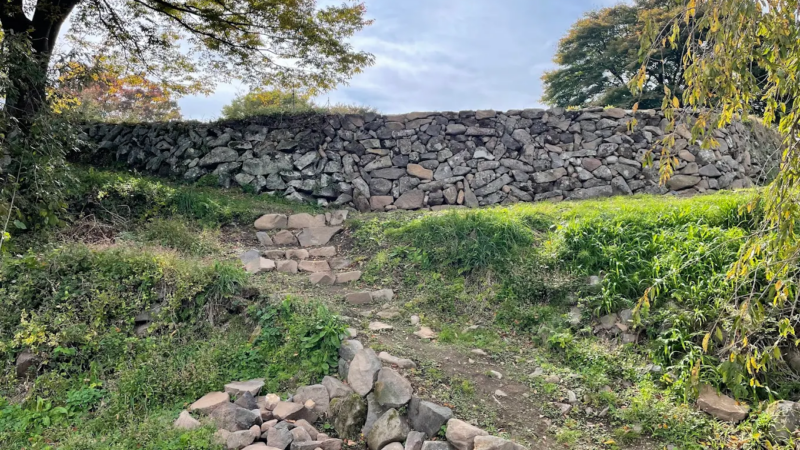
Located in the heart of Iida city are the Iida Castle Ruins, now home to the Iida City Museum of Art and Nagahime Shrine. It was the center of the Iida Domain during the Edo period, and remnants such as stone walls and moats can still be seen.
The Iida City Museum of Art boasts extensive exhibits on the history and culture of the Iida region, including the medieval history of the area, including Suzuoka Castle. Visiting before or after a visit to Suzuoka Castle will provide a deeper understanding.
Moto-Zenkoji Temple
Iida City is home to Moto-Zenkoji Temple, considered the predecessor of Zenkoji Temple in Nagano City. There’s a saying, “Visiting only Zenkoji is an incomplete pilgrimage,” and visiting both is recommended.
Located about a 10-minute drive from Suzuoka Castle Ruins Park, it’s well worth a visit as part of a historical exploration. The temple grounds are enveloped in a tranquil atmosphere, offering a peaceful and relaxing experience.
Iida City Apple Tree-lined Street
In the heart of Iida City, there is an apple tree-lined street stretching for approximately 400 meters. These apple trees, planted as a symbol of post-war reconstruction, line the streets, creating a unique landscape for Iida City.
In autumn, the apples ripen, allowing residents and tourists alike to enjoy harvesting them. Combining a visit to Suzuoka Castle with a stroll through Iida City is highly recommended.
Recommended Itinerary for Visiting Suzuoka Castle
Half-Day Course: Carefully Observe the Castle Ruins
Morning:
- 9:00 Arrive at Suzuoka Castle Ruins Park and park your car in the parking lot
- 9:15 Stroll through the main enclosure (honmaru) area, enjoying the earthworks and views
- 10:00 Observe the moats and dry moats, and take photos
- 10:45 Explore the second enclosure and outer baileys
- 11:30 Take a break in the park; picnics are also possible
Afternoon:
- 13:00 Travel to Matsuo Castle Ruins (approx. 15 minutes by car)
- 13:30 Stroll through Matsuo Castle Ruins
- 15:00 Travel to Iida City Museum of Art and view the exhibits
- 16:30 Iida City Walk (Apple Tree-lined Street, etc.)
This plan allows you to gain a comprehensive understanding of the medieval history of the Iida region by carefully observing the remains of Suzuoka Castle and then visiting related historical sites.
Visiting Plan During the Azalea Festival
The Azalea Festival in early May is an excellent opportunity to enjoy both flower viewing and historical exploration.
- Visit Suzuoka Castle Ruins Park in the morning and enjoy the azaleas in full bloom.
- Have a picnic in the park.
- In the afternoon, visit Motozenkoji Temple and enjoy a meal or shopping in Iida city.
During the Azalea Festival, many locals visit, making it a great opportunity to experience the local atmosphere.
Historical Significance of Suzuoka Castle
Suzuoka Castle is a castle ruin that symbolizes the rise and fall of medieval samurai groups in Shinano Province. The history of the Ogasawara clan, a prestigious family, and their internal divisions and conflicts over the authority of the Shugo (provincial governor) position, illustrates the reality of local samurai groups during the transition from the Muromachi period to the Sengoku period.
Of particular note is the relationship between the Suzuoka Ogasawara and Matsuo Ogasawara clans, who, despite being related, became enemies. The two families fiercely contested control of Igarashi Manor and the position of Shugo of Shinano Province, ultimately being resolved by the intervention of an external force, Takeda Shingen. This process can be considered a typical example of the reorganization of regional power during the Sengoku period.
Furthermore, the role of Suzuoka Castle in Takeda Shingen’s invasion of Ina Province is also important. The fact that the Matsuo Ogasawara clan played an active role as a vanguard for the Takeda forces and captured their own Suzuoka Castle demonstrates the methods of regional control employed by Sengoku daimyo. The Takeda clan efficiently brought new territories under their control by gaining the support of local forces.
The castle ruins, now known as Suzuoka Castle Ruins Park and beloved by locals, quietly tell visitors about the complex history that unfolded there. It’s a valuable historical site where you can feel the presence of those who lived through the turbulent Sengoku period while observing the remains.
Summary
Suzuoka Castle in Iida City, Nagano Prefecture, flourished as the residence of the Suzuoka Ogasawara clan and fell during Takeda Shingen’s invasion of Ina. Currently, it’s maintained as Suzuoka Castle Ruins Park, a valuable spot where visitors can observe clearly visible remains such as moats, dry moats, and earthworks.
Every year in early May, the Azalea Festival sees approximately 3,000 azalea bushes in full bloom, allowing visitors to enjoy both historical exploration and flower viewing. It also boasts a history as the oldest park in Iida City and is carefully preserved as a cultural heritage rooted in the community.
Access is convenient by car, approximately 10 minutes from the Iida Interchange on the Chuo Expressway, with free parking available. The surrounding area boasts numerous related historical sites, including the Matsuo Castle ruins, Iida Castle ruins, and Motozenkoji Temple, making it an ideal base for exploring the history of the Iida region.
Suzuoka Castle Ruins Park is recommended not only for castle enthusiasts but also for families and those who simply enjoy a stroll. Here, you can experience the spirit of the Sengoku period while enjoying the nature and history of Shinshu.