Complete Guide to Sakuramachi Jinya (Tochigi Prefecture): Highlights and Access to the National Historic Site Associated with Ninomiya Sontoku
Located in Monoi, Mooka City, Tochigi Prefecture, the Sakuramachi Jinya site is the remains of a jinya (fortified residence) built during the Edo period. It is particularly known as the historical site where Ninomiya Sontoku (Ninomiya Kinjiro) implemented his rural revitalization project, the “Hotoku Method.” Designated a national historic site in 1932 (Showa 7), and now developed as a historical park, this site played a crucial role in the history of Japanese agricultural policy.
This article comprehensively explains everything you need to know before visiting, from the historical background of Sakuramachi Jinya to current highlights and access methods.
History of Sakuramachi Jinya
Founding of the Jinya and the Utsu Family
Sakuramachi Jinya was founded in Genroku 12 (1699). This is a jinya (fortified residence) established by Utsu Noriyuki, the third son of Okubo Tadaaki, the lord of the Odawara Domain, to govern the three villages of Sakuramachi (part of present-day Mooka City, Tochigi Prefecture). Noriyuki branched off from the Okubo family and inherited the Utsu family, governing a territory of approximately 4,000 koku as a hatamoto (direct retainer of the shogun).
A jinya refers to an office and residence established by daimyo or hatamoto with a territory of less than 10,000 koku during the Edo period to govern their domain. While not a large-scale defensive structure like a castle, it was surrounded by earthworks and moats, and the entrance (koguchi) was designed with a bend to prevent intruders from advancing directly.
The Devastation of the Territory and the Emergence of Ninomiya Sontoku
From the late 18th to the early 19th century, the Sakuramachi territory faced severe devastation. Repeated famines, heavy taxes, and the dispersal of farmers reduced the village from over 600 households to approximately 120, and abandoned farmland spread.
To overcome this critical situation, in 1822 or 1823, Okubo Tadazane, the lord of the Odawara domain, dispatched Ninomiya Sontoku, who had already achieved success in rural reconstruction within the Odawara domain, to the Sakuramachi Jinya (fortified residence). Sontoku, then around 45 years old, would fully implement his unique rural reconstruction plan, known as the “Hotoku Method,” in this area.
Rural Reconstruction through the Hotoku Method
The Hotoku Method implemented by Ninomiya Sontoku at the Sakuramachi Jinya was not merely an economic policy, but a comprehensive regional revitalization program that integrated morality and economics. The main points are as follows:
Basic Principles
- “Sincerity” (honesty)
- “Diligence” (working hard)
- “Moderation” (managing expenses according to income)
- “Giving” (giving surplus to the future or to others)
Specific Measures
- Repair work on dilapidated irrigation canals, weirs, and bridges
- Reclaiming abandoned farmland and restoring agricultural land
- Establishment of a low-interest loan system for farmers
- Lending of rice seeds and farming tools
- Encouraging frugality and planned savings
- Promotion of education and morality
Sonotoku himself took the lead, working on the ground and sweating alongside the farmers, which moved the hearts of the exhausted farmers. As a result, the Sakuramachi domain was remarkably restored in about 10 years, and its rice yield also recovered.
Ninomiya Sonotoku stayed at the Sakuramachi Jinya (fortified residence) for 26 years (some sources say 36 years), and used this as a base to participate in reconstruction projects in the surrounding areas. The success in Sakuramachi led to requests for reconstruction from various regions, including the Nikko Shrine territory and the Soma Domain, and Sontoku’s fame spread throughout Japan.
Structure and Remains of the Sakuramachi Jinya Site
Jinya Building (Existing Structure)
The greatest highlight of the Sakuramachi Jinya is the existing jinya building. The building where Ninomiya Sontoku actually lived and worked still remains, making it a valuable example of Edo period jinya architecture nationwide.
The building is a single-story wooden structure, possessing the style of a samurai residence while also functioning as a practical government office. Inside, rooms used by Sontoku and spaces used for meetings with the local people are preserved, conveying the appearance of the jinya at that time.
Explanatory boards are installed around the building, providing detailed information about the use of each room and Sontoku’s daily life.
Earthworks and Moat
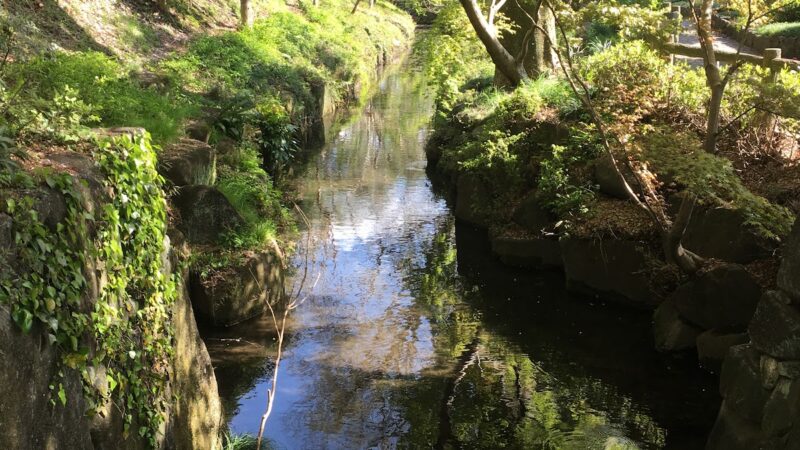
Earthworks and a moat surround the jinya. These served as defensive structures for the jinya. Currently, some parts have been restored, but original remains still exist, providing important elements for understanding the structure of the Edo period encampment.
The earthen ramparts are approximately 2-3 meters high and are arranged to surround the site. While the moat is currently not filled with water, its shape allows us to estimate its original scale.
Entrance (Koguchi)
The entrance to the encampment, the koguchi, has a winding structure designed to prevent intruders from advancing directly. This incorporates techniques from castle architecture, demonstrating a defensive design despite its small scale.
The original location of the koguchi is still preserved, allowing visitors to experience the atmosphere of the encampment’s entrance.
Highlights of the Sakuramachi Encampment Site
Development as a Historical Park
The Sakuramachi Encampment Site has been developed as “Sakuramachi Historical Park,” providing a space where visitors can stroll and learn about history. The park includes the following facilities and points of interest:
Encampment Buildings
These are existing Edo period buildings, and in some cases, internal viewing is possible (prior confirmation of viewing conditions is necessary). Restored Earthworks and Moats
By actually seeing the defensive structures of the encampment, you can experience the structure of the time.
Information Boards and Guideposts
Detailed information boards are installed throughout the historical park, allowing you to learn about the historical background and the characteristics of the buildings.
Cherry Trees
In spring, the cherry blossoms bloom in profusion, allowing you to enjoy both the historical scenery and the beauty of nature.
Ninomiya Sontoku Museum
Adjacent to the Sakuramachi Encampment Site is the “Ninomiya Sontoku Museum.” Here, exhibits are displayed about Sontoku’s life, details of the Hotoku method, and records of the reconstruction project in Sakuramachi.
Main Exhibits
- The life and achievements of Ninomiya Sontoku
- The philosophy and practical methods of the Hotoku method
- Records and results of the Sakuramachi reconstruction project
- Documents and related materials written by Sontoku himself
- Farming tools and daily life items of the time
- Explanations using video materials and models
Visiting the museum will allow you to gain a deeper understanding of the historical background of the encampment site. This is a valuable facility where you can learn in detail about the specifics of the Hotoku method and the character of Ninomiya Sontoku.
Ninomiya Shrine
Next to the site of the Jinya (fortified residence) is the Ninomiya Shrine, dedicated to Ninomiya Sontoku. It was built to honor Sontoku’s achievements and pass on his spirit to future generations.
The shrine grounds have a quiet and peaceful atmosphere, and are visited by many worshippers. Sontoku’s teachings of “diligence,” “sincerity,” “moderation,” and “sharing” are universal values that resonate even today, and are respectfully inherited by many people.
The name of the former Ninomiya town also originates from Ninomiya Sontoku, illustrating how important he was to the region.
Access and Visiting Information
Location
Address: Monoi, Mooka City, Tochigi Prefecture (formerly Ninomiya Town)
Access by Train and Bus
Using the Mooka Railway
- Approximately 15 minutes by car from Mooka Railway’s “Terauchi Station” or “Kugeda Station”
- Taking a taxi from the station is convenient
- Public transportation (buses) are limited, so please check in advance.
Access by Car
Kita-Kanto Expressway
- Approximately 20 minutes from Mooka Interchange
- Parking available (free)
Tohoku Expressway
- Approximately 40 minutes from Utsunomiya Interchange via National Route 408
Opening Hours and Fees
Sakuramachi Jinya Ruins (Historical Park)
- Free to visit (outdoors)
- Free admission
Ninomiya Sontoku Museum
- Opening hours: 9:00 AM – 5:00 PM (Last entry at 4:30 PM)
- Closed: Mondays (or the following day if Monday is a public holiday), New Year holidays
- Admission Fee: 300 yen for adults, 100 yen for elementary and junior high school students (Please check before visiting as fees are subject to change)
Notes for Visitors
- As the historical park is an outdoor facility, we recommend wearing appropriate clothing and shoes for the weather.
- Please take precautions against the heat in summer and cold in winter.
- For tours of the interior of the Jinya building, we recommend checking with the Mooka City Board of Education or the museum in advance.
- Photography is generally permitted, but there may be restrictions inside the museum.
Nearby Tourist Attractions
When visiting the Sakuramachi Jinya Ruins, visiting nearby tourist attractions will make your trip more fulfilling.
Attractions in Mooka City
Mooka Railway SL Train
The Mooka Railway operates SL trains mainly on weekends, allowing you to enjoy a retro steam locomotive journey.
Mooka Cotton Hall
This facility allows you to learn about Mooka cotton, a traditional industry of Mooka City.
Igashira Park
A vast prefectural park where you can enjoy seasonal flowers and nature.
Nearby Historical Spots
Utsunomiya Castle Ruins
A castle ruin located in Utsunomiya City, the capital of Tochigi Prefecture, with a portion of it restored.
Mashiko Pottery Village
Mashiko Town, known as a traditional pottery production area, is about a 30-minute drive from Sakuramachi Jinya.
Cultural Property Designation of Sakuramachi Jinya Ruins
National Historic Site Designation
Sakuramachi Jinya Ruins were designated a national historic site on March 25, 1932 (Showa 7). Later, on July 14, 2005 (Heisei 17), an additional designation was made, expanding the protected area.
The reasons for its designation as a National Historic Site are as follows:
- Historical Importance: As the site where Ninomiya Sontoku’s Hotoku method was put into practice, it is an important historical site in the history of Japanese agricultural policy and economics.
- Preservation of Remains: The jinya (fortified residence) buildings still exist, and remains such as earthworks and moats are well preserved.
- Academic Value: It is a valuable example for studying the structure of Edo period jinya.
Management and Preservation
The historic site is managed by Mooka City, and appropriate preservation and utilization are ensured. Regular surveys and maintenance projects are continuously carried out to protect the remains and provide information to visitors.
The Modern Significance of Ninomiya Sontoku and the Hotoku Method
Sustainable Community Development
The Hotoku method practiced by Ninomiya Sontoku at the Sakuramachi Jinya (fortified residence) shares many commonalities with modern concepts of “sustainable development” and “regional revitalization.”
The spirit of moderation emphasizes the importance of maintaining a balance between income and expenses and living within one’s means. This resonates with modern concepts of fiscal soundness and environmental protection.
The spirit of sharing is the idea of using surplus for future generations and the local community, and aligns with the principles of the modern SDGs (Sustainable Development Goals).
Application in Educational Settings
Ninomiya Sontoku’s teachings are also used as teaching materials in modern moral and economic education. The “Ninomiya Kinjiro statue” is installed in many schools and has become a beloved symbol of diligence.
The Sakuramachi Jinya Ruins are used as a place where these educational values can be learned firsthand, and are utilized as a site for school field trips and social studies excursions.
Visitor Voices and Experiences
Many visitors to the Sakuramachi Jinya Ruins have shared the following impressions:
- “Visiting the place where Ninomiya Sontoku, whom I learned about in textbooks, actually lived and worked made history feel much closer.”
- “It was fascinating to see the structure of an Edo-period Jinya in a quiet and peaceful atmosphere.”
- “The museum exhibits were excellent, and I was able to learn a lot about the Hotoku method.”
- “I visited during the cherry blossom season in spring, and the harmony between the historical scenery and the beauty of nature was wonderful.”
Photo Spots and Photo Gallery Information
The Sakuramachi Jinya Ruins have many spots suitable for photography:
Recommended Photo Spots
- Front of the Jinya building: You can capture the architectural style of the Edo period.
- Earthworks and moat: You can take photos that show the structure of the Jinya’s defensive facilities.
- Near the entrance: You can photograph the distinctive structure of the bent entrance.
- Torii gate of Ninomiya Shrine: You can create a composition combining the shrine and the historical park.
- Cherry blossom season: In spring, the collaboration of cherry blossoms and the Jinya makes for beautiful photos.
Summary
The Sakuramachi Jinya Ruins in Mooka City, Tochigi Prefecture, is a historically significant site where Ninomiya Sontoku achieved rural revitalization through his Hotoku method. The jinya, built in 1699, still stands today, preserved as a national historic site along with the surrounding earthworks and moats.
The adjacent Ninomiya Sontoku Museum offers detailed information about Sontoku’s life and the Hotoku method, while Ninomiya Shrine commemorates his achievements. The site, developed as a historical park, provides an ideal environment for historical exploration.
Located approximately 20 minutes by car from the Mooka Interchange and accessible from the Mooka Railway station, this historic site is an essential place for learning about the history of Japanese agricultural policy and a valuable cultural heritage where the spirit of Ninomiya Sontoku still lives on. When visiting Tochigi Prefecture, be sure to visit the Sakuramachi Jinya Ruins and experience the atmosphere of an Edo-period jinya and the great achievements of Ninomiya Sontoku.
--765x450.png)