Complete Guide to Kinojo Castle | History, Highlights, and Access Information for this Mysterious Ancient Mountain Castle
What is Kinojo Castle? | A Mysterious Ancient Mountain Castle Not Recorded in History Books
Kinojo Castle is an ancient mountain castle built on Mount Kinojo in Soja City, Okayama Prefecture. Located at the southern end of the Kibi Plateau, at an altitude of approximately 400 meters, it boasts a spectacular view overlooking the Soja Plain.
Its most striking feature is that it is not mentioned at all in historical texts such as the *Nihon Shoki* and *Shoku Nihongi*, which are considered official Japanese histories. It is extremely unusual for such a large mountain castle to have no records in historical documents, and it remains shrouded in mystery to this day.
Kinojo Castle’s outer perimeter, from the 7th to 9th stations of Mount Kinojo, which is shaped like an inverted mortar, is surrounded by a wall of stone and earthen ramparts stretching for approximately 2.8 kilometers. The castle grounds, surrounded by fortifications, cover an area of approximately 30 hectares, making it one of the largest ancient mountain castles in western Japan.
In 2006, it was selected as one of “Japan’s Top 100 Castles,” and ongoing historical site surveys and maintenance are still being carried out.
History of Kinojo Castle | A Fortress for National Defense by the Yamato Court
Construction Period and Background
The most widely accepted theory regarding the construction period of Kinojo Castle is that it was built by the Yamato Court for national defense after the Battle of Baekgang in 663. After their defeat by the Tang-Silla allied forces at the Battle of Baekgang, the Yamato Court built ancient mountain castles throughout western Japan to prepare for foreign invasions.
Based on pottery and architectural styles unearthed through archaeological excavations, it is believed to have been built between the late 7th and 8th centuries. However, because there are no records in historical texts regarding the exact construction date or builder, research continues to this day.
Role as the Central Point of Ancient Kibi
The Kibi region, where Kinojo Castle is located, is believed to have possessed power comparable to that of the Yamato regime in ancient times. The location of Mount Kinojo, overlooking the Soja Plain, was ideally situated as a strategic point for protecting the central region of ancient Kibi.
Within the castle grounds, the remains of foundation stones for buildings, warehouses, and blacksmith workshops have been discovered, suggesting that it was not merely a military facility but a comprehensive base with administrative functions as well.
Characteristics as a Kōgoishi-style Mountain Castle
Kinojo Castle is an ancient mountain castle with a unique structure known as a Kōgoishi-style mountain castle. Kōgoishi-style mountain castles are characterized by their construction techniques influenced by the Korean Peninsula, featuring stone and earthen ramparts that follow the contours of the mountain.
While approximately 20 Kōgoishi-style mountain castles have been identified in Japan, mainly in the Kyushu region, Kinojo Castle is a particularly valuable example of a large-scale and well-preserved structure in western Japan.
The Legend of Ura and Onijo Castle | The Story That Became the Root of Momotaro
Summary of the Legend of Ura
Onijo Castle is also known as the setting for the legend of Kibitsuhiko-no-Mikoto’s demon-slaying. This legend is said to be the prototype for the folktale “Momotaro.”
According to the legend, Ura, a prince of Baekje, built a castle on Onijo Mountain and attacked the surrounding villages, tormenting the people. The Yamato court dispatched Kibitsuhiko-no-Mikoto to defeat Ura. After a fierce battle, Kibitsuhiko-no-Mikoto is said to have killed Ura and restored peace.
Relationship Between Legend and Historical Facts
The legend of Ura is sometimes interpreted as a story symbolizing the conflict between the Yamato government and the Kibi forces in ancient times. The fact that Ura is a prince of Baekje may suggest interaction with the Korean Peninsula at the time and the presence of immigrant engineers.
The advanced construction techniques of Kinojo Castle show strong influences from the Korean Peninsula, suggesting that the legend may reflect some historical facts.
Relationship with Kibitsu Shrine
Kibitsu Shrine, dedicated to Kibitsuhiko-no-Mikoto, who defeated Ura, is located in Kita-ku, Okayama City. A legend persists that Ura’s head is buried beneath the main hall of Kibitsu Shrine, making it a popular tourist destination along with Kinojo Castle, due to its connection to the Ura legend.
Structure of Kinojo Castle | 2.8km of Castle Walls and Defensive Facilities
Structure and Construction Techniques of the Castle Walls
The castle walls of Kinojo Castle are constructed using advanced techniques combining stone ramparts and rammed earth. Rammed earth is a technique of creating walls by compacting layers of soil, a construction method introduced from the Korean Peninsula.
The height of the castle walls varies depending on the location, but the highest point reaches approximately 6 meters. The total length of the castle walls is approximately 2.8 kilometers, skillfully utilizing the mountainous terrain and strategically positioned for optimal defense.
The foundation of the earthen ramparts consists of rows of stones called “reiseki,” upon which rammed earth ramparts are built. This structure has maintained the strength of the castle walls over a long period.
Four Castle Gates
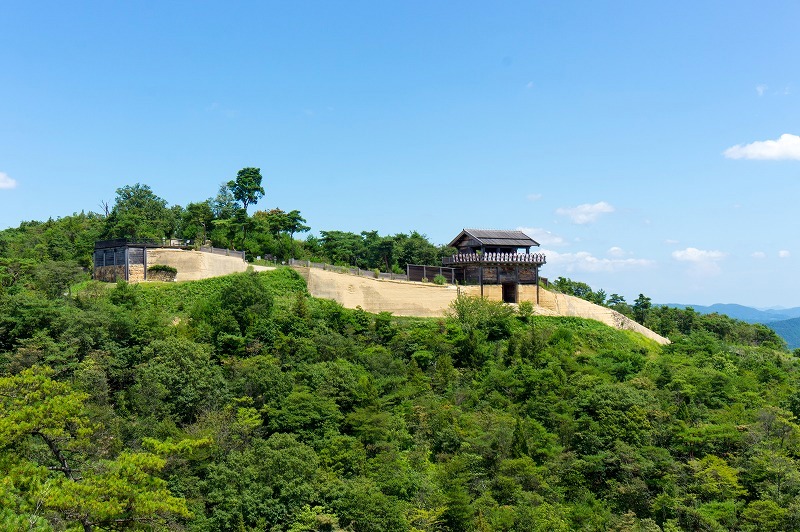
Kinojo Castle had four gates: the East Gate, West Gate, South Gate, and North Gate. Of these, the West Gate was restored in 2005 based on the results of archaeological excavations and is now a beloved symbol of Kinojo Castle.
The restored West Gate is a magnificent two-tiered gate with a hipped roof, built on a stone foundation. Castle walls line both sides of the gate, conveying the grandeur of an ancient mountain castle to the present day. The panoramic view from the West Gate is breathtaking, offering views of the Soja Plain, and on clear days, even the Seto Inland Sea and the mountain ranges of Shikoku.
Six Sluice Gates and Drainage System
The castle walls are equipped with a total of six sluice gates, from Sluice Gate 0 to Sluice Gate 5. These sluice gates were facilities for efficiently draining rainwater accumulated within the castle, demonstrating advanced civil engineering techniques of ancient times.
The sluice gates are constructed of stone, and some still retain their original form. Proper management of drainage within the castle prevented erosion of the earthworks and enabled the long-term maintenance of the castle walls.
Corner Towers
At key points in the castle walls, watchtowers called corner towers were installed. These corner towers were important facilities for monitoring enemy movements and directing defensive operations.
Excavation surveys have confirmed the remains of multiple corner towers, and the size and structure of the buildings have been revealed from the arrangement of foundation stones and post holes. Currently, there are points where visitors can view the remains of the corner towers.
Facilities within the Castle
Numerous foundation stone building remains and post-and-beam building remains have been confirmed within the castle. These are thought to have been used as warehouses, barracks, command posts, etc. Of particular note is the existence of the blacksmith’s workshop. The presence of facilities for manufacturing and repairing weapons and tools indicates that Kinojo Castle functioned not merely as a refuge, but as a long-term military base.
Furthermore, the remains of several reservoirs have been discovered within the castle grounds, demonstrating that consideration was given to securing water sources during sieges.
Highlights of Kinojo Castle | Restored Facilities and Scenic Viewpoints
Restored West Gate
The biggest highlight when visiting Kinojo Castle is the restored West Gate. Faithfully recreating ancient castle-building techniques, the West Gate boasts a magnificent structure approximately 8 meters high and 12 meters wide, reviving the grandeur of an ancient mountain castle in the modern age.
The interior of the West Gate is open to visitors, allowing close observation of the foundation stone arrangement and wooden structure. From the top of the gate, a spectacular panoramic view of the Soja Plain unfolds, allowing visitors to relive the scenery seen by ancient people.
Castle Wall Walking Course
Kinojo Castle has a walking course that follows the castle walls. The course, which circles the approximately 2.8-kilometer-long castle wall, is a popular hiking course that takes about 2-3 hours.
Along the course, you can see remnants of stone walls, earthworks, and water gates, giving you a real sense of the structure of an ancient mountain castle. From the ridge, you can enjoy panoramic views in all directions; on clear days, you can even see the Seto Inland Sea and the Shikoku Mountains.
Corner Tower Remains and Observation Spots
The corner towers, strategically placed along the castle walls, are still well-preserved. The corner towers around the west gate, in particular, offer spectacular views of the Soja Plain.
In autumn, a sea of clouds sometimes forms, attracting many photography enthusiasts who visit early in the morning to capture the fantastical scenery.
Water Gate Remains
Of the six water gates, the second and third water gates are particularly well-preserved, allowing you to observe ancient stonework techniques. The structure, with its precisely assembled massive stones, is unusually sophisticated for a technique dating back over 1300 years.
Foundation Stone Building Remains
The foundation stone building remains scattered throughout the castle grounds provide insight into the original building layout. The size and arrangement of the foundation stones allow for the estimation of their uses, such as warehouses and command posts.
Investigation, Research, and Protection | Ongoing Excavation and Restoration Projects
History of Excavation
Serious investigations of Kinojo Castle began in the 1970s. Led by the Soja City Board of Education, continuous excavation surveys have gradually revealed the structure of the castle walls, the location of the castle gates, and the layout of the castle facilities.
In particular, investigations since the 1990s have revealed the detailed structure of the west gate, leading to the restoration project in 2005. New discoveries continue almost every year, and research continues to unravel the full picture of Kinojo Castle.
Designation as a Historic Site and Preservation
Kinojo Castle was designated a national historic site in 1971 and is protected as a cultural property. The designation as a historical site has regulated the destruction and alteration of the remains, establishing a system for their preservation for the future.
In Soja City, a preservation and management plan has been formulated to balance the preservation and utilization of the historical site, and systematic development is underway.
Restoration Project
Following the restoration of the West Gate, research and investigations are currently underway for the restoration of other castle gates and corner towers. The restoration aims to reproduce the techniques and materials of the time as much as possible, based on the results of archaeological excavations.
The restoration project has academic significance not only as a tourist resource, but also for studying ancient castle-building techniques and passing them on to future generations.
Kijozan Visitor Center
Opened in 2005, the Kijozan Visitor Center exhibits the history and structure of Kijo Castle, as well as the results of archaeological excavations. With easy-to-understand explanations using models and videos, a visit before visiting Kijo Castle will allow for a deeper understanding.
The visitor center has a parking lot and can be used as a base for exploring Kinojo Castle.
Access and Tourist Information | How to Get to Kinojo Castle
Location
Address: Kuroo, Okusaka, Soja City, Okayama Prefecture
Inquiries: Soja City Tourism Project Division / Soja City Tourism Association
Access by Car
From Okayama: Approximately 15 minutes from Okayama-Soja IC on the Okayama Expressway. Take National Route 180 and then head north on the prefectural road.
Kinojo Mountain Visitor Center Parking: There are approximately 30 free parking spaces. It’s about a 15-minute walk from the visitor center to the west gate.
Notes: The mountain road is narrow and has many curves, so caution is required when driving. There are also sections where large buses cannot pass.
Access by Public Transportation
By JR: Get off at Soja Station on the JR Momotaro Line (Kibi Line). It’s about a 20-minute taxi ride from the station.
Taxi: A taxi from Soja Station will cost approximately 3,000 yen one way. We recommend booking your return taxi in advance.
Rental Bicycle: Rental bicycles are available around Soja Station, but the route to Kinojo Castle involves continuous uphill climbs, so even electric-assist bicycles require some stamina.
Opening Hours and Fees
Visiting Hours: Open all day (however, dangerous at night)
Admission Fee: Free
Kijozan Visitor Center Opening Hours: 9:00 AM – 5:00 PM
Closed Days: Mondays (or the following day if Monday is a public holiday), New Year’s holidays
Estimated Time Required
- West Gate Area Only: Approximately 30 minutes to 1 hour
- Main Points Walk: Approximately 1 hour 30 minutes to 2 hours
- Walking Around the Castle Walls: Approximately 2 hours 30 minutes to 3 hours
Clothing and Items to Bring
Since Kijozan is a mountain castle, we recommend the following preparations:
- Comfortable Walking Shoes: Sneakers or hiking boots are ideal
- Comfortable Clothing: Long sleeves and long pants are recommended (insect repellent)
- Hat and Sunscreen: Some areas have little shade
- Drinks: Vending machines are limited
- Rain Gear: This is a mountainous area with unpredictable weather.
Best Season for Visiting
Spring (March-May): Beautiful fresh greenery, mild weather, and ideal for strolling.
Autumn (September-November): Beautiful autumn foliage, clear air, and excellent views. A sea of clouds can sometimes be seen in the early morning.
Summer (June-August): Heat protection is necessary, but you can enjoy the lush green scenery.
Winter (December-February): Caution is advised due to the possibility of snow and ice.
Nearby Tourist Attractions | Places to Visit Along with Kinojo Castle
Kibitsu Shrine
Kibitsu Shrine, associated with the legend of Ura, is about a 30-minute drive from Kinojo Castle. The national treasure main hall and the approximately 400-meter-long corridor are must-sees.
Bitchu Kokubunji Temple
Bitchu Kokubunji Temple, a beloved symbol of the Soja Plain, is known for its beautiful five-story pagoda. In spring, rapeseed blossoms bloom, and in autumn, cosmos flowers bloom, making it a perfect photo spot.
Kofun (ancient burial mounds) of Soja City
Around Soja City, there are numerous large burial mounds, such as the Tsukuriyama Kofun and the Tsukuriyama Kofun. These are valuable historical sites that tell the story of the prosperity of ancient Kibi.
Kurashiki Bikan Historical Quarter
The Kurashiki Bikan Historical Quarter, about a 40-minute drive from Kinojo Castle, is a beautiful tourist destination with its white-walled townscape. It’s highly recommended to include it in your day trip itinerary.
Summary | The Charm of an Ancient Mountain Castle Shrouded in Mystery
Kinojo Castle, shrouded in mystery as it is not mentioned in historical records, is a valuable historical site that conveys the appearance of an ancient mountain castle from approximately 1300 years ago. It is believed to have been a fortress built by the Yamato court for national defense after the Battle of Baekgang, and is also linked to the roots of the Japanese folktale of Ura.
Onijo Castle boasts numerous attractions, including a castle wall stretching approximately 2.8 kilometers, a restored west gate, and a water gate showcasing ancient stonework techniques. The breathtaking panoramic view of the Soja Plain offers a rare opportunity to relive the landscape seen by ancient people.
With ongoing archaeological excavations, further discoveries are expected. Castle is a representative tourist spot in Okayama Prefecture where you can enjoy historical romance and magnificent nature simultaneously. Be sure to visit and experience the allure of this mysterious ancient mountain castle.