Complete Guide to Notsu Castle | Ruins and History of a Coastal Castle in Kotoura Town, Tohaku District, Tottori Prefecture
What is Notsu Castle? – An Important Coastal Castle of Hoki Province
Notsu Castle was a medieval castle located in Notsu, Kotoura Town, Tohaku District, Tottori Prefecture. Also known as Maki Castle, it was a coastal/hill castle built on a hill overlooking the Sea of Japan, serving as an important base controlling a key point for maritime traffic in Hoki Province (present-day central-western Tottori Prefecture).
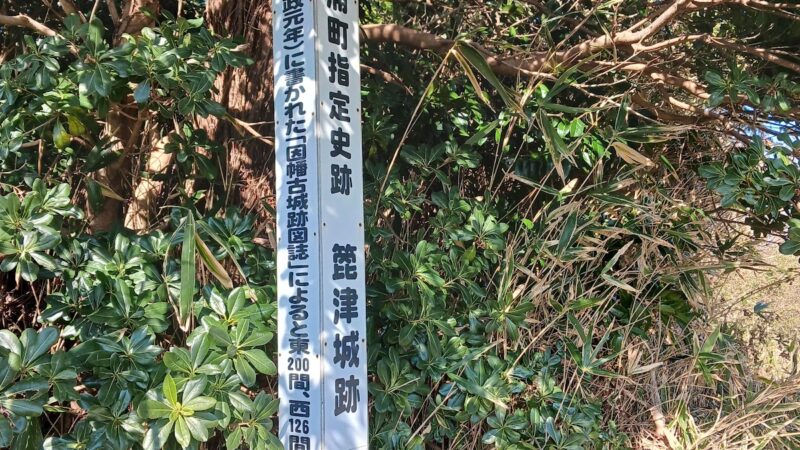
Currently, it is protected as a Kotoura Town designated cultural property (designated June 2, 1975, registered as a former Akasaki Town designated cultural property). Although the area has changed to farmland and open fields, some of the remains from its heyday still remain.
Basic Information on Notsu Castle
- Name: Notsu Castle
- Alternate Name: Maki Castle
- Location: Notsu, Kotoura-cho, Tohaku-gun, Tottori Prefecture
- Year of Construction: Unknown (Estimated to be the Kamakura period)
- Year of Abandonment: Tensho era (1573-1591) *Estimated*
- Builder: Maki clan
- Lords: Kasuya Shigeyuki (Rokuhara Tandai), Akasaka Yukikiyo (Vassal of the Nawa clan), Notsu Atsutada, Maki clan
- Type: Hill castle, coastal castle
- Cultural Property Designation: Kotoura-cho designated cultural property
History of Notsu Castle – From the Kamakura period to the Sengoku period
The Establishment of the Kamakura Period and the Rokuhara Tandai
The exact construction date of Noritsu Castle is unknown, but it is believed to date back to the Kamakura period. The earliest recorded lord of the castle is Kasuya Shigeyuki, who was associated with the Rokuhara Tandai. The Rokuhara Tandai was an organization established by the Kamakura Shogunate in Kyoto, responsible for controlling the samurai of western Japan. The fact that the Kasuya clan had a base in this area indicates that Noritsu was a strategically important military and administrative location from an early stage.
The Nanboku-cho Period and the Influence of the Nawa Clan
During the Nanboku-cho period, Akasaka Yukikiyo, a vassal of the Nawa clan, which wielded considerable power in Hoki Province, became the lord of the castle. The Nawa clan is known for Nawa Nagatoshi, who supported Emperor Go-Daigo, and was a central force for the Southern Court in Hoki Province. As Akasaka Yukikiyo’s residence, Noritsu Castle is thought to have functioned as one of the important strongholds of the Southern Court.
Furthermore, a person named Noritsū Atsutada is recorded as a castle lord during this period. The surname Noritsū suggests a high probability that he was a local powerful family rooted in the region, and it is presumed that he played a role in regional governance within the Nawa clan’s sphere of influence.
The Sengoku Period and the Maki Clan’s Rule
With the arrival of the Sengoku period, the Maki clan rose to prominence as the lords of Noritsū Castle. Because the castle was built or extensively renovated by the Maki clan, it also came to be known by the alternative name Maki Castle. The Maki clan were local lords who held power in the eastern part of Hōki Province, and they controlled the surrounding area from their base in Noritsū.
The name of the Maki clan is also recorded in local histories such as the ‘Hōki Mindanki’, confirming that this family was rooted in the region with Noritsū Castle as their residence. It is presumed that during the Maki clan’s era, defensive facilities as a castle were developed, and many of the remains seen today were formed.
Abandoned Castle During the Tensho Era
It is estimated that Noritsu Castle was abandoned during the Tensho era (1573-1591). This period was a time of national unification under Oda Nobunaga and Toyotomi Hideyoshi, and Hoki Province was also affected by Hashiba (Toyotomi) Hideyoshi’s invasion of the Chugoku region.
From 1580 to 1581, Hideyoshi invaded Hoki Province, resulting in the submission or destruction of many local lords. The Maki clan also declined during this process, and it is believed that Noritsu Castle lost its strategic value and was abandoned. Afterward, the castle site was used as farmland, and remains so to this day.
Layout and Structure of Noritsu Castle
Location as a Coastal and Hill Castle
Noritsu Castle is a coastal castle built on a hill overlooking the Sea of Japan, and at the same time possesses the characteristics of a hill castle, considering defenses against inland areas. Taking advantage of its location near the coastline, it is believed to have functioned as a base for monitoring and controlling maritime traffic, as well as serving as a base for a naval force.
The Sea of Japan coast of Hoki Province was important as a maritime trade route connecting Kyoto and the San’in region, and the port of Noritsu was a key point for the transport of goods and military movements. Noritsu Castle functioned as a strategic base controlling this maritime route.
Existing Remains
The following castle remains have been confirmed at the Noritsu Castle site:
Enclosure Remains (Kuruwa)
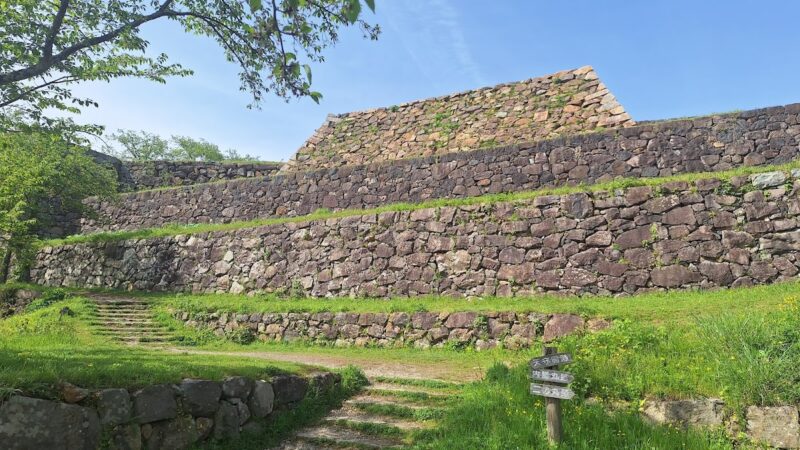
Multiple flat areas remain, suggesting the existence of sections such as a main enclosure and a second enclosure. However, since most of the area has been converted into farmland, it is difficult to reconstruct the exact layout of the castle grounds. Nevertheless, it is possible to infer the layout of the enclosures from the topography.
Steep Slopes
Steep slopes, artificially carved out, remain in various places. These steep slopes were important defensive structures that made enemy intrusion difficult, indicating that Hetsu Castle was a strong fortress designed with actual combat in mind.
Earthworks
Traces of earthworks surrounding the enclosures can be seen. Earthworks are earthen walls built by piling up earth, which served to protect against arrows and stones, as well as obstruct the enemy’s line of sight.
Dry Moats
Dry moats (moats without water) separating the enclosures remain. Dry moats were important structures that hindered enemy movement and enhanced defensive capabilities. Dry moats were more common than water moats in medieval mountain castles.
Entrance/Exit
The remains of a koguchi (entrance/exit) to the castle have been confirmed. Noritsu Castle employed a hirairi koguchi (a koguchi built on flat terrain), balancing defense and passage.
Earthen Bridge
An earthen bridge connected to the hirairi koguchi existed. This earthen bridge was a bridge made of earth to cross the moat and was a movable defensive structure that could be destroyed in times of emergency to prevent enemy intrusion.
Watchtower Platform
The remains of a yagura platform (a platform for a watchtower used for observation and attack) also remain. From the yagura platform, one could survey the surrounding area and detect enemy movements early.
Current Situation
The Noritsu Castle site is currently used as farmland and open field. Because large-scale development has not taken place, the terrain retains traces of the castle, but many of the remains have been altered by agricultural conversion. Nevertheless, it is protected as a designated cultural property of Kotoura Town and is carefully preserved as a local historical heritage.
Noritsu Castle and the Sengoku Period History of Hoki Province
Sengoku Daimyo and Local Lords of Hoki Province
During the Sengoku period, Hoki Province was divided among several local lords. The Nanjo clan held power in the east, the Yukimatsu and Susumu clans in the west, and the Maki clan in the central region, each forming their own sphere of influence.
Meanwhile, the Amago clan rose to power in the neighboring Izumo Province (eastern Shimane Prefecture), and the Mori clan rose to power in Aki Province (western Hiroshima Prefecture). The local lords of Hoki had to survive amidst these powerful forces. It is believed that the Maki clan, at times subservient to the Amago clan and at other times to the Mori clan, strived to preserve their own territory.
Hashiba Hideyoshi’s Invasion of Hoki Province
In 1580 (Tensho 8), Hashiba Hideyoshi, acting on orders from Oda Nobunaga, invaded the Chugoku region. While fighting against the Mori clan, Hideyoshi also began his conquest of Hoki Province. The local lords of Hoki successively submitted to Hideyoshi, and those who resisted were annihilated.
While detailed records of the Maki clan’s activities are scarce, the fact that Notsu Castle was abandoned during the Tensho era suggests that the Maki clan either fell into decline due to Hideyoshi’s invasion or were forced to abandon their castle after submitting.
The Region and Historical Background of Notsu
The Place Name Notsu
The place name Notsu has been used to refer to this region since ancient times. “Tsu” means port, indicating that Notsu flourished as a port town from ancient times. As a good port facing the Sea of Japan, it functioned as a center for the collection and distribution of goods and a transit point for maritime traffic.
Establishment of Kotoura Town
Kotoura Town, where Noritsu is located, was formed in 2004 through the merger of the former Tohaku Town and Akasaki Town. Noritsu belonged to the former Akasaki Town, and the Noritsu Castle ruins, which were registered as a designated cultural property of Akasaki Town before the merger, were inherited as a designated cultural property of Kotoura Town after the merger.
History of Tohaku District
Tohaku District is a district located in the eastern part of Hoki Province, and is an administrative division that has existed since ancient times. Currently, Tohaku District includes Kotoura Town, as well as Misasa Town, Yurihama Town, and Hokuei Town. Historically, it is a region formed by the integration of small districts such as the former Yatsuhashi District and Kawamura District, and is a region where diverse histories and cultures intersect.
Access and Visiting Information for Noritsu Castle Ruins
Location
689-2544 Noritsu, Kotoura-cho, Tohaku-gun, Tottori Prefecture
Access Methods
Public Transportation
- Approximately 10 minutes by car from JR San’in Main Line “Akasaki Station”
- Approximately 5 minutes on foot from the “Noritsu Higashiguchi” bus stop
By Car
- Approximately 15 minutes from San’in Expressway “Kotoura Higashi IC”
- Accessible via Prefectural Road from National Route 9
Notes for Visitors
Since Noritsu Castle Ruins are located on privately owned farmland and open fields, please note the following points when visiting.
- Avoid trespassing on private property and be considerate so as not to interfere with agricultural work.
- Do not damage the ruins or leave any trash.
- Remember to greet and show consideration to local residents.
- If there are information boards or explanatory signs, follow them during your visit.
Related Historical Sites in the Surrounding Area
When visiting the Noritsu Castle Ruins, you can gain a deeper understanding of the history of Hoki Province by also visiting other historical sites in Kotoura Town and Tohaku District.
- Ancient Castle Ruins of Former Kawamura District and Former Yatsuhashi District: Numerous medieval castle ruins are scattered throughout Tohaku District.
- Nawa Shrine: A shrine dedicated to Nawa Nagatoshi (Oyama Town).
- Hoki Ancient Castle Ruins: Remains of medieval castles throughout Hoki Province.
Research and Historical Materials on Noritsu Castle
Major Historical Materials
Historical materials concerning Noritsu Castle are limited, but descriptions can be found in the following documents.
“Hoki Mindanki”
This is a geographical record of Hoki Province compiled during the Edo period, containing descriptions of the Maki clan and Noritsu Castle. Compiled based on contemporary traditions and records, it is an important historical source for castle research.
“Hoki no Kuni Kojo Ato Zuroku”
This is a castle atlas created based on recent research, recording the layout and detailed remains of Noritsu Castle. It compiles the research findings of local researchers and history enthusiasts.
Future Research Issues
The following research issues remain regarding Noritsu Castle:
- Determining the construction date: Dating artifacts through archaeological excavations
- Genealogy of the castle lords: Clarification of detailed genealogies of the Maki and Noritsu clans
- Circumstances of the castle’s abandonment: Specific dates and reasons for its abandonment during the Tensho era
- Function as a coastal castle: Relationship with port facilities and naval forces
- Relationship with surrounding castles: Clarification of the castle network in eastern Hoki Province
Noritsu Castle and Local Culture
Exploring Ancient Castles and Historical Sites in Hoki Province
In recent years, historical tours of ancient castle ruins in Hoki Province have gained popularity. Projects such as “Shiro Totsutan” introduce castles in Hoki Province, including Noritsu Castle, and strive to promote the region’s history and culture. Through these efforts, the buried history of the region is being rediscovered and is attracting attention as a tourist resource.
Historical Preservation Activities in Kotoura Town
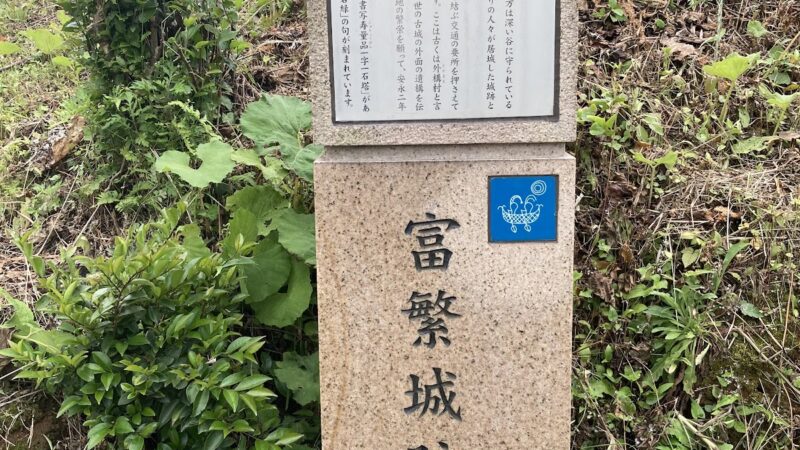
Kotoura Town is working on the preservation and utilization of cultural properties within the town, including the Noritsu Castle ruins. In addition to its protection as a town-designated cultural property, efforts are being made to pass on this historical heritage to future generations through the installation of information boards and educational activities for local residents.
Summary – Historical Significance of Noritsu Castle
Noritsu Castle is a medieval castle site remaining in Kotoura-cho, Tohaku-gun, Tottori Prefecture, and was an important base controlling a key point for maritime traffic in Hoki Province. From the Kamakura period to the Sengoku period, the castle lords changed hands from the Kasuya clan and vassals of the Nawa clan to the Noritsu clan and the Maki clan, reflecting the political and military situations of each era.
After being abandoned during the Tensho era, the land was used for farming, but remains such as the baileys, cliffs, earthworks, dry moats, gates, earthen bridges, and watchtower bases still remain and are protected as a Kotoura Town-designated cultural property.
Research into locally rooted castles like Noritsu Castle is essential for understanding the Sengoku period history of Hoki Province. Further archaeological excavations and historical research are expected to reveal even more facts.
Visiting the ruins of Noritsu Castle will allow you to reflect on the history of medieval Hoki Province and the lives of the people who lived in this land. It is a valuable historical site that should be carefully preserved and passed down as a regional historical heritage.