Nijō Old Castle: The Complete Picture of the Phantom Castle Built by Oda Nobunaga and the Residence of Ashikaga Yoshiaki
What is Nijō Old Castle?
Nijō Old Castle (Nijō Kojō) was a castle from the Sengoku period located in Kamigyo-ku, Kyoto City, Kyoto Prefecture. It is a completely different castle from the Nijō Castle built by Tokugawa Ieyasu, which is now a World Heritage Site. To avoid confusion, it is called “Old Nijō Castle” or “Nijō Old Castle.” This castle was built by Oda Nobunaga for Ashikaga Yoshiaki, the 15th Shogun of the Muromachi Shogunate, and is known for being completed in an astonishingly short period of only about 70 days.
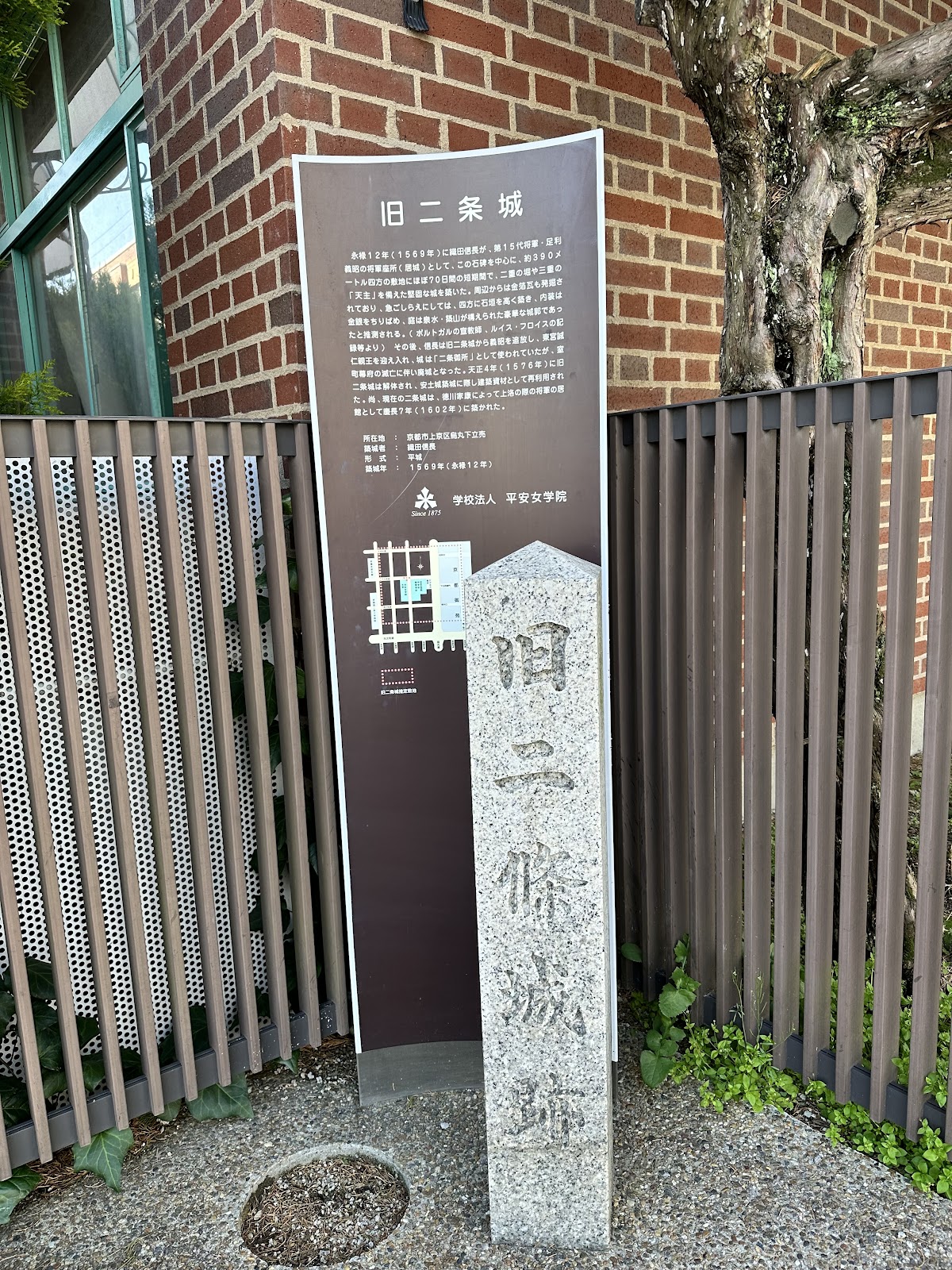
It is believed to have been located west of the current Kyoto Imperial Palace, near the Kyoto Campus of Heian Jogakuin University, and occupied a vast area from Izumi-dori in the north, to the vicinity of Marutamachi-dori in the south, to the vicinity of Shinmachi-dori in the west, and from Karasuma-dori to the vicinity of Higashinotoin-dori in the east. Unfortunately, very few remains of the castle exist today, and only a stone monument inscribed with “Former Nijō Castle Site” stands on the grounds of Heian Jogakuin University.
History of Nijō Castle
Construction History and Background
In 1568 (Eiroku 11), Oda Nobunaga entered Kyoto with Ashikaga Yoshiaki. Yoshiaki became the 15th Shogun of the Muromachi Shogunate, and initially used Honkoku-ji Temple as his temporary residence. However, in January 1569 (Eiroku 12), the Miyoshi Three suddenly invaded Kyoto and surrounded Honkoku-ji Temple.
Although the Miyoshi forces were repelled thanks to the valiant efforts of Nobunaga’s generals, including Sakuma Nobumori, this incident made it clear that a more robust castle was needed for the Shogun’s residence. Nobunaga immediately decided to construct a new castle for the shogun.
Astonishing Construction Speed
In February of Eiroku 12 (1569), Oda Nobunaga himself took command of the construction as the chief construction officer and began the construction of Nijō Castle. This construction is said to have been completed in an astonishingly short period of approximately 70 days.
To shorten the construction period, Nobunaga employed bold methods. First, he relocated many buildings from Honkoku-ji Temple and transported furnishings as well. Records indicate that this was a truly “unfortunate consequence” for Honkoku-ji Temple and its followers.
Furthermore, in constructing the stone walls, he forcibly collected and used tombstones, stone Buddhas, five-ring stupas, stone lanterns, and garden stones from court noble residences and temples. The use of such “repurposed stones” reflects the urgency of the time and Nobunaga’s pragmatic nature.
Nijō Castle during the Ashikaga Yoshiaki Era
The completed Nijō Castle was known by various names, including “Samurai Palace,” “Samurai Castle,” “Shogun’s Castle,” and “Nijō Bueijin no Gokamae.” The name “Nijō Castle” actually only came into use during the Edo period; it wasn’t called by these names at the time.
Ashikaga Yoshiaki made this castle his residence and aimed to restore the Muromachi Shogunate. However, his relationship with Nobunaga gradually deteriorated. Nobunaga tried to restrict Yoshiaki’s authority with the “Denchū Gookite” (Lord’s Regulations), among other things. Yoshiaki resisted this and attempted to form a coalition against Nobunaga, but ultimately lost the conflict.
In 1573 (Genki 4), Nobunaga expelled Yoshiaki from Kyoto, and the Muromachi Shogunate effectively collapsed. After Yoshiaki’s expulsion from the Kinai region, the remaining keep and gates of Nijō Castle were dismantled and repurposed for the construction of Azuchi Castle, which was under construction at the time.
The Transformation of Nobunaga’s Nijō Palace (Nijō Shinzō)
After the expulsion of Ashikaga Yoshiaki, a new history unfolded around the site of the old Nijō Castle. Oda Nobunaga built a new castle in a different location to serve as his lodging during his stays in Kyoto. This castle is known as “Nijō Shinzō” or “Nijō Shingosho.”
Originally the residence of the noble Nijō family, Nobunaga was fond of the garden’s view and acquired the Nijō residence, ordering Murai Sadakatsu, the Kyoto Shoshidai (Kyoto Deputy), to renovate it. In 1579 (Tenshō 7), he presented this castle to Crown Prince Masahito.
The Honnōji Incident and Oda Nobutada’s Siege
On June 2, 1582 (Tenshō 10), the Honnōji Incident occurred. When Oda Nobunaga was attacked at Honnoji Temple during Akechi Mitsuhide’s rebellion, Nobunaga’s eldest son, Oda Nobutada, was staying at Nijo Palace (Nijo Goshinzo).
Upon learning of Nobunaga’s death, Nobutada holed up in Nijo Palace and fought against Akechi’s forces, but ultimately committed suicide. This battle at Nijo Castle during the “Honnoji Incident” is often confused with events at “Nijo Old Castle,” but in reality, it took place at “Nijo Goshinzo,” which Nobunaga presented to the Crown Prince.
Thus, the name “Nijo Castle” encompasses several different castles, leading to much historical confusion.
Structure and Characteristics of Nijo Old Castle
Scale and Layout of the Castle
Nijo Old Castle was built around the site of the former residence of Ashikaga Yoshiteru, the 13th Shogun of the Muromachi Shogunate (Nijo Gosho Bueijin no Gokamae). The castle grounds were vast, extending approximately 200 meters east-west and 400 meters north-south.
The castle was built as a flatland castle, a full-fledged castle residence surrounded by moats and stone walls. A keep is believed to have existed, and records indicate it was later relocated to Azuchi Castle.
Defensive Structures
Despite being built in a short period, Nijō Old Castle possessed defensive structures befitting a shogun’s residence. The stone walls were sturdily constructed, utilizing many repurposed stones, and moats were also excavated.
Gates were built on all four sides of the castle, and the main gate, in particular, is said to have had a magnificent structure. These gates are also thought to have been later relocated to Azuchi Castle.
Architectural Style
The palace and other facilities were arranged around buildings relocated from Honkoku-ji Temple. It is presumed to be an architectural style that blended the aristocratic and samurai cultures of the Muromachi period.
The presence of the main keep (tenshu) was advanced for a castle of this period and is thought to reflect Nobunaga’s architectural philosophy. It has also been suggested that the main keep relocated to Azuchi Castle may have served as the prototype for the Azuchi Castle keep.
Differences between Nijo Old Castle and other “Nijo Castles”
Ashikaga Yoshiaki’s Nijo Old Castle (Old Nijo Castle)
This castle was built by Nobunaga for Yoshiaki in 1569 (Eiroku 12) and was located near the present-day Heian Jogakuin University. This is the castle primarily discussed in this article.
Nobunaga’s Nijo New Residence (Nijo Shin-Gosho)
Originally a renovated residence of the Nijo family, it was located in a different place from Nijo Old Castle. This is the castle where Oda Nobutada holed up during the Honnoji Incident. It was presented to Prince Masahito in 1579 (Tensho 7).
Tokugawa Ieyasu’s Nijo Castle
This castle, built by Tokugawa Ieyasu in 1603 (Keicho 8), is the one that remains today as a World Heritage Site. Its location and structure are completely different from the two castles mentioned earlier.
Because all three castles are sometimes referred to as “Nijo Castle,” historical confusion is very common. The local monument clearly distinguishes it from the Tokugawa clan’s Nijo Castle by inscribing it as “Former Nijo Castle.”
Remains and Current State of Old Nijo Castle
Existing Remains
Unfortunately, very few remains of Old Nijo Castle exist today. The castle was dismantled in 1573 (Genki 4), and its main buildings were relocated to Azuchi Castle. Since then, the site has been urbanized and is now a residential area and school facilities.
The only remaining trace is a monument inscribed with “Former Nijo Castle Site” on the grounds of Heian Jogakuin University, indicating the former existence of Old Nijo Castle. This stone monument is a valuable historical site that conveys the history of Nijo Castle to the present day.
Relocated Stone Walls
It is believed that some of the repurposed stones used at Nijo Castle were relocated again in later history. Among the repurposed stones found at temples, shrines, and castle ruins in Kyoto City, some may have originated from Nijo Castle.
Archaeological Excavations
Archaeological excavations have been conducted in the past on and around the grounds of Heian Jogakuin University, confirming the presence of parts of stone walls and traces of moats. These investigations are gradually revealing the scale and structure of Nijo Castle.
Access and Visiting Guide to Nijo Castle
Location
Kamigyo-ku, Kyoto City, Kyoto Prefecture (near the current Heian Jogakuin University Kyoto Campus)
Transportation Access
Access by Train:
- Approximately 5 minutes on foot from Marutamachi Station on the Kyoto Municipal Subway Karasuma Line
- Approximately 10 minutes on foot from Imadegawa Station on the Kyoto Municipal Subway Karasuma Line
Access by Bus:
- Approximately 3 minutes on foot from the Karasuma Marutamachi bus stop (Kyoto City Bus)
- Approximately 5 minutes on foot from the Karasuma Izumi bus stop (Kyoto City Bus)
Points to Note During Your Visit
Heian Jogakuin University is an educational institution, and access to the grounds is restricted. Since the monument is located on the university grounds, visitors must respect university rules and be considerate of classes and student activities.
While the monument may be visible from Karasuma Street, it is recommended to contact the university in advance if you wish to view it in detail.
Related Historical Sites in the Surrounding Area
Kyoto Gyoen National Garden:
Within walking distance, you can visit the former residences of court nobles and the Imperial Palace. It also includes the original location of the stones later used in the stone walls of Nijo Castle.
Myokenji Castle:
This is where Ashikaga Yoshiaki temporarily stayed before Nijo Castle, approximately a 15-minute walk away.
Honnoji Temple:
While the current Honnoji Temple is located at a later site, it is an important historical site for understanding the history of the Honnoji Incident. Approximately a 20-minute walk.
Tokugawa Ieyasu’s Nijo Castle:
The current World Heritage Site, Nijo Castle, is approximately a 15-minute walk away. You can experience the difference between it and Nijo Castle.
Historical Significance of Nijo Castle
The Stage of the End of the Muromachi Shogunate
Nijo Castle was the residence of Ashikaga Yoshiaki, the last shogun of the Muromachi Shogunate, and witnessed the end of the Muromachi Shogunate. This castle served as the stage for a crucial turning point in Japanese history: the conflict between Nobunaga and Yoshiaki, and the fall of the Muromachi Shogunate.
Oda Nobunaga’s Castle Construction Techniques
The construction of the castle in a short period of approximately 70 days is a prime example of Nobunaga’s organizational and mobilization skills, as well as his pragmatic approach to castle construction. Techniques and ideas that would later be seen in the construction of Azuchi Castle, such as the large-scale use of repurposed stones and the relocation of buildings, are evident.
Kyoto in the Sengoku Period
The history of Nijō Old Castle illustrates how politically and militarily important Kyoto was during the Sengoku period. It shows the tense situation in Kyoto at the time, including the danger of attacks on the shogun’s residence and the necessity of fortification.
Anecdotes Related to Nijō Old Castle
Forced Relocation from Honkoku-ji Temple
To shorten the construction period, many buildings were relocated from Honkoku-ji Temple. Honkoku-ji Temple was an important temple of the Nichiren sect, and this forced relocation imposed a heavy burden on the temple. It is known as an episode illustrating Nobunaga’s authoritarian methods.
Forced Collection of Reusable Stones
For the construction of the stone walls, gravestones and even Buddhist statues were forcibly collected from court noble residences and temples. The use of such “reusable stones” reflects Nobunaga’s pragmatism and the urgency of the time. His willingness to utilize even religious relics in castle construction symbolizes Nobunaga’s innovative and authoritarian character.
Relocation to Azuchi Castle
The fact that the keep and gates of Nijō Old Castle were relocated to Azuchi Castle is important for understanding the construction process of Azuchi Castle. It has also been suggested that the prototype of Azuchi Castle’s keep may have been at Nijō Old Castle, indicating Nijō Old Castle’s position in the history of Japanese castle architecture.
Nijō Castle and Castles of the Sengoku Period
Characteristics as a Flatland Castle
Nijō Castle is a typical flatland castle. In the Sengoku period, when mountain castles were dominant, it occupies an important position as a full-fledged castle built on the plains of Kyoto. It possessed elements that foreshadowed later early modern castles, such as defenses with moats and stone walls, and the presence of a main keep.
Role as a Shogun’s Residence
The residences of shoguns during the Muromachi period were called “Gosho” and were not necessarily fortified. Nijō Castle was groundbreaking in that it constructed the shogun’s residence as a full-fledged castle. This reflects the rising military tensions of the Sengoku period.
Nobunaga’s View of Castles
The construction of Nijō Castle demonstrates Nobunaga’s view on castles. His emphasis on efficiency and practicality is evident in its short construction period, the active use of repurposed stones, and the reuse of materials in the later Azuchi Castle.
Summary
Nijo Castle was a fortress built by Oda Nobunaga for Ashikaga Yoshiaki in 1569 (Eiroku 12), completed in an astonishingly short time of approximately 70 days. Located on the west side of the current Kyoto Imperial Palace, near Heian Jogakuin University, this castle was the stage for the end of the Muromachi Shogunate and witnessed a crucial turning point in Japanese history.
It is a different castle from Tokugawa Ieyasu’s Nijo Castle and Nobunaga’s Nijo Goshinzo, and is often confused with them, but each has its own unique historical significance. While very few remains today, a stone monument commemorates its existence.
The history of Nijo Castle, as a valuable historical site illustrating Oda Nobunaga’s pragmatic castle-building methods, the end of the Muromachi Shogunate, and the importance of Kyoto during the transition from the Sengoku period to the early modern period, occupies an important position in the history of Japanese castles.
When you visit Kyoto, why not take some time to contemplate not only the World Heritage Site of Nijo Castle, but also this legendary old Nijo Castle? Standing before the monument, imagining the magnificent castle that once stood here and the important events that shaped Japanese history that unfolded here, you will feel the weight of history.