Kaminaka Castle (Kyoto Prefecture) Complete Guide: The Full Picture and Highlights of the Late Heian Period Oval-Shaped Flatland Castle
What is Kaminaka Castle?
Kaminaka Castle (Kaminaka-jo) is a flatland castle located in Shimonaka-cho, Keihoku, Ukyo-ku, Kyoto City, Kyoto Prefecture, dating from the late Heian period to the Kamakura period. Also known as Tanaka Castle and Tanaka-no-Kojo, it is protected as a Kyoto City designated historical site.
Located about an hour’s drive north from downtown Kyoto, in the northern part of the Shuzan Basin, this castle site is surrounded by rice paddies in the plains and remains a valuable cultural asset, still strongly retaining its original appearance. It boasts an extremely rare oval-shaped layout for a castle built on flat land, and its well-preserved castle structure from the 12th to 13th centuries makes it an extremely important site in the history of castles.
History of Kaminaka Castle
Castle Construction and the Legend of the Northern Guard
Regarding the construction period of Kaminaka Castle, the most widely accepted tradition is that it was built during the Tenjin era (1108-1110). According to local historical materials such as the “Kyoto Kita Town History,” the builder was Kurō Kunimasa, a descendant of Kurōdo-daibu Masahira.
Kurō Kunimasa is said to have been one of the Northern Guard. The Northern Guard were a group of warriors who guarded the palace of the retired emperor (In-gosho) during the late Heian period, established during the reign of Emperor Shirakawa (1086-1129). The legend that warriors tasked with guarding the palace of a retired emperor built a castle in this area offers an interesting historical context that reflects the political situation and development in northern Kyoto at the time.
The Yuge Clan in the Muromachi Period
On the other hand, there is also a theory that Yuge Kuninao built it during the Muromachi period. Yuge Kuninao became the shoji (manager of the manor) of Yuge Manor and made this place his castle. His grandson, Echizen-no-kami Yoriyasu, was granted the surname Kusaki and is said to have ruled this area for generations.
The Yuge clan (Kusaki clan) was active as a powerful local lord in the Keihoku region from the Muromachi period to the Sengoku period. Records show that during the Tensho era (1573-1592), the castle lord Echizen-no-kami Morichika died of illness, and his son Tarozaemon Yoshinaga inherited the family headship.
The Era of Akechi Mitsuhide and Shuzan Castle
During the Tensho era, Akechi Mitsuhide, acting on orders from Oda Nobunaga, advanced into this region and built Shuzan Castle on a nearby mountain. Shūzan Castle was a large mountain castle serving as a base in the Kyōhoku region, but it was abandoned after Mitsuhide’s death following the Honnō-ji Incident (1582).
While the exact position of the Kusaki clan, lords of Kaminaka Castle during this period, is unclear, it is believed they were influential figures in the region and were involved in Mitsuhide’s control of Tanba in some way. The record that Echizen-no-kami Morichika, lord of Kaminaka Castle, died of illness around the time Shūzan Castle was built speaks volumes about this turbulent era.
The True Nature of the Castle Revealed by Archaeological Excavations
Recent archaeological excavations have scientifically revealed the specific structure and period of use of Kaminaka Castle. The results of the investigations revealed that the castle was primarily used from the 12th to the 13th centuries, providing important evidence supporting the theory that it was built during the Tenjin era.
The period from the late Heian period to the Kamakura period was a time of rise of the samurai class and the development of the manorial system. Kaminaka Castle is believed to have functioned as a residence for a local samurai during this transitional period, providing valuable historical information for the history of Japanese castles.
Structure and Characteristics of Kaminaka Castle
Unusual Oval Layout
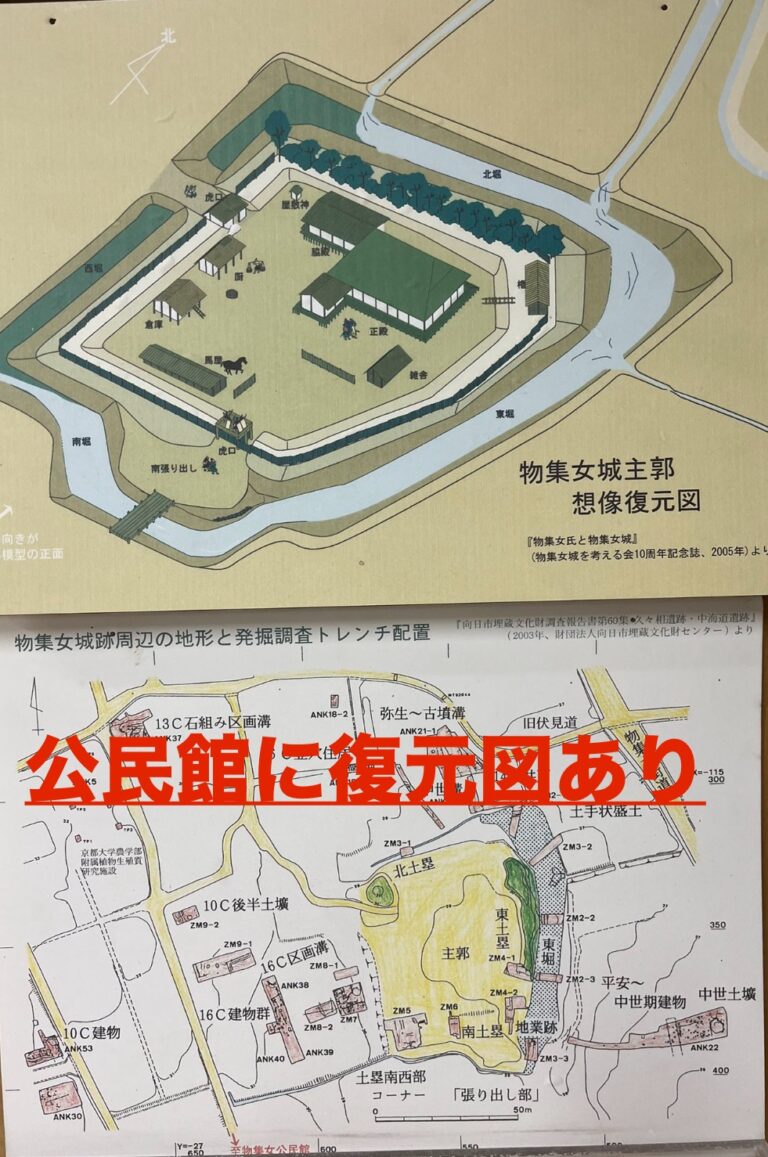
The most distinctive feature of Kaminaka Castle is its oval layout. Japanese castles are typically square or irregularly shaped, and oval-shaped castles built on flat land are extremely rare. This unique shape may reflect topographical constraints, defensive measures, or the age of its construction.
The dimensions of the castle, as revealed by archaeological excavations, are as follows:
- East-West: Approximately 84 meters
- North-South: Approximately 40 meters
- Castle Area: Approximately 3,000 square meters
- Height from Surrounding Rice Fields: Approximately 1 meter
While the castle is small to medium in size, it is considered a standard size for a local samurai residence in the late Heian period. Built on a slightly elevated area about 1 meter higher than the surrounding rice paddies, it utilizes a slight difference in elevation for its defensive structure.
Structure of the Moat and Earthworks
As defensive structures of Kaminaka Castle, a moat and earthworks have been identified.
Structure of the Moat:
- Width: Approximately 5 meters
- Depth: Approximately 1 meter
- Encircled the entire perimeter of the castle.
Currently, most of the moat has been filled in, but the gravel road surrounding it indicates the former moat’s location. Its size—5 meters wide and 1 meter deep—suggests it was not a large-scale water moat, but rather a dry moat with a clear demarcation and simple defensive function.
Structure of the Earthworks:
- Width: Approximately 5 meters
- Height: Approximately 1.8 meters
- Length: Approximately 20 meters
- Location: Northernmost part of the castle grounds
The earthworks still remain in good condition on the northwest side and are the most important remains of Kaminaka Castle. The 1.8-meter height, while practical as a defensive structure, suggests a residential character rather than an imposing military facility.
Castle Grounds
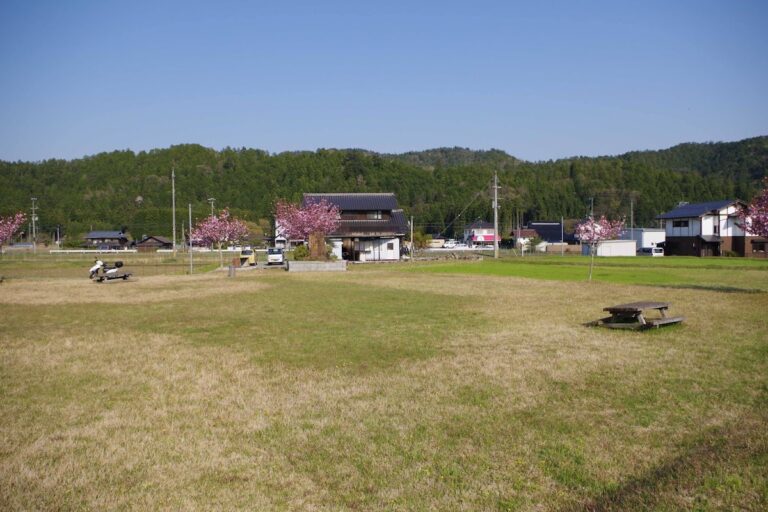
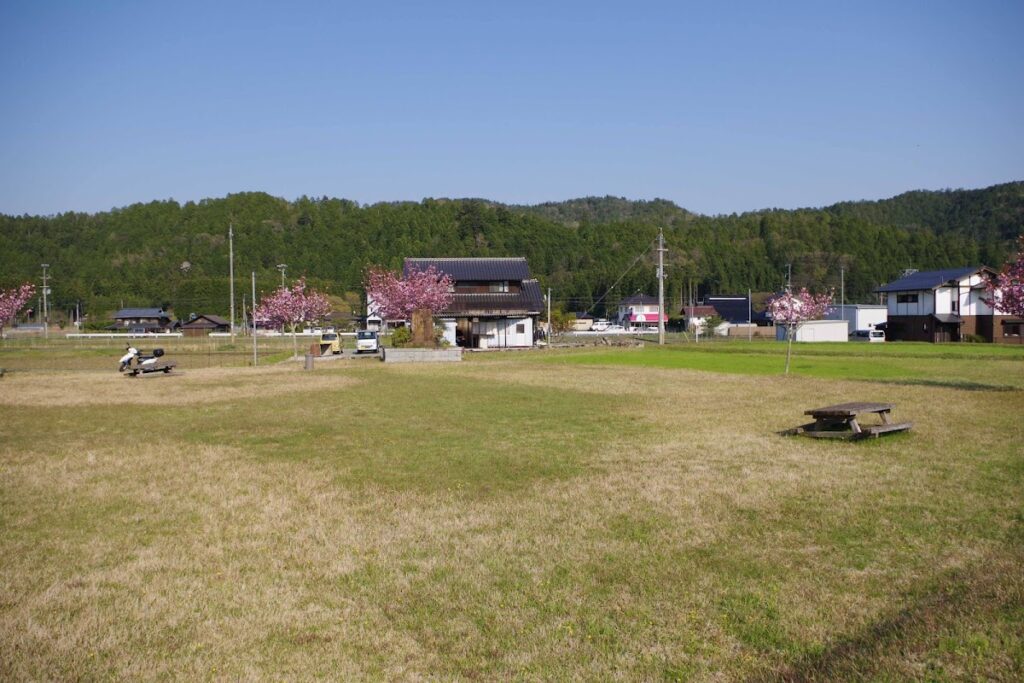
The castle grounds are currently used differently in the northern and southern halves. The northern half has been developed into a park-like area with a grassy field, creating an environment where visitors can easily observe the remains. The southern half is used as farmland, indicating that the castle remains are still a vital part of the local community’s life.
The grassy field slopes downwards in three tiers towards the southeast, and these slight elevation differences may reflect the original layout. It is thought that a residence from the late Heian period would have contained a main hall, warehouses, and stables, but further research is needed to determine the specific building arrangement.
Highlights of Kaminaka Castle
Remains of the Northern Earthwork
When visiting Kaminaka Castle, you should definitely see the remains of the earthwork on the northwest side. The earthen rampart, approximately 1.8 meters high and 20 meters long, is a valuable historical structure that showcases the civil engineering techniques of the late Heian and Kamakura periods.
Standing atop the rampart, you can overlook the entire castle grounds and appreciate its oval-shaped layout. The contrast with the surrounding rural landscape allows you to imagine how important this area was at the time.
Gravel Path Indicating the Moat
The gravel path surrounding the castle ruins indicates the former moat. You can see the 5-meter-wide moat encircling the entire area by walking along the site. Walking along the moat allows you to grasp the overall layout of the oval-shaped castle and provides an excellent opportunity to understand the structure of a castle on flat ground.
Information Boards and Explanation Boards
Information boards are installed at the castle ruins, providing detailed explanations about the history and structure of Kaminaka Castle. They also include information on the results of archaeological excavations and the castle’s transformations, allowing you to deepen your understanding not only by studying before your visit but also by viewing the actual remains on-site.
The Overall View of the Oval-Shaped Castle Grounds
The greatest appeal of Kaminakajo Castle is that, because the entire castle site is well-preserved, you can grasp the entirety of its unusual oval-shaped grounds. While many castle sites have been altered by development, Kaminakajo Castle retains much of its appearance from the late Heian period, making it a valuable place to experience a castle from that era.
Surrounding Rural Landscape and Watermill
Kaminakajo Castle is located in a plain surrounded by rice paddies, and you can see a watermill in the adjacent stream. This idyllic landscape symbolizes the charm of the Keihoku region, where time seems to flow slowly despite being within Kyoto City. Enjoying the surrounding rural landscape in conjunction with a visit to the castle grounds is a unique experience of Kaminakajo Castle.
Access to Kaminakajo Castle
Location
Keihoku Shimonaka-cho, Ukyo-ku, Kyoto City, Kyoto Prefecture
Although within Kyoto City, it is located quite far north of the city center, in a mountainous basin. It is located even further north than the Shuzan Basin where Shuzanjo Castle is located.
Access by Car
Access by car is the most convenient way to reach Kaminakajo Castle.
- Head north from Kyoto city center on National Route 162 (Shuzan Kaido)
- Continue north via Shuzan
- Estimated travel time: Approximately 1 hour from Kyoto city center
Parking is available near the castle ruins, making your visit worry-free. However, parking for large vehicles may be difficult, so visiting in a regular-sized car is recommended.
Access by Public Transportation
If using public transportation, you will need to use JR Bus or Kyoto Bus. However, the number of services is limited, so it is recommended to check the timetable in advance. The castle ruins are within walking distance from the nearest bus stop, but since it is a sparsely populated area, you should plan accordingly and allow ample time.
Points to Note When Visiting
- Part of the castle ruins are used as farmland, so please be careful not to trespass on private property.
- The park area can be freely visited, but please cooperate in protecting the remains.
- As the surrounding area is a rural area, please be considerate of the neighbors regarding noise, etc.
- In winter, there is a possibility of snowfall, so please check road conditions in advance.
Nearby Attractions
Shuzan Castle
South of Kaminaka Castle, on a mountain overlooking the Shuzan Basin, lies Shuzan Castle. It is a large mountain castle built by Akechi Mitsuhide during the Tensho era, and the remains of the stone walls and baileys are well-preserved. While Kaminaka Castle is a flatland castle from the late Heian period, Shuzan Castle is a mountain castle from the Sengoku period, offering a contrasting character. Visiting both castles allows you to experience the history of castle development.
History and Culture of the Keihoku Region
The Keihoku region has long been a thriving forestry area and is known as a production area for “Kitayama cedar.” When visiting Kaminakajo Castle, you can also enjoy the local traditional culture and beautiful natural scenery. Furthermore, the area is dotted with ancient shrines and temples, creating an ideal environment for historical exploration.
The Cultural Value of Kaminakajo Castle
An Ancient Castle Dating Back to the Late Heian Period
The greatest value of Kaminakajo Castle lies in its extremely old age, dating back to the late Heian period. Most Japanese castles date from the Sengoku period (Warring States period) onward, and examples of castles from the 12th and 13th centuries remaining in good condition are extremely rare.
This period saw the rise of the samurai class and the establishment of local governance based on manors. Kaminakajo Castle is a valuable historical resource that concretely illustrates the nature of a local samurai residence during this era.
Unusual Oval Shape
An oval shape is extremely rare for a castle built on flat land, making it a significant point in castle research. There are various theories as to why the oval shape was chosen, but various factors are thought to be at play, such as topographical constraints, characteristics of castle construction techniques, or a reflection of defensive thinking.
The entire castle site is well-preserved
While many castle sites have been altered by development or only partially remain, Kaminaka Castle is noteworthy for the fact that the entire castle site is well-preserved. Major remains such as earthworks, moat traces, and the oval layout can be confirmed, making it a valuable example for understanding the overall structure of a castle at that time.
Due to these characteristics, Kaminaka Castle is protected as a Kyoto City designated historical site and is carefully preserved as an important cultural property of the region.
Kaminaka Castle and the Northern Guard
Let’s take a closer look at the Northern Guard, who appear in the legend of the construction of Kaminaka Castle.
The Northern Guard was a group of warriors established by Emperor Shirakawa to guard the imperial palace when he began his cloistered rule. Until then, the security of the imperial court was mainly handled by the Kebiishi (police and judicial officials), but during the Insei period (rule by retired emperors), the Hokumen no Bushi (Northern Guard Warriors) played an important role as the retired emperor’s own military force.
The Hokumen no Bushi were appointed from powerful samurai clans such as the Taira and Minamoto. While performing security duties in Kyoto, they also owned territories in the provinces and earned income from them. The legend that Kuro Kunimasa built Kaminaka Castle may reflect the reality that the Hokumen no Bushi owned territories in the manors north of Kyoto and had residences there.
The Tenjin era (1108-1110) was the Insei period of Emperor Shirakawa, a time when the Hokumen no Bushi system was established. The legend that a castle was built in the Keihoku region of northern Kyoto during this period is consistent with the historical background and is considered highly credible.
What has been revealed by archaeological excavations
Recent archaeological excavations have revealed many new facts about Kaminaka Castle.
Determining the Period of Use
Analysis of excavated pottery and artifacts has scientifically proven that Kaminaka Castle was primarily in use from the 12th to the 13th centuries. This is consistent with the tradition of its construction during the Tenjin era (1108-1110) and supports the idea that the castle was functional from the late Heian period through the Kamakura period.
Clarification of Specific Structure
Excavation revealed specific dimensions, such as the width (approximately 5 meters), depth (approximately 1 meter) of the moat, and the size of the earthworks (approximately 5 meters wide, 1.8 meters high, and 20 meters long). This has revealed the true nature of the castle, which was not apparent from documentary records alone.
Traces of Life
Artifacts indicating daily life have also been excavated from within the castle, confirming that it functioned not merely as a military facility but also as a living space. This provides valuable information for understanding the daily life of local samurai during the late Heian period.
The Significance of Visiting Kaminaka Castle
Kaminaka Castle is not a famous tourist destination, but for those interested in castle history and Japanese medieval history, it is a historical site well worth visiting.
Experience a Heian Period Castle
While castles from the Sengoku period remain throughout Japan, opportunities to actually visit and experience a castle from the late Heian period are limited. At Kaminaka Castle, you can experience firsthand the style of a castle from the ancient 12th century.
Historical Exploration in a Quiet Environment
Unlike the tourist spots in Kyoto city, Kaminaka Castle is located in a quiet rural area. Without the crowds of tourists, it provides an environment where you can slowly observe the remains and reflect on history.
Discovering the Charms of the Keihoku Region
Visiting Kaminaka Castle is also an opportunity to discover the hidden charms of the Keihoku region of Kyoto. With its beautiful nature, traditional rural landscape, and rich history and culture, this region reveals a new side of Kyoto.
Summary
Kaminaka Castle is a late Heian period flatland castle located in Keihoku, Ukyo-ku, Kyoto City, Kyoto Prefecture. It is a valuable historical site with the following characteristics:
- An ancient castle believed to have been built by the Northern Guard during the Tenjin era (1108-1110)
- Has an unusual oval-shaped layout for a flatland castle
- Archaeological excavations have revealed it was primarily used from the 12th to 13th centuries
- Meets its size: 84 meters east-west, 40 meters north-south, and covers an area of approximately 3,000 square meters
- Surrounded by a moat 5 meters wide and 1 meter deep
- A 5-meter wide, 1.8-meter high, and 20-meter long earthen rampart remains at the northern end
- The entire castle site is well-preserved and designated a Kyoto City Historic Site
Located in the northern part of the Shuzan Basin, about an hour’s drive from downtown Kyoto, Kaminaka Castle is a valuable cultural asset that conveys the reality of a local samurai residence from the late Heian period. Visiting the castle ruins nestled in a tranquil rural landscape will allow you to experience an important chapter in the history of Japanese castles.
Visiting nearby historical sites such as Shuzan Castle will allow you to trace the development of castles from the Heian period to the Sengoku period, leading to a deeper understanding of history. We highly recommend visiting Kaminaka Castle, a hidden historical spot in Kyoto.