Complete Guide to Nejame Gusuku: History and Highlights of the Hidden Fortress Castle Ruins in Ogimi Village, Okinawa Prefecture
Located in the northern hilly area of Ogimi Village, Okinawa Prefecture, Nejame Gusuku is an important castle ruin that conveys the history of the Ryukyu Kingdom era. Also known as “Nejame Castle” or “Uigusuku,” this gusuku, believed to have been built around the 12th century, is attracting attention as a valuable site with the first moat discovered on Okinawa Island. This article thoroughly explains the charm of this hidden fortress, from its historical background, structural features, highlights, to access information.
What is Nejame Gusuku?: Basic Information and Historical Positioning
Nejame Gusuku is a gusuku (castle ruin) from the Ryukyu period located in Nejame, Ogimi Village, Kunigami District, Okinawa Prefecture. It is a fortress-like structure built during the Gusuku period (12th-16th centuries) and played an important role as a military base in Ryukyu history.
Characteristics as a Gusuku
A Gusuku is a unique form of castle in the Ryukyu Islands, not merely a military facility, but a complex space including a sacred site (utaki). Nejame Gusuku also possesses this characteristic, with the Ufugusuku (Great Castle) Utaki located in the highest enclosure, and the Kami Ashagi and Nakagusuku Utaki located in the enclosure below.
This arrangement clearly demonstrates the social structure in Ryukyu where faith, politics, and military affairs were integrated. Even today, it remains an object of worship for the local people, a valuable place where the traditional spiritual culture of Ryukyu is preserved.
Construction Period and Historical Background
Nejame Gusuku is believed to have been built around the 12th century, dating back to the “Three Kingdoms period” or earlier, before Ryukyu became a unified kingdom. During this period, local powerful families called Aji were scattered throughout Okinawa Island, each building Gusuku to demonstrate their power.
Records show that Kunigami Anji participated as a member of the allied Anji during Shō Hashi’s conquest of Hokuzan in the first half of the 15th century, aiming to unify Ryukyu. This historical fact is one piece of evidence illustrating the importance of Nejame Gusuku.
The Mystery of Nejame Gusuku’s Lords: Kunigami Anji and Ōgimi Anji
There are two theories in historical research regarding the lord of Nejame Gusuku. This debate is one of the interesting topics in the study of Ryukyu history.
The Kunigami Anji Residence Theory (Leading Theory)
Currently, the more widely accepted theory is that it was the residence of Kunigami Anji. The following points are cited as evidence supporting this theory:
Consistency with Historical Records: During Shō Hashi’s conquest of Hokuzan, the name of Kunigami Anji clearly appears among the allied Anji, but the name of Ōgimi Anji is not recorded. This fact suggests that the Kunigami Anji held significant influence in this region at the time.
Relationship with Shuri: Records indicate that the Kunigami Anji resided in the Kunigami Palace in Shuri after the establishment of the Ryukyu Kingdom. This is evidence that the Kunigami Anji was highly regarded by the royal government and supports the strategic importance of Nejame Gusuku, their base of operations.
The Ogimi Anji Castle Theory
On the other hand, there is also a theory that it was the castle of the Ogimi Anji, a descendant of King Eiso of Chuzan. This theory is based on its geographical location (located in Ogimi Village) and local traditions, but due to contradictions with the aforementioned historical records, it currently does not have as much support as the Kunigami Anji theory.
However, the very existence of both theories may suggest the complex political situation in this region and the shifts in power among the Anji, and further research is anticipated.
Structure and Defensive System of Nejame Gusuku
The most distinctive feature of Nejame Gusuku lies in its superior defensive system. Its structure, skillfully utilizing the natural terrain, demonstrates the high level of Ryukyuan castle-building technology.
Location and Topographical Advantages
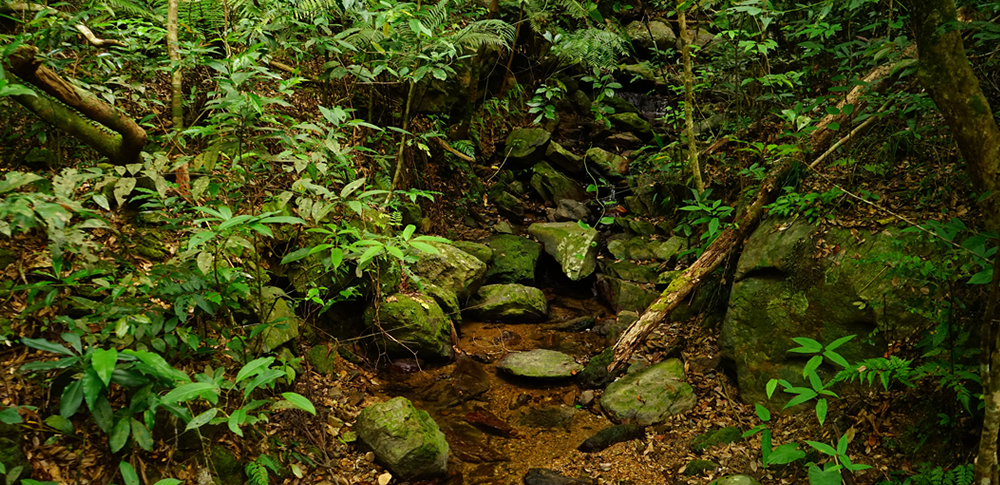
Nejame Gusuku is located on a hill southeast of Jana Castle, surrounded by cliffs and steep slopes, making it a natural stronghold. This topographical feature created a natural defensive wall that made enemy intrusion extremely difficult.
Looking out from the top of the hill, a wide view unfolded, allowing for surveillance of a vast area from the northern mountainous region to the East China Sea. It is believed to have also functioned as a military surveillance base.
First Moat Remains on Okinawa Island
Of particular note at Nejame Gusuku is the presence of a moat that cuts across the southeastern ridge. A moat is a defensive structure created by artificially excavating a ridge to prevent enemy intrusion. This particular remains are extremely valuable, being the first such discovery on Okinawa Island.
The discovery of a moat, a common defensive structure in mountain castles on the mainland, in Okinawa holds significant meaning in considering cultural exchange and the transmission of castle-building techniques between Ryukyu and mainland Japan. It also serves as proof that the builders of Nejame Gusuku possessed advanced military knowledge.
Arrangement and Structure of the Enclosures
Nejame Gusuku is composed of multiple enclosures (kuruwa), characterized by a hierarchical spatial arrangement.
Uppermost Enclosure: The Utaki (sacred site) of Ufugusuku is located here, making it the most sacred space. It holds dual significance: militarily, it is the final line of defense, and spiritually, it is the highest-ranking sacred site.
Middle Enclosure: The Kami Ashagi (a ritual facility for welcoming the gods) and the Nakagusuku Utaki were located here, functioning as a place for daily religious activities.
Other Enclosures: These are presumed to have been used for living spaces, storage of supplies, and garrisoning of soldiers, but further details are left to future research.
Stone Masonry Techniques
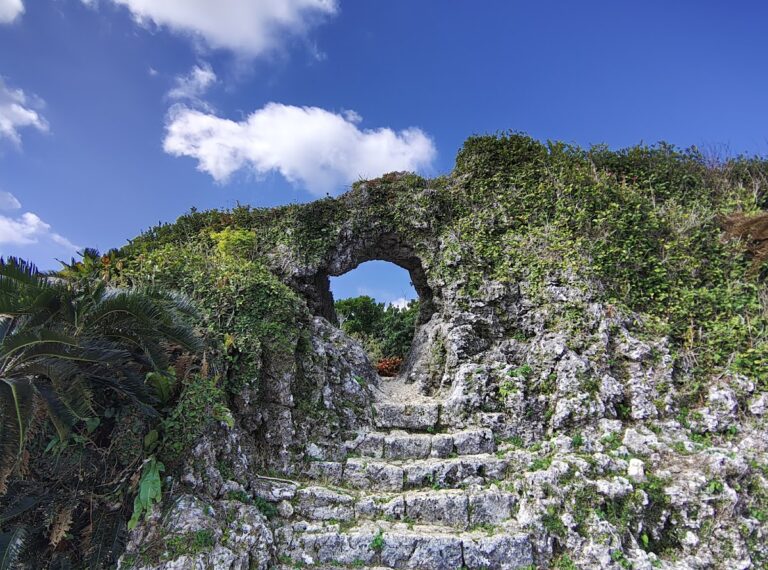
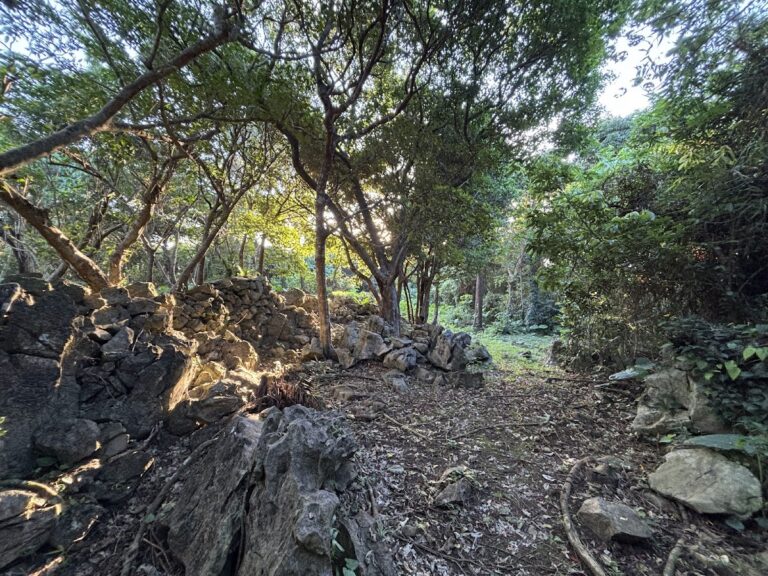
Negame Gusuku features stone masonry using Ryukyu limestone. Unlike the characteristic curved stone walls of Ryukyu gusuku, this masonry exhibits a simpler, older technique, providing evidence supporting its construction period of around the 12th century.
While some parts of the stone masonry have completely collapsed, the remaining sections allow us to infer the level of technology and the scale of labor mobilization at the time.
Major Remains and Highlights of Negame Gusuku
This section provides a detailed introduction to the main remains and highlights of Negame Gusuku that you should pay attention to when visiting.
Utaki of Ufugusuku
Located at the highest point, Utaki of Ufugusuku is the most sacred place within Negame Gusuku. It remains a cherished object of local worship, and respectful treatment is expected during visits.
From the area surrounding the sacred grove (Utaki), one can see the settlement of Ogimi Village, the surrounding mountains, and even the East China Sea, allowing one to imagine how the former lord (Anji) surveyed his territory from this spot.
Kami Ashagi and Nakagusuku Utaki
Located in the enclosure below the Ogusuku Utaki, the Kami Ashagi is a traditional Ryukyuan ritual site. Kami Ashagi means “place to welcome the gods,” and it was an important space where gods were invoked and prayers offered during rituals.
Together with the Nakagusuku Utaki, this enclosure is thought to have been a center of daily religious activity. The hierarchical arrangement of multiple sacred groves reflects the unique Ryukyuan belief system.
Well Remains
The remains of a well are preserved within the gusuku (castle). Securing a water source was a matter of life and death for a castle, and the existence of a well was essential when considering a siege.
Further excavations are expected to reveal more about the water supply capacity and structure of the well at Nejame Gusuku.
Moat Remains
The moat cutting across the southeastern ridge is one of the most notable features of Nejame Gusuku. As the first such discovery on Okinawa Island, it holds significant academic value and is an indispensable structure for understanding the history of Ryukyu castle construction.
At the site, visitors can observe the clear cut in the ridge, directly confirming the traces of large-scale civil engineering work from that time. The timing and purpose of this moat’s addition remain a subject of ongoing debate among researchers.
Sacred Sites (Uganju)
Several sacred sites are scattered throughout the gusuku, and local people still visit them to offer prayers. Importantly, these sites are not merely historical relics, but continue to function as “living places of worship.”
Visitors, even those visiting for tourism purposes, should understand that these sacred sites remain sacred and treat them with appropriate respect.
Cultural Value of Nejame Gusuku
Nejame Gusuku possesses high cultural value from multiple perspectives.
Archaeological Value
In addition to its uniqueness as the first moat-cut structure on Okinawa Island, its early gusuku period (around the 12th century) provides valuable information for understanding the early stages of the Ryukyu Gusuku period. Further excavations are likely to yield even more significant discoveries, making it an important research subject in Ryukyu archaeology.
Historical Value
It is an important historical site for understanding the political situation in the northern region, particularly during the Anji era before the unification of Ryukyu. It provides clues to understanding the sphere of influence of the Kunigami Anji and the role of the northern Anji in the process of Ryukyu unification by Sho Hashi.
Folkloric Value
The fact that it still functions as an object of worship today is evidence that traditional Ryukyu beliefs have been passed down to the present day. It is a valuable field for studying Ryukyu’s unique religious culture, such as the Utaki faith and the Noro (female priest) system.
Scenic Value
The site, utilizing the natural terrain, and the beautiful view of Ogimi Village from there, possess cultural landscape value. The integrated landscape of the gusuku (castle) and its surrounding environment is an important example of how the Ryukyuan people coexisted with nature.
Access and Visiting Information
For those planning a visit to Nejame Gusuku, we have compiled detailed access information and points to note.
Location
Address: Nejame, Ogimi Village, Kunigami District, Okinawa Prefecture
Access by Car
From Naha Airport:
- Approximately 50 minutes via the Okinawa Expressway to Kyoda IC
- Approximately 40 minutes north on National Route 58 towards Ogimi Village from Kyoda IC
- Total travel time: Approximately 1 hour 30 minutes to 2 hours
From Nago City:
- Approximately 30-40 minutes north on National Route 58
The specific entrance to Nejame Gusuku can be difficult to find, so we recommend checking information in advance at the Ogimi Village Office or a local tourist information center.
Access by Public Transportation
Access by public transportation is difficult. It is a considerable distance on foot from the nearest bus stop, and the roads are not well-maintained, so we strongly recommend using a rental car.
Precautions for Visiting
Clothing and Equipment:
- Suitable hiking boots (trekking shoes recommended)
- Long-sleeved shirt and long pants (for protection from plants and insects)
- Hat and sunscreen (for sun protection)
- Sufficient drinking water
- Insect repellent spray
Safety:
- Be extremely careful of your footing as there are many cliffs and steep slopes.
- Avoid visiting alone; it is recommended to travel in groups.
- Avoid visiting during or after rain, as footing becomes poor.
- Check cell phone signal strength in advance.
Manners:
- Treat the sacred sites and places of worship with respect, as they are still objects of faith.
- Do not enter places of worship without permission.
- Always take your trash with you.
- Refrain from actions that disrupt the peaceful atmosphere, such as shouting.
- Do not damage the ruins or move stones.
Photography:
- General photography is permitted, but please refrain from photographing places of worship.
- Please refrain from taking photos if local people are performing religious rites.
- When posting on social media, please be mindful of disclosing location information.
Estimated Visiting Time
If you plan to leisurely explore the castle grounds, please allow approximately 1-2 hours. Including time for photography and enjoying the scenery, you may need more time.
Facility Information
There are no tourist facilities (toilets, shops, parking, etc.) at Nejame Gusuku. It is important to prepare necessary arrangements before visiting. The nearest toilets and rest facilities are located in the center of Ogimi Village.
Combination Plans with Nearby Tourist Spots
This section introduces tourist spots in Ogimi Village and the surrounding area that can be enjoyed in conjunction with a visit to Nejame Gusuku.
Tourist Spots in Ogimi Village
Michi-no-Eki Ogimi Yanbaru no Mori Visitor Center:
This center features products made with Shikuwasa, a specialty of Ogimi Village, and exhibits about the nature of Yanbaru. It is ideal for a break before or after visiting Nejame Gusuku.
Ta-taki Waterfall:
A representative natural tourist spot in Ogimi Village. You can have a unique experience walking through the river to reach the waterfall.
Kijoka Bashofu Museum: A facility where you can observe the production process of bashofu, a traditional Okinawan craft. You can learn about traditional techniques designated as an Important Intangible Cultural Property.
Nearby Gusuku (Castles)
Nakijin Castle Ruins (Nakijin Gusuku): A representative Ryukyu gusuku (castle) registered as a World Heritage Site. Approximately 40 minutes by car from Nejame Gusuku. Its large scale and well-maintained state make it ideal for comparison, allowing you to understand the diversity of Ryukyu gusuku.
Zakimi Castle Ruins (Zakimi Gusuku): A World Heritage Site characterized by its beautiful arched gate. Located in Yomitan Village, approximately 1 hour and 30 minutes by car from Nejame Gusuku.
Suggested Model Courses
Yanbaru Historical Exploration 1-Day Course:
- Morning: Visit Nejame Gusuku (2 hours)
- Lunch: Local cuisine at Michi-no-Eki Ogimi
- Afternoon: Visit Nakijin Castle Ruins (2 hours)
- Evening: Sunset viewing on Kouri Island
Ogimi Village Full Experience Course:
- Morning: Visit Nejame Gusuku
- Lunch: Restaurant in Ogimi Village
- Afternoon: Trekking to Ta-taki Waterfall
- Evening: Visit the Kijoka Bashofu Museum
Research and Future Prospects of Nejame Gusuku
Nejame Gusuku is an academically important archaeological site, and it is expected that much more will be revealed through future research.
Current Research Status
Full-scale excavation surveys of Nejame Gusuku have not yet been sufficiently conducted, and many mysteries remain. The discovery of the moat is relatively recent, and it is considered highly likely that new remains will be discovered through future investigations.
Research institutions, including the University of the Ryukyus, are undertaking a project to systematically study the gusuku (castle) sites in Okinawa Prefecture, and Nejame Gusuku is one of the important research subjects.
Challenges in Preservation and Utilization
The following challenges exist regarding the preservation and utilization of Nejame Gusuku:
Preservation of the Ruins: Because it is located in a natural environment, weathering and destruction by vegetation are progressing. Appropriate preservation measures are required.
Improving Access: If utilization as a tourist resource is considered, the development of safe access roads is necessary, but balancing this with the protection of the ruins is a challenge.
Information Dissemination: There is a lack of information dissemination to widely convey the historical value and appeal of Nejame Gusuku.
Harmony with Religious Activities: Because it still functions as a place of worship, harmonizing tourism use with religious activities is important.
Potential for World Heritage Status
Nine properties in Okinawa Prefecture are registered as World Heritage Sites under the name “Gusuku Sites and Related Properties of the Kingdom of Ryukyu,” but Nejame Gusuku is not included. However, considering its historical and archaeological value, it holds the potential to become a candidate for future World Heritage site registration.
In particular, its uniqueness as the first moat-cut structure on Okinawa Island could be a factor that attracts international attention. Depending on future research results, it may even be possible to elevate its status to a cultural property or pave the way for World Heritage status.
Summary: The Charm and Significance of Visiting Nejame Gusuku
Nejame Gusuku may be less well-known than the famous gusuku (castles) registered as World Heritage sites. However, precisely because of this, it retains its unspoiled, unspoiled appearance, allowing visitors to experience a unique atmosphere where Ryukyu history and nature harmonize.
Its archaeological value as the first moat-cut structure on Okinawa Island, its historical importance as the residence of the Kunigami Anji (lord), and its cultural significance as a place of worship that continues to this day—these three aspects intersect at Nejame Gusuku, making it a valuable place to experience the multifaceted history of Ryukyu.
While visiting may be somewhat challenging, the sense of accomplishment upon arrival and the breathtaking views from the top are truly exceptional. Standing atop the fortress, protected by cliffs and steep slopes, and gazing upon the landscape that the ancient lords must have seen, you’ll feel a closer connection to the history of the Ryukyu Kingdom.
For those interested in Okinawan history and culture, those who enjoy visiting gusuku (castles), or simply those who want to experience beautiful nature and a historical atmosphere, Nejame Gusuku is a hidden gem well worth a visit.
Why not experience the historical romance of the Ryukyu Kingdom and the quintessential Okinawan landscape at Nejame Gusuku, nestled amidst the rich nature of Yanbaru?