Myōzenji Castle (Okayama Prefecture) – A mountain castle in Bizen Province built by Ukita Naoie and the site of the Battle of Myōzenji
Myōzenji Castle is a Sengoku period mountain castle built on Mt. Misao in Sawada, Naka Ward, Okayama City, Okayama Prefecture. It is known for being built in 1566 by Ukita Naoie, a Sengoku daimyo of Bizen Province, and for being the site of the Battle of Myōzenji the following year. Even today, as Misaoyama Park, the remains of the castle, such as the baileys and moats, are well preserved, making it a valuable historical site that conveys the appearance of a Sengoku period mountain castle.
History of Myōzenji Castle
Background of Construction and Ukita Naoie’s Ambition
Myōzenji Castle was built in 1566. At that time, Ukita Naoie, whose base was Kameyama Castle (Numa Castle), was steadily expanding his power within Bizen Province. Naohisa is known as a Sengoku period warlord who expanded his power through the skillful use of strategy and military force. His ambition extended beyond Bizen Province to Bitchu Province in the west.
In 1566 (Eiroku 9), Naohisa executed a daring stratagem, ordering the Endo brothers, Hidekiyo and Toshimichi, to assassinate Mimura Iechika, lord of Bitchu Matsuyama Castle. This assassination temporarily disrupted the Mimura clan’s power, giving Naohisa a foothold for his westward expansion. As a defense against Bitchu, he constructed Myōzenji Castle on the tip of a ridge jutting out from the northern side of Mt. Misao.
The castle’s name originates from the fact that it was built on the site of a former temple called Myōzenji. Located at an altitude of approximately 100 meters with a relative height of approximately 95 meters, this mountain castle possessed natural fortifications, with the Asahi River flowing along its western base and the Hyakken River flowing from north to east.
Battle of Myōzenji – Clash with the Mimura Clan
Myōzenji Castle first appeared on the historical stage in the spring of Eiroku 10 (1567), the year after its construction. Mimura Motochika, whose father, Iechika, had been assassinated, launched a surprise attack on Myōzenji Castle as revenge against the Ukita clan. This marked the beginning of the “Battle of Myōzenji” (also written as the Battle of Myōzenji).
The Mimura forces succeeded in temporarily occupying Myōzenji Castle through a surprise attack. However, Ukita Naoie observed the situation from Shishikanbana and launched a counterattack to recapture the castle. This battle was fierce, and ultimately the Ukita forces succeeded in recapturing the castle.
The Battle of Myōzenji occupies an important position in the history of the Sengoku period in Bizen and Bitchū provinces, symbolizing the conflict between Ukita Naoie and the Mimura clan. After this battle, the Ukita clan further solidified their position within Bizen Province, eventually growing into a powerful daimyo (feudal lord) based at Okayama Castle.
The Subsequent History of Myōzenji Castle
While the detailed history of Myōzenji Castle after the Battle of Myōzenji is unclear, it is believed that when Ukita Naoie made Okayama Castle (then Ishiyama Castle) his base, Myōzenji Castle served as a subsidiary castle. After Naoie’s death, when his son Ukita Hideie established himself as a daimyo under the Toyotomi regime, the focus of castle development shifted to Okayama Castle, and it is presumed that Myōzenji Castle gradually ceased to play a role.
The Layout and Structure of Myōzenji Castle
A Concentric Mountain Castle Structure
Myōzenji Castle is a concentric mountain castle with a castle area extending approximately 300 meters from the tip of a ridge jutting out from the northern part of Mt. Misao to the south. The “renkaku-shiki” style is a typical layout for mountain castles, where multiple baileys (kuruma) are arranged linearly along a ridge, making maximum use of the terrain.
The northernmost point of the castle is the highest point, where the main bailey is located. From the main bailey, one can see the Okayama Plain, the Asahi River and Hyakken River, and the direction of Bitchu, clearly demonstrating its function as a military observation post.
Major Remains
Main Bailey (Honmaru)
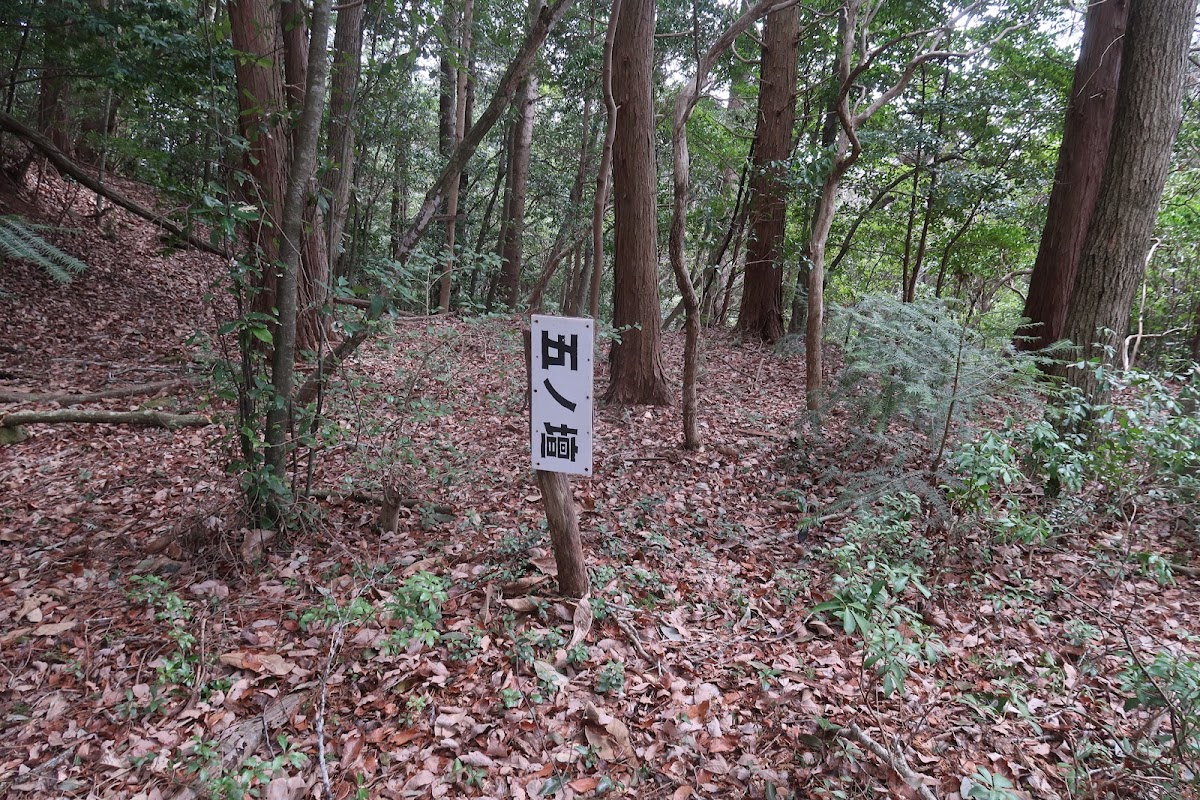
The main bailey, the center of the castle, is located at the highest point on the northern end. An information board is currently installed here, where visitors can learn about the castle’s history and structure. Traces of earthworks can be seen around the main bailey, indicating that defensive facilities were in place.
Bailey Group
Southward from the main bailey, multiple baileys are arranged in a stepped pattern. Each bailey is skillfully constructed utilizing the ridge’s topography, providing a glimpse into the mountain castle construction techniques of the Sengoku period. There are elevation changes between the baileys, demonstrating a design intended to enhance defensive capabilities.
Moat
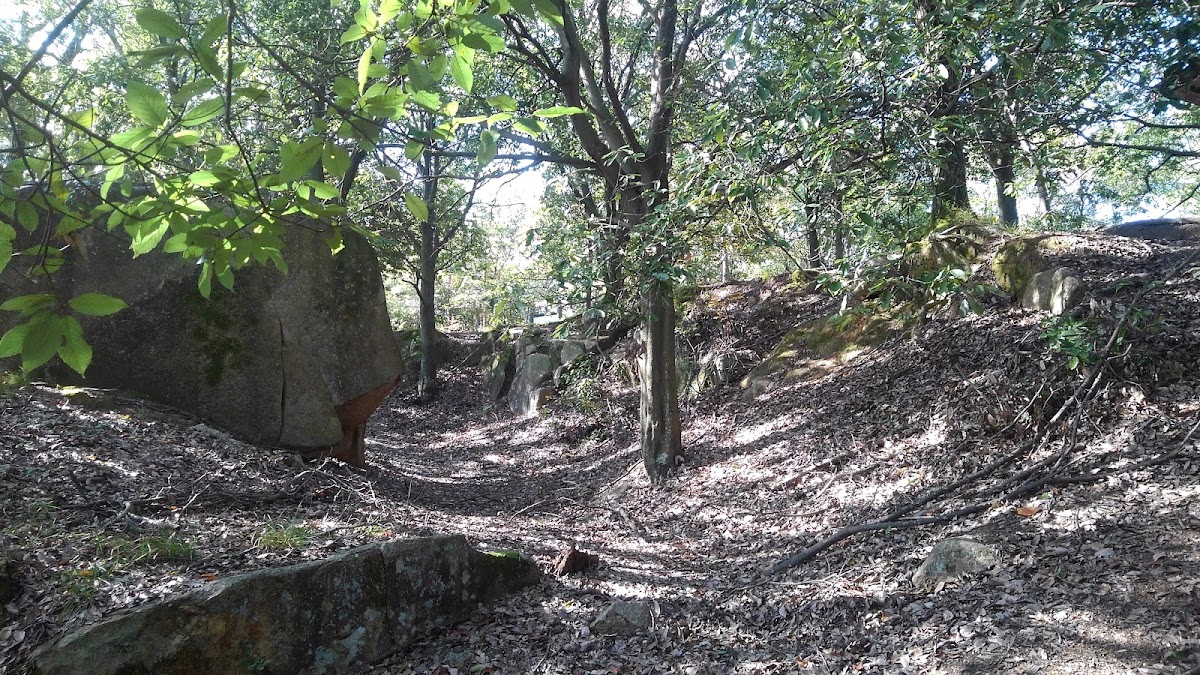
Moats dug to cut off the ridge are important defensive structures to prevent enemy intrusion. At Myōzenji Castle, a clear moat can be seen behind the main bailey (south side). This moat deeply cuts the ridge and is a key defensive feature of this mountain castle.
Stone Walls
Traces of stone walls and ramparts can be seen in some baileys. It is noteworthy that stone structures existed at a relatively early stage for a mountain castle of the Sengoku period. However, due to later alterations and natural collapse, only a limited portion remains as clearly defined stone walls.
Utilization of Topography
The most distinctive feature of Myōzenji Castle lies in its layout, which makes maximum use of the topography of the ridge of Mt. Misao. The northern side has a steep slope, functioning as a natural stronghold. The Asahi River, flowing along the western foot of the hill, and the Hyakken River, flowing from north to east, served as natural moats, enhancing the castle’s defensive capabilities.
Furthermore, Mount Misao is a highly isolated hill jutting out into the Okayama Plain, making it an ideal location for overlooking the surrounding terrain. It is believed that Ukita Naoie chose this location for two purposes: military surveillance and as a base for expansion into the Bitchu region.
Highlights of Myōzenji Castle
Well-Preserved Remains
The current Myōzenji Castle site is maintained as part of Misaoyama Park, and the remains of the mountain castle are preserved in relatively good condition. While some parts of the baileys, including the main enclosure, are overgrown with vegetation, the undulations of the terrain allow us to imagine the castle’s appearance in its heyday.
The moats, in particular, remain clearly visible, making them a must-see for mountain castle enthusiasts. The depth and width of the moats demonstrate how much emphasis was placed on defense in this castle’s construction.
The Magnificent View
The view from the main enclosure is one of the major attractions of visiting Myōzenji Castle. To the north, the city of Okayama stretches out, and on clear days, you can see as far as Bitchū. It’s a valuable place to relive the perspective of a Sengoku period warlord, imagining what Ukita Naoie gazed upon from this spot.
While observing the flow of the Asahi River and the ancient terrain scattered amidst the modern cityscape, you can understand the geopolitical importance of the Sengoku period.
The Nature of Misaoyama Park
Misaoyama Park, where the Myōzenji Castle ruins are located, is a beloved satoyama (traditional rural landscape) with abundant nature. You can enjoy the scenery of each season: cherry blossoms in spring, fresh greenery in early summer, and autumn leaves in fall. The ability to enjoy both exploring the castle ruins and observing nature simultaneously is another charm of this place.
At the Misaoyama Park Satoyama Center, you can obtain information about the nature and history of Misaoyama, and we recommend stopping by before visiting the castle ruins.
Access and Visiting Guide
Location
Address: Sawada, Naka-ku, Okayama City, Okayama Prefecture
Location: Within Misayama Park
Access by Public Transportation
When using public transportation to Myozenji Castle Ruins from JR Okayama Station, the bus is the most convenient option.
- Using the Bus from Okayama Station
From the Okayama Station East Exit Bus Terminal, take the Ryobi Bus bound for “Sawada” and get off at the “Sawada” bus stop. From the bus stop, it’s about a 15-20 minute walk to the castle entrance.
- Walking Time
Walking from Okayama Station takes about 40-50 minutes. The route to Misayama Park goes through the city center.
Access by Car
It’s about a 15-minute drive from the Sanyo Expressway Okayama Interchange. Misayama Park has a parking lot, and you can access the castle entrance on foot from there. However, since you will need to climb a mountain path from the parking lot to the castle ruins, we recommend wearing comfortable shoes.
Points to Note When Visiting the Castle
- Estimated Time: It takes about 20-30 minutes on foot from the parking lot or entrance to the main enclosure.
- Attire: As it is a mountain castle, comfortable shoes and clothing are essential.
- Season: Insect repellent is recommended in summer, and non-slip shoes are recommended even in winter.
- Drinks: There are no vending machines in the mountains, so prepare your own drinks beforehand.
- Maintenance: The walking paths are well-maintained, but some areas are overgrown.
Nearby Attractions
When visiting Myozenji Castle, we recommend also visiting the following nearby spots.
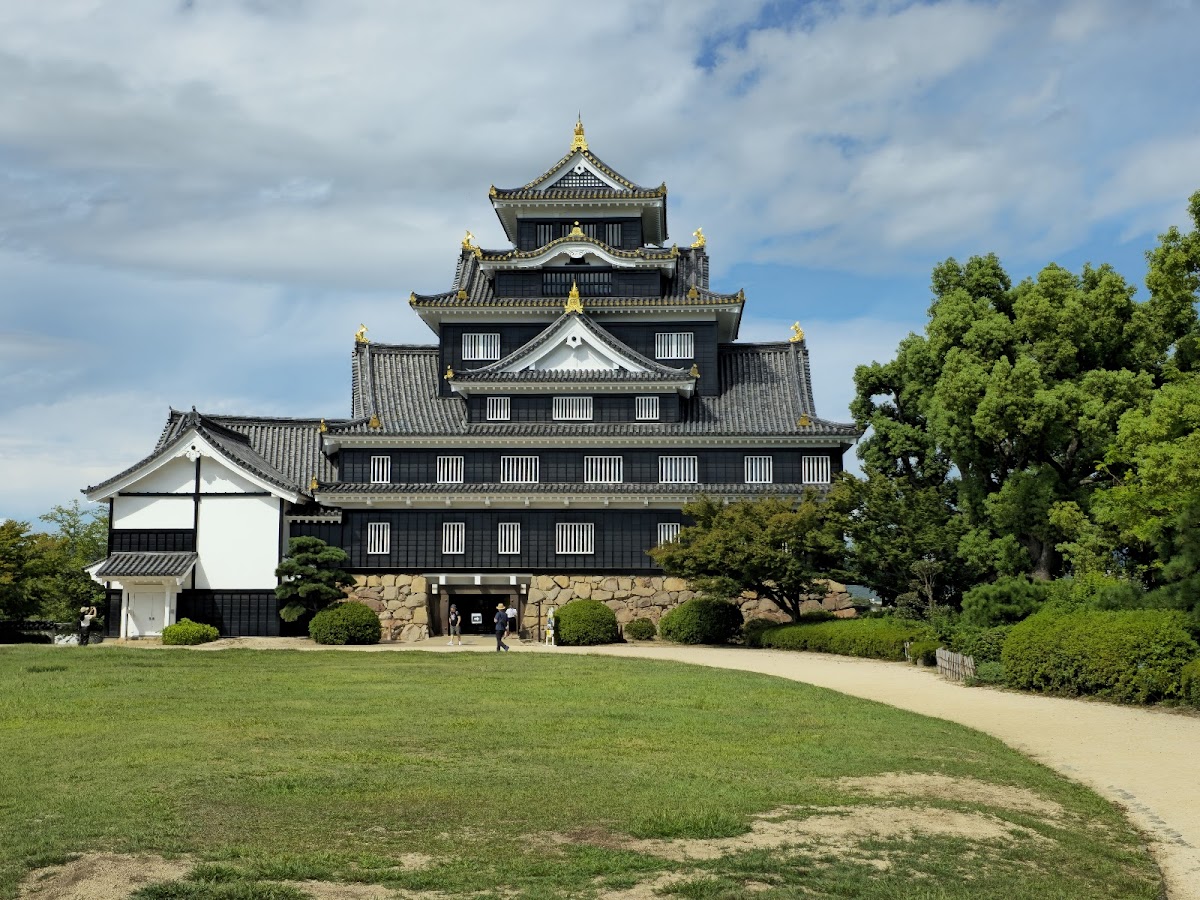
Okayama Castle Okayama Castle, which was extensively renovated by Ukita Hideie, is about a 15-minute drive from Myozenji Castle. Visiting Okayama Castle, which developed as the base of the Ukita clan, will give you a deeper understanding of its relationship with Myozenji Castle.
Misaoyama Park Satoyama Center
This facility allows you to learn about the nature and history of Misaoyama. It also displays materials about Myozenji Castle, making it ideal for gathering information before your visit.
Sawada Otsuka Kofun
Many Kofun period ruins are located around Misaoyama, including historical sites such as the Sawada Otsuka Kofun. You can feel the historical importance of this area, which has continued since ancient times.
Relationship between Myozenji Castle and the Ukita Clan
The Figure of Ukita Naoie
Ukita Naoie (1529-1582) was a samurai known as a Sengoku period daimyo of Bizen Province. The Ukita clan, which served the Urakami clan in his grandfather’s generation, declined for a time, but Naoie restored and expanded their power through strategy and military force.
Naohisa was known as a “genius of strategy,” and he expanded his power by skillfully using assassination and manipulation of rival warlords. The assassination of Mimura Iechika is one example, and the construction of Myōzenji Castle was a strategic action that was an extension of his strategic maneuvers.
The Road to Unifying Bizen
At the time of building Myōzenji Castle, Naohisa was still merely one power within Bizen Province. However, he gradually surpassed his lord, Urakami Munekage, and eventually became the de facto ruler of Bizen Province. Myōzenji Castle played a crucial role as a base to the west during this process.
Naohisa’s son, Ukita Hideie, was highly favored by Toyotomi Hideyoshi and grew to become a daimyo with a domain of 570,000 koku, becoming one of the Five Great Elders. Myōzenji Castle can be considered one of the castles that laid the foundation for the Ukita clan’s rise to power.
The Situation in Bizen and Bitchu Provinces during the Sengoku Period
Conflict with the Mimura Clan
The construction of Myōzenji Castle was rooted in the conflict between two major powers: the Ukita clan of Bizen Province and the Mimura clan of Bitchu Province. The Mimura clan, based at Matsuyama Castle in Bitchu Province, wielded considerable power within the region.
The assassination of Mimura Iechika by Ukita Naoie solidified the conflict between the two clans. The Battle of Myōzenji was a retaliatory battle waged by Mimura Motochika, and a symbolic event in the power struggle along the Bizen-Bitchū border.
Relationship with the Mōri Clan
The Mimura clan was allied with the Mōri clan, the dominant power in the Chūgoku region. Therefore, conflict with the Mimura clan indirectly meant conflict with the Mōri clan for the Ukita clan. However, Ukita Naoie skillfully used diplomatic techniques to approach Oda Nobunaga, eventually growing into a force that could rival the Mōri clan.
Relationship with the Mōri Clan
The Mimura clan was allied with the Mōri clan, the dominant power in the Chūgoku region. For the Ukita clan, conflict with the Mimura clan indirectly meant conflict with the Mōri clan as well. Myōzenji Castle was a symbolic castle that demonstrated the Ukita clan’s westward ambitions amidst the complex political landscape of the Sengoku period.
Value and Preservation Status as a Mountain Castle
A Typical Example of a Sengoku Period Mountain Castle
Myōzenji Castle is a valuable historical site that preserves the typical structure of a Sengoku period mountain castle. It compactly incorporates the basic elements of a mountain castle, such as a multi-bailey layout, the arrangement of baileys utilizing ridges, and defenses using moats, making it an important site for mountain castle research.
While stone structures such as stone walls are limited, this also means that it well preserves the appearance of a mountain castle as an earthen castle. Myōzenji Castle provides a valuable example for understanding what mountain castles looked like in the mid-Sengoku period.
Current Preservation Status
Currently, as part of the Misaoyama Park, the Myōzenji Castle ruins receive a certain level of protection. Information boards have been installed at the main remains, ensuring that visitors can understand the castle’s history and structure.
However, a challenge unique to mountain castles is the burial of remains due to overgrown vegetation and tree growth. Although regular maintenance is carried out, not all remains are clearly observable. Balancing castle site preservation with nature conservation remains a challenge for the future.
As a Place for Local History Education
The Myozenji Castle ruins are also utilized as a place for local history education. This castle site plays an important role in local elementary and junior high school local history studies and as a subject for fieldwork for history enthusiasts.
The Misaoyama Park Satoyama Center holds exhibitions and lectures on the history of Misaoyama, including Myozenji Castle, providing local residents with opportunities to learn about their local history.
The Significance of Visiting Myozenji Castle
Compared to large-scale castles like Okayama Castle and Bitchu Matsuyama Castle, Myozenji Castle is a relatively small and less well-known castle site. However, this castle holds important episodes that tell the history of Bizen and Bitchu during the Sengoku period.
How did Ukita Naoie, a genius of strategy, expand his power? How was the fierce Battle of Myōzenji fought? And how did this small mountain castle lay the foundation for the later 570,000-koku daimyo, the Ukita clan? When we confront these questions, Myōzenji Castle appears before us not merely as an earthen rampart, but as a living historical site where the history of the Sengoku period breathes.
Walking through the castle ruins amidst the nature of Mt. Misao, feeling the spirit of the Sengoku warlords, will be a historical learning experience that cannot be obtained from textbooks. When you visit Okayama, be sure to visit the Myōzenji Castle ruins and feel the ambition of Ukita Naoie and the spirit of the Sengoku period.
Summary
Myōzenji Castle is a Sengoku period mountain castle located on Mt. Misao in Okayama City, Okayama Prefecture. It was built in 1566 by Ukita Naoie and became the stage for the Battle of Myōzenji the following year. This mountain castle, with its interconnected layout, boasts well-preserved remains such as baileys and moats, conveying the appearance of a Sengoku period mountain castle to the present day.
Even now, as Misaoyama Park, it offers plenty to see, including the views from the main bailey and clearly defined moats. It’s relatively easy to access from Okayama Station, making it popular not only with history buffs but also with hikers.
As the stage for Ukita Naoie’s westward ambitions, fierce conflicts with the Mimura clan, and the eventual rise of the Ukita clan, Myozenji Castle holds a significant place in the Sengoku history of Bizen and Bitchu provinces. It’s a historical site that anyone wanting to learn more about Okayama’s history should definitely visit.