Muya Castle (Naruto City, Tokushima Prefecture) Complete Guide | History, Highlights, and Access Information
Muya Castle, located in Hayashizaki, Muya-cho, Naruto City, Tokushima Prefecture, is a historic castle site also known as “Okazaki Castle” or “Hayashizaki Castle.” This castle, which played an important role as a gateway to Awaji Island at the easternmost tip of Shikoku, is now designated as a Naruto City Historic Site as “Okazaki Castle Ruins” and is a popular tourist attraction as Myokenyama Park. This article provides a detailed explanation of Muya Castle, from its history to its current highlights and access methods.
What is Muya Castle? | Basic Information and Overview
Muya Castle is a flatland castle built on Myokenyama (Kojoyama), which is 62 meters above sea level. Its excellent location overlooking the Konaruto Strait meant it played a crucial role in monitoring the maritime traffic between Awa Province (present-day Tokushima Prefecture) and Awaji Island.
Alternative Names and Historic Site Designation
Muyō Castle has several names:
- Okazaki Castle (Okazaki-jō): The most common alternative name, and the official name of the city-designated historic site is “Okazaki Castle Ruins.”
- Hayashizaki Castle (Hayashizaki-jō): An alternative name derived from the place name where it is located.
Currently, it is designated as a cultural property of Naruto City as “Okazaki Castle Ruins” and is protected as a local historical heritage site.
Position as One of the Nine Castles of Awa
Muyō Castle is counted as one of the Nine Castles of Awa. The Nine Castles of Awa are a collective term for the nine castles that Hachisuka Iemasa established as branch castles of Tokushima Castle after the conquest of Shikoku in 1585, when he became the new lord of Awa Province. These castles were strategically located within Awa Province, centered around Tokushima Castle, and served as bases for governing and defending the territory.
Muya Castle held a particularly important position among them, functioning as a strategic stronghold controlling the sea route to Awaji Island.
History of Muya Castle | From Construction to Abandonment
Medieval Muya Castle | The Era of the Ogasawara and Miyoshi Clans
Many details about the founding date of Muya Castle are unknown, and no reliable records remain. According to tradition, it was the residence of the Ogasawara clan, but the specific construction date and detailed circumstances are unclear.
During the Muromachi period, Muya was within the sphere of influence of the Miyoshi clan, who ruled Awa Province, and developed as a castle town of the Miyoshi clan. During this period, Muya prospered through trade with Awaji Island, establishing its position as an important port town in northern Awa Province.
The Shikoku Campaign and the Entry of the Hachisuka Clan
The history of Muya Castle underwent a major turning point with the Shikoku Campaign in 1585 (Tensho 13). Following Toyotomi Hideyoshi’s conquest of Shikoku, Awa Province came under the control of Hachisuka Iemasa, who had previously ruled under the Chosokabe clan.
Hachisuka Iemasa made Tokushima Castle his residence and adopted a policy of establishing branch castles at strategic locations within Awa to strengthen his control over the territory. At this time, Muya Castle was officially incorporated into the network of Tokushima Castle’s branch castles as one of the nine castles of Awa.
The Era of Masuda Masatada and the Castle Warden
Hachisuka Iemasa appointed his retainer, Masuda Masatada, as the castle warden (responsible for defending the castle) of Muya Castle. The Masuda family had traditionally managed Muya Castle, monitoring and defending the sea route to Awaji Island and governing the surrounding area.
Muya Castle was less of a complete military fortress and more of a castle that monitored a strategic transportation hub and served as a base for governing the territory. With the establishment of the castle warden, the town of Muya further developed as a castle town.
The Edo Period and the Abandonment of Castles
During the Edo period, many branch castles were abandoned due to the Tokugawa Shogunate’s “One Castle Per Province” decree. It is believed that Muyō Castle also lost its formal function as a castle, but it may have continued to be used in some form under the management of the Tokushima Domain.
After the Meiji Restoration, the castle site became the grounds of Myōken Shrine, and remains a place of local worship to this day.
Present-day Muyō Castle | Myōkenyama Park and a Replica Keep
Development as Myōkenyama Park
Currently, Myōkenyama, where the Muyō Castle ruins are located, has been developed as Myōkenyama Park, a place of relaxation for the citizens of Naruto. The park has walking paths and offers a rich natural environment where visitors can enjoy cherry blossoms in spring and autumn leaves in fall.
From near the summit, you can enjoy a panoramic view of the Konaruto Strait, the city of Naruto, and Awaji Island, allowing you to appreciate the importance of the watchtower function the castle once played.
Construction of the Mock Castle Tower
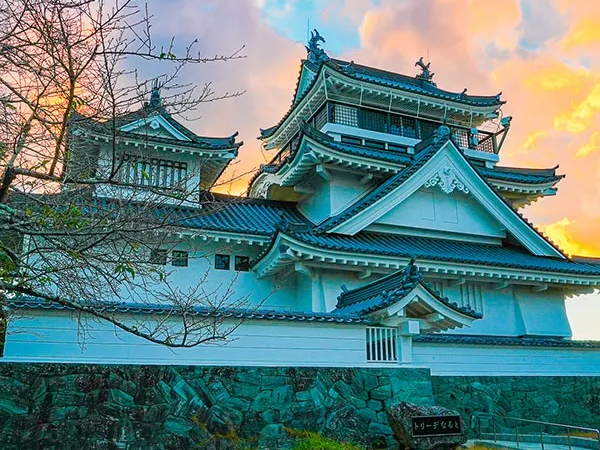
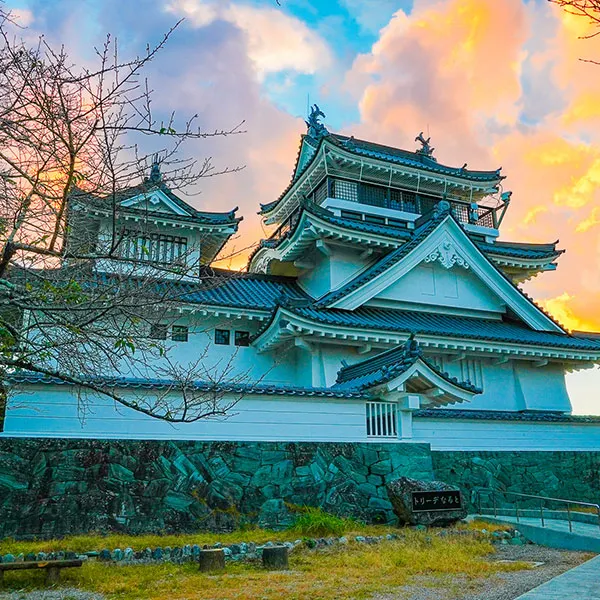
Near the summit of Mt. Myoken, a three-story mock castle tower has been erected. This tower is not a historical reconstruction based on historical documents, but rather a replica built as a tourist attraction. However, it is a beloved symbol of Muyō Castle.
The white-walled tower stands out even from afar and is one of Naruto City’s landmarks. The interior was once used as a community exchange facility, and has now reopened as “Toride Naruto,” serving as a hub for local cultural activities and tourism.
Relationship with Myoken Shrine
Myoken Shrine, from which Mt. Myoken derives its name, is located in the center of the castle ruins. The approach to Myoken Shrine serves as the access route to the castle ruins; a five-minute climb up the stone steps leads to the castle ruins area.
The integrated landscape of the shrine and castle ruins is a common sight at Japanese castle ruins, creating a unique atmosphere where faith and history are fused.
Highlights of Muyō Castle | Points to Note When Visiting
Remains of Stone Walls and Enclosures
At the site of Muyō Castle, some of the original stone walls remain. While not in their complete form, you can observe the rough-hewn stone walls, offering a glimpse into the castle-building techniques of the Sengoku period to the early Edo period.
Traces of the castle’s layout (design) also remain in the terrain, allowing you to enjoy understanding the castle’s structure by imagining the arrangement of the enclosures (kuruwa, sections within the castle) as you stroll around.
Stunning Views
One of the greatest attractions of Muyō Castle is the view from the mountaintop. You can see Awaji Island across the Naruto Strait, and enjoy panoramic views of Naruto city and the mountains of Shikoku. On clear days, you can even see the islands of the Seto Inland Sea, experiencing the same scenery that the former lords and castle guards saw.
The view at sunset is particularly beautiful and is a popular spot for photography.
View from the Replica Castle Tower
From the upper levels of the replica castle tower, you can enjoy an even higher vantage point (opening hours vary depending on the season, so please check before visiting). The 360-degree panoramic view is breathtaking, offering a wide vista stretching towards the Naruto Strait and Tokushima City.
Castle Notes | Points of Interest for Visitors
Points of interest for castle enthusiasts and history buffs visiting Muya Castle:
- Comparison with the Nine Castles of Awa: Visiting while comparing it with the other nine castles of Awa (Tokushima Castle, Kawashima Castle, Ushiki Castle, Ichinomiya Castle, etc.) helps understand the Hachisuka clan’s territorial control strategy.
- Naval Castle Characteristics: Due to its location facing the Konaruto Strait, it has the characteristics of a “naval castle” that monitored maritime traffic.
- Connection to Local History: The relationship between Muya’s salt industry and development as a port town and the castle.
Access Information | How to Get to Muya Castle
Access by Public Transportation
By Train:
- Get off at JR Naruto Line “Muya Station,” approximately 15 minutes on foot.
- Walk from the station to the torii gate of Myoken Shrine, then climb the stone steps of the approach.
By Bus:
- Get off at Tokushima Bus “Muya” bus stop, approximately 10 minutes on foot.
Access by Car
Using the Expressway:
- Approximately 5 minutes from the Naruto Kita Interchange on the Kobe-Awaji-Naruto Expressway
- Approximately 10 minutes from the Naruto Interchange on the same expressway
Parking:
- Parking spaces available around Myoken Shrine (limited number of spaces)
- Parking at Myokenyama Park is available
Location
772-0003 Hayashizaki, Muya-cho, Naruto City, Tokushima Prefecture
Nearby Tourist Attractions | Places to Visit in Combination with Muya Castle
Naruto Whirlpools
The Naruto Whirlpools, a representative tourist attraction of Naruto City, are approximately 15 minutes by car from Muya Castle. You can view the world’s largest whirlpools from sightseeing boats or the “Uzunomichi” promenade on the Great Naruto Bridge.
Otsuka International Museum of Art
Japan’s largest museum, featuring life-size reproductions of world-famous paintings on ceramic panels. Located approximately 20 minutes by car from Muya Castle, it’s a facility you can enjoy for a whole day.
A Tour of the Nine Castles of Awa
For history buffs, a trip to visit the other nine castles of Awa in Tokushima Prefecture is also recommended:
- Tokushima Castle (Tokushima City): The residence of the Hachisuka clan; the castle hill and garden are highlights.
- Kawashima Castle (Yoshinogawa City): A flatland castle along the Yoshino River.
- Ichinomiya Castle (Tokushima City): Well-preserved remains of a mountain castle.
Exploring the Townscape of Muya
The old town of Muya retains the atmosphere of a former castle town and port town. Facilities that tell the history of the local salt industry and old merchant buildings are scattered throughout the area.
Cultural Value of Muya Castle | Importance in Regional History
Relationship with Awaji Island
Muya Castle was located at a key point for maritime traffic connecting Shikoku and Awaji Island, and therefore played an important role in the history of exchange between the two regions. Throughout the Edo period, it functioned as a gateway to Awaji Island, managing the movement of people and goods.
Connection to the Salt Industry
Muya has long been known as a region of salt industry. “Muya salt” was a renowned specialty product of Awa Province and supported the economy of the castle town. The castle’s administrators also oversaw salt production and distribution, making it an important source of revenue for the domain.
Core of Regional Identity
Even today, the ruins of Muya Castle symbolize the regional identity of Naruto citizens, especially those from the former Muya town area. The replica castle tower is a beloved symbol of the region and serves as a base for various events and community activities.
Best Season and Ways to Enjoy Visiting Muya Castle
Spring Cherry Blossom Season
Cherry trees are planted in Myokenyama Park, and they are in full bloom from late March to early April. The contrast between the cherry blossoms and the replica castle tower is beautiful, making it a popular spot for cherry blossom viewing among locals.
Autumn Foliage Season
Mid-November to late November is the season for beautiful autumn foliage. The entire mountain is ablaze with color, allowing visitors to enjoy the harmony between the historic castle ruins and nature.
Estimated Visit Time
- Short Visit: 30 minutes to 1 hour (Visit to Myoken Shrine and stroll around the reconstructed castle tower)
- In-Depth Visit: 1 to 2 hours (Includes time for observing the stone walls and baileys, and enjoying the views)
- Including Surrounding Sightseeing: Half a day to a full day (Combining a stroll through the town of Muya with other tourist spots)
The Future of Muya Castle | Preservation and Utilization Efforts
Naruto City is working to preserve the Muya Castle ruins as a valuable cultural asset while also utilizing them as a tourist resource. The facility’s renewal as “Toride Naruto” is part of this effort.
It is also used as a place for local history education, and is utilized in various ways, including for local history studies by elementary and junior high school students and as a research subject for history enthusiasts.
Summary | Experience the Charm of Muya Castle
Muya Castle in Naruto City, Tokushima Prefecture, is a historic castle site that, as one of the nine castles of Awa Province, protected a strategic point connecting Shikoku and Awaji Island. Currently, it is maintained as Myokenyama Park, a tourist spot where visitors can enjoy a replica of the castle tower, remnants of the stone walls, and magnificent views.
By visiting Muya Castle in conjunction with other famous tourist attractions such as the Naruto whirlpools and the Otsuka International Museum of Art, you can comprehensively experience the nature, culture, and history of Naruto City. When traveling to Shikoku, be sure to visit Muya Castle and enjoy the history of Awa Province and the spectacular views of the Seto Inland Sea.
Climbing the path to Myoken Shrine and gazing at the scenery seen by the former castle lords, you will feel closer to the history of Awa Province from the Sengoku period to the Edo period. Muya Castle is a fascinating historical site where the history of Japanese castles and local culture are fused together.