Motoyama Castle (Kochi Prefecture, Nagaoka District) Complete Guide | History and Highlights of the Castle of the Motoyama Clan, One of the Seven Heroes of Tosa
What is Motoyama Castle?
Motoyama Castle is a Japanese castle located in Motoyama, Motoyama-cho, Nagaoka-gun, Kochi Prefecture. Known as the residence of the Motoyama clan, one of the “Seven Heroes of Tosa” during the Sengoku period, it played a crucial role in the history of Tosa Province as a mountain castle built at a strategic point along the Yoshino River. Currently, it is designated as a historical site by Motoyama Town and is maintained as Shiroyama Park.
Built on a mountaintop approximately 250 meters above sea level, Motoyama Castle boasted an excellent location overlooking the Yoshino River, making it a strategic base controlling a key transportation point in the mountainous region of Nagaoka District, Tosa Province. The castle ruins retain well-preserved remains such as baileys and moats, making it a valuable cultural asset that conveys the appearance of a Sengoku period mountain castle.
Basic Information on Motoyama Castle
Location: Motoyama, Motoyama-cho, Nagaoka-gun, Kochi Prefecture
Former Province: Tosa Province
Other Names: None
Castle Structure: Mountain Castle
Builder: Motoyama Clan (Yagi Clan)
Year of Construction: Details unknown (estimated to be the medieval period)
Main Lord: Motoyama Clan
Year of Abandonment: Around 1575 (Tensho 3)
Remains: Enclosures, moats, earthworks, stone walls (partial)
Designated Cultural Property: Motoyama Town Designated Historic Site
Elevation: Approximately 250 meters
Relative Height: Approximately 70 meters
History and Background of Motoyama Castle
The Origins and Construction of the Motoyama Clan
There are various theories regarding the origins of the Motoyama clan, but the most plausible theory is that the Yagi clan, a branch of the Kira clan descended from the Seiwa Genji, settled in the area and adopted the name “Motoyama” after the place name. On the other hand, there is also a theory that they were descended from the Taira clan. In any case, it is believed that the Motoyama clan began when the Yagi clan took root in the area, adopted the name Motoyama, and built up their power.
The exact construction date of Motoyama Castle is unknown, but it is thought to have already functioned as the Motoyama clan’s residence during the medieval period. Its location along the Yoshino River, controlling a major transportation route, provided ideal conditions for a political and military base in the inland part of Tosa Province.
Rise During the Sengoku Period
During the Sengoku period, the Motoyama clan became powerful enough to be counted as one of the “Seven Great Heroes of Tosa.” The Seven Great Clans of Tosa refer to seven powerful local clans that vied for power in Tosa Province during the Sengoku period. Besides the Motoyama clan, these included the Chosokabe, Aki, Tsuno, Ohira, Kira, and Kosokabe clans.
The Motoyama clan reached its peak of power during the time of Motoyama Shigemune (Baikei). Shigemune is said to have possessed a territory worth 5,000 kan and expanded his influence into central Tosa. During this period, the Motoyama clan sought to advance into the Tosa Plain, building Asakura Castle (Asakura, Kochi City) and moving their residence there. Asakura Castle was strategically located in the Tosa Plain, serving as a base that allowed for broader control.
Motoyama Shigemune is known as an excellent military commander and pursued an aggressive policy of territorial expansion. The Motoyama clan’s influence within Tosa was at its greatest during this period, and at one time, it is said to have rivaled the power of the Chosokabe clan.
Conflict with the Chosokabe Clan and Decline
However, from the mid-16th century, the power dynamics within Tosa Province changed dramatically. The Chosokabe clan rapidly expanded its power under two generations, Kunichika and Motochika, and began its path to unifying Tosa. Chosokabe Motochika, in particular, displayed exceptional military talent, subjugating numerous surrounding powerful families.
The Motoyama clan also came under the pressure of the Chosokabe clan. During the time of Motoyama Shigetatsu, the eldest son of Motoyama Shigemune, the conflict with the Chosokabe clan intensified. In the Battle of Nagahama in 1560 (Eiroku 3), Chosokabe Motochika made his debut, achieving victory against the Motoyama clan.
The pressure from the Chosokabe clan continued, and the Motoyama clan gradually found themselves at a disadvantage. Finding it difficult to maintain Asakura Castle, Motoyama Shigetatsu was forced to reluctantly return his base to Motoyama Castle. This event symbolized the decline of the Motoyama clan’s power.
The Fall of Motoyama Castle and the Downfall of the Motoyama Clan
Around 1575 (Tensho 3), Motoyama Castle is believed to have finally fallen to an attack by the Chosokabe clan. While detailed records of the siege are not available, it is believed that the Motoyama clan surrendered to the Chosokabe clan and came under their control around this time.
After the fall of Motoyama Castle, the Motoyama clan was incorporated as vassals of the Chosokabe clan. This once prominent family, one of the seven powerful clans of Tosa, lost its independence during the Chosokabe clan’s unification of Tosa, thus ending its historical role.
From the Edo Period Onward
In the Edo period, Tosa Province came under the rule of the Yamauchi clan. Yamauchi Kazutoyo, who was granted Tosa Province by Tokugawa Ieyasu for his service in the Battle of Sekigahara, entered the province and governed the Tosa Domain from Kochi Castle.
Although Motoyama Castle was abandoned during the Edo period, some of its facilities may have been in use. Records suggest that retainers of the Yamauchi clan, such as Yamauchi Gyobu, governed the area and were involved in the management of the castle ruins.
After the Meiji Restoration, Motoyama Castle was largely neglected, but in the latter half of the 20th century, it began to be re-evaluated as a local historical heritage site. Currently, it is maintained as Shiroyama Park by Motoyama Town, with hiking trails and information boards. Designated as a town historical site, it is utilized for local history education and as a tourist resource.
Structure and Remains of Motoyama Castle
Overall Structure of the Castle
Motoyama Castle has the typical structure of a medieval mountain castle, with multiple baileys arranged around the main bailey at the mountaintop. It utilizes the Yoshino River as a natural moat and is protected by steep slopes on the north and east sides, creating a strong and formidable fortress.
The castle area extends approximately 300 meters north-south and 200 meters east-west, and while relatively compact, it was designed with an emphasis on defensive functionality. From the main enclosure, a series of baileys are arranged along the ridge, with trenches strategically placed to deter enemy intrusion.
Main Enclosure (Honmaru)
Located at the mountaintop, the main enclosure is the core of Motoyama Castle. Measuring approximately 40 meters east-west and 30 meters north-south, it is presumed to have housed the lord’s residence and important facilities. Even today, a relatively flat terrain remains, allowing us to imagine its former appearance.
Remnants of earthworks can be seen around the main enclosure, indicating its strong defenses. Additionally, some stonework, believed to be stone walls, remains, but there is debate as to whether these are original to the castle’s construction or later additions.
Group of Baileys
Several baileys are arranged around the main enclosure. In particular, the western and southern sides feature a series of terraced baileys, forming a defensive line. These enclosures are thought to have been used as residences for retainers, barracks for soldiers, and storage facilities for supplies.
While the size of each enclosure varies, they all skillfully utilize the mountainous terrain, demonstrating the high level of castle-building technology of the medieval period. The enclosures are separated by steep slopes (artificially constructed ramparts), a design feature that enhances defensibility.
Moats
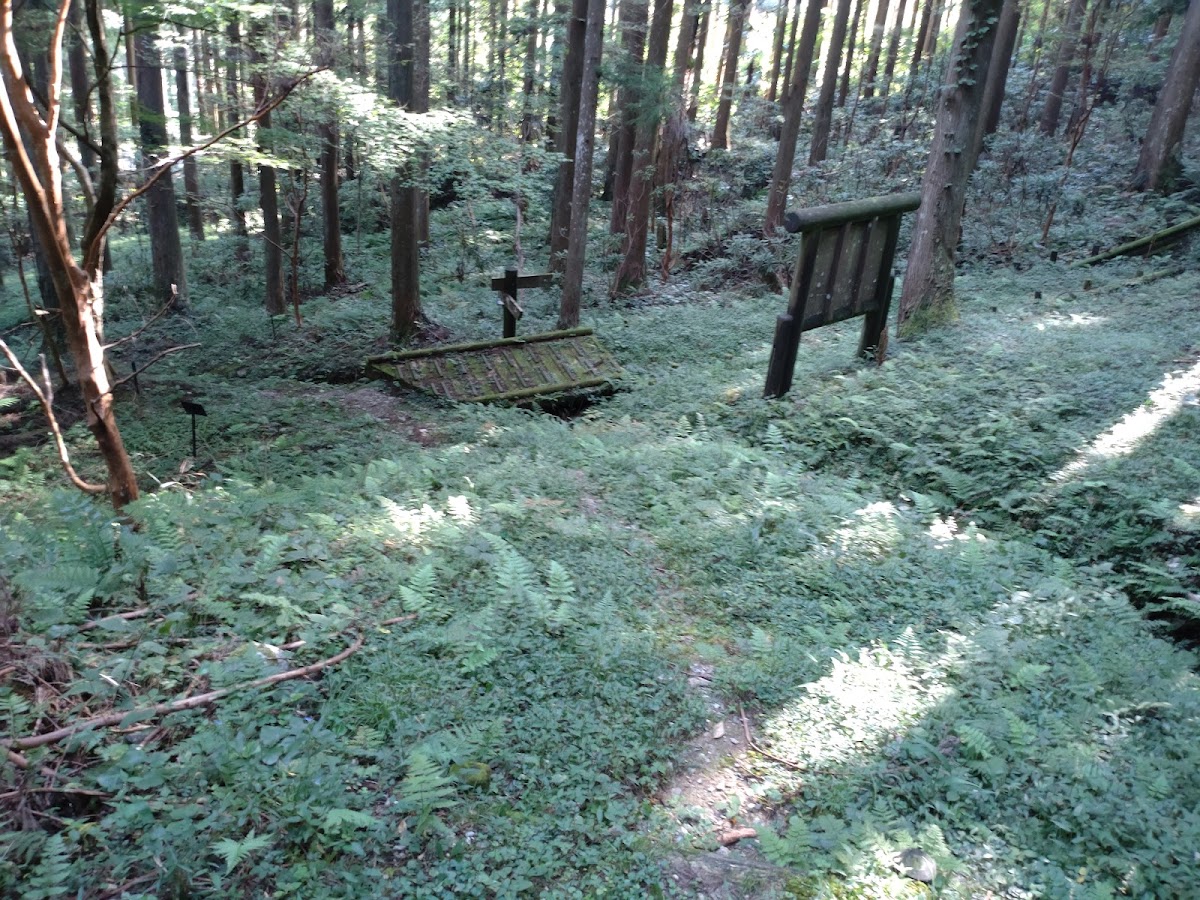
The moats are particularly noteworthy defensive features of Motoyama Castle. Digged to cut off the ridgeline, these moats played a crucial role in preventing enemy incursions. Clear traces of moats can still be seen in several locations, with particularly large moats remaining on the southern ridge.
The depth of the moats varies depending on the location, but some reach over 5 meters in depth, making them valuable historical remains that demonstrate the level of civil engineering technology at the time.
Stone Walls and Stone Masonry
Stone walls and stone masonry can be seen in parts of Motoyama Castle. However, it is believed that these stone masonry structures are a mixture of those from the time of construction and those built after the Edo period. There are parts that are difficult for even experts to determine, and further detailed investigation is awaited.
Stone wall construction techniques developed rapidly from the late Sengoku period to the early Edo period, so determining the age of the stonework at Motoyama Castle is an important clue to understanding the castle’s history.
Access Route and Gate
Currently, the access route to Motoyama Castle is maintained from near the Junisho Shrine, but this was established in modern times. There are no clear records of the locations of the original main and rear entrances.
Some topographical features suggesting the remains of a gate (koguchi) are visible, but the detailed structure is unknown. Further excavations are expected to reveal a more detailed castle structure.
Highlights of Motoyama Castle
Well-Preserved Enclosures and Moats
The greatest highlight of Motoyama Castle is the well-preserved group of enclosures and moats. The enclosures around the main enclosure, in particular, are clearly identifiable, allowing observation of a typical structure of a medieval mountain castle. The moat is deeply and sharply dug, making it a valuable historical site that allows you to experience the reality of defensive structures from the Sengoku period.
View of the Yoshino River
From the mountaintop, you can enjoy a panoramic view of the Yoshino River and its basin. This view gives a real sense of the strategic importance of Motoyama Castle as a key transportation point. Especially on clear days, you can enjoy the beautiful scenery created by the Tosa mountain range and the clear Yoshino River.
Development as Shiroyama Park
The area has been developed as Shiroyama Park by Motoyama Town, with hiking trails and information boards. Because it is a relatively easy mountain castle to climb, even beginners can easily visit. In spring, cherry blossoms bloom, and it is a popular place of relaxation for local residents.
Junisho Shrine
Near the entrance to the castle, Junisho Shrine has deep ties to Motoyama Castle. It is said to have been a shrine worshipped by the Motoyama clan and played an important role as the guardian shrine of the castle. We recommend visiting this shrine when exploring the castle ruins.
Access Methods
Access by Car
Approximately 20 minutes from the Otoyama Interchange on the Kochi Expressway via National Route 439. There is a parking lot at the Motoyama Town Platinum Center, from which you can walk to the castle ruins.
Parking: Motoyama Town Platinum Center (Free)
Estimated Time: Approximately 5 minutes on foot from the parking lot to the Junisho Shrine, and approximately 15 minutes on foot from the Junisho Shrine to the castle ruins (main area).
Access by Public Transportation
Approximately 25 minutes on foot from Motoyama Station on the JR Dosan Line to the castle entrance. Since the number of trains is limited, it is recommended to check the timetable in advance.
Precautions for Visiting the Castle
- The hiking trail is well-maintained, but we recommend wearing comfortable, broken-in shoes.
- Don’t forget insect repellent in summer and warm clothing in winter.
- Bring drinking water with you.
- Be careful as the ground can be slippery during and after rain.
Attractions Around Motoyama Castle
Motoyama Town Historical and Folk Museum
This museum displays materials related to Motoyama Castle and the Motoyama clan. Visiting before visiting the castle ruins will allow you to understand the history more deeply.
Asemigawa River
The Asemigawa River, a tributary of the Yoshino River, is known for its clear waters and is a great place to enjoy river activities in the summer. It’s a spot where you can experience the rich nature of Motoyama Town.
Kizenzan Park
This park in Motoyama Town is known as a famous cherry blossom viewing spot. It is bustling with many cherry blossom viewers in spring.
Research and Preservation Activities for Motoyama Castle
Research and investigation of the Motoyama Castle ruins are being conducted primarily by the Motoyama Town Board of Education. In recent years, investigations by local history enthusiasts and castle researchers have also been carried out, accumulating new knowledge.
Regarding the preservation of the remains, minimal maintenance is being carried out to prevent natural collapse, but the policy is to avoid excessive alteration and preserve the castle’s original appearance as much as possible. It is expected that more detailed archaeological excavations will reveal more about the true nature of Motoyama Castle.
Local residents also conduct cleaning and guided tours, carefully protecting the site as a local historical heritage.
Summary
Motoyama Castle was the residence of the Motoyama clan, who played an important role in Tosa Province during the Sengoku period, and is a valuable historical site that conveys the history of a prominent family that was one of the seven powerful clans of Tosa. The well-preserved remains, such as baileys and moats, are important resources for understanding the structure of medieval mountain castles.
The view overlooking the Yoshino River and the atmosphere of the castle ruins nestled in the quiet mountains evoke the spirit of the Sengoku period in visitors. Because it’s a relatively easy mountain castle to climb, it’s a recommended spot not only for castle enthusiasts but also for general history buffs.
When visiting Kochi Prefecture, why not take a trip to Motoyama Castle ruins and reflect on the Sengoku history of Tosa?
References
- “Comprehensive Survey of Japanese Castles, Vol. 15: Kochi and Ehime” (Shin Jinbutsu Oraisha)
- “History of Motoyama Town” (Motoyama Town History Compilation Committee)
- “Medieval Castle Sites in Kochi Prefecture” (Kochi Prefecture Board of Education)
- “Tosa no Kuni Gunsho Ruiju” (Tosa Province Compendium of Historical Documents)
- “Castle Research Series” (supervised by Hirai Sei)
- “Illustrated Dictionary of Medieval Castles” (Shin Jinbutsu Oraisha) (edited by Murata Shuzo)