Complete Guide to Matsuo Old Castle (Ueda City, Nagano Prefecture) | A Thorough Explanation of the Sanada Clan’s Early Mountain Castle
What is Matsuo Old Castle?
Matsuo Old Castle (Matsuo-kojō) is a Sengoku period mountain castle located in Sanada-machi, Ueda City, Nagano Prefecture. It is known as one of the earliest castles used by the Sanada clan before they fully emerged onto the historical stage. To distinguish it from the Sanada main castle (Matsuo Castle) later built by the Sanada clan, it is also called “Matsuo Old Castle” or “Kakuma Castle.”
Built on the summit of a mountain at an altitude of 1033.7m, at the tip of a ridge extending from Mount Masuo, nestled between the Kakuma River and the Kanna River, this castle boasts an excellent location overlooking the Ueda Basin and Sugadaira Plateau. It is an important historical site that can be considered the origin of the Sanada clan’s development in Chiisagata District, Shinano Province.
Basic Information on Matsuo Old Castle
Location: Hinata/Yokosawa, Naga, Sanada-machi, Ueda City, Nagano Prefecture
Other Names: Matsuo Castle, Kakuma Castle
Castle Structure: Mountain Castle
Elevation: 1033.7m (Relative Height approx. 200m)
Construction Period: Estimated to be mid-to-late Muromachi period
Builder: Believed to be the first or second head of the Sanada clan
Main Lord: Sanada clan
Year of Abandonment: Late Sengoku period (due to relocation to Sanada Honjo Castle)
Remains: Enclosures, moats, stone walls, earthworks
Designated Cultural Property: Ueda City Historic Site
History of Matsuo Old Castle
The Sanada Clan’s Early Residence
The exact construction date of Matsuo Castle is uncertain due to a lack of clear historical records. However, archaeological excavations at the “Hinatahata Ruins,” located at the southern foot of the castle, have uncovered burial mounds dating from the Muromachi to Sengoku periods. These ruins are believed to be the site of the Sanada clan’s early residence, and a connection to Matsuo Castle has been suggested.
The Sanada clan, as a branch of the Unno clan, established their power in this region. Matsuo Castle is presumed to have been used by the Sanada clan during the process of establishing their power as a local powerful family before they rose to prominence as a full-fledged Sengoku daimyo.
Relocation to Sanada Main Castle
As the Sengoku period progressed, the Sanada clan built a new castle, Sanada Main Castle (Matsuo Castle), which offered superior defenses and habitability. Located north of Matsuo Castle, Sanada Main Castle was developed as a mountain castle with larger baileys, and it came to function as the Sanada clan’s headquarters.
This relocation marked the end of Matsuo Old Castle’s role as the main castle, but it may have continued to function as a subsidiary castle or lookout post of the Sanada main castle. Given its strategic location at the entrance to the Kakuma Valley, it is believed to have played a role in monitoring enemy movements from the Ueda and Sugadaira areas.
The Sanada Clan and the Sengoku History of Shinano
The Sanada clan experienced a significant rise during the time of Sanada Yukitaka (Yukitsuna), who served Takeda Shingen. Yukitaka played a crucial role in the Takeda’s invasion of Shinano, particularly achieving military success in the capture of Toishi Castle. Later, Sanada Masayuki survived as an independent force after the fall of the Takeda clan, and in 1583, he built Ueda Castle.
Matsuo Old Castle, as one of the earliest bases in the Sanada clan’s development, is an indispensable historical site for understanding the roots of the Sanada clan.
Layout and Remains of Matsuo Old Castle
Characteristics of the Main Enclosure (Honmaru)
The main enclosure of Matsuo Old Castle is located on the mountaintop at an altitude of 1033.7m and measures approximately 30m east-west and 20m north-south. The view from the main enclosure is excellent, offering panoramic views of the Sugadaira Plateau to the north, Ueda city to the south, and the Chikuma River basin to the east. This wide view supports its function as a lookout post.
Remnants of earthworks remain around the main enclosure, indicating defensive measures. Furthermore, traces of stonework have been confirmed within the main enclosure, suggesting that it was not simply an earthen castle, but that a certain level of stonework technology was employed.
Arrangement of Enclosures
Matsuo Old Castle has a layout of interconnected enclosures, with multiple enclosures arranged along the ridge, centered around the main enclosure. The second and third baileys are arranged in a stepped fashion to the east and west of the main enclosure, cleverly utilizing the ridge’s topography.
Moats are provided between each bailey, a measure taken to prevent enemy intrusion. The moat between the main enclosure and the second bailey is particularly well-preserved, conveying the defensive system of the time.
Stone Walls and Stone Masonry
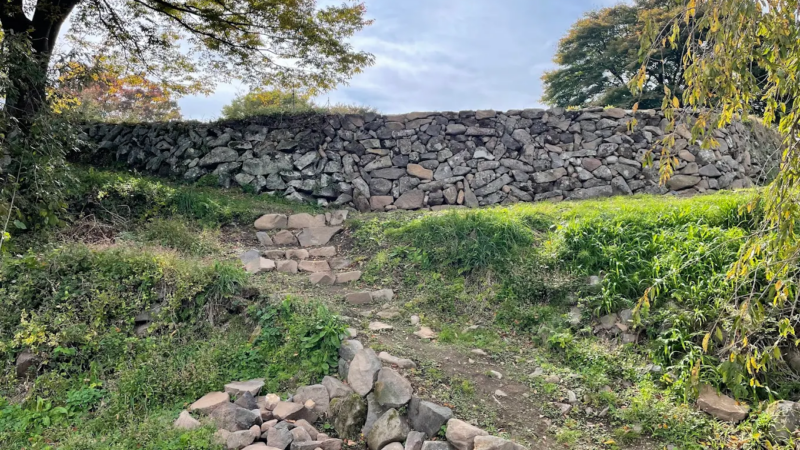
At Matsuo Old Castle, traces of stone masonry have been confirmed, mainly in the main enclosure. While these are not the highly sophisticated stonework techniques seen in later castles like Sanada Honjo or Ueda Castle, they suggest that stones were piled up to reinforce the edges of the baileys and the entrances.
The stone masonry technique is similar to “nozurazumi,” a simple method of stacking natural stones, but it is an important remains indicating that the Sanada clan possessed stone-based castle construction techniques from an early stage.
Moats and Earthworks
Moats that divide the ridge are important defensive structures in mountain castles. At Matsuo Old Castle, a large moat was constructed behind the main enclosure (on the north side), serving to block enemies advancing along the ridge.
The moat is still over 5 meters deep today, and it is estimated to have been even deeper in the past. Earthen ramparts were built on both sides of the moat, further enhancing its defensive capabilities. This combination of moat and ramparts is a typical defensive structure common to mountain castles of the Sengoku period.
Function as a Lookout Post
It is highly likely that Matsuo Old Castle continued to function as a lookout post even after the relocation to Sanada Main Castle. Its location at an altitude of 1033 meters, allowing for monitoring of a wide area towards Ueda, Komoro, and Sugadaira, made it an ideal base for information gathering.
In the Sengoku period, quickly detecting enemy movements was a matter of life and death. Mountain castles with good visibility, like Matsuo Old Castle, played a crucial role in transmitting information to the main castle via signal fires and messengers.
Matsuo Old Castle and the Sanada Clan’s Castle Network
Relationship with Sanada Honjo Castle
Sanada Honjo Castle (Matsuo Castle) is located approximately 1 km north of Matsuo Old Castle and served as the Sanada clan’s main base. Sanada Honjo Castle has a larger network of baileys than Matsuo Old Castle and is a comprehensive mountain castle that also functions as a residence.
The two castles are located on a ridge and formed a castle network that worked together to defend the Sanada region. It is believed that Matsuo Old Castle was responsible for monitoring the south, while Sanada Honjo Castle served as the core defensive base.
Surrounding Sanada Clan Related Castles
In addition to Matsuo Old Castle and Sanada Honjo Castle, the Sanada clan built several other fortresses in this region.
Toishi Castle: An important stronghold captured by Sanada Yukitaka for Takeda Shingen. Located in Ueno, Ueda City, it played a crucial role in the expansion of the Sanada clan’s power.
Toishi Castle: A group of castles integrated with Toishi Castle. Known as an impregnable fortress, it was the stage for battles between the Takeda and Murakami clans.
Ueda Castle: A flatland castle built by Sanada Masayuki in 1583. It repelled the Tokugawa army in the First and Second Battles of Ueda, establishing the Sanada clan’s reputation as an “impregnable castle.”
These castle complexes are important historical sites that tell the story of the Sanada clan’s growth from a small local lord to a powerful Sengoku-period daimyo. Matsuo Old Castle, as the starting point of this growth, is indispensable in the study of Sanada clan history.
Access and Parking Information for Matsuo Castle
Access by Public Transportation
By Train and Bus:
- Get off at Ueda Station on the JR Hokuriku Shinkansen, Shinano Railway, or Ueda Electric Railway.
- Take the Ueda Electric Railway bus bound for Sanada, Kamishibusawa, or Sugadaira Kogen from Ueda Station (approximately 30 minutes).
- Get off at the Sanada bus stop and walk approximately 20 minutes to the castle entrance.
Since bus services are limited, it is recommended to check the timetable in advance. Especially on weekends and holidays, the number of services may be reduced.
Access by Car
Using Expressways:
- Approximately 15 minutes from the Ueda-Sugadaira Interchange on the Joshinetsu Expressway
- Approximately 40 minutes from the Koshoku Interchange on the Nagano Expressway
Using Local Roads:
- Approximately 20 minutes north from Ueda city center on National Route 144 towards Sanada town.
Parking Information
There is no dedicated parking lot for Matsuo Castle, but there are a few parking spaces near the entrance to the castle. However, the road is a narrow mountain path, making it difficult for large vehicles to access.
Another option is to use the parking lots at the Sanada Clan History Museum or the Sanada Clan Main Castle Ruins and access the castle on foot from there. The Sanada Clan History Museum has a free parking lot.
Ascent Route and Estimated Time
It takes approximately 40-60 minutes on foot from the entrance to the main enclosure via the mountain trail. Since the trail has an elevation difference of approximately 200m, the following equipment and preparations are necessary.
Required Equipment:
- Hiking boots or trekking shoes (sneakers acceptable)
- Drinking water (500ml or more recommended)
- Towel, hat
- Insect repellent spray (spring to autumn)
- Rain gear (for unstable weather)
- Bear bell (for wildlife protection)
Precautions when climbing the castle:
- The hiking trail is well-maintained, but there are steep sections.
- Be careful as the trail can become slippery during and after rain.
- Climbing the castle is difficult in winter (December to March) due to snow.
- Avoid climbing alone; it is recommended to visit with multiple people whenever possible.
Highlights of Matsuo Old Castle
Spectacular Views
The greatest highlight of Matsuo Old Castle is the breathtaking view from the main enclosure. A 360-degree panoramic view unfolds from the 1033m-high mountaintop, allowing you to truly understand why the Sanada clan chose this location as their base.
To the north, you can see the magnificent scenery of the Sugadaira Plateau; to the south, the Ueda Basin and the Chikuma River; to the east, Mount Asama; and to the west, the mountains towards Utsukushigahara. The views are especially spectacular during the autumn foliage season and on clear winter days.
Well-Preserved Remains
Although Matsuo Castle has been abandoned for over 400 years, its remains, such as baileys, moats, and earthworks, are relatively well-preserved. The large moat behind the main bailey is particularly impressive, allowing visitors to experience the defensive system of a Sengoku period mountain castle.
Information boards are also installed, ensuring that even first-time visitors can understand the location and function of the remains while exploring.
Feeling the Roots of the Sanada Clan
Matsuo Castle was the residence of the Sanada clan, who would later become famous throughout Japan, when they were still a minor local family. Visiting this castle allows you to feel the origins of the Sanada clan’s history, which continued from Sanada Yukitaka, Masayuki, to Nobushige (Yukimura).
Visiting Ueda Castle and Sanada Honjo Castle together offers a valuable opportunity to relive the history of the Sanada clan’s development in chronological order.
Nearby Tourist Attractions
Sanada Clan Honjo Castle (Matsuo Castle)
Located approximately 1 km north of Matsuo Old Castle, about a 30-minute walk, this is the Sanada clan’s main base. Larger in scale than Matsuo Old Castle, this mountain castle boasts a more complex layout, offering insights into the Sanada clan’s advancements in castle construction techniques.
Sanada Clan History Museum
Located in the heart of Sanada town, this museum provides detailed information on the history of the three generations of the Sanada clan (Yukitaka, Masayuki, and Nobushige). With a rich collection of exhibits including weapons, historical documents, and dioramas, a visit before Matsuo Old Castle will deepen your understanding.
Opening Hours: 9:00 AM – 4:00 PM
Closed Days: Tuesdays (or the following day if Tuesday is a public holiday), New Year’s holidays
Admission Fee: General 300 yen, High school students and above 200 yen, Elementary and junior high school students 100 yen
Ueda Castle Ruins Park
This park is built on the site of Ueda Castle, constructed by Sanada Masayuki. Visitors can see reconstructed turrets, stone walls, and moats. It’s also famous as a cherry blossom viewing spot in spring. By comparing Ueda Castle, considered the culmination of the Sanada clan’s castle architecture, with the earlier Matsuo Old Castle, you can truly appreciate the Sanada clan’s growth.
Kakuma Valley
This valley, stretching out below Matsuo Old Castle, is known for its beautiful fresh greenery and autumn foliage. A walking path is maintained, allowing visitors to enjoy nature walks. Visitors can truly appreciate the strategic location of Matsuo Old Castle, which controlled the entrance to this valley.
Bessho Onsen
Located in the southern part of Ueda City, this is one of the oldest hot spring resorts in Shinshu (Nagano Prefecture). Known as “Shinshu’s Kamakura,” it boasts numerous cultural assets, including Anraku-ji Temple with its national treasure, the octagonal three-story pagoda. It’s ideal for relaxing after a visit to Matsuo Castle.
Best Season for Visiting Matsuo Castle
Spring (April-May)
The fresh greenery is beautiful, and the temperature is suitable for hiking. However, be aware that the trails may be muddy immediately after the snow melts.
Summer (June-August)
The greenery is lush, and the views are excellent, but the high temperatures make hiking physically demanding. Early morning visits are recommended. Insect repellent is essential.
Autumn (September-November)
The autumn foliage is beautiful, making this the most suitable season for visiting. Mid-October to early November is particularly ideal, as the surrounding mountains are ablaze with color, offering spectacular views from the main keep. The temperature is also suitable for hiking.
Winter (December-March)
Climbing the castle is difficult due to snow. The Sanada region is a heavy snowfall area, and winter visits are not recommended.
Historical Value of Matsuo Castle
Importance in Sanada Clan Research
Matsuo Castle was the residence of the Sanada clan when they were still a branch of the Unno clan and had established themselves in the region. It is an indispensable historical site for exploring the roots of the Sanada clan. Including its connection to the Hinatahata Ruins, it provides clues to understanding the early life and sphere of influence of the Sanada clan.
Research on Mountain Castles in Shinano
Nagano Prefecture is known as a treasure trove of mountain castles, and Matsuo Castle retains the typical form of a medieval mountain castle in Chiisagata District, Shinano Province, occupying an important position in the research of regional castle history.
Mountain castles built at altitudes exceeding 1000m are rare, making it a valuable example for understanding the castle construction techniques and defense strategies of the time.
Local Cultural Heritage
Ueda City protects Matsuo Castle as a city-designated historical site, positioning it as an important cultural heritage site in the region. As one of the historical sites related to the Sanada clan, its use as a tourist resource is also being promoted.
Manners and Precautions When Visiting Matsuo Castle
For Historical Site Protection
- Please be careful not to damage the remains or collapse the stone walls.
- Collecting plants or capturing animals is prohibited.
- Please take all your trash with you.
- Please respect the information boards and signs.
For Safety
- If the weather deteriorates, do not force yourself to continue.
- Entering areas other than the hiking trails is dangerous.
- There are areas where cell phone signals do not reach.
- Be aware of wild animals (bears, wild boars, etc.) and carry a bear bell.
- Avoid traveling alone and inform family or friends of your plans.
Regarding Photography
Personal photography is permitted, but commercial use may require permission from the Ueda City Board of Education. Prior confirmation is required for drone use.
Summary
Matsuo Old Castle is a historically significant mountain castle, considered the origin of the Sanada clan. The breathtaking views from the 1033m-high summit, the well-preserved remains, and the atmosphere that evokes the roots of the Sanada clan make it well worth a visit, even for those who aren’t castle enthusiasts.
Visiting it along with Ueda Castle and Sanada Honjo Castle allows you to experience the Sanada clan’s growth from a local lord to a powerful daimyo through the changes in the castle’s architecture. Be sure to visit this historically romantic mountain castle with appropriate hiking gear and ample time.
The story of the Sanada clan, from Sanada Yukitaka to Masayuki and Nobushige (Yukimura), began at Matsuo Old Castle. Standing on the mountaintop overlooking the Kakuma Valley, you can feel the spirit of the Sanada clan during the Sengoku period.