Completion guide for Songjia City (Shinpu Province): history, structure and bright points explanation
Is this Song Castle?
Matsuoka Castle (Japanese: 松冈城, 罗马字: Matsuoka-jō) is a Japanese castle fort located in Takamori-cho, Shimo-gun, Uzu. It was built during the Northern and Southern Dynasties by the Matsuda clan, a local ruler in Ichida, Ina District, Ina Province, located on the west bank of the Tenryu River, and was built by the Matsuda clan for approximately 250 years.
Songcheng City is located at the end of the 560-meter river in Yuhai, overlooking the Tianlong River on the east side, and stretching out to the plains on the west side. Since then, the natural defense construction has been known as the topography of the Tianlong River, which is approximately 100 meters long and has a north-south trend of the Fukaya structure.
In about 1588, the lord of Matsuda Castle, Tokugawa Ieyasu, was transferred to Tokugawa Ieyasu. However, the history of the castle fort still exists, and the history of the castle was a rare occasion when the mission was completed.
History of the Matsushi clan
From time to time to Nanboku Town
The origins of the Matsuda clan can be traced back to the end of the Heian period, during the Japanese era. The Matsuda clan was awarded the position of Jido (local government official) in Ichida, Ina District, and the district was established. As a matter of fact, Matsuda Castle was actually constructed during the Nanbokucho period, and it is recognized that it was a defensive construction work during the war and reconstruction at the time.
Historical records, 1400 years when Matsujiro Zengyu served as advisor to the Great Eastern Battle, and the Yosori Daimyo Ogasawara clan’s shoulder war. In addition, in 1440, the Matsuda clan served as advisors to the Yukinowar, and from the Muromachi shogunate onwards, they maintained a stronghold on the feudal lords of the country, and were powerful owners of the area.
Yotakeda clan’s conquest during the war
During the war period, a large-scale reconstruction of Songshu Castle was carried out. It was around that time that the capital was completed as it can be seen today.
In 1554, Takeda Shingen of Kai Province invaded the Ina region, and the Matsuka clan surrendered to the Takeda clan. After this, the Matsuda clan came to power, and became a part of the Takeda family’s “Ina tribe,” and one of the four great heavenly kings of the Takeda family, under Masakage Yamagata.
The Matsuda clan’s presence in the Takeda clan led to an important role during the invasion of foreign countries, and the Takeda clan was established in the Ina area. During this period, Songshu Castle was known to be a military fortress in the southern part of the Takeda clan.
Overturn of the Takeda family and decline of the Yomatsu family
In 1582, after the death of the Takeda family, he moved to Shinga Province and became Nobunaga no Te. After the change of Honno-ji Temple, the three-sided battle between Ieyasu Tokugawa, Shinho Province, and Uesugi clan.
Finally, Ieyasu Tokugawa’s forces entered the Ina area. However, in the year 1588, Ieyasu Tokugawa, the lord of Matsuda Castle, was stripped of the castle. However, the reason for the castle’s destruction was revealed, however, the story of the construction of the Song’s castle was established by the Song’s family for the last 250 years, and after this the castle was destroyed.
松冈城结组和纱 Bureau
Typical straight concentric fabric
The name of the typical concentric fabric of Songjia Castle. The concentric fabric is a straight line arrangement with multiple fingers in the castle, which is a separate structure for the castle river or land process. The castle is located in Songsong, and between the five walls of the castle, there is a clear separation between the city and the river, and the design has been fully utilized for the east-west trending narrow and long terrace terrain. In this way, the vertical division defense has actually been realized, and the enemy can immediately attack and occupy one outer fort, and it is also possible to continue to defend one outer fort.
Honmaru and other outer forts
Honmaru is the center of Matsuda Castle and the highest point of Isadaden. This is a three-sided glass wall built on the cliffs, naturally formed and solid defense construction, which has been conquered since then.
The second, third, and fifth outer forts of Uhonmaru Mukai Nishi Yoritsugu. Each foreign fort is separated from the castle and river, each foreign fort is designed and an independent defense source is created.
Terrain defense system used
The special feature of Songshu Saijo is its clever use of rivers, valleys, and terraces as a topographical defense system.
To the east is the Tianlong River, which is about 100 meters high on the Nari River, and it is impossible to attack in this direction. The north and south sides are divided into deep valleys, forming a natural river.
The west side (rearward) is the only possible direction of attack, because the strategic terrain has been set up with multiple trenches and forts, and a multilayered defense system. The details are as follows: The envoys have established a strong mountain fortress, and the immediate envoys have a small number of capable and effective defenses.
The current history and brightness of Songshu Castle
Existence
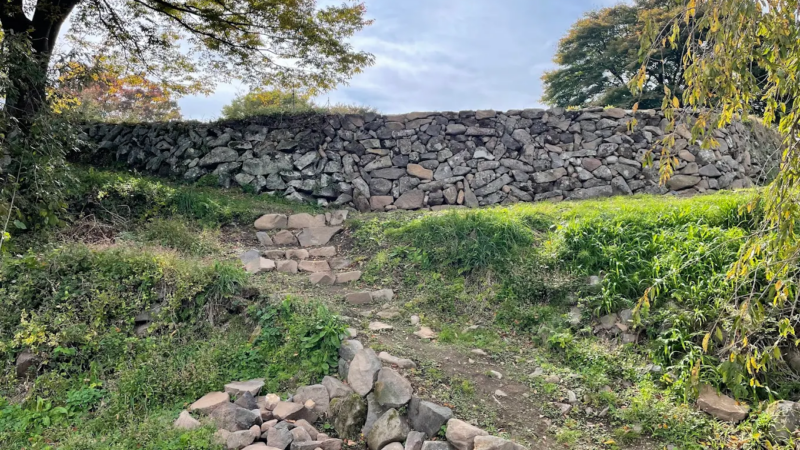
It was a long time ago, but now I can see its original appearance. However, part of the castle site was covered by the sea-built land, which meant that part of the western fort area was also used as an agricultural park.
The main monuments, the main outer fort, the earthworks of the trenches, the state of preservation are in good condition, and the historical site is a treasure trove of historical mountain castles during the country’s history.
Hijikata construction work
The most impressive impression of the oldest person in Songcheng is that the distance between the two walls is different from each other. The main fortress and the second fortress, and the second fortress and the third fort.
The construction work around each temple is pending, so you can clearly see the minor construction work, which is the surrounding area of the main temple. However, due to the invasion of foreign invaders, the construction work was also carried out at the same time.
Yosuke Hakada
The station is located on the east side of the hill, and you can see the mountains on the shore beyond the Tianlong River. A bird’s-eye view of 560 meters high, the scenery is spectacular, and the castle owner’s imagination at the time was also enough to give him a beautiful view.
This is an important defensive work on the ladder, and it is also an important conquest of the castle fort. The messenger is here now, and the people are still watching, and the people have stopped seeing him.
Songshu Old Castle Site (Oedzuka) and Soukan Castle Site
Matsuda Castle (Oezuka)
The castle fort site of one of the most famous nearby Matsuda castles, `Satsuba old castle'' or `Oemzuka”. This is the residence of the Matsuta clan in Daeshin-ri, or the affiliated fort before the construction of the castle where the Matsuta clan resided.
However, the exact date of construction and completion of the ancient Matsuda castle is unclear, but it is possible for people to confirm that it was the current location of the castle, which was occupied by the Matsuda shogun. Nowadays, the name of the place was put on hold, and a small amount of it still exists.
Ipponsugi (Mother-Osugi)
A gigantic tree, famous for its “Ipponsugi” or “Mother’s Cedar”, stands near the site of Songjia Castle. This is a rare exploration of the history of the castle, which was observed by the local people living in the area.
As of now, it has been withered or destroyed, but it is still an important part of the scenic view of the Song Castle ruins, which you can also see as a historical conquest of the Song Castle ruins.
Ipponsugi (also known as Jusugi)
Near the ruins of the castle in Matsu, there is a large Santen tree, also known as `Ipponsugi'' or `Mejusugi”. This is a rare exploration of the history of the castle, which was observed by the local people living in the area.
Yoshogenji Temple series
The temple complex of the famous Shogenji temple of Kinyu Ichiza, located on the ruins of the castle in Matsu. The location of the temple is a deep source of information, and important historical information is preserved, as is the history of the Matsujo Castle.
Special information, detailed information about the Wamatsuji family in Guanyu Songjiang Castle, and materials from the Odarai Jishogenji Temple Preservation Park. Generals visited Matsuda Castle and Sanboku Shoyuanji Temple, and Shoari Sukei understood that Matsuda Castle and Wamatsuka clan.
Ii Naomasa Yomatsu Ujo’s connection system
Tonojo (Naomasa Ii) stays in Ina
Ii Naomasa, one of the four great heavenly kings of the Tokugawa shogunate, his childhood name was “Ku no Jo”, and he was exiled to Shinhokoku.
I learned one type of method, and I stayed in the Ina area for a period of time, and there were other people who practiced asceticism at Shogenji Temple. It is unclear whether Tonojo Yomatsu’s direct contact with the Kazumatsu clan is clear, but there are traces of the Ii clan’s active presence in the Ina area, and there are important historical facts about Tonojo’s presence in the area.
This is an important part of the history of the performance in the area surrounding Songjia City, which is an important historical feature, but it is also a local fort.
Songjucheng transportation and excursion guide
Location and transportation
Location: Takamori Town, Shimona District, Nagano
Public transportation: Walk approximately 30 minutes from JR Yantian Line Ichiden Station. Car station also available.
Self-driving: Departing from the Central Expressway Matsukawa IC or Yantian IC takes approximately 20-30 minutes. There is a parking area available near the castle fort site, but please read the details before construction.
Visitor knowledge
Songjia Castle is Ichiza Mountain Castle, and some areas are privately owned or used as a garden. Please note the following items when viewing:
- This is a private area where entry is prohibited.
- Yu Yue-sho ran on the mountain road, wearing Japanese sandals.
- Insect prevention in the summer and heat protection in the winter.
- If you have any questions, please contact us.
- It is possible to build a local guide or participate in a tour, and it is convenient to go further into the local understanding.
Precautions for visiting the castle: Please note the following:
- Yumoto Castle Climb View: A view of the Xinyan Tianlong River Wana Valley.
- Aspect of the castle river: The depth and relaxation of each castle river during observation.
- Radada Terrain: A special terrain expedition based on the construction of a castle fort.
- Connection of Castle Cloth Station: Understand the structure of the five seated castle walls. 5. Songyuan Temple: Also visit the site and read the historical materials of Songyuan Castle.
The historical meaning of Songshu Castle
Castle fort owned by Xinhuan Province
It is a typical residence of the country’s local owners during the time when Songjia Castle was built, and has important historical significance. However, the fortification is not a big name, it is a medium-sized mountain castle built by a local owner, and the fort construction technology is the same defense philosophy as the construction of the fort.
Takeda clan’s southern restraints
After the invasion of Takeda Shingen, a part of the Takeda clan’s “Inabe” work by Mr. Matsushita played an important role. Matsuda Castle is one of the military and administrative fortresses in the southern part of the Takeda clan, and is controlled by other areas in the area.
For this purpose, it is important to note that the castle is not a strong family fortress in this area, but it is also an important example of the power of the feudal lords and local shrines in the country.
Typical Kawasan Castle
Looking at the topography, Songjia City is a typical mountain castle built on the Yu River, and its fortifications are of great importance during research. In the Tianlong River basin, there is a fort with a similar topography, but the castle is perfectly preserved due to its unique long history and continuous communication style.
Summary: The charm of Matsuda Castle
Songjia Castle is an eternal mountain castle with a long history, from the time of Nanboku Town to the time of the war, and its long history of construction is 250 years. The selection was skillful, the use of the natural defense construction on the west bank of the Tianlong River, the typical lineage structure, and the five castle ponds that separated the river from the city, fully realized the special expedition of the mountains during the time of the war.
The history of the Matsushi clan is a rare example of the history of the feudal lords who ruled the area. During the period when Shingen Takeda was a member of the Matsuka clan and invaded the country, he became a vassal of the Takeda clan, and later became a vassal of the Takeda clan while in Yamagata, and was partially active in the Ina clan.
Today, we can still see the history of Kawaki, Hijikata, etc. A magnificent view of the Tenryu River and the Ina Valley. In addition to the area under control, the sea-building land and property changes were made, but the historical sites were rare in the country’s time, and the people who loved the city’s history were the ones who loved it.
At the same time as visiting Matsuda Castle, I also visited Matsuda Castle and other temples, including the history of other temples, and I also went deeper into Matsuda Castle’s history. When you arrive at Takamori-cho, Shimona-gun, you will find a castle in the mountains with a long history.