Matsuoka Castle (Shinano Province) Complete Guide: A Thorough Explanation of History, Structure, and Highlights
What is Matsuoka Castle?
Matsuoka Castle (Matsuoka-jō) was a Japanese castle located in Takamori-machi, Shimoina-gun, Nagano Prefecture. Built by the Matsuoka clan, who were the local administrators of Ichida-gō, Ina-gun, Shinano Province, during the Nanboku-chō period, it served as the Matsuoka clan’s base for approximately 250 years on the tip of a river terrace on the west bank of the Tenryū River.
Situated at an altitude of 560 meters on the tip of a terrace, it overlooks the Tenryū River to the east and is built on a terrain that extends to the plains to the west. It is known as a natural stronghold formed by a sheer cliff approximately 100 meters above the Tenryū River and deep valleys running north and south.
Around 1588, the castle was abandoned when its lord, Matsuoka Sadatoshi, was dismissed by Tokugawa Ieyasu. However, remains still exist today, making it a valuable historical site that conveys the structure of a castle from the Sengoku period.
History and Rise of the Matsuoka Clan
From the Kamakura Period to the Nanboku-cho Period
The origins of the Matsuoka clan are said to date back to the late Heian period and the Kamakura period. The Matsuoka clan, having obtained the position of jitō (land steward) of Ichida-go, Ina-gun, Shinano Province, established their power in this region. It is believed that Matsuoka Castle was actually built during the turbulent Nanboku-cho period, and it is presumed to have been developed as a defensive base to cope with the wars of this era.
Records show that Matsuoka Jiro participated in the Battle of Ōtō in 1400, fighting alongside the shugo (provincial governor) Ogasawara clan. Furthermore, the Matsuoka clan participated in the Battle of Yuki in 1440, indicating their continued relationship with the Muromachi Shogunate and the shugo daimyo as influential local lords of Shinano Province.
The Sengoku Period and Subjugation to the Takeda Clan
During the Sengoku period, Matsuoka Castle underwent extensive renovations. Many of the remains visible today are believed to have been completed during this period.
In 1554, when Takeda Shingen of Kai Province invaded the Ina region, the Matsuoka clan surrendered to the Takeda. From then on, the Matsuoka clan became part of the “Ina-shu” (Ina Group) under the Takeda, and served under the command of Yamagata Masakage, one of the Takeda’s Four Heavenly Kings.
The Matsuoka clan played a crucial role in the Takeda’s invasion from Shinano to Tōtōmi Province, supporting the Takeda’s control over the Ina region. During this period, Matsuoka Castle is thought to have functioned as a military base for the Takeda in southern Shinano.
The Fall of the Takeda Clan and the Decline of the Matsuoka Clan
After the fall of the Takeda clan in 1582, Shinano Province came under the control of Oda Nobunaga. Following the Honnoji Incident, it became the stage for a struggle between Tokugawa Ieyasu, the Hojo clan, and the Uesugi clan.
Ultimately, the Ina region was incorporated into Tokugawa Ieyasu’s sphere of influence. However, around 1588, Matsuoka Sadatoshi, the lord of Matsuoka Castle, was dispossessed by Tokugawa Ieyasu. While there are various theories regarding the reason for the dispossession, this marked the end of Matsuoka Castle’s approximately 250-year history as the Matsuoka clan’s base, and the castle was abandoned.
Structure and Layout of Matsuoka Castle
Typical Linear Concentric Layout
Matsuoka Castle is known as a castle with a typical linear concentric layout. A concentric layout is a structure in which multiple baileys are arranged in a straight line, by moats or earthworks. At Matsuoka Castle, the five baileys are clearly separated by moats, and the design makes maximum use of the long, narrow terraced terrain extending east to west. This structure allowed for a vertically layered defense, where even if the enemy captured one bailey, the defense could continue in the next.
Arrangement of the Main Bailey (Honmaru) and Other Baileys
The main bailey (Honmaru), the center of the castle, is located at the very tip of the terrace. This location, surrounded on three sides by steep cliffs, is a natural stronghold, making it difficult to attack.
From the main bailey, the second, third, fourth, and fifth baileys are arranged sequentially to the west. Each bailey is separated by a moat, and each is designed to function as an independent defensive unit.
Defense System Utilizing the Terrain
The most distinctive feature of Matsuoka Castle is its defense system, which skillfully utilizes the river terrace terrain.
The eastern side faced the Tenryu River, a steep cliff approximately 100 meters high, making attacks from this direction virtually impossible. Deep valleys cut into both the north and south sides, functioning as natural moats.
On the western side (rear), the only possible attack, multiple trenches and baileys were strategically placed to create a multi-layered defensive structure. This structure made Matsuoka Castle a formidable mountain capable castle of effective defense even with a small force.
Existing Remains and Highlights of Matsuoka Castle
Current Status of Remains
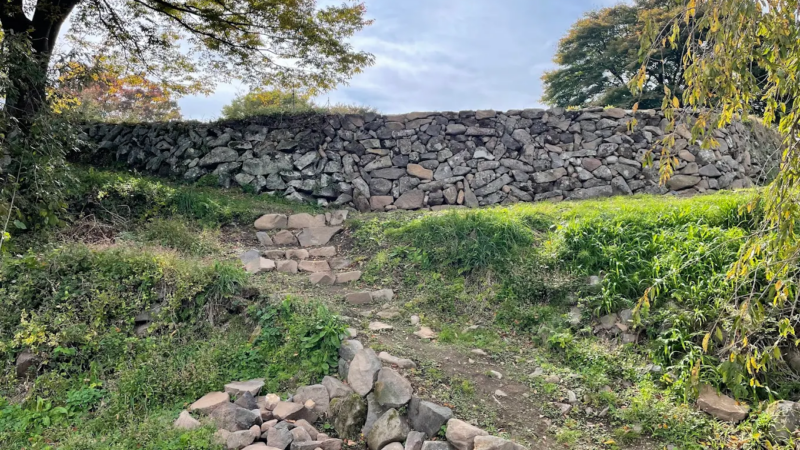
Although many years have passed since Matsuoka Castle was abandoned, remnants of the original structure can still be seen today. However, some parts of the site have been by land reclamation, and in particular, parts of the western baileys are now used as orchards.
Nevertheless, the main remains, such as the main baileys, trenches, and earthworks, remain in relatively good condition, making it a valuable historical site for understanding the structure of mountain castles from the Sengoku period.
Moats and Earthworks
The most impressive remains at Matsuoka Castle are the moats that divide each enclosure. The moats between the main enclosure and the second enclosure, and between the second and third enclosures, are particularly impressive in both depth and scale, demonstrating the high level of castle-building technology of the time.
Earthworks also remain around each enclosure, and are relatively clearly visible, especially around the main enclosure. These earthworks are thought to have served to prevent enemy intrusion and also functioned as foundations for buildings.
Terrace Cliffs and Views
Standing on the east side of the main enclosure, one can see the Tenryu River and the mountains on the opposite bank below. The view from this high vantage point of 560 meters above sea level is magnificent, and the castle lords of the time must have enjoyed this scenery as well.
These steep terrace cliffs were both a crucial defensive feature and a symbol of the castle’s grandeur. Even today, their imposing presence can be felt.
Matsuoka Old Castle Ruins (Oiezuka) and Related Historical Sites
Matsuoka Old Castle (Oiezuka)
Near Matsuoka Castle lies another castle site called “Matsuoka Old Castle” or “Oiezuka.” This is believed to be the site of the Matsuoka clan’s residence or a subsidiary castle prior to the main Matsuoka Castle (the castle commonly known as Matsuoka Castle today).
While the exact construction and abandonment dates of Matsuoka Old Castle are unclear, it has been suggested that it may have been a base for the Matsuoka clan before they moved their main castle to its current location. Currently, the name remains as a place name, and only a few remnants can be seen.
Ipponsugi (Meotosugi)
Near the Matsuoka Castle ruins stood a giant tree known as “Ipponsugi” or “Meotosugi.” These were cherished by the local people as symbolic presences that watched over the history of Matsuoka Castle.
Although they have since died or been cut down, they were once an important element characterizing the castle ruins’ landscape and were valued as symbols that passed down the history of the Matsuoka clan.
Ipponsugi (Meotosugi)
Near the Matsuoka Castle ruins stood a giant tree known as “Ipponsugi” or “Meotosugi.” These trees were cherished by the local people as symbolic presences that watched over the history of Matsuoka Castle.
Relationship with Shogenji Temple
Near the Matsuoka Castle ruins is a temple called Shogenji. This temple is said to have had a deep connection with the Matsuoka clan and preserves important historical materials and information that convey the history of Matsuoka Castle.
In particular, detailed information about Matsuoka Castle and the Matsuoka clan is largely known from the materials preserved and made public at Shogenji Temple. Visiting Shogenji Temple in conjunction with a visit to Matsuoka Castle will provide a deeper understanding.
Connection between Ii Naomasa and Matsuoka Castle
Kame-no-jo (Ii Naomasa)’s Stay in Ina
Ii Naomasa, known as one of the Four Heavenly Kings of Tokugawa, went by the name “Kame-no-jo” during his childhood and spent a period of time in exile from Totomi Province to Shinano Province.
According to one theory, Kame-no-jo stayed in the Ina region for a period, and there is a legend that he spent time at Shogenji Temple. While the direct connection with Matsuoka Castle and the Matsuoka clan is not clear, it is an important element in the local history as a trace of the Ii clan’s presence in the Ina region.
This legend suggests that the area surrounding Matsuoka Castle played an important role in a broader historical context during the Sengoku period, not merely as a local castle.
Access and Visiting Guide to Matsuoka Castle
Location and Access
Location: Takamori-machi, Shimoina-gun, Nagano Prefecture
Public Transportation: Approximately 30 minutes on foot from Ichida Station on the JR Iida Line. Taxis are also available from the station.
By Car: Approximately 20-30 minutes from Matsukawa IC or Iida IC on the Chuo Expressway. Parking may be available near the ruin castles, but it is recommended to check in advance.
Notes for Visitors
Matsuoka Castle is a mountain castle, and some parts are privately owned or used as orchards. Please note the following points when visiting:
- Avoid trespassing on private property and do not enter areas marked as off-limits.
- Wear comfortable clothing and shoes as you will be walking on mountain paths.
- Remember to take precautions against insects in summer and warm clothing in winter.
- Do not damage the ruins or litter.
- If possible, use a local guide or tour to gain a deeper understanding.
Points to Note When visiting Matsuoka Castle, paying attention to the following points will make your visit more fulfilling:
- View from the Main Enclosure: Enjoy the scenery of the Tenryu River and the Ina Valley.
- Scale of the Moats: Check the depth and width of the moats between each enclosure.
- Terrace Topography: Experience the topographical features on which the castle was built.
- Consecutive Enclosure Layout: Understand the structure in which the five enclosures are arranged in a straight line.
- Matsugenji Temple: Visit it as well to check historical materials on Matsuoka Castle.
Historical Significance of Matsuoka Castle
Castle of a Local Lord in Shinano Province
Matsuoka Castle holds significant historical importance as a typical residence of a local lord in Shinano Province during the Sengoku period. While not a massive castle of daimyo class, it is a valuable historical site that conveys the castle-building techniques and defensive philosophies of the time, as a medium-sized mountain castle built by a powerful local lord.
Part of the Takeda Clan’s Control of Southern Shinano
After Takeda Shingen’s invasion of Shinano, the Matsuoka clan played a crucial role as part of the Takeda clan’s “Ina-shu” (Ina group). Matsuoka Castle functioned as one of the Takeda clan’s military and administrative bases in southern Shinano, supporting their control over the province.
In this respect, Matsuoka Castle is not merely a castle of a local powerful family, but also an important case study for understanding the relationship between daimyo power and local communities during the Sengoku period.
A Typical Example of a Mountain Castle on a River Terrace
Topographically, Matsuoka Castle is noteworthy in castle research as a typical example of a mountain castle built on a river terrace. Several castles utilizing similar terrain exist in the Tenryu River basin, but Matsuoka Castle stands out for its sparsely well-preserved remains and its distinctive linear, interconnected layout.
Summary: The Charm of Matsuoka Castle
Matsuoka Castle is a historic mountain castle that served as the base of the Matsuoka clan strongly for approximately 250 years, from the Nanboku-cho period to the Sengoku period. Its location, utilizing the natural fortifications of a river terrace on the west bank of the Tenryu River, its typical linear, interconnected layout, and the structure of five baileys separated by moats, reflect the characteristics of Sengoku period mountain castles.
The history of the Matsuoka clan, who became vassals of the Takeda clan during Takeda Shingen’s invasion of Shinano Province and operated under the command of Yamagata Masakage as part of the Ina clan, is a valuable example illustrating the relationship between local communities and daimyo power during the Sengoku period.
Even today, remains such as moats and earthworks can be seen, and from the main bailey, one can enjoy a magnificent view of the Tenryu River and the Ina Valley. Although some parts have been altered by land reclamation, this valuable historical site, where you can feel the spirit of the Sengoku period, is a place worth visiting for enthusiast castles and history buffs.
Visiting it along with related historical sites such as Matsugenji Temple will allow you to gain a deeper understanding of the history of Matsuoka Castle and the Matsuoka clan. When you visit Takamori Town in Shimoina District, Nagano Prefecture, be sure to stop by this historic mountain castle.