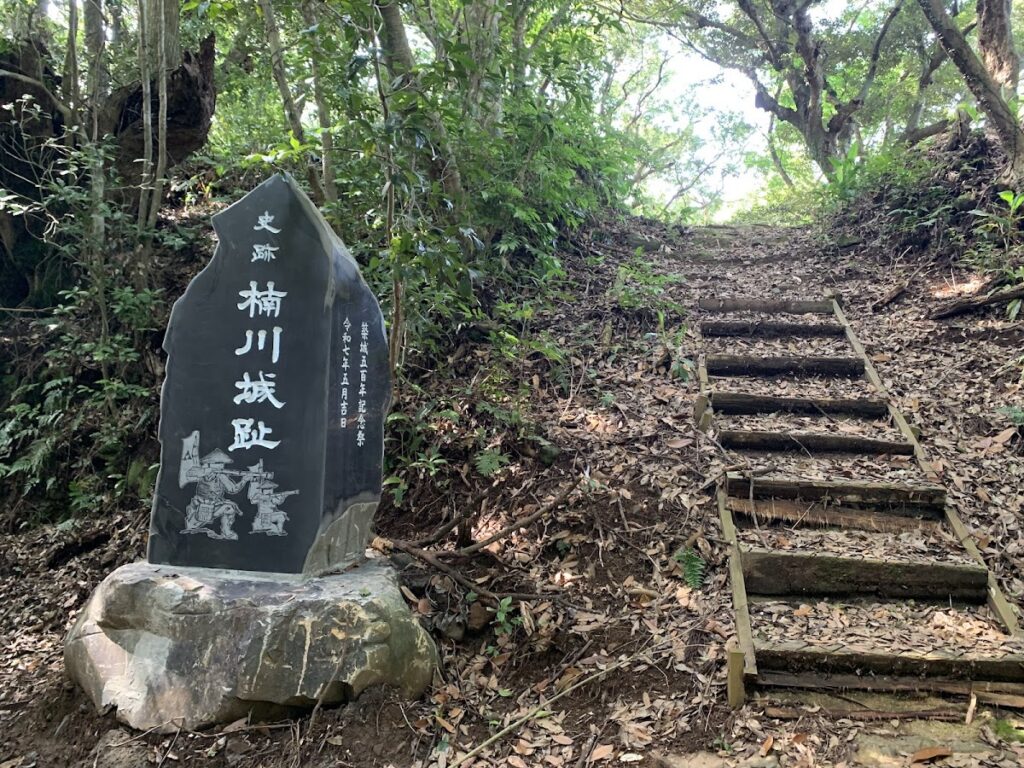
Complete Guide to Kusugawa Castle (Yakushima Town, Kagoshima Prefecture) | A Mountain Castle of the Tanegashima Clan Built on a World Heritage Island
What is Kusugawa Castle?
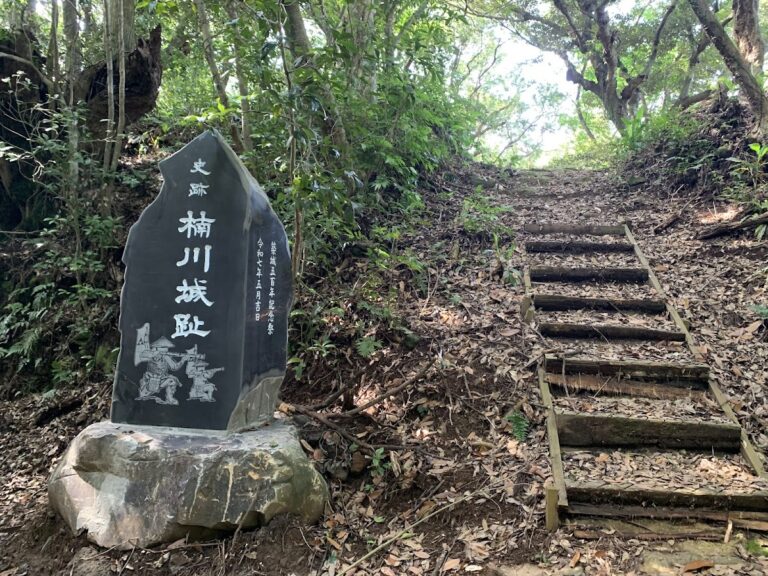
Kusugawa Castle is a Sengoku period mountain castle located in Kusugawa, Yakushima Town, Kumage District, Kagoshima Prefecture. It is a valuable historical site as the only medieval castle documented on Yakushima, a World Natural Heritage site.
Built in 1524 by Tanegashima Tadatoshi, the twelfth lord of Tanegashima, the castle is situated on the tip of a hill approximately 50 meters above sea level, overlooking Kusugawa Port, and functioned as a base for controlling Yakushima. As the only castle site on the island mentioned in the “Comprehensive Survey of Japanese Castles,” it was designated a Yakushima Town Historic Site on November 21, 1995.
History of Kusukawa Castle
Background of Construction and the Tanegashima Clan’s Rule over Yakushima
During the Sengoku period, when Kusukawa Castle was built, Yakushima was under the control of the Tanegashima clan. The Tanegashima clan were local lords based on Tanegashima, and they had expanded their influence to Yakushima across the strait.
In 1524 (Daiei 4), Tanegashima Tadatoki built a castle in Kusukawa to strengthen his control over Yakushima. The reasons for choosing this location include its advantageous position overlooking the important port of Kusukawa, and its clear view of Tanegashima across the strait, allowing for communication via smoke signals.
Changes in Castle Lords and the Nejime Clan
Besides the Tanegashima clan, the Nejime clan is also recorded as a lord of Kusukawa Castle. The Neji clan was a powerful local family in Osumi Province, and it is believed they controlled this castle for a time during the power struggles on Yakushima Island.
There is said to have been a conflict between the Tanegashima clan and the Neji clan over control of Yakushima, and Kusukawa Castle was a crucial strategic point on the front lines. The ownership of this castle, which controlled a vital point for maritime traffic, was directly linked to the control of Yakushima as a whole.
Abandonment and Aftermath
While there are no clear records regarding the year of Kusukawa Castle’s abandonment, it is believed that its military role ended with the end of the Sengoku period (Warring States period). During the Shimazu clan’s unification of Kyushu, many small mountain castles were abandoned, and Kusukawa Castle was likely no exception.
After its abandonment, the castle ruins were largely forgotten for a long time, but recent advances in castle research have led to a re-evaluation of its historical value.
Structure and Layout of Kusukawa Castle
Layout Composed of Three Enclosures
Kusukawa Castle’s layout is centered around three enclosures (kuruwa). An enclosure is a flat area within the castle grounds, used for building structures and deploying troops.
The group of enclosures, arranged on different levels around the main enclosure, cleverly utilizes the limited hilly terrain. Each enclosure, though relatively small, possesses a practical structure equipped with the necessary defensive functions.
Defensive Design Utilizing Natural Fortifications
The most distinctive feature of Kusukawa Castle lies in its defensive design, which makes maximum use of the natural terrain.
The north and northwest sides are steep cliffs, making attacks from these directions facing the sea virtually impossible. The west side also features a steep slope along the river, serving as a natural moat.
On the other hand, artificial dry moats were constructed on the south and east sides, where the terrain is gentler. This dry moat disrupts the continuity with the surrounding hills, creating a structure that prevents enemy intrusion.
Remains of Earthworks and Dry Moats
Even today, the remains of earthworks and dry moats are well-preserved at the Kusukawa Castle site.
The earthworks were built to surround the baileys and functioned as a defensive wall. While their height varies, some sections can be clearly identified as elevations.
The dry moats are particularly prominent on the south side, and their depth and width suggest a high level of defensive awareness at the time. Excavations are gradually revealing the detailed structure of these dry moats.
Strategic Significance of the Location Overlooking Tanegashima Island
From near the top of Kusukawa Castle, Tanegashima Island can be seen across the strait. This excellent view held not only aesthetic beauty but also military importance.
In the Sengoku period, when smoke signals were common for communication, the location, which allowed for visual contact with Tanegashima Island, was extremely important as a hub for information transmission. It is believed that in times of emergency, it would have been possible to request reinforcements from Tanegashima.
Highlights of Kusukawa Castle
Exploring the Fortifications
The greatest highlight of Kusukawa Castle is the well-preserved remains of the fortifications. You can experience the structure of a Sengoku period castle by touring the three fortifications.
The main enclosure is the largest flat area, and it is presumed that the lord’s residence and other important buildings were located here. Although it is now a grassy area, you can walk around imagining the layout of the time.
The Impressive Dry Moat
The dry moat remaining on the south side is one of the most impressive remains of Kusukawa Castle. Standing at the bottom of the deeply excavated moat, you can truly appreciate the high level of medieval castle construction technology.
From the cross-section of the moat, you can observe the excavation methods and differences in soil type, making it a must-see point for castle enthusiasts.
The Magnificent View
The view from the castle ruins is also a major attraction. Below lies the village and harbor of Kusukawa, and on clear days, you can even see as far as Tanegashima Island.
Its location as a mountain castle overlooking the sea is unique among castles in Kagoshima Prefecture, and its character as a castle protecting a strategic point for maritime traffic is clearly evident.
Doraemon as a Landmark at the Castle Entrance
One of the things that makes people say they’re visiting Kusukawa Castle is the Doraemon statue near the entrance. This Doraemon, placed by locals, has become a landmark for visitors to the castle ruins, and is widely known as a sign that “if you see Doraemon, you’re at the entrance.”
Thanks to this friendly landmark, even first-time visitors can easily find the entrance.
Kusukawa Castle 500th Anniversary Celebration
In 2016, Kusukawa Castle celebrated its 492nd anniversary since its construction, and the “Kusukawa Castle Festival” was held. This event served as an important occasion for reaffirming the value of Kusukawa Castle as a local historical heritage site and passing it on to future generations.
Kusukawa Castle ruins, designated as a town-designated historical site, are recognized by local residents as a cultural asset to be proud of, and preservation activities are underway.
Archaeological Excavations and New Discoveries
Recent archaeological excavations have been conducted at Kusukawa Castle ruins, yielding new insights.
The investigations have confirmed the detailed structure of the dry moats and the remains of structures that may be the remains of buildings within the castle grounds. Analysis of excavated artifacts is also revealing the period when the castle was in use and the lifestyle of the time.
These research results provide valuable data for understanding the medieval history of Yakushima, and further research is expected.
Access Information
How to Get to Yakushima
To visit Kusukawa Castle, you must first travel to Yakushima.
By Plane
- Approximately 40 minutes from Kagoshima Airport to Yakushima Airport
- Approximately 1 hour 20 minutes from Fukuoka Airport to Yakushima Airport (seasonal operation)
By Boat
- Approximately 2 hours by high-speed boat (jetfoil) from Kagoshima Port to Miyanoura Port
- Approximately 4 hours by ferry from Kagoshima Port to Miyanoura Port or Anbo Port
How to get to Kusukawa Castle Ruins
By Bus from Miyanoura Port
Take a bus from Miyanoura Port and get off at the “Kusukawa” bus stop (fare approximately 240 yen). It’s about a 5-10 minute walk from the bus stop to the castle entrance. The landmark for the entrance is where you can see a Doraemon statue.
By Car from Yakushima Airport
Approximately 20 minutes by car from Yakushima Airport. Enter the Kusukawa settlement and head towards the castle entrance.
Parking Information
There is no dedicated parking lot for the castle ruins, but there is space for a few cars near the entrance to the castle. However, please be considerate as this is also a local road used by residents.
Time Required for Visiting the Castle
It takes approximately 10-15 minutes to walk from the entrance to the castle ruins, and about 20-30 minutes to explore the ruins. If you want to explore thoroughly, allow about an hour.
Precautions for Visiting
Clothing and Equipment
Since Kusugawa Castle is a mountain castle, the following equipment is recommended:
- Comfortable walking shoes (hiking boots or trekking shoes are ideal)
- Long-sleeved shirt and long pants (to protect from plants and insects)
- Hat
- Drinking water
- Insect repellent (especially in summer)
Weather and Season
Yakushima is known for its high rainfall. Rain gear is essential, and caution is needed as the ground can become slippery in rainy weather.
The best seasons to visit are spring (March-May) and autumn (October-November), when the weather is relatively stable. Summer is hot and insect-heavy, while winter is cold and rainy.
Manners and Precautions
- The castle ruins are a town-designated historical site. Please do not damage the remains or take any artifacts.
- Please take all your trash with you.
- You may pass through private property, so please be considerate of local residents.
- Photography is permitted, but please respect the privacy of local residents.
Nearby Tourist Attractions
Major Tourist Attractions of Yakushima
When visiting Kusugawa Castle, be sure to enjoy the rich nature of Yakushima, a World Natural Heritage site.
Jomon Cedar
A symbol of Yakushima, said to be thousands of years old. A round-trip trek of about 10 hours is required, but it is well worth seeing.
Shiratani Unsuikyo Gorge
A mystical forest said to be the model for the setting of the movie “Princess Mononoke.” Enjoy it with a half-day trek.
Chihiro Falls
A powerful waterfall cascading down a massive single rock face. It can be viewed from the observation deck.
Around Kusukawa Village
Kusukawa village itself is a charming place where you can experience the traditional lifestyle of Yakushima. You can learn about the local history and culture while strolling through the village.
Other Castles in Kagoshima Prefecture
For castle enthusiasts who have visited Kusukawa Castle, other castle ruins in Kagoshima Prefecture are also recommended.
Chiran Castle
A medieval mountain castle located in Chiran, known for its samurai residences. It features a unique layout that utilizes the topography of the Shirasu plateau.
Takayama Castle
A mountain castle known as the residence of the Kimotsuki clan. The stone walls and baileys are well-preserved.
Kagoshima Castle (Tsurumaru Castle)
A flatland castle built during the Edo period as the residence of the Shimazu clan. It is currently open to the public as the Kagoshima Prefectural Historical Materials Center, Reimeikan.
Shibushi Castle
A large mountain castle with a complex layout. It is a nationally designated historical site.
Kanoya Castle
A castle that functioned as a branch castle of the Kimotsuki clan. It is a castle ruin that is easily accessible, located close to the city center.
Cultural Value of Kusukawa Castle
Kusukawa Castle has high cultural value in the following respects:
The Only Medieval Castle on an Island
As a medieval castle built on the island of Yakushima, it is a valuable presence in the history of castles in Kyushu. As a castle protecting a key point for maritime traffic, it is an important site that tells the story of the Tanegashima clan’s maritime control strategy.
Well-Preserved Remains
Having escaped the waves of development, the remains such as baileys, earthworks, and dry moats are relatively well-preserved. This is valuable material for studying the structure of medieval castles.
A Witness to Local History
Kusukawa Castle is a witness to diverse historical events, including the conflict between the Tanegashima and Neji clans, the medieval history of Yakushima, and the history of maritime transportation. In medieval Yakushima, where written historical sources are limited, it holds significant importance as a concrete historical trace.
Summary
Kusukawa Castle, as the only remaining castle on Yakushima, a World Natural Heritage site, is a historical and culturally valuable site.
Built in 1524 by Tanegashima Tadatoshi, this mountain castle is characterized by its strategic location overlooking Kusukawa Port and its skillful defensive design that utilizes the natural terrain. The remains, including three baileys, earthworks, and dry moats, are well-preserved, making it a valuable place to experience the structure of a medieval castle.
While Yakushima is known for its rich natural beauty, including the Jomon Cedar, a visit to Kusukawa Castle allows you to glimpse a lesser-known aspect of the island’s history. The view from the castle ruins is magnificent, and you’ll truly appreciate the strategic importance of its location overlooking Tanegashima Island.
While access takes a little time, this hidden gem of a castle is definitely worth visiting when you’re in Yakushima. Why not use Doraemon as a landmark and experience the romance of a maritime castle from the Sengoku period?