Kanaya Castle (Futtsu City, Chiba Prefecture) Complete Guide | History, Remains, and Visiting Information for a Sengoku Period Coastal Castle
What is Kanaya Castle?
Kanaya Castle (Kanaya-jo) is a Sengoku period mountain castle located in Kanaya, Futtsu City, Chiba Prefecture. Also known as Akegane Castle, it was built on a hill extending north from Mount Nokogiri. The castle’s most distinctive feature is its nature as a coastal castle facing Tokyo Bay (Edo Bay).
With the Uraga Channel stretching out before it and the Miura Peninsula within easy reach, its location at the border between Kazusa Province and Awa Province made it a strategic point, playing a crucial role as a naval base for various forces during the Sengoku period.
Currently, the Kanaya Castle site is located within the grounds of TJK Resort Kanaya Castle, owned by the Tokyo Information Service Industry Health Insurance Association. While normally off-limits, it is open to the public on special opening days a few times a year.
History of Kanaya Castle
Construction and the Satomi Clan Era
While there are no clear records regarding the exact construction date of Kanaya Castle, it is believed to have been built during the Sengoku period by the Satomi clan, who were based in Awa Province. The Satomi clan were a powerful daimyo family that controlled the southern part of the Boso Peninsula, and Kanaya Castle was an important base for their expansion into Kazusa Province and securing control of Tokyo Bay.
Internal Conflict within the Satomi Clan and Kanaya Castle
A particularly important aspect of Kanaya Castle’s history is the power struggle within the Satomi clan. In 1533, an internal conflict arose between Satomi Yoshitoyo, the head of the Satomi clan, and his uncle, Satomi Sanetaka.
In this conflict, Sanetaka was nearly executed by Yoshitoyo, but Sanetaka’s eldest son, Satomi Yoshitaka, launched a counterattack. Yoshitaka, using Kanaya Castle as one of his bases, clashed with Yoshitoyo and ultimately defeated him, becoming the head of the Satomi clan. This event marked a crucial turning point in the history of the Satomi clan, and the clan reached its peak during Yoshitaka’s reign.
Conflict with the Hojo Clan
After Satomi Yoshitaka became the head of the clan, the Satomi clan fiercely clashed with the Hojo clan (Later Hojo clan), based in Sagami Province. Kanaya Castle, situated across Tokyo Bay from the Miura Peninsula, was strategically extremely important for securing sea routes with the Hojo clan and for naval battles.
In 1554, the Satomi and Hojo clans broke their alliance, entering a full-scale state of war. During this period, Kanaya Castle functioned as a frontline base for the Satomi navy and became the stage for battles for control of Tokyo Bay.
From the Late Sengoku Period to the Early Modern Period
In the late Sengoku period, the Hojo clan was destroyed by Toyotomi Hideyoshi’s siege of Odawara (1590), and the Satomi clan came under the control of Tokugawa Ieyasu. It is believed that the military importance of Kanaya Castle declined from this period onward.
In the Edo period, the Satomi clan was dispossessed of their domain, and Kanaya Castle was abandoned. However, its remains have been preserved in good condition to this day, making it a valuable historical site that conveys the appearance of a coastal castle from the Sengoku period.
Structure and Layout of Kanaya Castle
Location and Topography
Kanaya Castle was built on the tip of a hill extending north from Mount Nokogiri, at an altitude of approximately 70 meters. This location clearly demonstrates its character as a coastal castle, offering an excellent vantage point overlooking Tokyo Bay.
The eastern side of the castle faces Tokyo Bay as a steep cliff, and the western side is protected by a valley called a yato. The southern side features a ridge leading towards Mount Nokogiri, while the northern side descends a slope towards the Kanaya settlement, demonstrating a clever use of natural fortifications.
Main Enclosure (Honmaru)
The central part of Kanaya Castle is the main enclosure (shukaku), the highest point. The main enclosure measures approximately 40 meters east-west and 30 meters north-south, and is surrounded by earthen ramparts. These ramparts remain clearly visible today, reaching heights of over 2 meters in some places.
From the main enclosure, one can enjoy a panoramic view of Tokyo Bay and the Miura Peninsula across the bay. It is presumed that watchtowers and other facilities once stood here. This suggests it functioned as a command center for monitoring maritime traffic and directing naval movements.
Enclosures
Several enclosures (kuruwa, also written as kuwa) are arranged around the main enclosure. These enclosures are arranged in a stepped pattern, forming a multi-layered structure that defends the main enclosure.
In particular, a series of enclosures can be seen along the southern ridge, forming a defensive line against incursions from the direction of Mount Nokogiri. Between each enclosure, there are artificial steep slopes called “kirigishi,” demonstrating a design intended to hinder enemy advances.
Moats and Vertical Moats
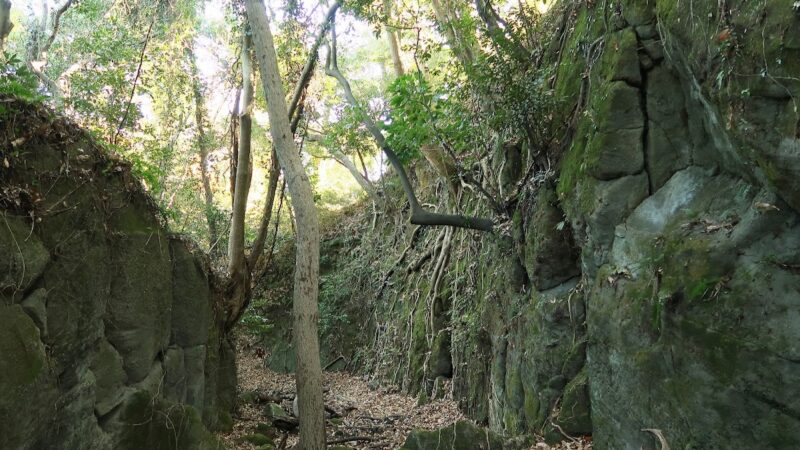
An important defensive feature of Kanaya Castle is the horikiri (moat). A horikiri is a dry moat dug to cut across a ridge, serving to prevent enemy incursions. Several horikiri have been identified, especially along the southern ridge of Kanaya Castle, some reaching depths of over 5 meters.
Furthermore, tatebori (vertical moats) dug along the slope from the horikiri can also be seen. Vertical moats restrict the movement of enemy soldiers climbing the slope and make lateral movement difficult.
Koguchi (Entrance)
The koguchi (entrance) to the castle is also an important defensive feature. The entrance to Kanaya Castle is thought to have been more than just a simple opening; it’s believed to have incorporated ingenious features such as a “staggered entrance” combining earthworks and baileys to hinder a direct enemy advance.
Characteristics as a Coastal Castle
The most distinctive feature of Kanaya Castle, compared to other mountain castles, is its nature as a coastal castle. The eastern side of the castle directly faces Tokyo Bay, allowing for the transport of supplies by ship and the sortie of naval forces.
It is presumed that Kanaya had port facilities at the time, with the castle and port functioning as a single integrated unit. This allowed for resupply by sea even if land routes were cut off, making it a structure capable of withstanding long sieges. Furthermore, its location provided favorable conditions for rapid sorties and retreats, making it a suitable forward base for naval forces.
Highlights of Kanaya Castle (Castle Notes)
Well-Preserved Earthworks
The greatest highlight of Kanaya Castle is the excellent state of preservation of the earthworks surrounding the main bailey. This earthen rampart, a testament to the civil engineering techniques of the Sengoku period, retains much of its original height and width, making it a must-see for castle enthusiasts.
Walking along the rampart allows you to experience the perspective of the castle’s soldiers and, combined with the view of Tokyo Bay, evoke the atmosphere of a Sengoku-era coastal castle.
Clear Moats
The group of moats remaining on the southern ridge are important remains for understanding Kanaya Castle’s defensive system. The particularly large moats are deep and wide, giving a real sense of the scale of the civil engineering work at the time.
Standing at the bottom of the moat and looking up at the cliffs on both sides, you can appreciate the strength of this defensive structure. Furthermore, the vertical moats extending from the moats remain clearly visible, allowing you to observe the ingenuity of the slope defenses.
Spectacular Views of Tokyo Bay
The views from Kanaya Castle are breathtaking. From the main enclosure, you can enjoy a panoramic view of Tokyo Bay (Uraga Channel), and on a clear day, you can see the Miura Peninsula on the opposite shore and even Mount Fuji in the distance.
This view speaks volumes about why Kanaya Castle was considered so important as a coastal castle. It’s a place where you can truly appreciate the strategic value of this location, including monitoring maritime traffic, commanding naval forces, and early detection of enemy ships.
Multiple Enclosure Structure
The arrangement of the enclosures extending downwards from the main enclosure is also impressive. The terraced enclosures each function as independent defensive positions, forming a multi-layered defensive system that makes approaching the main enclosure difficult.
The differences in elevation between the enclosures and the angles of the cliffs provide valuable insights into the castle-building techniques of the Sengoku period.
Integration with Natural Terrain
Kanaya Castle is a mountain castle that skillfully utilizes the natural terrain. By adding artificial modifications to natural terrain such as steep cliffs, deep valleys, and ridges, maximum defensive effect was achieved with minimal effort.
This fusion of nature and artificiality provides an important perspective for understanding the castle-building philosophy of the Sengoku period.
Current Kanaya Castle and Visiting Information
TJK Resort Kanaya Castle and Access Restrictions
Currently, the Kanaya Castle site is located within the grounds of “TJK Resort Kanaya Castle,” a resort facility owned by the Tokyo Information Service Industry Health Insurance Association (TJK). Therefore, access is generally restricted to members only.
TJK Resort Kanaya Castle is a resort facility equipped with accommodation, restaurants, and hot springs, and is available for use by members and their families. Since the castle ruins are located within the grounds of this facility, unauthorized entry is strictly prohibited.
Special Opening Days
Several times a year, with the cooperation of TJK, special opening days are set up, providing an opportunity for members and the general public to visit the Kanaya Castle ruins. Special public viewings typically include the following:
- Lecture: Expert commentary on the history and characteristics of Kanaya Castle as a fortress.
- Site Tour: Guided tour of the main enclosure, moats, and other remains.
- Q&A: Interaction with castle researchers and local historians.
The dates for special public viewings are announced in advance on the Futtsu City Tourism Association website and by organizations such as the Chiba Castle Preservation and Utilization Association. Advance registration is often required, so early information gathering is important.
In the past, special public viewings have been held in March and September, attracting many castle enthusiasts and history buffs each time.
Points to Note When Visiting
The following are points to note when visiting Kanaya Castle on a special public viewing day.
- Advance Registration: In most cases, advance registration is required, so check the announcement and register early.
- Attire: As it is a mountain castle, comfortable clothing and non-slip shoes (such as trekking shoes) are essential.
- Items to Bring: Prepare drinking water, a hat, insect repellent, rain gear, etc.
- Time: The visit takes about 1.5 to 2 hours, so plan your schedule with plenty of time.
- Manners: Remember that it is private property, follow the guide’s instructions, and be careful not to damage the ruins.
Estimated Visit Time
For a visit to Kanaya Castle, including the lecture, you should allow 2 to 3 hours. If you only wish to view the ruins, 1.5 hours is standard.
The path to the main enclosure has some steep sections, so those who are not confident in their physical fitness are advised to allow extra time. However, the distance itself is not very long, so those with average physical fitness should be able to visit without any problems.
Photography
Photography of the ruins is often permitted on special public viewing days. There are plenty of photo opportunities, including earthworks, moats, and views of Tokyo Bay.
However, please be considerate of the privacy of TJK Resort guests and follow the guide’s instructions regarding no-photography zones and photography etiquette.
Access
Location
Address: 77 Kanaya, Futtsu City, Chiba Prefecture (within TJK Resort Kanaya Castle)
Access by Train
The nearest station is JR Uchibo Line’s “Hamakanaya Station”.
- From Tokyo Station: Approximately 1 hour to Kimitsu Station on the JR Sobu Line Rapid/Yokosuka Line, then approximately 20 minutes to Hamakanaya Station on the JR Uchibo Line (total approximately 1 hour 20 minutes)
- From Chiba Station: Approximately 1 hour 30 minutes to Hamakanaya Station on the JR Uchibo Line
TJK Resort Kanaya Castle is approximately a 15-minute walk from Hamakanaya Station. Exit the station and head towards Tokyo Bay. Continue south on National Route 127, and you will find the facility entrance on your right.
On special open days, a shuttle bus may operate from Hamakanaya Station; please check the information provided in advance.
Access by Car
From Tokyo:
- Take the Tokyo Bay Aqua-Line towards Kisarazu, exit at Futtsu-Kanaya IC on the Tateyama Expressway, and head south on National Route 127 for approximately 5 minutes.
Parking: TJK Resort Kanaya Castle has a parking lot, but please check the information provided in advance regarding its use on special open days. If parking is limited, using public transportation may be recommended.
Access by Ferry
Kanaya Port is also a departure and arrival point for the Tokyo Bay Ferry.
- From Kurihama Port (Kanagawa Prefecture): Approximately 40 minutes by Tokyo Bay Ferry to Kanaya Port.
TJK Resort Kanaya Castle is approximately a 10-minute walk from Kanaya Port. If you’re visiting from the Miura Peninsula area, taking a ferry is a convenient option.
Nearby Tourist Attractions
Nokogiriyama (Mount Nokogiri)
Mount Nokogiri, towering just south of Kanaya Castle, is a representative tourist destination in Chiba Prefecture. From its 329-meter-high summit, you can enjoy a spectacular view of Tokyo Bay. Nihonji Temple boasts famous landmarks such as the giant stone Buddha “Nihonji Daibutsu” and the cliffside viewpoint “Jigoku-no-zoki” (Hell’s Gaze).
The Nokogiriyama Ropeway allows you to easily reach near the summit. It’s an ideal spot to visit in conjunction with a visit to Kanaya Castle.
Kanaya Port and Tokyo Bay Ferry
Kanaya Port is a bustling port serving as a departure and arrival point for the Tokyo Bay Ferry. Around the ferry terminal, you’ll find restaurants and souvenir shops where you can enjoy fresh seafood.
In particular, Kanaya’s specialties, “Aji no Tataki” (horse mackerel sashimi) and “Kaisendon” (seafood rice bowl), are must-try dishes when you visit.
Tōrōzaka Daishi Cut-Through Tunnel
Located on the way from Kanaya towards Mount Nokogiri, the Tōrōzaka Daishi Cut-Through Tunnel is a hand-dug tunnel created during the Edo period for the mining of Bōshū stone (stone quarried from Mount Nokogiri).
The tunnel, approximately 100 meters long, has a mystical atmosphere and is a popular spot for photography. It’s within walking distance of Kanaya Castle, so if you have time, be sure to stop by.
Futtsu Cape
Located about 20 minutes north of Kanaya by car, Futtsu Cape is a sandbar jutting out into Tokyo Bay. From the tip of the cape, you can enjoy a 360-degree view of Tokyo Bay, including the industrial areas of Yokohama and Kawasaki on the opposite shore, and Mount Fuji.
Futtsu Park also has a swimming pool and a campsite, making it a great spot for families.
Voices of Castle Enthusiasts Visiting Kanaya Castle
Among castle enthusiasts, Kanaya Castle is highly regarded as a “master of sea castles.” Castle information websites such as Kojodan (Castle Attack Group) have received the following comments from people who have actually visited the castle:
- “The earthworks and moats are wonderfully preserved, and the appearance of the Sengoku period (Warring States period) is well-preserved.”
- “The view of Tokyo Bay is breathtaking. You can really feel the importance of its location as a coastal castle.”
- “It’s usually off-limits, so you should make sure not to miss the special opening days.”
- “You can enjoy it more deeply if you visit after learning about the history of the Satomi clan.”
The average rating is around 3.0 stars, which is moderate, but this is likely due to the limited opportunities for visits and the difficulty of access. Those who have actually visited are highly satisfied, and many recommend it as a castle that “more people should know about.”
Preservation of Kanaya Castle and Future Challenges
Preservation Status and Challenges
The remains of Kanaya Castle have been managed as private land, thus avoiding development and maintaining a good state of preservation. However, the following challenges have also been pointed out.
- Limited Public Access: Only a few special public viewings per year, limiting opportunities for many people to visit.
- Age-Related Deterioration: Earthworks and cliffs are gradually deteriorating due to natural weathering.
- Tree Growth: The growth of trees covering the remains is making it difficult to understand the castle’s layout in some areas.
- Low Awareness: Despite its high historical value, it is not widely known.
Preservation Activities
Organizations such as the Chiba Castle Preservation and Utilization Association are leading efforts to widely disseminate information about Kanaya Castle’s historical value. Efforts continue to raise awareness of Kanaya Castle through special public viewings and lectures.
Participants have called for “early preservation measures,” and formal designation as a cultural property and planned preservation and maintenance are desired.
Future Prospects
To make Kanaya Castle a more accessible historical site for more people in the future, the following initiatives can be considered:
- Public protection through cultural property designation
- Establishment of regular public viewing days
- Surveying of the remains and creation of detailed layout maps
- Development of explanatory signs and guideposts
- Provision of virtual tours utilizing digital technology
Maintaining a cooperative relationship with TJK (Tanaka Japan Castle) and creating a system to pass on the value of this historical heritage to future generations is crucial.
Things to know before visiting Kanaya Castle
Learn about the Satomi clan
To understand Kanaya Castle more deeply, we recommend learning about the Satomi clan, who were the castle’s lords, beforehand. The Satomi clan were a Sengoku period daimyo (feudal lord) based in Awa Province and are also known as the model for “Nansō Satomi Hakkenden” (The Eight Dog Heroes of Nansō Satomi).
The history of the Satomi clan shows the typical rise and fall of a regional daimyo during the Sengoku period, including internal conflicts, clashes with the Hōjō clan, submission to Toyotomi Hideyoshi, and ultimately, confiscation of their territory. Understanding this historical background will make the strategic importance of Kanaya Castle clearer.
Understanding the Characteristics of Coastal Castles
Coastal castles are fortresses that take advantage of their location facing the sea, functioning as bases for naval forces and strategic points for maritime traffic. Kanaya Castle, a representative example of a coastal castle in Tokyo Bay, possesses the following characteristics:
- Ability to resupply from the sea
- Functions as a base for naval attacks and retreats
- Monitoring and control of maritime traffic
- A communication hub with forces on the opposite shore
Understanding these characteristics of coastal castles before visiting will allow for a deeper understanding of the layout and significance of the remains.
Related Books
The following books offer information about Kanaya Castle and the Satomi clan:
- *Castles of Boso* (edited by the Chiba Castle Research Society)
- *Studies on the Satomi Clan* (various research books)
- *The Conflicts of Sengoku Boso and the Satomi Clan*
- *History of Chiba Prefecture* (Prefectural History Series)
These books are often available for viewing at local libraries and local history museums.
Summary
Kanaya Castle (Futtsu City, Chiba Prefecture) is a historical site that preserves valuable remains of a coastal castle from the Sengoku period. This castle, which served as a base for the Satomi clan and was the stage for battles over control of Tokyo Bay, is currently located within the grounds of TJK Resort Kanaya Castle and is normally off-limits.
However, on special open days held a few times a year, visitors can see well-preserved remains such as earthworks, moats, and baileys, and enjoy a spectacular view of Tokyo Bay. While opportunities to visit are limited, it is a castle well worth visiting.
For castle enthusiasts, those interested in Sengoku period history, and those wanting to learn about the structure of coastal castles, Kanaya Castle is a must-see spot. Check the information on special open days regularly and visit if you have the opportunity.
It is easily accessible from Hamakanaya Station, and there are many other tourist attractions nearby, such as Mt. Nokogiri and Kanaya Port, allowing you to enjoy the history and nature of the Boso Peninsula in a full day.