Iono-yakata (Tochigi Prefecture) Complete Guide: A Thorough Explanation of the Nasu Clan Residence Site and its Historical Value
What is Iono-yakata?
Iono-yakata is a medieval residence site located in Iono, Nasu-machi, Nasu-gun, Tochigi Prefecture. Built in 1239 (En’ō 1) during the early Kamakura period by Iono Sukenaga, a member of the Nasu clan, it functioned as the Iono clan’s residence for approximately 250 years until the late Muromachi period.
The area around the current Iono Elementary School corresponds to the former residence site, and as a valuable historical site that preserves the typical form of a medieval rectangular residence, it is an indispensable part of understanding the history of Nasu-machi.
Historical Positioning of Iono-yakata
Iono-yakata is an important archaeological site that demonstrates the residential form of medieval samurai groups in the Nasu region. The Nasu clan is known as the family of Nasu Yoichi, who distinguished himself in the Genpei War. The Iono clan, a branch of the Nasu clan, played a crucial role in the politics and military affairs of the Nasu region as one of the “Six Nasu Families.”
The Iono Manor was a residence built on flat land, functioning as a base for daily life. However, with the arrival of the Sengoku period (Warring States period), they moved their base to a more defensible mountain castle (Iono Castle). This transition clearly illustrates the turning point from the medieval period to the Sengoku period.
History of the Iono Clan and its Relationship with the Nasu Clan
Establishment of the Iono Clan
Iono Sukenaga, the ancestor of the Iono clan, was born as the second son of Nasu Yorimasa, the younger brother of Nasu Mitsusuke. In 1239, Sukenaga was granted the Iono area from the Nasu clan’s territory and adopted the name “Iono Jirozaemon-no-jo Sukenaga,” marking the beginning of the Iono clan.
This period marked the establishment of the Kamakura Shogunate and the consolidation of samurai clans throughout Japan. The Nasu clan was a powerful samurai group with influence stretching from northern Shimotsuke Province to southern Mutsu Province. The Iono clan emerged during the process of its members dispersing and consolidating their power in various regions.
Complex Relationship with the Nasu Main Family
While the Iono clan, as a branch of the Nasu main family, generally supported them, their relationship was not always unified. At times, they formed alliances with the powerful Satake clan of Hitachi Province, putting them in conflict with the Nasu main family.
These complex political maneuvers are fascinating examples illustrating the power struggles within families and the realities of diplomatic relations with surrounding forces in medieval samurai society. Nevertheless, the Iono clan survived the Sengoku period and maintained their family name until the Edo period.
Genealogy of the Iono Clan
From the first generation, Sukenaga, to the twelfth generation, Sukeyasu, the Iono clan used this Iono Manor as their base. Each successive head of the family used the character “資” (suke) as a common character in their name, maintaining their identity as a Nasu clan.
During the time of the 13th head, Sukekiyo, around 1487 (Chōkyō 1), it is believed that Iōno Castle (a mountain castle) was built on the mountain behind the residence, and the base of operations was moved there. This period marked the beginning of the Sengoku period after the Ōnin War, reflecting the urgent need to strengthen defensive capabilities.
Structure and Remains of Iōno Residence
Typical Form of a Medieval Square Residence
Iōno Residence had a typical square plan for a medieval samurai residence. It had a nearly square floor plan, surrounded by earthen ramparts and a moat. This form was a standard style of residence widely seen in the Kanto region from the Kamakura period to the Muromachi period.
A square residence is a facility that prioritizes the function of a place for daily life while also possessing a certain degree of defensive capability. Earthen ramparts and moats prevented intrusion from the outside, and it is believed that the main hall, living quarters for retainers, and stables were arranged within the mansion.
Current Status of Existing Earthen Ramparts
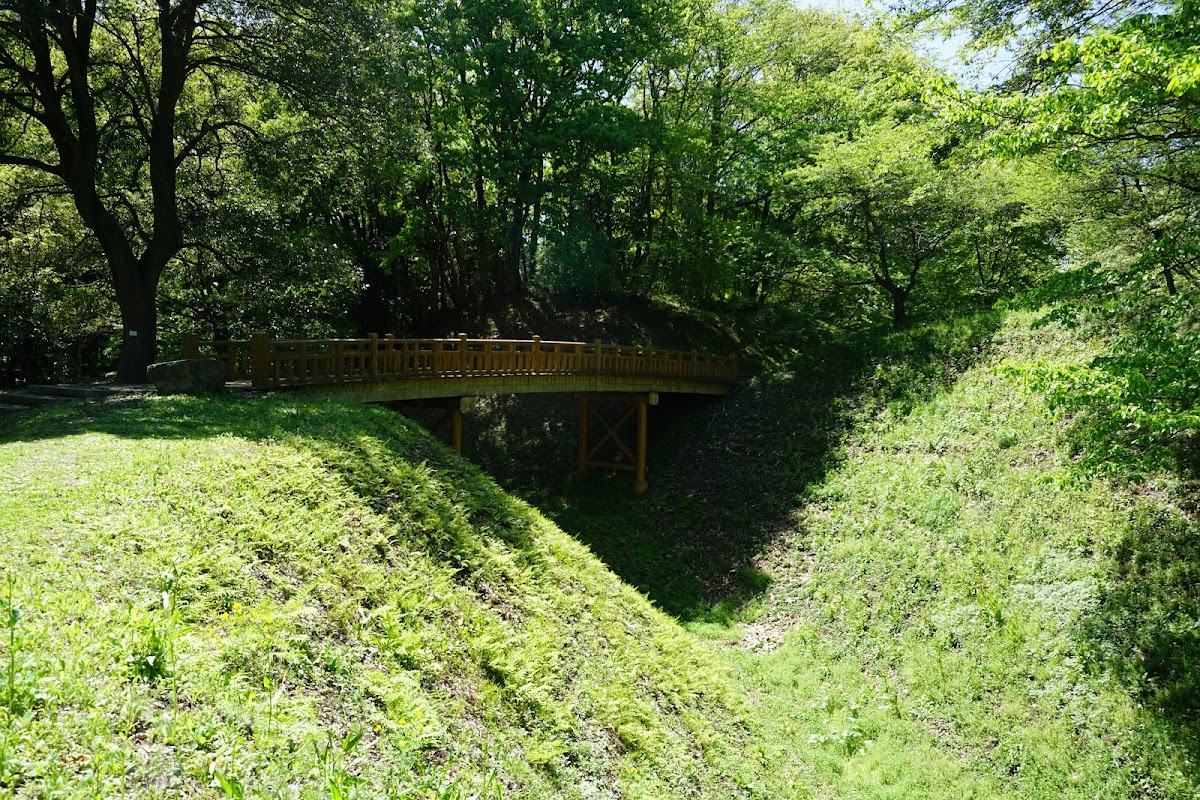
Currently, the remains of the Iono Mansion are scattered throughout the grounds of Iono Elementary School and its surroundings. In particular, the earthen ramparts on the hillside (north side) of the school remain in good condition, providing valuable clues to understanding the scale and structure of the medieval residence.
The height and width of the ramparts, and the construction techniques used, allow us to infer the extent of the Iono clan’s power and the type of defensive system they employed. The ramparts are not simply mounds of earth, but were carefully constructed using techniques such as rammed earth, making them valuable remains that demonstrate the level of civil engineering technology in the medieval period.
Size and Layout of the Mansion
While the exact size of the Iono Mansion remains unclear due to limited archaeological excavations, it is estimated from the location of the existing ramparts and the topography that it was a rectangular area with sides of approximately 100 meters.
This size is appropriate for the residence of the Iono clan, one of the six powerful families of Nasu. The residence included the main hall, as well as offices for retainers, warehouses, and stables, functioning as the center of the Iono clan’s rule.
Relocation from Iono Residence to Iono Castle
The Arrival of the Sengoku Period and the Need for Strengthened Defenses
Around 1487 (Chōkyō 1), the 13th head of the clan, Iono Sukekiyo, built a new castle on a mountain approximately 130 meters high, towering behind the residence. This was Iono Castle (a mountain castle).
This period marked the decline of the Muromachi Shogunate’s authority and the beginning of the Sengoku period, when various daimyo rose to power throughout the country. The limitations of a residence on flat ground necessitated stronger defensive structures, creating a historical context where more robust defensive facilities were required.
Combined Use of Residence and Mountain Castle
It is believed that even after the relocation to Iono Castle, Iono Castle was not completely abandoned. It is highly probable that the mountain castle served as a defensive base during wartime, while the former residence was used for daily life during peacetime.
This type of castle structure, known as the “Negoya-shiki” (base camp style), was common in castles of the Sengoku period (Warring States period), and was a rational system that balanced practicality and habitability.
Characteristics of Iono Castle
Iono Castle is a full-fledged Sengoku period castle, a mountain castle equipped with defensive facilities such as moats and vertical trenches. It featured baileys such as the main keep, second bailey, and third bailey, functioning as a military base for the Iono clan.
Currently, part of the Iono Castle site has been developed into a park, allowing visitors to actually see the remains of moats and vertical trenches. Visiting both Iono Castle and Iono Castle together makes it a valuable spot to experience the transformation of castles from the medieval period to the Sengoku period.
The Later Life of the Iono Clan and the Edo Period
Toyotomi Hideyoshi’s Siege of Odawara and Territory Reduction
In 1590, during Toyotomi Hideyoshi’s siege of Odawara, the Nasu clan incurred Hideyoshi’s displeasure and had their territories drastically reduced. Both the main Nasu family and the Iono clan received harsh punishments, and their power greatly declined.
During this period, while many samurai groups from the medieval era were dispossessed or had their territories drastically reduced, the Iono clan managed to preserve their family name.
Achievements at the Battle of Sekigahara
In the Battle of Sekigahara in 1600, the Iono clan distinguished themselves on the Tokugawa side by preventing the Uesugi forces from advancing south. For this achievement, their territory was increased, and they served the Edo shogunate as hatamoto (direct retainers of the shogun).
Iono Sukenobu, a descendant of the Iono clan, was counted as one of the “Seven Knights of Nasu,” and the Iono clan maintained its position as a powerful family in the Nasu region even during the Edo period.
Abandonment of Iono Castle
In 1627 (Kanei 4), Iono Castle was abandoned. Due to the Edo shogunate’s “One Castle Per Province” decree, each domain was ordered to abolish castles other than its principal residence, and it is believed that Iono Castle was included in this order.
With this, the history of castles in the Iono region, which had continued since the Kamakura period, came to an end.
Access and Visiting Information for Iono-kan
Location and Transportation Access
Location: Iono, Nasu-machi, Nasu-gun, Tochigi Prefecture (around Iono Elementary School)
Access by Car:
- Approximately 20 minutes from Shirakawa IC on the Tohoku Expressway via National Route 294
- Approximately 30 minutes from Nasu IC on the Tohoku Expressway via National Route 294
Access by Public Transportation:
- Approximately 15 minutes by taxi from Kurodahara Station on the JR Tohoku Main Line
- Public transportation is limited, so visiting by car is recommended.
Precautions During Visits
The Iono-kan site is now largely part of the Iono Elementary School grounds, so consideration for the school’s educational activities is necessary during visits. Remains such as earthworks are located around the school’s perimeter and on the mountainside, and can be observed from the public road.
Visiting is free, but please refrain from trespassing on private property or school grounds. Furthermore, to protect the remains, care must be taken not to climb on or damage the earthworks.
Related Historical Sites in the Surrounding Area
When visiting Iono-kan, we recommend also visiting the following related historical sites:
Iono Castle Ruins (Mountain Castle): A Sengoku period mountain castle located on the mountain behind Iono-kan. It is accessible on foot, and the remains such as moats and vertical trenches are well preserved.
Shofuku-ji Temple: A temple associated with the Iono clan. It also serves as a trailhead to the Iono Castle Ruins.
Former Oshu Kaido Road, Iono-juku: The Iono area flourished as a post town during the Edo period. Strolling through the area, which retains the atmosphere of an old townscape, is also appealing.
Historical Value and Preservation Status of Iono-kan
Importance in Medieval Residence Research
Iono-kan has high academic value as a typical example of a medieval samurai residence in the Kanto region. The relatively well-preserved rectangular form of the manor house makes it a valuable resource for studying medieval residential forms and defensive philosophies.
In particular, the clear traceability of how the same clan moved their base from a plains residence to a mountain castle is an important case study in castle history research.
Positioning as a Cultural Property of Nasu Town
The Iono Manor Site is recognized as an important cultural heritage of Nasu Town and is an indispensable historical site for understanding the town’s history. However, because it is located on the grounds of an elementary school, balancing preservation and utilization is a challenge.
In recent years, with the growing momentum for tourism promotion utilizing local historical heritage, appropriate methods for preserving and opening the Iono Manor Site are being considered.
Expectations for Future Preservation and Utilization
More detailed investigations and appropriate preservation measures for the Iono Manor Site are desired. If archaeological excavations reveal the detailed structure of the manor and the actual living conditions, it will greatly contribute to medieval history research.
Furthermore, creating an environment where visitors can easily learn about history, such as installing explanatory signs and developing walking paths, is also important. The development of a historical walking course, including the Iono Castle ruins, is also anticipated.
Historical Background of the Iono Region
The Old Tōsandō Road and an Ancient Transportation Hub
The Iono region has held an important position as a transportation hub since ancient times. The old Tōsandō Road passed through it, making it an important route connecting Mutsu Province (present-day Fukushima and Miyagi Prefectures, etc.) and Shimotsuke Province.
This geographical condition is thought to be one of the reasons why the Iono clan was able to establish an independent power as a branch of the Nasu clan. Controlling the highway had great economic and military significance.
Development as a Post Town and Castle Town
In the Middle Ages, Iono continued to develop as a castle town of the Iono clan, and in the Edo period, as a post town on the Ōshū Kaidō (Ōshū Highway). Even today, the urban area is formed along National Route 294, conveying its character as an ancient transportation hub.
Characteristics as a Border Region with Fukushima Prefecture
The Iono region is located in the easternmost part of Tochigi Prefecture, bordering Tanagura Town and Shirakawa City in Fukushima Prefecture. This border region characteristic has given Iono a unique historical and cultural identity.
Amidst the power struggles between the Nasu clan, the Shirakawa Yuki clan, and the Satake clan, the Iono clan skillfully employed diplomacy to establish its own unique position.
The Nasu Clan and the Six Nasu Families
The Legend of Nasu Yoichi and the Nasu Clan
The Nasu clan is widely known as the family of Nasu Yoichi, who shot down the fan target at the Battle of Yashima (1185) during the Genpei War. This legend is depicted in the *Tale of the Heike*, making the Nasu clan’s name known throughout Japan.
The Iono clan, as a branch of this prestigious Nasu clan, shared in its glory while developing its own unique path.
Composition of the Six Nasu Families
Besides the main Nasu family, several branch families were known as the “Six Nasu Families.” The Iono family was one of them, and the others included the Otawara family and the Senbon family.
These branch families shared control of the Nasu region, sometimes cooperating and sometimes competing. Their relationships were complex, sometimes uniting against external enemies, and sometimes engaging in internal power struggles.
Development of the Seven Nasu Knights
From the Sengoku period to the Edo period, particularly powerful families within the Nasu clan came to be known as the “Seven Nasu Knights.” Iono Sukenobu was one of them, and maintained his position as a powerful figure in the Nasu region even during the Edo period.
Recommended Points When Visiting Iono Manor
Observing the Earthworks
The earthworks remaining on the hillside of Iono Elementary School are a valuable historical site where you can actually see the defensive facilities of a medieval residence. By carefully observing their height, width, and structure, you can experience the castle-building techniques and defensive philosophies of the time. The earthen ramparts are overgrown with trees, but these too are part of the long history that has unfolded over many years. You can also enjoy the ever-changing scenery of the ramparts depending on the season.
Understanding the Topography
To understand the location of Iono-kan, it is important to observe the surrounding topography. Behind it lies the mountain where Iono Castle stands, while a relatively flat area stretches out in front.
This topography clearly demonstrates the castle strategy of the medieval and Sengoku periods, suitable for residence during peacetime, while allowing for a siege to the mountain castle behind in times of conflict.
Visiting Iono Castle in conjunction with Iono-kan
If you have the time, we highly recommend visiting both Iono-kan and Iono Castle. You can learn firsthand about the typical pattern of Japanese castle history: the development from a flatland residence to a mountain castle.
Iono Castle can be reached by climbing a mountain path from beside Shofuku-ji Temple, taking about an hour round trip. From the mountain castle, you can enjoy a panoramic view of the town of Iono, experiencing the perspective of the former castle lord. ### Local Historical Walk
Besides the castle ruins, the Iono district boasts a townscape with a historical atmosphere and numerous old temples and shrines. A leisurely stroll allows you to experience the history of the area as a post town and castle town.
Through interactions with locals, you might hear legends about the Iono clan and the region’s history.
Summary
Iono-kan is the site of a medieval residence from the Kamakura to Muromachi periods, located in Nasu Town, Tochigi Prefecture. The Iono clan, a branch of the Nasu clan, used it as their base for approximately 250 years, playing a crucial role in the history of the Nasu region.
As a valuable historical site preserving the typical rectangular form of a residence, and as a historical site illustrating the evolution of castles from the medieval to the Sengoku period, it holds high historical value. Although currently the site of Iono Elementary School, the earthworks and other remains still convey its original appearance.
Visiting it together with Iono Castle (a mountain castle) offers a valuable opportunity to experience the developmental process of Japanese castle history. When you visit the Nasu region, be sure to stop by the historic Iono Manor ruins. You’ll be able to reflect on the lives of medieval samurai and the history of the Iono clan, who survived through turbulent times.
.png)