.png)
Iidoi Castle (Tako Town, Chiba Prefecture) Complete Guide | Thorough Explanation of History, Remains, and Access
Iidoi Castle, located in Tako Town, Katori District, Chiba Prefecture, is a medieval hilltop castle also known as “Wakejo” (branch castle). Built by the Chiba clan, this castle still retains well-preserved remains such as earthworks and dry moats, making it a valuable historical site for learning about the structure of medieval castles. This article provides a detailed explanation of Iidoi Castle, from its history and highlights to access methods, for castle enthusiasts and history buffs.
Basic Information on Iidoi Castle
Iidoi Castle is a medieval castle located in Minami-naka, Tako Town, Katori District, in the northeastern part of Chiba Prefecture. Built on the eastern edge of the Shimosa Plateau, the castle sits on a plateau approximately 30 meters above sea level, with a relative elevation difference of about 10 meters from the surrounding lowlands.
Castle Data
- Location: 1328-1 Minami-naka, Tako-machi, Katori-gun, Chiba Prefecture (Myoken Shrine)
- Alternate Name: Wakejo (or Bunjo)
- Castle Type: Hilltop Castle
- Construction Period: Late Kamakura period to Nanboku-cho period
- Builder: Chiba Tanetsada (Chida Osumi-no-kami Tanetsada)
- Main Lord: Chiba Tanetsada
- Remains: Enclosures, earthworks, dry moats, trenches, watchtowers
- Designated Cultural Property: None
- Current Status: Within the grounds of Myoken Shrine
History of Iidoi Castle
The Background of the Castle’s Construction and Chiba Tanesada
Chiba Tanesada, believed to be the builder of Iidoi Castle, was a samurai of the Chiba clan, known as Chida Osumi-no-kami. According to a memorial tablet preserved at Myoken Shrine, it reads, “Founder of Kyoeizan Tokusei-ji Temple, Lord of Iidoi Castle, Chiba Osumi-no-kami Tanesada, Gotokuin-dono Nichiei Daikoji, passed away on November 29, 1336 (Kenmu 3).” This indicates his death in 1336.
It is said that Chiba Tanesada built Iidoi Castle as a defensive base for his residence in an area called Kubo. During the turbulent period from the late Kamakura period to the Nanboku-cho period, the Chiba clan expanded its power in Shimosa Province (present-day northern Chiba Prefecture), and Iidoi Castle is thought to have been built as part of this expansion.
Origin of the Name “Wakejo”
Iidoi Castle is also known by the alternative name “Wakejo” (branch castle). This name is thought to mean a branch castle separated from the main castle, or a castle built when territory was divided. Several castles and residences related to the Chiba clan existed in the Tako region, and Iidoi Castle may have played a specific role among them.
Iidoi Castle in the Sengoku Period
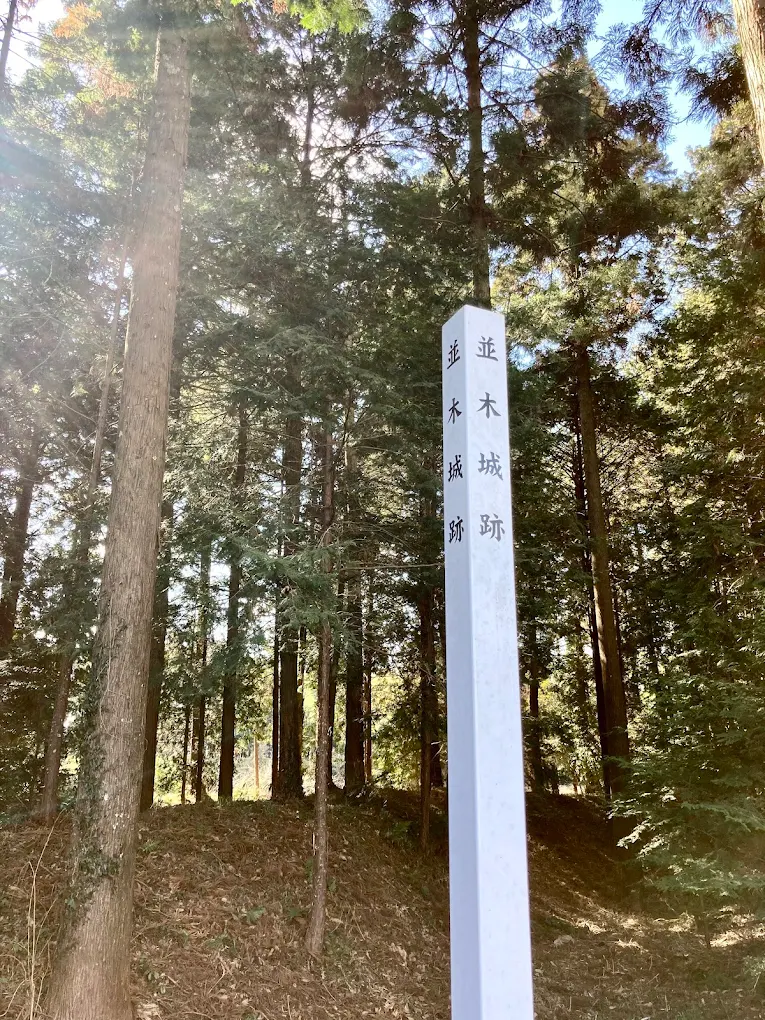
Iidoi Castle is presumed to have been renovated and improved in preparation for the Sengoku period (Warring States period). Given its location on the same plateau as Namiki Castle, it is thought that the two castles worked together for defense. Its location on the eastern edge of the Shimosa Plateau was of significant importance as a defensive base against invasions from the east.
The Shimosa region during the Sengoku period was in a complex political situation, with internal conflicts within the Chiba clan and the expansion of the Odawara Hojo clan’s power. While it is unclear when Iidoi Castle was last used, it is possible that it functioned in some form until the end of the Sengoku period.
The Chiba Clan and Myoken Worship
Currently, a Myoken Shrine stands on the site of Iidoi Castle. The Chiba clan revered Myoken Bodhisattva (Hokushin Myoken Daibosatsu) as their tutelary deity for generations, and Myoken shrines were often found in castles associated with the Chiba clan. The Myoken Shrine at Iidoi Castle is important evidence of its deep connection to the Chiba clan.
Myoken worship is the deification of the North Star and the Big Dipper, and for samurai families, it was an object of prayer for military success and the security of their territories. The Chiba clan’s enshrinement of Myoken shrines in various castles is thought to have been not merely for religious reasons, but also as a symbol of their control over their territories.
The Layout and Structure of Iidoi Castle
Overall Layout
Iidoi Castle is a flatland castle utilizing the edge of a plateau, with a layout that skillfully makes use of the natural terrain. The castle grounds measure approximately 150 meters east-west and 100 meters north-south, placing it in the medium-sized category for a medieval castle.
It exhibits a typical medieval castle structure, with multiple enclosures arranged around the main enclosure, separated by earthworks and dry moats. A steep slope was constructed along the edge of the plateau to enhance its defensive capabilities.
Structure of the Main Enclosure
The area where the main hall of Myoken Shrine currently stands is believed to be the main enclosure. The main enclosure was located at the highest point and surrounded by earthworks. The earthworks remain about 1-2 meters high today, suggesting they were even higher in the past.
From the main enclosure, one could overlook the surrounding terrain, and it is presumed to have functioned as a lookout post. While some remains have been altered due to the development of the Myoken Shrine grounds, the basic structure remains intact.
Characteristics of the Earthworks
The earthworks of Iidoi Castle are particularly well-preserved in the western part of the castle. The long, impressive earthen rampart, accompanied by a steep cliff, measures approximately 2-3 meters in height and 5-6 meters in width at its base, a standard structure for earthen ramparts of medieval castles.
The construction method of the rampart is thought to have been the “rammed earth” technique, where soil excavated from the natural ground is piled up. While vegetation grows densely on the surface of the rampart, in areas where the cross-section can be observed, the layered construction of the soil can be seen.
Dry Moats and Moats
Several remains of dry moats remain at Iidoi Castle. In particular, a clear dry moat can be seen behind the main hall of Myoken Shrine. This dry moat is approximately 5-8 meters wide and 2-3 meters deep, and served to demarcate the baileys.
Moats were also constructed to divide the plateau, serving as important defensive structures to prevent enemy intrusion. Although they no longer retain their original form due to burial and collapse, their locations can be estimated from the topography.
Layout of the Enclosures
It is believed that multiple enclosures were arranged around the main enclosure. Based on the current topography and the arrangement of earthworks, it is estimated that at least 3-4 enclosures existed. Each enclosure was demarcated by earthworks and dry moats, functioning as an independent defensive unit.
The size of the enclosures varied, and it is thought that more important facilities were located in the enclosures closer to the main enclosure. Since no archaeological excavations have been conducted, details such as building remains are unknown, but it is possible that residential facilities or warehouses were built there.
Highlights and Exploring the Remains of Iidoi Castle
Remains within the Grounds of Myoken Shrine
The central point of interest when visiting Iidoi Castle is Myoken Shrine. The entire shrine grounds are the castle site, allowing visitors to observe the remains while paying their respects. Earthworks surround the shrine buildings, conveying the atmosphere of a medieval castle.
While the shrine buildings are relatively new, their layout may reflect the structure of the castle. The main shrine is located in the center of the main enclosure, and the worship hall and torii gate may suggest the relative positions of the castle’s entrance.
Western Cliff and Earthwork
The greatest highlight of Iidoi Castle is the long cliff and earthwork remaining on the west side. Walking west of the shrine, a clear cliff continues along the edge of the plateau. The steep slope, approximately 3-4 meters high, was artificially carved and served as a defensive structure to make it difficult for enemies to climb.
An earthwork is built on top of this cliff, forming a double line of defense. While it is not possible to walk on the top of the earthwork, looking up from below is overwhelming due to its sheer scale. Although covered with vegetation, the remains can be observed more clearly in winter.
Dry Moat Behind the Main Shrine
Behind the main shrine (north side) of Myoken Shrine, a well-preserved dry moat remains. This dry moat is approximately 6 meters wide and 2.5 meters deep, with a V-shaped cross-section. While it’s not possible to walk along the bottom of the moat, looking down from above allows you to get a real sense of the defensive structures as they once were.
Earthworks were built on both sides of the dry moat, clearly demonstrating the combined defensive system of moat and earthworks. This dry moat is thought to have demarcated the main enclosure and the second enclosure, and also served to control movement within the castle.
Remains of the Watchtower
On the eastern side of the castle grounds, there remains a raised area believed to be a watchtower. From this location, one could overlook the plains to the east, making it an excellent position for monitoring enemy movements. The watchtower is an earthen mound approximately 1.5 meters high, with a flat top.
Earthworks surround the watchtower, suggesting that the watchtower itself may have functioned as an independent enclosure. Currently, visibility is poor due to overgrown trees, but it is thought that the surrounding trees were cleared in the past to ensure a clear view.
Entrance to the Castle and the Main Gate
The current approach to Myoken Shrine may indicate the location of the main gate (the castle’s main entrance) in the past. The approach to the castle gently ascends from the south side of the plateau, suggesting this was the main approach.
Earthworks protrude around the entrance, and topography resembling flanking defenses (a mechanism for attacking from the side) can also be observed. However, it is possible that the path was altered during the development of the shrine’s approach, so the exact structure of the time is unknown.
Access and Visiting Guide to Iidoi Castle
Access by Public Transportation
The following route is convenient for visiting Iidoi Castle by public transportation:
By Train and Bus
- Get off at “Airport Terminal 2 Station” on the Keisei Main Line/Narita Sky Access Line
- Take the Chiba Kotsu Bus “Tako Main Line” (approximately 30 minutes)
- Get off at the “Michi-no-Eki Tako” bus stop
- Walk approximately 15 minutes to Myoken Shrine (Iidoi Castle Ruins)
Since bus services are limited, it is recommended to check the timetable in advance. At Michi-no-Eki Tako (Roadside Station Tako), you can purchase local specialty products, so it’s worth stopping by during your visit.
Access by Car
Access by car is the most convenient.
From Tokyo
- Approximately 30 minutes from Narita IC on the Higashi-Kanto Expressway
- Take National Route 296 towards Tako
Parking Information
There are several parking spaces within the grounds of Myoken Shrine. Parking is free, but priority is given to worshippers, so be aware of potential crowds. There is also some street parking near the entrance to the shrine’s approach, but please be considerate of local residents and avoid obstructing their passage.
Visiting Hours and Estimated Time Required
Visiting Hours: All day (as it is within the grounds of Myoken Shrine)
Recommended Visiting Hours: Daytime (around 9:00 AM to 4:00 PM)
Estimated Time Required: Approximately 30-60 minutes
If you plan to carefully observe the remains within the shrine grounds, allow about 1 hour. If you include photography and exploring the surrounding area, allow 1.5 to 2 hours.
Points to Note During Your Visit
- Clothing: Long sleeves and long pants are recommended as the areas around the earthworks and dry moats are overgrown with vegetation. Sneakers or trekking shoes are suitable as some areas can be slippery.
- Season: Winter (November to March) is ideal for observing the remains. The vegetation withers, making the terrain easier to see. Insect repellent is essential in summer.
- Manners: Remember that you are on the grounds of Myoken Shrine and be considerate of other visitors. Care must be taken not to damage the shrine buildings or stone monuments.
- Safety: Avoid getting too close to the earthworks and cliffs, as they are at risk of collapse. Do not descend to the bottom of the dry moat.
Visit nearby attractions as well
Namiki Castle
This medieval castle is located on the same plateau as Iidoi Castle. They are within walking distance, allowing for consecutive visits. It is believed to have worked in conjunction with Iidoi Castle for defense, and visiting both together will help you understand the medieval castle network in this region.
Tako Castle
This was a major castle of the Chiba clan, located in the center of Tako Town. It is about a 10-minute drive from Iidoi Castle. It is a larger castle and served as a base for the Chiba clan in the Tako region.
Michi-no-Eki Tako
This roadside station, which also serves as a bus stop, offers local specialties, including Tako rice. It has excellent rest facilities and is a convenient base for castle tours.
Photo Spots at Iidoi Castle
Recommended Photo Spots
- Myoken Shrine and Earthwork: Photographing the earthwork with the shrine in the background creates a photo that conveys the atmosphere of a castle ruin.
- Western Cliff: Photographing from a low angle, looking up, captures the height and impressive scale of the cliff.
- Dry Moat Behind the Main Shrine: Photographing from an angle is recommended to show the V-shaped cross-section of the dry moat.
- View from the Earthwork: Photographing the surrounding scenery from the top of the earthwork helps understand the castle’s location.
Photo Tips
- Lighting: Good light comes from the east in the morning and from the west in the afternoon.
- Season: While the ruins are clearly visible in winter, beautiful photos can also be taken during the fresh green season (April-May).
- Weather: Cloudy weather softens shadows, making the shapes of the earthworks and dry moats easier to see.
Historical Value and Future Preservation of Iidoi Castle
Academic Value
Iidoi Castle is an important historical site as a castle of the Chiba clan and in the study of medieval castles in the Shimosa region. Its academic value is particularly recognized in the following respects:
- Remains demonstrating the expansion of the Chiba clan’s power: Built by a member of the Chiba main family, it demonstrates the Chiba clan’s control over Shimosa.
- A typical example of a medieval castle: Basic defensive structures such as earthworks, dry moats, and steep slopes are well-preserved, making it valuable as a teaching material for learning about the structure of medieval castles.
- Connection to Myoken worship: A valuable example demonstrating the Chiba clan’s Myoken worship, important for studying the religious practices of medieval samurai.
Preservation Status and Challenges
The remains of Iidoi Castle are maintained within the grounds of Myoken Shrine, resulting in a relatively good state of preservation. However, the following challenges exist:
- Tree Overgrowth: Trees growing on the remains are causing concern about damage to the structures by their roots.
- Earthwork Collapse: Some earthworks are collapsing, requiring appropriate preservation measures.
- Low Awareness: Because it is not designated as a cultural property, general awareness is low, making it difficult to spread understanding of its preservation.
Future Prospects
To pass on the value of Iidoi Castle to future generations, the following initiatives are expected:
- Detailed Survey: Clarify the castle’s structure by creating an accurate layout map.
- Installation of Information Boards: Install easy-to-understand information boards so that visitors can understand the remains.
- Regular Maintenance: Conduct appropriate maintenance, such as mowing grass and repairing dangerous areas.
- Utilization as a Local Historical Resource: To utilize Tako Town as a historical tourism resource, in conjunction with other historical sites.
History of Tako Town and the Chiba Clan
Medieval History of the Tako Region
Tako Town is located in the eastern part of Shimosa Province and was an important territory controlled by the Chiba clan during the medieval period. The Chiba clan developed into a powerful samurai group in Shimosa Province, starting with Chiba Tsunetane’s service to Minamoto no Yoritomo at the end of the Heian period.
Several castles and residences of the Chiba clan were built in the Tako region, and Iidoi Castle is one of them. These castles and residences cooperated with each other to defend and control the region, and are an important group of ruins for understanding the political and military system of medieval Shimosa.
The Chiba Clan and Shimosa Province
The Chiba clan was a branch of the Kanmu Taira clan based in Shimosa Province, and maintained its power for approximately 400 years, from the Kamakura period to the Sengoku period. A key characteristic of the Chiba clan was their adoption of the “Soryo system,” a system where family members were stationed in various locations to govern their territories.
Chiba Tanetsada, the builder of Iidoi Castle, is believed to have been a branch of the Chiba main family, entrusted with governing the Tako region. The alternative name, “Bunjo” (branch castle), may reflect this system of Chiba clan rule.
Information for Castle Enthusiasts
Castle Visit Records and Evaluation
Within the castle enthusiast community, Iidoi Castle is regarded as a “hidden gem.” While not a large-scale castle, its well-preserved remains make it an ideal site for learning the basic structure of medieval castles.
According to data from Kojodan (a castle-visiting website), the average rating is ★★★☆☆ (3.00), and the average visit time is 26 minutes. While the number of visitors is not particularly high, castle enthusiasts who have visited have given it high praise, praising its “excellent earthworks and dry moats” and noting its “clearly demonstrating the characteristics of a Chiba clan castle.”
Tips for Visiting Castles
Here are some points to help you effectively visit Iidoi Castle.
- Prior Study: Learning about the history of the Chiba clan and the basics of medieval castles before visiting will help you better understand the meaning of the remains.
- Using Maps: Since there are no detailed signs on site, it is helpful to obtain a layout map or topographic map in advance.
- Comparison with Surrounding Castles: Visiting Iidoi Castle in conjunction with surrounding castles such as Namiki Castle and Tako Castle will help you understand the castle network in this region.
- Seasonal Selection: Winter visits are recommended for beginners. The remains are easier to see, and there are fewer insects, making for a more comfortable visit.
Related Castles
For those interested in castles related to the Chiba clan, the following castles are also recommended:
- Hon-Sakura Castle (Shisui Town, Chiba Prefecture): The base of the Chiba clan, designated as a National Historic Site.
- Sakura Castle (Sakura City, Chiba Prefecture): An Edo period castle built on land associated with the Chiba clan.
- Inohana Castle (Chiba City, Chiba Prefecture): A castle considered to be the early base of the Chiba clan.
Summary
Iidoi Castle is a medieval castle remaining in Tako Town, Chiba Prefecture, and is a historical castle built by Chiba Tanetsada, a member of the Chiba clan. Also known as “Bunjo” (branch castle), it is currently well-preserved as part of the grounds of Myoken Shrine.
The remains of earthworks, dry moats, cliffs, and watchtowers are clearly visible, making it an ideal historical site for learning about the structure of medieval castles. The long cliff and earthworks on the west side, and the dry moat behind the main shrine are particularly worth seeing.
Access is convenient by car, but it is also possible to visit by public transport. Admission is free, and the visit takes approximately 30 minutes to 1 hour. Visiting in winter makes it easier to observe the remains and is also suitable for photography.
For those interested in the history of the Chiba clan, medieval castles, or castle-visiting enthusiasts, Iidoi Castle is a historical site well worth visiting. Visiting it along with the nearby Namiki Castle and Tako Castle will allow you to gain a deeper understanding of medieval Shimosa history.
When you visit Tako Town, be sure to stop by the Iidoi Castle ruins and experience the atmosphere of this medieval castle with nearly 800 years of history.