History and Highlights of Ibaraki Castle (Osaka Prefecture) | From Nakagawa Kiyohide’s Residence to the Present Day
What is Ibaraki Castle?
Ibaraki Castle was a Japanese castle located in Ibaraki City, Osaka Prefecture. Situated in the present-day center of Ibaraki City, near Ibaraki Shrine, it was a hilltop castle that functioned as an important base in Settsu Province from the Sengoku period to the early Edo period.
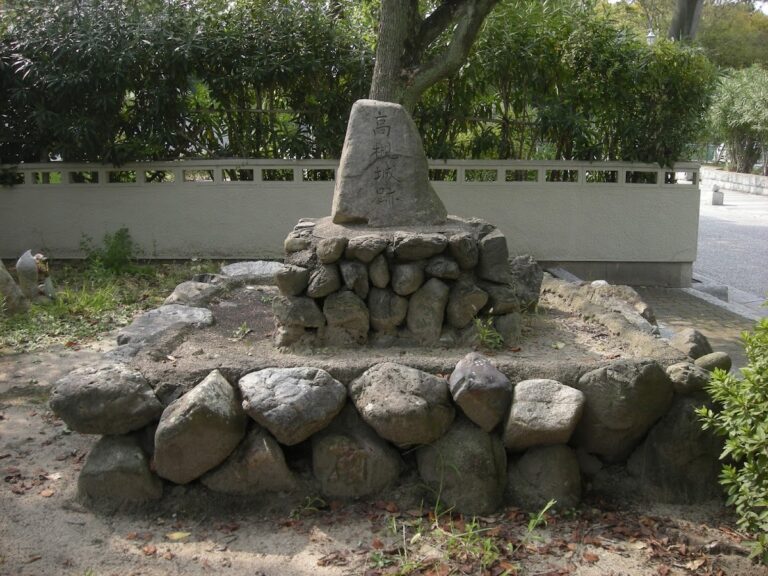
While the castle site has been largely developed into residential land and very few remains of the castle itself, a few historical sites remain that evoke the past, such as the rear gate (said to have been relocated to Ibaraki Shrine) and the reconstructed turret gate at Ibaraki Elementary School.
Location and Geographical Characteristics of Ibaraki Castle
Ibaraki Castle was a hilltop castle built near the Ai River. Located along the Saigoku Kaido road connecting Kyoto and Osaka, and also providing access to the Tanba region, it was a strategically important location. This geographical advantage is one of the reasons why Ibaraki Castle was considered important for so long. The castle is surrounded by Ibaraki Shrine and Ama-no-Iwato-wake Shrine (the inner sanctuary of Ibaraki Shrine), and even today, the town layout remaining around these shrines gives a sense of the former castle town’s atmosphere.
History of Ibaraki Castle
Construction and Early History
There are various theories regarding the construction period of Ibaraki Castle, but the most widely accepted theory is that it was built by Kusunoki Masashige in the first half of the Muromachi period. However, there are few historical records regarding the construction date and builder, leaving many points unclear.
From the Kamakura period to the Nanboku-cho period, this region was considered an important strategic point in Settsu Province, and the Ibaraki clan ruled this area for generations. The Ibaraki clan established their control over the region as a powerful local clan.
The Ibaraki Clan Era
During the Sengoku period, the Ibaraki clan made Ibaraki Castle their base as castle lords. Ibaraki Nagataka, in particular, is known as a powerful lord of the Ibaraki clan. In 1568 (Eiroku 11), Ibaraki Sado-no-kami, the lord of the castle, surrendered to Oda Nobunaga, who had invaded Settsu Province, and received confirmation of his territory.
However, the Ibaraki clan’s rule did not last long. In 1571 (Genki 2), the Ibaraki clan was defeated in a battle against the Ikeda clan and was destroyed. This battle led to a new ruler for Ibaraki Castle.
The Entry and Development of Nakagawa Kiyohide
In 1577 (Tensho 5), Nakagawa Kiyohide, known as one of the Seven Spears of Shizugatake, entered Ibaraki Castle. Kiyohide was a samurai who served Oda Nobunaga and later Toyotomi Hideyoshi, and he governed Settsu Province from Ibaraki Castle.
Nakagawa Kiyohide managed his domain from Ibaraki Castle and developed the castle town. During this period, Ibaraki Castle’s functions as a fortress were strengthened, and the castle town flourished. The reign of Kiyohide is considered one of the golden ages of Ibaraki Castle.
However, in the Battle of Shizugatake in 1583, Nakagawa Kiyohide fought on the side of Shibata Katsuie and was killed in action. After Kiyohide’s death, his son, Nakagawa Hidemasa, inherited the family headship and became the lord of Ibaraki Castle.
From Nakagawa Hidemasa to Toyotomi Direct Control
Nakagawa Hidemasa succeeded his father as lord of Ibaraki Castle, but was later transferred to Miki Castle in Harima Province. After Hidemasa’s transfer, Ibaraki Castle became a direct territory of Toyotomi Hideyoshi and was managed as an important base under the Toyotomi regime.
During this period, Ibaraki Castle was under the direct control of the Toyotomi family and became a symbolic presence demonstrating the influence of the Toyotomi regime in Settsu Province.
The Era of Katagiri Katsumoto
After the Battle of Sekigahara in 1600, Katagiri Katsumoto, one of the Seven Spears of Shizugatake, and his younger brother, Katagiri Sadataka, became the lords of Ibaraki Castle. Katagiri Katsumoto was known as a senior retainer of the Toyotomi family and governed from Ibaraki Castle, maintaining a delicate position between the Tokugawa shogunate and the Toyotomi family.
During Katagiri Katsumoto’s time, Ibaraki Castle continued to prosper as a castle town. Katsumoto is said to have possessed excellent administrative skills and enjoyed the deep trust of his people.
The Road to Abandonment
After the Siege of Osaka (1614-1615), Ibaraki Castle became a territory directly controlled by the Edo shogunate. As a direct territory of the Tokugawa shogunate, Ibaraki continued to maintain its importance as a transportation hub connecting Kyoto and Osaka, and as a base on the road to the Tanba region.
However, with the advent of the Edo period, the military necessity of Ibaraki Castle diminished, and it gradually lost its function as a fortress. While the exact date of its abandonment is unclear due to a lack of historical records, it is believed that the castle facilities were gradually lost from the early to mid-Edo period.
Structure and Layout of Ibaraki Castle
Scale and Arrangement of the Castle
Ibaraki Castle is presumed to have been built as a hilltop castle, with a structure comprising a main keep, second bailey, and third bailey. While detailed layout maps do not exist, the castle structure can be inferred to some extent from the surrounding topography and town layout.
The castle is thought to have utilized the Ai River as a natural moat, and also surrounded by artificial moats. The castle town was developed around the castle, with samurai residences and merchant districts systematically arranged.
Castle Gates and Turrets
Ibaraki Castle had multiple gates, and it is said that the rear gate was relocated to Ibaraki Shrine. This gate still remains on the grounds of Ibaraki Shrine and is a valuable structure as one of the few remaining structures of Ibaraki Castle.
Furthermore, a turret gate has been restored at the back gate of Ibaraki Elementary School. This recreates its original appearance and is an important facility that conveys the atmosphere of Ibaraki Castle’s gates to the present day.
Ibaraki Castle Today and its Highlights
The Rear Gate of Ibaraki Shrine
Ibaraki Shrine has a gate that is said to have been relocated from Ibaraki Castle’s rear gate. This gate retains the architectural style of the early Edo period and is considered to have high historical value as one of the few remaining structures of Ibaraki Castle.
Ibaraki Shrine is located near the site of the former main keep of Ibaraki Castle, and visiting the grounds allows you to feel the atmosphere of the former castle. The Ten’iwamono-wake Shrine (the inner shrine of Ibaraki Shrine) is also adjacent to the shrine, making it a popular spot for historical walks.
Restored Tower Gate at Ibaraki Elementary School
At the back gate of Ibaraki Elementary School, there is a restored tower gate of Ibaraki Castle. This restored tower gate was recreated based on historical documents and examples of other castles, allowing visitors to visually understand what the gate of Ibaraki Castle looked like.
Since it is located on school grounds, consideration is needed when visiting, but the exterior can be seen from the public road.
Traces of the Castle Town Remaining in the Town Layout
Although almost none of Ibaraki Castle itself remains, traces of the castle town era can be seen in the surrounding town layout. The arrangement of roads and the shape of the blocks allow one to imagine the layout of the former samurai residences and merchant districts.
In particular, the area from around Ibaraki Shrine to along the Saigoku Kaido road retains a strong atmosphere of Edo period town layout, making it an ideal area for historical walks.
Historical Sites Around the Castle Ruins
There are other historical points of interest scattered around the Ibaraki Castle ruins. Along the Saigoku Kaido road, remnants of the old townscape remain, allowing visitors to experience the atmosphere of a post town.
Furthermore, the Ibaraki City Cultural Properties Museum exhibits materials related to Ibaraki Castle and the history of Ibaraki, allowing visitors to learn more about the castle’s history.
Access to Ibaraki Castle
Access by Public Transportation
The nearest stations to the Ibaraki Castle ruins are JR Kyoto Line “Ibaraki Station” or Hankyu Kyoto Line “Ibaraki-shi Station”.
- From JR Ibaraki Station: Approximately 15 minutes on foot
- From Hankyu Ibaraki-shi Station: Approximately 10 minutes on foot
From either station, you can reach the area around the castle ruins by walking towards Ibaraki Shrine. Ibaraki Shrine is located in the center of Ibaraki City, making it relatively easy to access.
Access by Car
By car, it’s approximately 15 minutes from the Meishin Expressway “Ibaraki Interchange” or “Ibaraki-Senteiji Interchange”. However, there is no dedicated parking lot around the castle ruins, so you will need to use a nearby coin-operated parking lot.
Ibaraki Shrine has parking spaces for visitors, but the number of spaces is limited, so using public transportation is recommended.
Points to Note When Visiting
Ibaraki Castle ruins are located in an urban area, and most of it has been developed into residential land. The reconstructed gate tower of Ibaraki Elementary School is located on school grounds, so please avoid entering during class hours and limit your visit to viewing the exterior only.
Ibaraki Shrine is usually open to visitors, but it can get crowded during festivals and events. If you want to visit at a leisurely pace, weekday mornings are generally less crowded and recommended.
Historical Background of Ibaraki Castle and its Surroundings
Ibaraki’s Position in Settsu Province
Settsu Province was one of the important provinces in the Kinai region from ancient times, and it flourished as a transportation hub connecting Kyoto and Osaka. Within Settsu Province, Ibaraki was located at the intersection of the Saigoku Kaido and Tanba Kaido roads, making it a strategically crucial location.
This geographical location is the reason for the construction of Ibaraki Castle, and it also explains why many warlords valued this castle throughout the Sengoku period.
Relationship with the Seven Spears of Shizugatake
Ibaraki Castle is known for having been the castle lord of two warlords known as the Seven Spears of Shizugatake: Nakagawa Kiyohide and Katagiri Katsumoto. The Seven Spears of Shizugatake refer to seven warlords who served Toyotomi Hideyoshi and distinguished themselves in the Battle of Shizugatake in 1583.
Nakagawa Kiyohide died in this battle, but Katagiri Katsumoto survived and later became the lord of Ibaraki Castle. The fact that these two warlords served as castle lords is a noteworthy event in the history of Ibaraki Castle.
Ibaraki in the Edo Period
During the Edo period, Ibaraki became a shogunate territory, and a magistrate’s office was established. Although it lost its function as a castle, it continued to prosper as a post town and a commercial center.
As a post town on the Saigoku Kaido road, Ibaraki was a bustling place with many travelers passing through. This prosperity laid the foundation for modern-day Ibaraki City.
Recommended Spots When Visiting Ibaraki Castle
Ibaraki Shrine
Ibaraki Shrine is the central point of interest when visiting the Ibaraki Castle ruins. This shrine, where the rear gate is said to have been relocated, is located in the heart of the castle ruins, presumably near the former main keep. The grounds have a quiet and peaceful atmosphere, allowing for a leisurely stroll while feeling the history.
Ibaraki City Cultural Properties Museum
For those who want to learn more about Ibaraki Castle and the history of Ibaraki, a visit to the Ibaraki City Cultural Properties Museum is recommended. It houses exhibits related to Ibaraki Castle and the history of Ibaraki City, and a visit before or after visiting the castle ruins will deepen your understanding.
Townscape of the Saigoku Kaido Road
Around the Ibaraki Castle ruins, remnants of the townscape from its time as a post town on the Saigoku Kaido road remain. Old merchant houses and townhouses are scattered throughout, allowing visitors to enjoy a stroll while experiencing the atmosphere of the Edo period.
Historical Significance of Ibaraki Castle
Ibaraki Castle was a castle that functioned as an important base in Settsu Province from the Sengoku period to the early Edo period. Its importance is evident from the fact that famous warlords such as Nakagawa Kiyohide and Katagiri Katsumoto served as its lords.
Although very few remains of the castle exist today, the rear gate of Ibaraki Shrine, the reconstructed turret gate of Ibaraki Elementary School, and the remnants of the castle town remaining in the town layout allow us to imagine the former appearance of Ibaraki Castle.
Located in the heart of Ibaraki City, the Ibaraki Castle ruins are easily accessible and a suitable spot for historical walks. When touring castle ruins in Osaka Prefecture, be sure to visit the Ibaraki Castle ruins.
Summary
Ibaraki Castle was a hilltop castle located in Ibaraki City, Osaka Prefecture. From the Muromachi period to the early Edo period, it played a crucial role as a strategic point in Settsu Province. While there are various theories about its builder, the most widely accepted is that it was constructed by Kusunoki Masashige.
During the Sengoku period, various warlords, including the Ibaraki clan, Nakagawa Kiyohide, and Katagiri Katsumoto, served as lords of the castle. The castle’s golden age was particularly during the time of Nakagawa Kiyohide and Katagiri Katsumoto, known as the Seven Spears of Shizugatake. After the Siege of Osaka, it became a territory of the Edo Shogunate, and although it lost its function as a castle, it continued to prosper as a post town.
Currently, the castle site has been largely developed into residential land, and very few remains exist. However, the rear gate, said to have been relocated to Ibaraki Shrine, and the reconstructed turret gate at Ibaraki Elementary School, offer a glimpse of its former glory. The surrounding town layout also evokes the atmosphere of a castle town, making it a suitable spot for historical walks.
Currently, the castle site has been largely developed into residential land, and very few remains are left. However, the rear gate, said to have been relocated to Ibaraki Shrine, and the turret gate, restored at Ibaraki Elementary School, offer a small glimpse of its past. Ibaraki Castle Ruins, accessible on foot from JR Ibaraki Station and Hankyu Ibaraki-shi Station, is one of the historical sites you should definitely visit when touring castles in Osaka Prefecture.