Takatsuki Castle (Osaka Prefecture) Complete Guide: History and Highlights of the Only Early Modern Castle in Northern Osaka
What is Takatsuki Castle?
Takatsuki Castle (Takatsuki-jō) was a Japanese castle that once existed in Takatsuki Village, Shimakami District, Settsu Province (present-day Jōnai-chō, Takatsuki City, Osaka Prefecture). Also known as “Irie-jō,” it was built at a strategically important transportation hub located midway between Kyoto and Osaka.
In 1691, Engelbert Kaempfer, a Dutch trading post official traveling from Nagasaki to Edo, wrote in his “Edo Sanpu Ryoko Nikki” (Diary of a Journey to Edo) (Tōyō Bunko): “Across the river to the left, the castle appeared to be built in the water. This castle was the residence of a small daimyo named Takatsuki, and it stood out beautifully in the field from afar.”
Currently, Takatsuki Castle was demolished in 1874 (Meiji 7), and most of its remains have been lost. However, a castle ruins park has been developed as a designated historical site of Osaka Prefecture, and visitors can learn about the history of Takatsuki Castle at the Castle Ruins History Museum.
The Establishment of Takatsuki Castle and the Irie Clan
Takatsuki Castle first appears in historical records in the first half of the 14th century during the Nanboku-cho period. It is believed to have begun with the establishment of a residence by Irie Harunori.
The Irie clan were local lords of Settsu Province and ruled this region. It is thought that the initial Takatsuki Castle was more of a residence surrounded by earthworks and a moat, rather than a full-fledged castle. The existence of the Irie clan is also confirmed in records from the Daiei era (1521-1528), indicating that the Irie clan ruled this area throughout the Muromachi period.
During the time of the Irie clan, Takatsuki Castle was a smaller structure compared to the nearby Akutagawa Castle (a stronghold of the Miyoshi clan). However, its strategic importance gradually increased due to its location along the highway connecting Kyoto and Osaka.
Wada Koremasa and the Third Castle Tower in Japan
A major turning point occurred in 1569, at the end of the Sengoku period. Wada Koremasa, who accompanied Shogun Ashikaga Yoshiaki to Kyoto, became the lord of Takatsuki Castle.
Wada Koremasa was a samurai who served under Oda Nobunaga and developed Takatsuki Castle into a full-fledged fortress. Notably, Wada Koremasa constructed a “castle tower” (tenshu) at Takatsuki Castle. This is considered the third castle tower in Japan, after Azuchi Castle and Gifu Castle, and was a groundbreaking undertaking for its time.
Wada Koremasa strengthened the castle’s defenses and laid the foundation for the castle town. However, he was killed in the Battle of Shirai-gawara in 1571, and his son, Wada Korenaga, succeeded him.
The Castle Town of the Christian Daimyo Takayama Ukon
In 1573, Takayama Tomoteru and his son Ukon, vassals of the Wada clan, expelled Wada Korenaga, and Takayama Ukon became the lord of Takatsuki Castle. This period is the most famous in the history of Takatsuki Castle.
Castle Development by Takayama Ukon
Takayama Ukon is known as a devout Christian daimyo. He extensively renovated Takatsuki Castle, incorporating townhouses within the castle grounds to create a strong fortress. The castle area was expanded, defensive facilities were strengthened, and the castle town was also developed.
It is believed that Ukon began full-scale construction of Takatsuki Castle in 1573 (Tensho 1), and even built part of the stone walls. During this period, Takatsuki Castle functioned as an important base in Settsu Province.
Formation of a Christian Castle Town
The most notable characteristic of Takayama Ukon was his fervent devotion to spreading Christianity. A cathedral (church) was built within Takatsuki Castle, and many of his subjects converted to Christianity. According to the records of missionary Luis Frois, the majority of Takatsuki’s population became Christians.
Not only a church, but also a seminary (theological school) was established in the castle town, making Takatsuki a major center of Christianity in western Japan. However, when Toyotomi Hideyoshi issued the Edict of Expulsion of Missionaries in 1587 (Tensho 15), Takayama Ukon was forced to abandon his territory and be exiled in order to maintain his faith.
Changes After Ukon’s Exile
After Takayama Ukon’s exile, the church within Takatsuki Castle was demolished, and Nomi Shrine was rebuilt on the site. This shrine still exists in Takatsuki City today, preserving the remnants of the former church.
Hashiba Kokichi Hidekatsu and Toyotomi’s Gold-Leaf Tiles
After Takayama Ukon, from 1585 to 1591, Hashiba Kokichi Hidekatsu (Toyotomi Hidekatsu), nephew of Toyotomi Hideyoshi, became the lord of Takatsuki Castle.
During Hidekatsu’s time, the castle was further improved to demonstrate the power and prestige of the Toyotomi regime. Recent archaeological excavations have unearthed gold-leaf tiles, indicating that Takatsuki Castle during the Toyotomi period possessed lavish decorations. Gold-leaf tiles were a special type of tile permitted only for major castles under the Toyotomi regime, illustrating the importance of Takatsuki Castle.
After Hidekatsu’s death, Takatsuki Castle changed hands several times, first to Shinjo Naoyori, then to Naito Nobunari and his son Nobumasa. In 1602 (Keicho 7), Naito Nobumasa was appointed as the castle’s lord with a 30,000 koku stipend.
From the Front Lines of the Tokugawa Shogunate to Castle Construction
The Siege of Osaka and Takatsuki Castle
During the Winter Siege of Osaka in 1614 (Keicho 19), Takatsuki Castle became a crucial base for the Tokugawa forces. Its proximity to Osaka Castle allowed it to function as a front-line base for the Tokugawa army. It played a similar role in the Summer Siege of Osaka the following year, becoming a key element in the control of Settsu Province after the fall of the Toyotomi family.
The Great Renovation of Genna
In 1617 (Genna 3), the Tokugawa Shogunate ordered a large-scale renovation of Takatsuki Castle. This was part of a policy to strengthen control over western Japan after the Siege of Osaka.
This renovation transformed Takatsuki Castle from a medieval castle centered on earthen ramparts into a modern castle with high stone walls. A three-story keep was constructed, and it became a large-scale castle with numerous baileys. This completed form of Takatsuki Castle remained throughout the Edo period.
Appearance and Layout of Modern Takatsuki Castle
Scale and Structure of the Castle
The scale of modern Takatsuki Castle is estimated to be approximately 630 meters east-west and 580 meters north-south. This was the only full-fledged modern castle in the Hokusetu region.
The castle was built as a flatland castle, with the main bailey at its center, surrounded by the second and third baileys. A three-story keep stood in the main bailey, and numerous turrets and gates were constructed. The stone walls were built high, and a wide moat surrounded the castle.
Keep and Main Buildings
The keep is thought to have been three stories high and of a watchtower-type structure. From the castle tower, one could see towards Kyoto and Osaka, making it a strategically important observation point.
Besides the castle tower, the Honmaru Palace was constructed in the main enclosure, providing the lord’s residence and administrative offices. The second enclosure housed the residences of senior retainers and the domain’s main facilities, while the third enclosure included the residences of lower-ranking samurai and a merchant district.
Features of the Moat and Stone Walls
Takatsuki Castle’s moat was a water moat, drawing water from the Yodo River system. As Kaempfer noted, it “appeared to be built in water,” presenting a beautiful landscape from a distance, as if the castle were floating on water.
The stone walls were constructed in earnest during the Genna era renovations. Techniques ranging from rough-hewn stone masonry to fitted stonework were employed, incorporating the latest technology of the time. While the height varied depending on the location, it is estimated that the highest points reached over 10 meters.
Takatsuki Castle and Successive Lords in the Edo Period
The Nagai Clan Era
In 1633 (Kanei 10), Nagai Naokiyo was appointed to the domain with a stipend of 36,000 koku, and the Nagai clan continued as lords of Takatsuki Domain until the Meiji Restoration. The Nagai clan served the Tokugawa Shogunate as hereditary daimyo, governing Settsu Province from Takatsuki Castle.
During the Nagai clan’s era, efforts were made to maintain and manage the castle while also developing the castle town. The Karamon gate of Nagai Shrine was relocated from within the castle grounds and still exists in Takatsuki City today.
Life in the Castle Town
During the Edo period, Takatsuki Castle town flourished as a post town along the Kyo-kaido (Tokaido) road. A temple district formed within the castle town, and many temples, including Hongyo-ji Temple, were built. The gate of Hongyo-ji Temple was relocated from within the castle grounds and is one of the valuable surviving historical structures.
In the merchant district, commerce flourished, with brewing and textile industries thriving. Furthermore, samurai residences were neatly arranged in the castle town, where the domain’s retainers resided. The population is thought to have remained around 10,000 throughout the Edo period.
Takatsuki Castle, located midway between Kyoto and Osaka, was a busy transit point for daimyo (feudal lords) on their sankin-kotai (alternate attendance) journeys and travelers. Inns and teahouses lined the castle town, creating a bustling transportation hub.
Takatsuki Castle from the Late Edo Period to the Meiji Restoration
The Turmoil of the Late Edo Period
During the late Edo period, the Takatsuki domain acted on the side of the shogunate. During the Tenchugumi Incident of 1863 and the Kinmon Incident of 1864, it was tasked with guarding Kyoto.
In the Battle of Toba-Fushimi in 1868 (Keio 4), the Takatsuki Domain initially fought on the side of the shogunate, but after observing the course of the battle, it submitted to the new government. This swift response allowed the Takatsuki Domain to survive even after the Boshin War.
Abolition and Demolition of the Castle
After the Meiji Restoration, the Takatsuki Domain ceased to exist due to the abolition of the feudal domains and establishment of prefectures. Takatsuki Prefecture was established in 1871 (Meiji 4), but it was soon incorporated into Osaka Prefecture.
In 1873 (Meiji 6), Takatsuki Castle was officially abolished under the castle demolition order. The following year, 1874 (Meiji 7), when construction of the Tokaido Main Line (present-day JR Kyoto Line) began, the stone walls of Takatsuki Castle were used as construction materials.
During this period, structures such as the keep and turrets were demolished, and most of the stone walls were removed. Furthermore, the castle ruins were occupied by an army engineering corps, resulting in significant destruction of the castle’s remains.
Current Takatsuki Castle
Castle Ruins Park and Remains
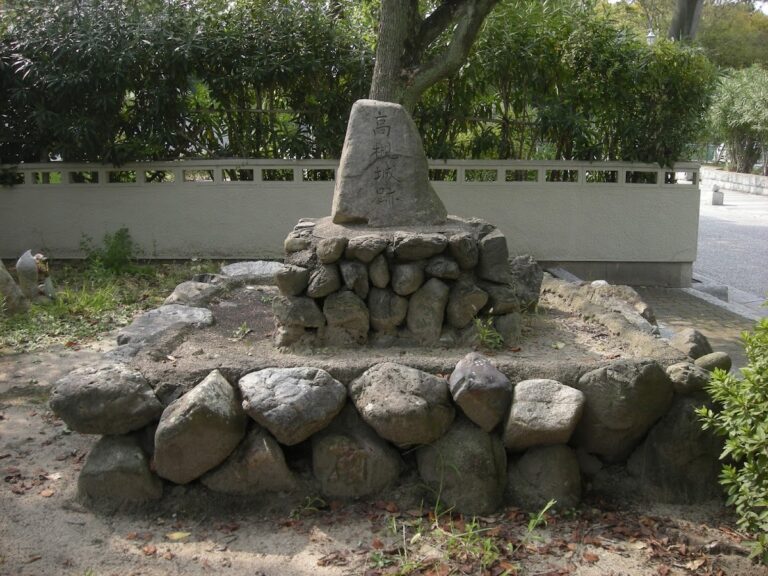
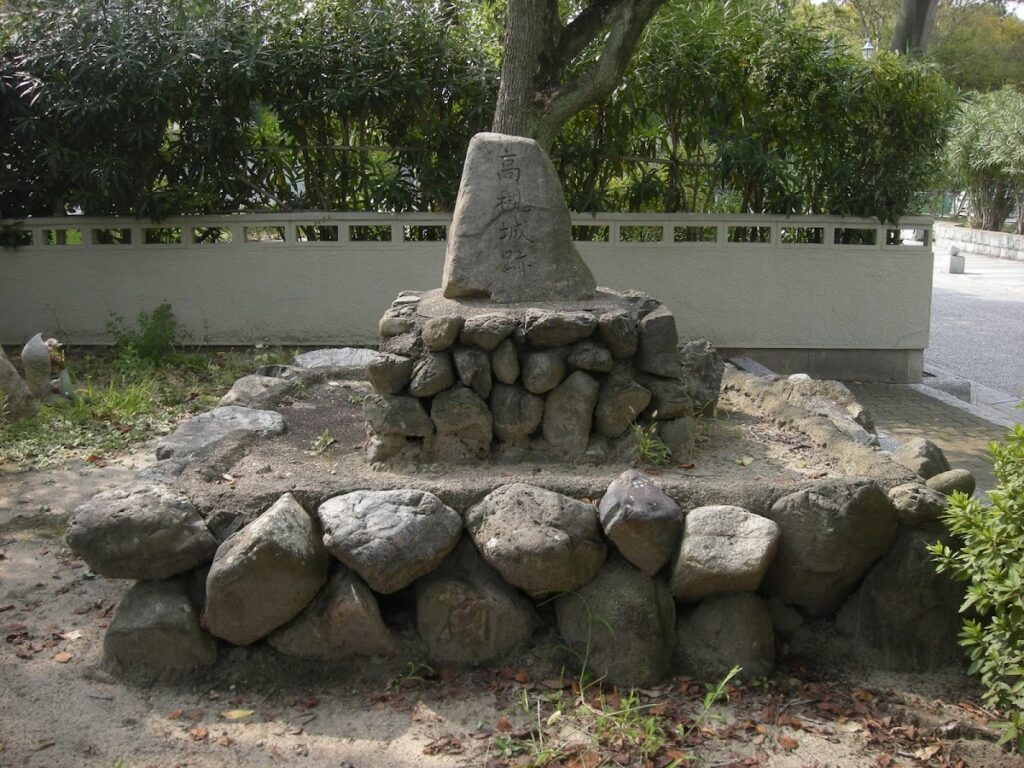
Currently, a portion of the Takatsuki Castle ruins has been developed as “Castle Ruins Park.” Within the park, there are reconstructed stone walls and a castle tower base, allowing visitors to imagine its former appearance.
Among the actual remaining remains, a portion of the moat can be seen. Excavations have unearthed foundations of the stone walls, cornerstones, and gold-leafed roof tiles, which are on display at the Takatsuki City Castle Ruins History Museum.
A statue of Takayama Ukon stands within the park, commemorating the achievements of Ukon, known as a Christian daimyo. In 2017, Takayama Ukon was beatified (elevated to the rank of blessed), recognized by the Catholic Church as a figure equivalent to a saint.
Shiroato History Museum
The Takatsuki City Shiroato History Museum is a facility built adjacent to the castle ruins park, and comprehensively introduces the history of Takatsuki Castle and the history of Takatsuki City.
Inside the museum, artifacts unearthed during archaeological excavations are on display, including gold-leaf roof tiles, ceramics, and armor. Furthermore, a reconstructed model of Takatsuki Castle, a layout map, and illustrations are on display, allowing visitors to visually understand the appearance of the castle in its heyday.
The history museum also regularly holds special exhibitions, exploring the history of Takatsuki on various themes such as Takayama Ukon, Christian culture, and life in the castle town during the Edo period.
Relocated and Existing Structures
The following structures from Takatsuki Castle have been confirmed to still exist:
- Hongyo-ji Temple Gate: A gate relocated from within the castle grounds, it still exists at Hongyo-ji Temple in Takatsuki City.
- Nagai Shrine Karamon Gate: A structure relocated from within the castle grounds, it still exists on the grounds of Nagai Shrine.
These are among the few remaining structures from Takatsuki Castle and are valuable cultural assets.
Access and Visiting Information
Location: Jonai-cho, Takatsuki City, Osaka Prefecture (Castle Ruins Park)
Access:
- Approximately 10 minutes on foot from JR Kyoto Line “Takatsuki Station”
- Approximately 15 minutes on foot from Hankyu Kyoto Line “Takatsuki-shi Station”
Castle Ruins History Museum:
- Opening Hours: 10:00 AM – 5:00 PM (Last entry at 4:30 PM)
- Closed: Mondays (or the following day if Monday is a public holiday), New Year holidays
- Admission Fee: 200 yen for adults, 100 yen for elementary and junior high school students
The castle ruins park is always open and you can freely stroll around. It is also known as a famous cherry blossom viewing spot in spring, attracting many citizens.
Historical Significance of Takatsuki Castle
Takatsuki Castle is a historically important castle in the following respects:
- Center of Christian Culture: During the time of Takayama Ukon, it became a base for Christian missionary work in western Japan, and a unique culture flourished there.
- A Key Transportation Hub: Located midway between Kyoto and Osaka, it functioned as an important base along the Tokaido (Kyoto Road).
- A Typical Early Modern Castle: A prime example of a castle’s transformation from a medieval to an early modern structure through renovations during the Genna era.
- The Only Early Modern Castle in Northern Osaka: Throughout the Edo period, it existed as the only full-fledged early modern castle in the Northern Osaka region.
- International Recognition: As recorded by Engelbert Kaempfer, it was a beautiful castle that impressed even foreigners.
Summary
Takatsuki Castle originated as the residence of the Irie clan during the Nanboku-cho period, developed into a castle during the Sengoku period under figures such as Wada Koremasa and Takayama Ukon, and played an important role as the only early modern castle in Northern Osaka during the Edo period.
As the residence of the Christian daimyo Takayama Ukon and a strategically important transportation hub connecting Kyoto and Osaka, Takatsuki Castle holds a significant place in the history of Settsu Province. Although only limited remains survive due to its demolition during the Meiji era, visitors to the castle ruins park and the Shiroato History Museum can still imagine its former glory.
Protected as a designated historical site by Osaka Prefecture, the Takatsuki Castle ruins are a valuable cultural heritage site that conveys the region’s history, and its preservation and utilization are expected to continue. When visiting Takatsuki City, be sure to visit the castle ruins park and the Shiroato History Museum to experience the history of northern Settsu.