Complete Guide to Hiroshima Castle | A Thorough Explanation of History, Structure, Highlights, and Latest Information
What is Hiroshima Castle? – Overview and Alternative Names of Rijo Castle
Hiroshima Castle (Hiroshima-jo) is a representative flatland castle of Japan, located in Motomachi, Naka-ku, Hiroshima City, Hiroshima Prefecture. It is affectionately known as Rijo (Carp Castle) and is known as a magnificent castle built in the Ota River Delta.
Construction began in 1589 (Tensho 17) during the Azuchi-Momoyama period by Mori Terumoto, and it is highly regarded as a representative castle of the early modern period alongside Osaka Castle and Okayama Castle. It is also counted among the Three Great Flatland Castles of Japan, along with Matsumoto Castle and Nijo Castle.
Currently, the area of Hiroshima Castle, centered around the main keep and second bailey, covers approximately 120,000 square meters and is designated as a national historic site. It is a popular attraction for citizens and tourists alike, as part of Hiroshima Central Park. The interior of the castle tower served as a museum showcasing Hiroshima’s samurai culture and the history of its castle town, but it closed on March 22, 2027.
History of Hiroshima Castle – From Construction to the Present
Construction by Mori Terumoto
The history of Hiroshima Castle begins when Mori Terumoto, the ruler of the Chugoku region, decided to move his base from his previous residence, Koriyama Castle (Akitakata City).
In 1589 (Tensho 17), Terumoto began construction of a new castle in the delta area at the mouth of the Ota River, a strategic point for land and water transportation. The construction was strongly influenced by Toyotomi Hideyoshi’s Jurakudai and Osaka Castle, and it is said that Kuroda Kanbei (Kuroda Yoshitaka) provided advice on its construction.
At that time, the delta area was a vast wetland, requiring large-scale land development work known as “island construction.” In 1591 (Tensho 19), Terumoto entered the castle, but it is said that it took approximately 10 years to complete the entire castle complex. At the time of its completion, Hiroshima Castle was a magnificent fortress comparable in scale to Osaka Castle.
The Era of the Fukushima and Asano Clans
After the Battle of Sekigahara, the Mori clan sided with the Western Army and had their territory reduced. In 1600 (Keicho 5), Fukushima Masanori, who had distinguished himself on the Eastern Army’s side, entered Hiroshima Castle as a daimyo with a domain of 498,000 koku in Aki and Bingo provinces.
Fukushima Masanori expanded the castle, extending its reach to the outer moat and increasing the castle grounds to approximately 900,000 square meters. However, in 1619 (Genna 5), he was dispossessed of his domain for repairing the castle without the shogunate’s permission, and Asano Nagaakira from Kishu entered the castle.
For approximately 250 years, until the Meiji Restoration, twelve generations of the Asano clan ruled Hiroshima Castle as the residence of the Hiroshima Domain, which had a 426,000 koku (unit of rice production) yield. During this time, Hiroshima Castle flourished as the political, economic, and cultural center of Aki Province, and the castle town also developed significantly.
Modern Era and Atomic Bombing
After the Meiji Restoration, with the abolition of the feudal domains and the establishment of prefectures, Hiroshima Castle became military land, and during the Meiji era, facilities of the Imperial Japanese Army were located there. While the keep and some turrets remained, many other buildings were demolished.
On August 6, 1945 (Showa 20), the first atomic bomb in human history was dropped, causing the keep and all other buildings of Hiroshima Castle to collapse and burn down. Located approximately one kilometer from the hypocenter, Hiroshima Castle vanished in an instant.
Restoration and the Modern Era
As a symbol of post-war reconstruction, the castle tower was restored in reinforced concrete in 1958 (Showa 33) to coincide with the “Hiroshima Reconstruction Grand Exposition.” This restoration, realized through the support and donations of many citizens, became a symbol of hope for the people of Hiroshima.
Subsequently, in the Heisei era, restoration and development of the Ninomaru area progressed, and from 1991 (Heisei 3) to 1994 (Heisei 6), the Omote-gomon Gate, Hirayagura Turret, Tamon-yagura Turret, Taiko-yagura Turret, and others were restored in wood.
On March 22, 2027, the castle tower, restored in 1958 (Showa 33), closed its doors after approximately 68 years of history due to safety concerns related to concrete deterioration and aging equipment. The construction of a new castle tower is currently being considered.
Structure of Hiroshima Castle – Characteristics of a Ring-Shaped Flatland Castle
Basic Structure of the Castle
Hiroshima Castle is a ring-shaped flatland castle. A ring-shaped castle is a style where the main keep (Honmaru) is at the center, with the second and third baileys arranged concentrically in a “circular” shape. This structure is commonly found in flatland castles.
Built on the flat land of the Ota River delta, it lacked the topographical defensive capabilities of a mountain castle. However, it compensated for this with a complex arrangement of moats and turrets, enhancing its defensive capabilities.
The castle grounds were surrounded by a triple moat system: an inner moat, a middle moat, and an outer moat. At its peak, the area extending to the outer moat covered approximately 900,000 square meters. Currently, approximately 120,000 square meters, centered around the main keep and second bailey within the inner moat, is preserved as a historical site.
Structure of the Castle Tower
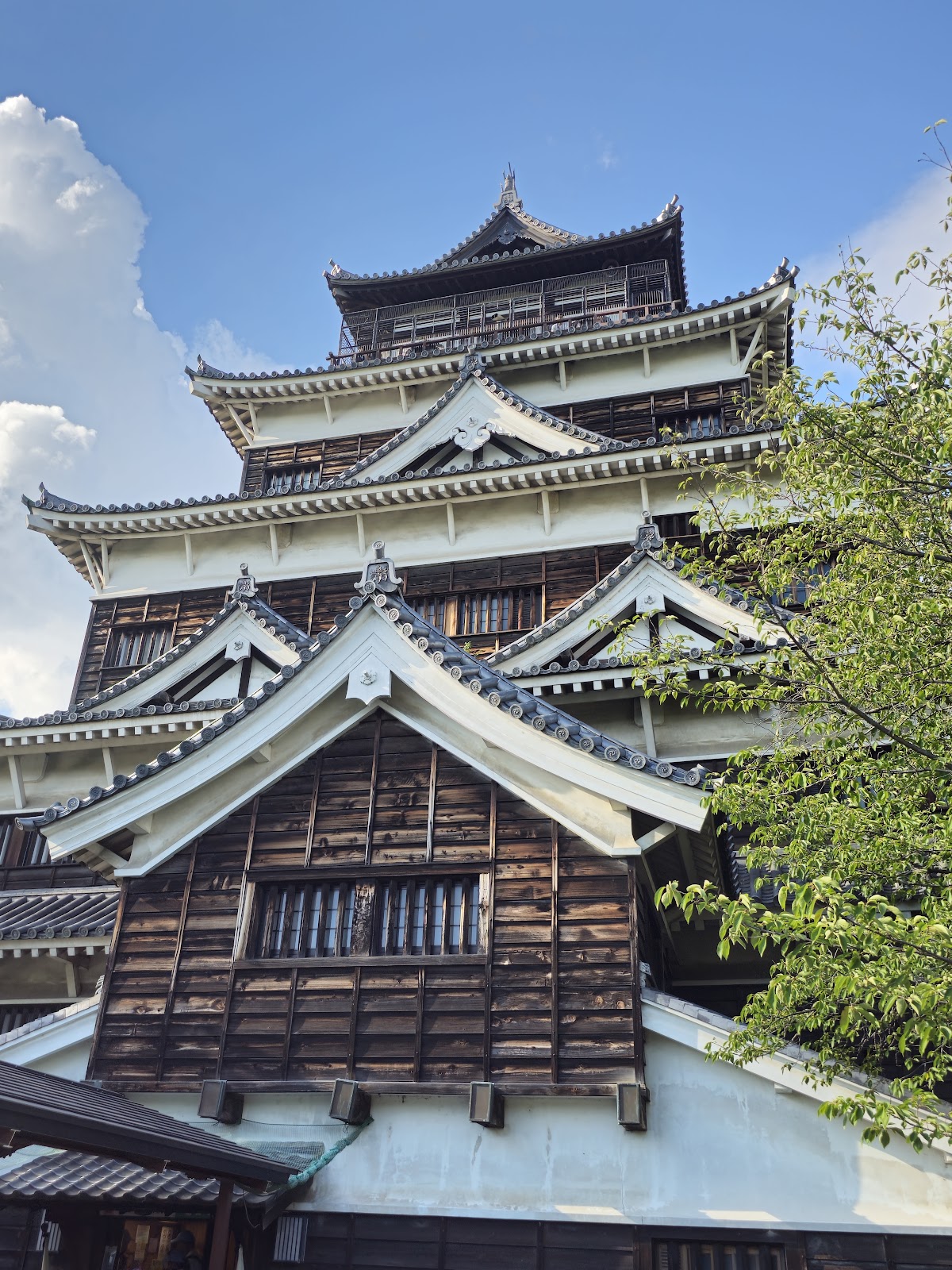
Hiroshima Castle’s castle tower was a connected-style castle tower, consisting of a five-story, five-tiered main tower and a three-story, three-tiered smaller tower connected by a covered walkway. This style is a highly formal structure also seen in Osaka Castle and Nagoya Castle.
The exterior of the castle tower was covered with black lacquered clapboard, and a shachi (mythical fish-like creature) adorned the roof. The interior had rooms on each floor, and the top floor functioned as an observation deck.
The current reconstructed castle tower replicates the exterior of the original, but the interior has been used as a museum. It is a five-story reinforced concrete building, with exhibits on the history of Hiroshima Castle and samurai culture on each floor, and the top floor serving as an observation room offering panoramic views of Hiroshima city.
Arrangement of Turrets and Gates
In the past, Hiroshima Castle had as many as 23 turrets facing the inner moat. These turrets served as defensive structures as well as important buildings that demonstrated the castle’s grandeur.
Currently, the Ninomaru (second enclosure) features the Hirayagura, Tamonyagura, Taikoyagura, and Omote-Gomon, all reconstructed in wood during the Heisei era, allowing visitors to imagine the castle’s appearance during the Edo period. The Taikoyagura, in particular, housed a drum used to announce the time and was closely intertwined with the life of the castle town.
Highlights of the Honmaru (Main Enclosure)
The Honmaru is the central area of Hiroshima Castle, with the main keep at its center and important facilities such as the Honmaru Palace arranged around it.
Main Keep (Closed)
The interior of the main keep, which was open until March 22, 2027, was a five-story museum facility.
- 1st Floor: Exhibits on the history of Hiroshima Castle and the development of the castle town
- 2nd Floor: Exhibits on weapons and armor passed down through the Asano family
- 3rd Floor: Materials on the politics and culture of the Hiroshima domain
- 4th Floor: Special exhibition room
- 5th Floor: Observation room (panoramic view of Hiroshima city, the Atomic Bomb Dome, and the Seto Inland Sea)
The view from the castle tower provided a valuable perspective for understanding Hiroshima’s urban landscape.
Castle Tower Base and Stone Walls
The stone walls of the castle tower base collapsed due to the atomic bomb, but were rebuilt during restoration. The stone walls were constructed using a technique called uchikomi-hagi, which involves processing the surface of the stones to minimize gaps.
The stone walls of the inner moat surrounding the main enclosure are also a highlight; the reflection of the castle tower and stone walls on the water’s surface is a representative landscape of Hiroshima Castle.
Ninomaru – The Charm of the Reconstructed Wooden Structures
Ninomaru is located north of Honmaru and was an important area where the lord’s residence and administrative facilities were located.
Omote-Gomon Gate and Gomonbashi Bridge
The Omote-Gomon Gate, the main gate to Ninomaru, was reconstructed in wood in 1991 (Heisei 3). It is a magnificent gate in the Koraimon style, with the Gomonbashi Bridge spanning it.
Passing through the Omote-Gomon Gate allows you to experience the atmosphere of a samurai residence from that era, making it one of the highlights of a visit to Hiroshima Castle.
Hirayagura, Tamon-yagura, and Taiko-yagura Towers
On the east side of Ninomaru are the Hirayagura, Tamon-yagura, and Taiko-yagura towers. These were reconstructed in wood in 1994 (Heisei 6), faithfully reproducing them using Edo period architectural techniques.
The Taiko Yagura (drum tower) is a particularly noteworthy structure. It housed a drum used to announce the time within the castle and the surrounding town. Currently, its interior is sometimes open to the public during special events, allowing visitors to learn about the tower’s function and structure in its heyday.
The Tamon Yagura (multi-story tower) is a long, narrow building used as an armory and guardhouse for soldiers. Its beautiful contrast between white walls and black tiled roof makes it a popular photo spot.
Gardens and Spaces of Ninomaru
Ninomaru features a plaza where visitors can enjoy strolling while admiring the restored buildings. Cherry blossoms bloom in spring, and the autumn leaves are stunning, making it a place to enjoy the scenery of each season.
Furthermore, Ninomaru often hosts events. Special events such as “Hiroshima Castle Memorial Day” feature special public viewings of the Taiko Yagura and samurai processions, attracting many visitors.
The Third Bailey and Outer Walls
The Third Bailey was an area extending outside the Second Bailey, where the residences of retainers and merchant districts were located. Currently, it is Hiroshima Central Park and part of the city center, and little remains of its former appearance, although some historical sites indicating the site of the Third Bailey still exist.
The remains of the outer moat are now roads and rivers, illustrating the vastness of Hiroshima Castle’s grounds.
Hiroshima Castle and the Atomic Bomb – Memories of the Atomic Bombing
Hiroshima Castle was completely destroyed by the atomic bombing on August 6, 1945. The keep, located approximately 1 kilometer from the hypocenter, collapsed instantly due to the blast and was subsequently destroyed by fire.
At the time of the atomic bombing, the Imperial General Headquarters was located within Hiroshima Castle, and many soldiers and military personnel were killed. The memories of those who were exposed to the bombing within the castle are crucial testimonies in telling the history of Hiroshima’s atomic bombing.
The current Hiroshima Castle site retains trees and parts of the stone walls that survived the atomic bombing, serving as a place to convey the power of the atomic bomb and the preciousness of peace. The castle keep’s exhibits also showcase the history of the atomic bombing and subsequent reconstruction.
Hiroshima Castle Events and Uses
Various events are held at Hiroshima Castle throughout the year.
Hiroshima Castle Memorial Day
Held around May each year, “Hiroshima Castle Memorial Day” is a special event that widely promotes the appeal of Hiroshima Castle. A variety of programs are offered, including a special opening of the Taiko Yagura (drum tower), a samurai procession, performances of traditional arts, and armor try-on experiences, making it enjoyable for a wide range of people, from families to history enthusiasts.
Special Exhibitions and Events
Before the castle keep closed, special exhibitions on the history of Hiroshima Castle and samurai culture were regularly held. Furthermore, photo events and history lectures were held in the Ninomaru (second bailey), continuing efforts to convey the appeal of Hiroshima Castle from multiple perspectives.
A Famous Cherry Blossom Spot
Hiroshima Castle is also known as a famous cherry blossom spot, with approximately 370 cherry trees in full bloom during the spring. The cherry trees along the inner moat and in the Ninomaru area are particularly beautiful, attracting many visitors. The trees are also illuminated at night, allowing visitors to enjoy the magical sight of cherry blossoms after dark.
Access – How to get to Hiroshima Castle
Access by Public Transportation
Streetcar (Hiroshima Electric Railway)
- Get off at “Kamiyacho Higashi” or “Kamiyacho Nishi” streetcar stop, approximately 15 minutes on foot
- Get off at “Shukkei-en-mae” streetcar stop, approximately 10 minutes on foot
Bus
- Get off at Hiroshima Bus “Hiroshima Castle (Gokoku Shrine)” bus stop, immediately
- Get off at Hiroshima Bus “Godo Chosha-mae” bus stop, approximately 8 minutes on foot
JR
- Approximately 25 minutes on foot from JR Hiroshima Station
- Approximately 15 minutes by streetcar or bus from JR Hiroshima Station
Astramline
- Get off at “Kencho-mae” station, approximately 10 minutes on foot
Access by Car
Expressway
- Approximately 20 minutes from Sanyo Expressway “Hiroshima IC”
- Approximately 10 minutes from Hiroshima Expressway “Gion Shindo Kita IC”
Parking
- Hiroshima City Central Parking Lot (Paid)
- Nearby Coin Parking
*There is no dedicated parking lot for Hiroshima Castle, so we recommend using public transportation.
Combining with Nearby Facilities
The following tourist spots are located near Hiroshima Castle:
- Shukkei-en Garden: Approximately 10 minutes on foot. A beautiful Japanese garden designated as a National Place of Scenic Beauty.
- Hiroshima Prefectural Art Museum: Adjacent to Shukkei-en Garden.
- Atomic Bomb Dome: Approximately 15 minutes on foot. A World Heritage Site.
- Peace Memorial Park: Approximately 20 minutes on foot.
- Hiroshima Central Park: Adjacent to Hiroshima Castle. A vast urban park.
Combining these will allow you to enjoy a fulfilling Hiroshima sightseeing experience.
Closure of Hiroshima Castle Keep and Future Plans
On March 22, 2027, the Hiroshima Castle keep, which was restored in 1958, closed. The keep had been a beloved landmark for Hiroshima citizens and tourists for approximately 68 years, but due to the deterioration of the reinforced concrete structure and the aging of the facilities, this measure was taken for safety reasons.
Reasons for Closure
- Deterioration of concrete over time
- Insufficient seismic resistance
- Deterioration of facilities (electricity, air conditioning, disaster prevention, etc.)
- Difficulty in making the castle barrier-free
Future Prospects
Hiroshima City is currently considering the construction of a new castle tower. Various options, including wooden reconstruction, are being discussed, and donations to enhance the appeal of Hiroshima Castle are being accepted.
In addition, information is being sought regarding the utilization of the timber used in the castle tower, and citizen participation initiatives are underway.
The wooden reconstruction of the Ninomaru remains open to the public and functions as a place to convey the history and charm of Hiroshima Castle.
History of Hiroshima Castle and Aki Province
Hiroshima Castle, as the center of Aki Province (present-day western Hiroshima Prefecture), is deeply intertwined with the history of the region.
During the era when the Mori clan reigned as the rulers of the Chugoku region, Hiroshima Castle was a symbol of the Mori clan’s power. Afterwards, the castle lords changed hands between the Fukushima and Asano clans, but it consistently functioned as the political, economic, and cultural center of Aki Province.
During the Edo period, the Hiroshima Domain, under the Asano clan, prospered as a large domain with a 426,000 koku (unit of rice production) yield, and its castle town also flourished. The development of Hiroshima’s industries, particularly shipping and brewing, was largely due to the economic activity of the castle town centered around Hiroshima Castle.
Even today, Hiroshima Castle remains a beloved symbol of Hiroshima City, preserved and utilized as an important cultural asset that conveys Hiroshima’s history and culture.
Hiroshima Castle as a Photography Spot
Hiroshima Castle is also a popular photography spot due to its beautiful appearance.
Recommended Photography Spots
The Keep Across the Inner Moat
The reflection of the keep on the surface of the inner moat is a representative view of Hiroshima Castle. The light is particularly beautiful in the early morning and at dusk, and it displays different expressions throughout the seasons.
Restored Structures of the Second Bailey
The rows of structures—the main gate, flat turret, multi-story turret, and drum turret—convey the beauty of Edo period castle architecture. The contrast between the white walls and black tiles is striking.
Cherry Blossom Season
In spring, you can enjoy the collaboration of cherry blossoms and the castle tower. The row of cherry trees along the inner moat is a particularly popular photo spot.
Nighttime Illumination
At night, the castle is illuminated, creating a magical atmosphere. The reflection of the light on the water is also beautiful, showing a different face than during the day.
When taking photographs, please be considerate of other visitors and follow the rules, such as using tripods.
Summary – The Charm and Value of Hiroshima Castle
Hiroshima Castle is a famous castle with high historical value, being one of Japan’s three great flatland castles and a representative example of early modern castle architecture.
With a history of over 400 years since its construction by Mori Terumoto, it has always functioned as the center of Aki Province, changing lords from the Fukushima clan to the Asano clan. Although completely destroyed by the atomic bomb, Hiroshima Castle was restored through the enthusiasm of its citizens and became a symbol of Hiroshima’s reconstruction.
Currently, the castle tower, restored in the Showa era, is closed, but the wooden reconstructed buildings in the second bailey still convey the beauty of Edo-period castle architecture. Hiroshima Castle is not merely a tourist attraction, but an important cultural heritage site that tells the history of Hiroshima, the memory of the atomic bombing, and the steps of its reconstruction.
With attention focused on future restoration of the castle tower, Hiroshima Castle continues to evolve towards a new era. When you visit Hiroshima, be sure to visit Hiroshima Castle and experience its history and charm.