Miyao Castle (Hiroshima Prefecture) Complete Guide | Mori Motonari’s Strategic Base, the Stage of the Battle of Itsukushima
What is Miyao Castle?
Miyao Castle (Miyao-jo) is a medieval mountain castle located in Miyajima-cho, Hatsukaichi City, Hiroshima Prefecture. It is also known by other names such as Miyano-o Castle, Miyao Castle, Miyano Castle, and Yogaiyama Castle. Built near the port of Itsukushima (Miyajima), a World Heritage Site, this castle played a crucial role in the Battle of Itsukushima, one of Japan’s three greatest surprise attacks.
Built on a small hill approximately 27-30 meters above sea level, just south of Miyajima Port, the entire island, including the castle, is designated as a National Special Historic Site and Special Place of Scenic Beauty, and is also part of the Seto Inland Sea National Park. While its relative height of approximately 30 meters is not particularly high, its location facing the sea and strategic placement greatly contributed to Mori Motonari’s victory in the Battle of Itsukushima.
History of Miyao Castle
Background of Construction
Miyao Castle is believed to have been built between 1554 (Tenbun 23) and 1555 (Koji 1). At that time, in Aki Province (present-day western Hiroshima Prefecture), the conflict between Mori Motonari and Sue Harukata, who held real power over the Ouchi clan (who controlled Suo and Nagato provinces), was intensifying.
The Ouchi clan had long held control of Itsukushima, but when Sue Harukata overthrew his lord, Ouchi Yoshitaka, and seized power, relations with Mori Motonari rapidly deteriorated. Mori Motonari devised a bold strategy to seek a battlefield on Itsukushima in order to defeat Sue Harukata.
Role in the Battle of Itsukushima
In May 1555 (Koji 1), Mori Motonari built Miyao Castle on Itsukushima and made it his base. The construction of this castle had a clear strategic intention. Motonari used this castle as a “decoy castle” to lure Sue Harukata to the narrow island of Miyajima.
Motonari enlisted the support of the island’s townspeople and prepared his forces to prevent Sue’s army from advancing into Hiroshima Bay. Koi Naoyuki and others entered the castle as castellan, strengthening its defenses. When Sue Harukata learned that the Mori forces had built a castle on Itsukushima, he led a large army to land there to attack and capture it.
However, this was precisely Motonari’s plan. Having landed a large army on the narrow island, Sue’s forces lost their mobility and suffered a devastating blow from Mori Motonari’s surprise attack. This victory at the Battle of Itsukushima gave Mori Motonari a foothold in establishing his hegemony in the Chugoku region.
Miyajima Castle After the Battle
After the Battle of Itsukushima, Miyajima Castle came under the control of the Mori clan, but its role as a major military base gradually diminished. With the end of the Sengoku period and the beginning of the Edo period, the castle lost its function and was abandoned. Only ruins remain today, but as the site of the historical Battle of Itsukushima, it still attracts many history enthusiasts and castle fans.
Structure of Miyao Castle
Layout and Arrangement
Miyao Castle is a small mountain castle built on a hill approximately 27-30 meters above sea level. The castle’s structure is broadly divided into the western and eastern baileys, separated by a moat or cut-through at the eastern saddle.
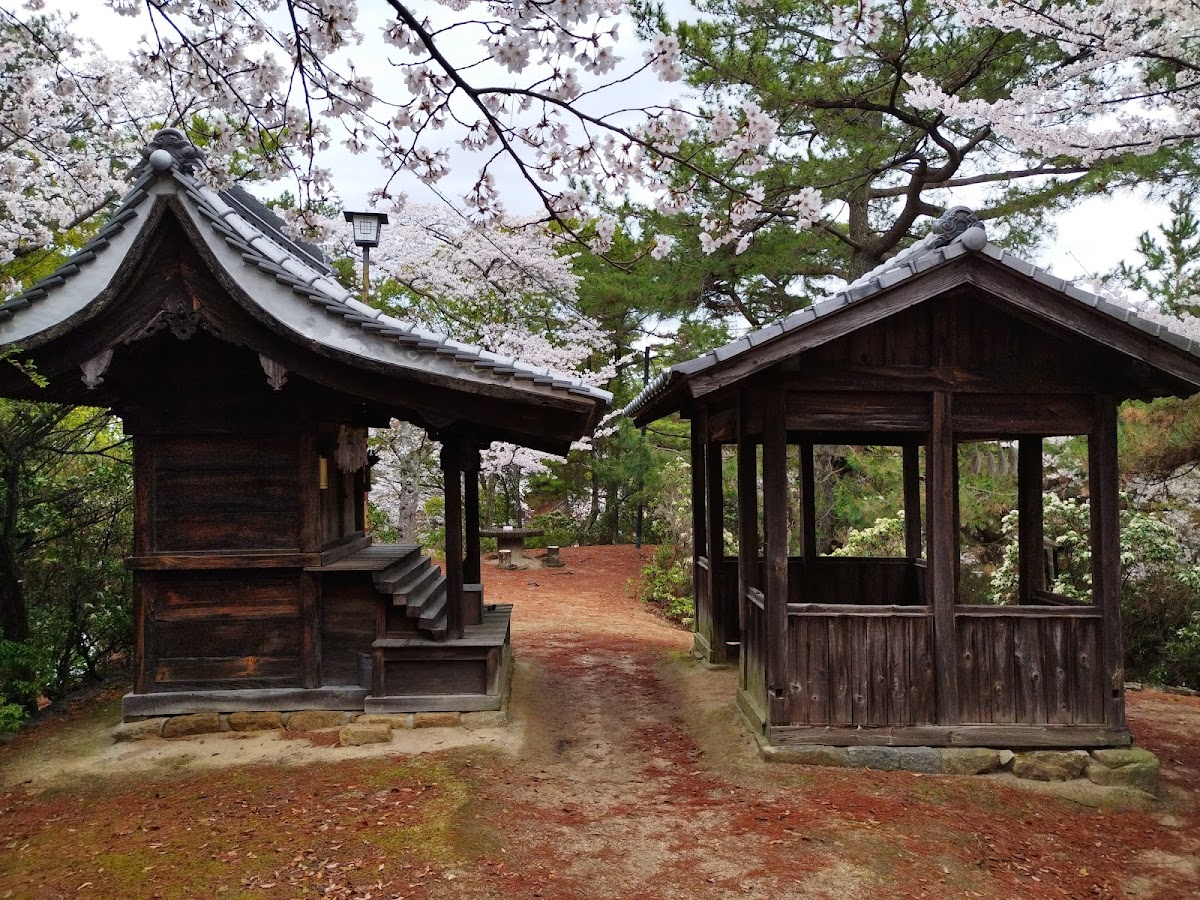
Currently, a gazebo and the Imaise Shrine are located at the summit, corresponding to the western bailey. The western bailey is close to Miyajima Port, making it a suitable location for surveillance and defense from the sea. The eastern summit, on the other hand, is the eastern bailey, and even combined, the two baileys are not large in scale.
Defensive Facilities
The most distinctive defensive facility of Miyao Castle is the moat. The moat between the western and eastern baileys served as a crucial defensive line to prevent enemy intrusion. Furthermore, the castle’s location, surrounded by the sea on three sides, functioned as a natural stronghold.
Due to its low elevation and relative height of only about 30 meters, large-scale stone walls and complex defensive structures are not visible. However, what was required in the Battle of Itsukushima was not a long-term siege, but rather a “show castle” designed to lure the Sue army to the island. In that sense, Miyao Castle can be said to have fully fulfilled its purpose.
Strategic Aspects of its Location
The most distinctive feature of Miyao Castle lies in its location. Its position just south of Miyajima Port was ideal for controlling a key point in maritime traffic. In Aki Province at that time, control of maritime routes was extremely important militarily and economically, and Itsukushima was located at the heart of this.
While the terrain, surrounded by the sea on three sides, was advantageous defensively, it also carried the risk of having one’s retreat route cut off. If Sue Harukata had fully recognized this danger, he might not have fallen into Mori Motonari’s trap. However, the Sue army overestimated the strength of their large force and landed on the narrow island.
Highlights of Miyao Castle
Remains of the Enclosures
Even today, the topography of the western and eastern enclosures remains relatively well-preserved. Walking across the flat area at the top of the mountain, you can truly feel that castle facilities once stood here. From the western enclosures, where a gazebo is located, you can enjoy beautiful views of Miyajima Port and the Seto Inland Sea, allowing you to imagine the scenery that the castle soldiers must have seen.
Moat
The moat between the western and eastern enclosures is an important remnant of Miyao Castle’s defensive structure. Although it currently resembles a cut-through, it is believed to have once functioned as a clear moat. Walking along this moat reveals that, despite its small size, the castle’s layout was designed with defense in mind.
Imaise Shrine
The Imaise Shrine is enshrined at the summit of the mountain, serving as a place of worship for the local community. The presence of the shrine has also contributed to the preservation of the castle ruins for generations. Visiting the shrine and offering prayers allows you to experience the unique atmosphere of Miyajima, where history and faith intertwine.
View
Although the elevation is low, its location on a small hill offers a panoramic view of Miyajima. A 360-degree panorama unfolds, encompassing Miyajima Port, Itsukushima Shrine, and the islands of the Seto Inland Sea. Especially on clear days, you can see the mainland across the water and surrounding islands, giving you a real sense of why this location was strategically important.
Access
Travel to Miyajima
Miyajima, where Miyajima Castle is located, is accessed by ferry from the mainland. The main ferry routes are as follows:
From Miyajimaguchi Pier
- Approximately 10 minutes by ferry from Miyajimaguchi Pier, which is a short walk from JR Miyajimaguchi Station or Hiroden Miyajimaguchi Station.
- Operated by JR West Miyajima Ferry or Miyajima Matsudai Kisen.
- Ferries run every 15-20 minutes.
From Hiroshima City
- Approximately 25-30 minutes by high-speed boat from Hiroshima Port (Ujina Port) (limited number of services).
From Miyajima Port to Miyao Castle Ruins
After arriving at Miyajima Port, Miyao Castle Ruins are accessible on foot.
- Approximately 5-10 minutes on foot south from Miyajima Port Pier.
- Miyao Castle Ruins are located on a small hill just south of the port.
- Approximately 5-10 minutes of gentle climbing from the entrance to the summit.
The castle ruins are relatively small, and a visit should take approximately 20-30 minutes. The hiking trail is well-maintained, but comfortable walking shoes are recommended.
Points to Note When Visiting
- Since the entire island of Miyajima is designated as a Special Historic Site and Special Place of Scenic Beauty, please be considerate of the preservation of the historical remains.
- As you will be walking on mountain paths, comfortable clothing and shoes are recommended.
- Insect repellent is recommended during the summer months.
- Miyajima is a tourist destination, so ferries can be crowded, especially on holidays and during peak tourist season.
Nearby Tourist Attractions
Itsukushima Shrine
After visiting Miyajima Castle, be sure to also visit Itsukushima Shrine, a World Heritage Site. The large torii gate and shrine buildings standing in the sea are one of Japan’s most representative landscapes. It is about a 10-15 minute walk from Miyajima Port.
Mount Misen
Mount Misen (535 meters above sea level), the highest peak on Miyajima, has long been revered as a sacred mountain. It can be reached relatively easily by ropeway, and the view from the summit is spectacular.
Daiganji Temple and Daishoin Temple
Miyajima also has many historical temples. Daiganji Temple flourished as the head temple of Itsukushima Shrine, and Daishoin Temple is known as an ancient temple of the Shingon sect. Both are important spots for understanding the history of Miyajima.
Miyajima Historical and Folk Museum
For those who want to learn more about the history and culture of Miyajima, the Miyajima Historical and Folk Museum is recommended. It also has exhibits related to the Battle of Itsukushima, allowing for a deeper understanding of the historical background of Miyao Castle.
The Historical Significance of Miyao Castle and the Battle of Itsukushima
One of Japan’s Three Great Surprise Attacks
The Battle of Itsukushima is counted as one of Japan’s three great surprise attacks, along with the Battle of Okehazama and the Battle of Kawagoe. This battle, in which Mori Motonari defeated Sue Harukata’s army of approximately 20,000 with a force of about 4,000-5,000 men, is a noteworthy example in the history of Sengoku period tactics.
Miyao Castle was an important element of this surprise attack. Motonari’s strategy of luring the Sue army to the island by building a castle and neutralizing their large army’s advantages in the narrow terrain was a resounding success.
The Rise of the Mori Clan
With his victory at the Battle of Itsukushima, Mori Motonari paved the way for establishing hegemony in the Chugoku region. By defeating Sue Harukata, he absorbed the former territories of the Ouchi clan, and the Mori clan rapidly rose to the status of a powerful daimyo during the Sengoku period.
Subsequently, the Mori clan grew into a powerful daimyo controlling most of the Chugoku region, and by the end of the Sengoku period, they were a force that could confront Oda Nobunaga and Toyotomi Hideyoshi. Miyao Castle was the starting point of this rise of the Mori clan.
Its Place in Castle History
Miyao Castle is also an interesting example in castle history as a typical example of “temporary construction” during the Sengoku period. Castles built for short periods for specific battles, rather than as long-term bases of control, were not uncommon during the Sengoku period.
However, few castles possessed such a clear strategic purpose as Miyao Castle, and few actually achieved that purpose. The purpose of its construction, the selection of its location, and its use in battle—all demonstrate the sharp strategic vision of Mori Motonari.
Best Season to Visit Miyao Castle
Spring (March-May)
During cherry blossom season, the entire Miyajima Island is beautifully colored. The weather is mild, making it ideal for exploring the castle ruins. However, Golden Week sees a large influx of tourists.
Autumn (October-November)
Autumn foliage season is also a peak season for Miyajima tourism. Especially from mid- to late November, you can enjoy beautiful autumn leaves in places like Momijidani Park. The view from Miyao Castle becomes even more beautiful with the colorful trees.
Summer/Winter Visits
Summer is somewhat unsuitable for exploring the castle ruins due to the heat, humidity, and numerous insects. Winter sees relatively fewer tourists, allowing for a more leisurely visit, but cold weather precautions are necessary.
Summary
Miyao Castle (Hatsukaichi City, Hiroshima Prefecture), though small in scale, is a castle ruin of extremely high historical value as the site of the Battle of Itsukushima, a crucial battle in Japanese history. Built by Mori Motonari to defeat Sue Harukata, this castle, with its strategic location and clear purpose, brilliantly fulfilled its role as a “decoy castle.”
Built on a small hill approximately 30 meters above sea level, the castle features a western and eastern group of baileys, separated by a moat, preserving the characteristics of a Sengoku period mountain castle despite its small size. Currently designated a National Special Historic Site, it is protected as part of Miyajima, a World Heritage site.
When visiting Miyajima, in addition to famous tourist spots such as Itsukushima Shrine and Mount Misen, be sure to visit the Miyao Castle ruins. Standing on the small hill overlooking the Seto Inland Sea and reflecting on the historical battle that unfolded approximately 470 years ago, you will gain a deeper appreciation for the historical depth of Miyajima.
Miyajima Castle is conveniently located within walking distance of Miyajima Port, and a visit takes only about 30 minutes. It is highly recommended not only for history buffs but also for anyone who wants to enjoy Miyajima from a slightly different perspective. Be sure to see for yourself the site of the Battle of Itsukushima, where Mori Motonari’s strategic brilliance shone.