Himenono Castle (Kochi Prefecture) Complete Guide | A Thorough Explanation of the History and Highlights of Hanzan Castle, the Former Residence of the Tsuno Clan
What is Himenono Castle?
Himenono Castle (Himenono-jo) was a Japanese castle located in Himenono, Tsuno-cho, Takaoka-gun, Kochi Prefecture. It is also known as Hanzan Castle or Hangetsu Castle. It was a mountain castle that served as the ancestral residence of the Tsuno clan, a powerful local lord of Tosa Province, and is now preserved as a designated historical site of Tsuno Town.
It is a medieval mountain castle built on a small hill at an elevation of 189 meters (some sources say 193 meters or 196 meters) on the north side of the plain on the left bank of the middle reaches of the Shinjo River, behind the current Tsuno Town Hayama Elementary School. The area around the castle hill is now developed as Shiroyama Park, and visitors can view the remains of the castle from that time via walking trails.
Basic Information on Himenono Castle
Location: Himenono, Tsuno-cho, Takaoka-gun, Kochi Prefecture
Former Province: Tosa Province
Classification/Structure: Mountain Castle
Construction Period: Nanboku-cho period (around the 14th century)
Builder: Tsuno Tsunetaka
Main Lord: Tsuno clan
Year of Abandonment: Keicho era (early 1600s)
Remains: Enclosures, moats, ridged vertical moats, earthworks, part of stone walls
Designated Cultural Property: Tsuno Town Designated Historic Site
Common Name/Alternate Name: Hanzan Castle, Hangetsu Castle
History of Himenono Castle
Origin of the Tsuno Clan and Construction
The history of Himenono Castle begins with its construction by Tsuno Tsunetaka during the Nanboku-cho period. The Tsuno clan were local lords based in Tsunoyama, Takaoka District, Tosa Province, and controlled a vast area stretching from Yusuhara-machi to Tsuno-machi. They managed the Tsuno Manor on the banks of the Shinjo River and wielded considerable power as a prominent local family.
The Tsuno clan established their castle in Himenono, forming a fortified residence and castle town at the foot of the mountain, which served as their base of operations. The castle functioned not only as a military fortress but also as a crucial center for the administration of their territory.
Changes during the Sengoku Period
Himenono Castle served as the residence of the Tsuno clan for 18 generations, but the Sengoku period brought about a turbulent era.
In 1517 (Eisho 14), the death of Tsuno Motosane in battle significantly weakened the Tsuno clan. Following this, the Tsuno clan surrendered to the Ichijo clan, a powerful daimyo family in Tosa. The Ichijo clan was a Sengoku period daimyo (feudal lord) based in Nakamura (present-day Shimanto City) and controlled western Tosa Province.
Later, as the power of Chosokabe Motochika, who aimed to unify Tosa, expanded, the Tsuno clan made a crucial decision in 1571 (Genki 2). They adopted Chikatada, the third son of Chosokabe Motochika. This strategic adoption brought the Tsuno clan under the control of the Chosokabe clan.
Chosokabe Chikatada succeeded the Tsuno clan and made Himenono Castle his residence. In the Chosokabe clan’s unification of Shikoku, the Tsuno territory became an important strategic base, and Himenono Castle played a key role.
The Road to Abandonment
In the Battle of Sekigahara in 1600 (Keicho 5), the Chosokabe clan sided with the Western Army and were subsequently dispossessed of their lands. Consequently, the Tsuno clan fell into decline, and Himenono Castle was abandoned. During the Edo period, Tosa came under the control of the Yamauchi clan, and Himenono Castle was never used militarily again.
Structure and Characteristics of Himenono Castle
Layout and Arrangement
Himenono Castle is a typical medieval mountain castle with its main enclosure located on a mountaintop approximately 190 meters above sea level. The structure centers around the Tsume-no-dan (main enclosure) at the mountaintop, surrounded by the Nin-no-dan (second enclosure), with the baileys arranged in a stepped pattern.
The remains of barracks, armory sites, and belt-shaped baileys can be found throughout the castle grounds, preserving typical characteristics of a medieval mountain castle. Furthermore, a religious facility called Shiro Hachiman existed within the castle grounds, serving as a spiritual center for the samurai.
Defensive System of Ridge-Shaped Vertical Moats
The most distinctive feature of Himenono Castle is the Ridge-Shaped Vertical Moat Group surrounding the main enclosure. This is a defensive structure consisting of multiple parallel trenches dug vertically into the slope, which made flanking attacks difficult and prevented approach to the castle.
A massive series of vertical trenches surrounds the main enclosure, demonstrating the high level of technical skill and labor invested in its construction. The ridged vertical trenches are an important historical feature demonstrating the development of castle-building techniques in the late Sengoku period, indicating that Himenono Castle was not merely an old-style mountain castle, but was modified and strengthened according to the times.
Moats and Defensive Lines
Continuous moats are provided along the ridge. A moat is a trench dug to cut across a ridge, serving to block enemy incursions. At Himenono Castle, multiple moats are arranged in a series, revealing a concept of multi-layered defense.
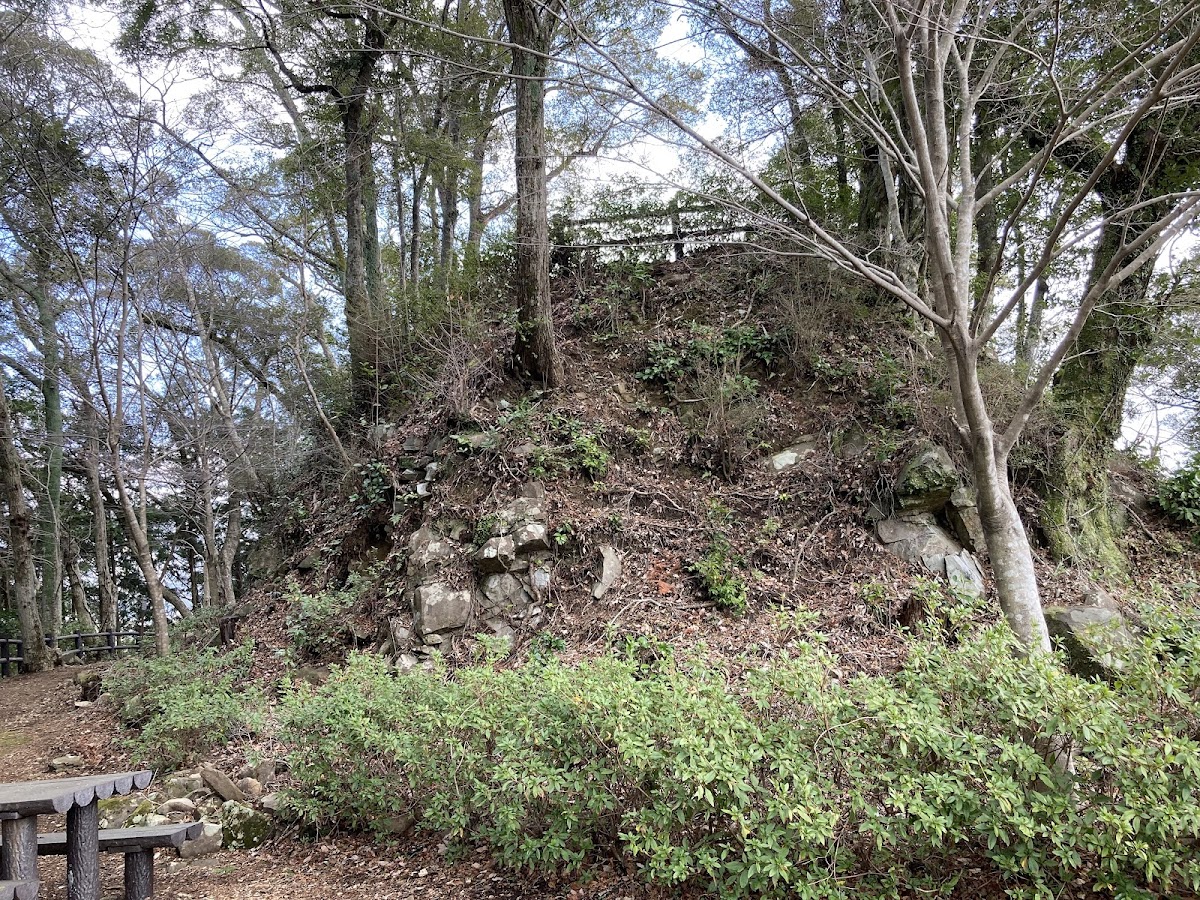
Dry moats remain on the east and west sides of the second level, and traces of collapsed stone walls can be seen in the northwestern part of the final level. To the east of the main enclosure is a section called “Higashi Honjo,” indicating the complex development of the castle’s structure.
Earthworks and Enclosures
Earthworks were built around each enclosure, enhancing its defensive capabilities. The enclosures were cleverly arranged to allow for mutual support. The belt-shaped enclosures were long, narrow flat areas along the slope, used for troop deployment and movement.
These remains indicate that Himenono Castle was not merely a fortified outpost, but a full-fledged mountain castle designed for long-term sieges.
Highlights of Himenono Castle
Development as a Castle Mountain Park
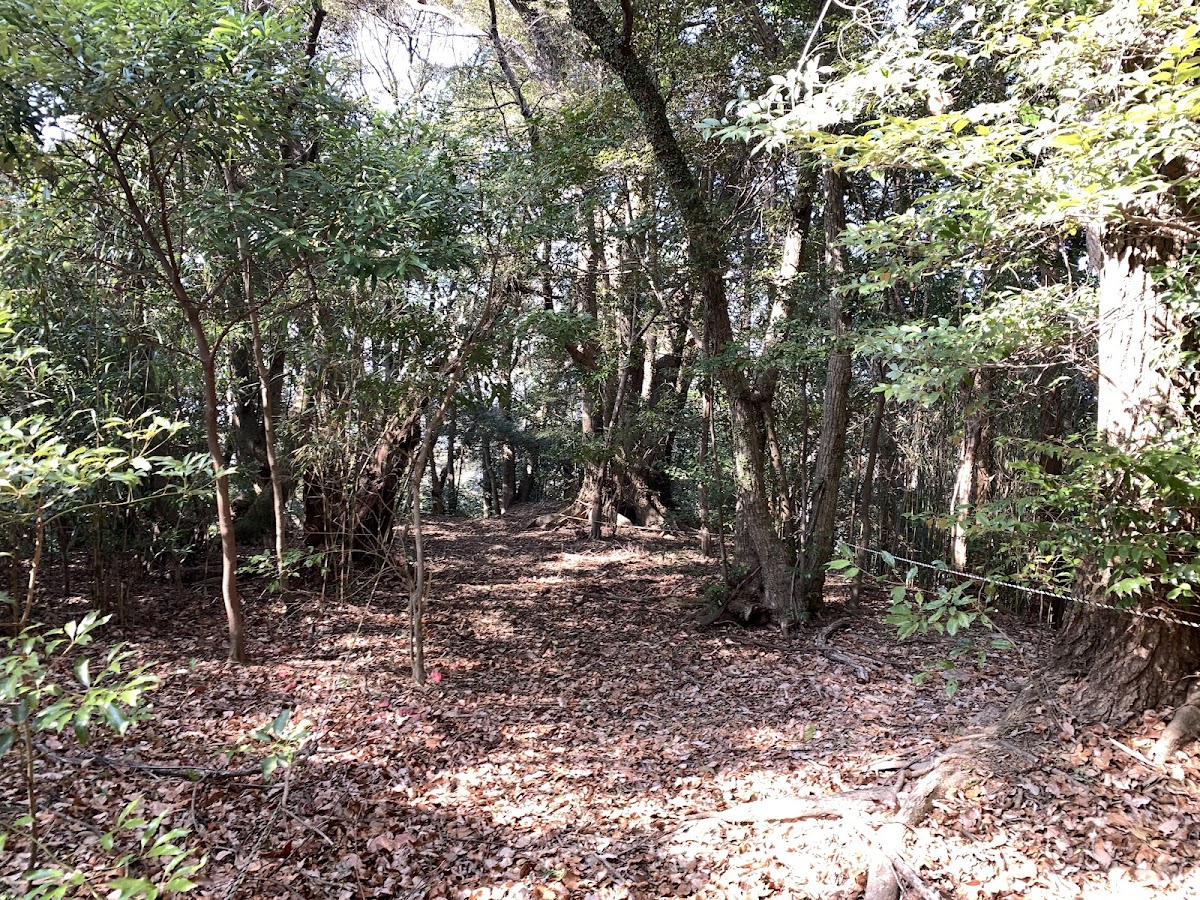
Currently, the Himenono Castle ruins are developed as a castle mountain park, allowing visitors to observe the remains of the medieval mountain castle up close while walking along the trails. Information boards are also installed, making it possible for first-time visitors to understand the castle’s structure while exploring.
Shirakumo Shrine
Shirakumo Shrine is located at the entrance to the castle ruins, and it is accessible by car. There is a parking lot around the shrine, making it a convenient starting point for exploring the castle ruins. Shirakumo Shrine itself is a historical shrine and remains a cherished center of local faith.
The Impressive Rows of Vertical Moats
The biggest highlight when actually visiting is undoubtedly the rows of vertical moats. The regular, continuous moats carved into the slope are far more impressive in person than in photographs. For mountain castle enthusiasts, especially those who love the remains of earthen castles (“Yamashiro-to”), Himenono Castle is arguably one of the finest castles in Kochi Prefecture.
The View
From the main enclosure at the summit, you can enjoy a panoramic view of the plains of the Shinjo River basin. The castle lords of yesteryear must have contemplated their domain’s management while gazing at this scenery. You can also enjoy the beauty of nature throughout the seasons, especially during the fresh green of spring and the autumn foliage.
Access and Visiting Information
Access by Car
It’s about a 1-hour drive from Kochi City. Take National Route 33 towards Tsuno Town. It’s easiest to aim for Shirakumo Shrine. Using the Health and Welfare Center “Satoraku” as a landmark will make it easier to find the entrance to the shrine.
You can drive to Shirakumo Shrine, and there is ample parking. The hiking trail from the shrine to the castle ruins is well-maintained, but since it’s a mountain path, we recommend wearing comfortable shoes.
Estimated Visiting Time
Allow about an hour to visit the castle ruins. If you want to carefully observe the remains or enjoy taking photos, we recommend allowing 1.5 to 2 hours.
Important Notes
- As it is a mountain castle, the ground can become slippery during and after rain.
- Insect repellent is necessary during the summer.
- Bring your own drinking water.
- While there are information boards, researching the castle’s history and structure beforehand will enhance your experience.
Nearby Tourist Attractions
History and Culture of Tsuno Town
Besides Himenono Castle, Tsuno Town boasts numerous historical sites. It’s a region where you can enjoy both history and nature, with historical sites associated with the Tsuno clan, the clear waters of the Shinjo River, and the beautiful natural scenery of the mountainous areas.
Nearby Castle Ruins
Many mountain castles remain in Kochi Prefecture. Visiting them along with Himenono Castle will provide a deeper understanding of Tosa’s Sengoku period history. Castle ruins related to the Chosokabe and Ichijo clans, such as Sakawa Castle and Kure Castle, are also scattered throughout the area.
Historical Significance of Himenono Castle
Base of a Tosa Local Lord
Himenono Castle holds an important position as a typical residence of a local lord in Tosa Province. The Tsuno clan maintained a certain distance from central power while independently managing their territory. Himenono Castle, their base, can be considered a microcosm of the politics, military, and economy of medieval Tosa.
Evolution of Castle Construction Techniques
From its construction during the Nanboku-cho period to its renovation during the Sengoku period, Himenono Castle bears the marks of the evolution of castle construction techniques throughout different eras. In particular, the ridged vertical moats are valuable remains demonstrating defensive techniques from the late Sengoku period and are important historical materials for castle research.
The Chosokabe Clan’s Unification of Shikoku and Himenono Castle
Adopting Chosokabe Chikatada was a survival-oriented decision for the Tsuno clan. This decision made Himenono Castle an important base in the western part of the Chosokabe clan’s unification of Shikoku. In the Chosokabe clan’s strategy, which progressed from the unification of Tosa to the unification of Shikoku, the role played by Himenono Castle and the Tsuno clan was by no means insignificant.
The Value of Visiting Himenono Castle
Attraction for Mountain Castle Enthusiasts
Although Himenono Castle’s buildings have not been restored, it is highly regarded for the excellent preservation of its earthen castle remains. Numerous vertical moats and trenches can be seen, making it a valuable castle site where one can truly experience the defensive system of a medieval mountain castle.
Among castle enthusiasts, it is known as a particularly well-preserved and impressive mountain castle within Kochi Prefecture. Visitors have given it high praise, saying things like, “I was overwhelmed by the scale of the vertical moats,” and “You can experience the true essence of a medieval mountain castle.”
As a Place for Historical Learning
Himenono Castle is an excellent learning resource for studying the lives and strategies of local powerful families during the Sengoku period. This place offers a unique opportunity to experience local history—something not found in textbooks—through actual historical remains. It’s recommended not only for history enthusiasts but also for anyone interested in learning about the region’s history.
Harmony with Nature
The castle ruins are surrounded by abundant nature, allowing visitors to enjoy both historical walks and forest bathing simultaneously. The tranquil scenery of the Shinjo River basin and the serenity of the mountain castle harmonize, providing a sense of peace and tranquility to visitors.
Summary
Himenono Castle (Hanzan Castle) is the ancestral castle of the Tsuno clan, located in Tsuno Town, Kochi Prefecture. It’s a valuable historical site that conveys the history of Tosa from the Nanboku-cho period to the Sengoku period. Built on a mountaintop approximately 190 meters above sea level, this mountain castle retains many excellent features of a medieval mountain castle, such as ridged vertical moats and continuous trenches.
Flourishing as the residence of 18 generations of the Tsuno clan and involved in the Chosokabe clan’s unification of Shikoku, Himenono Castle is an important historical site that tells the story of the rise and fall of local powerful families and the changes in the power structure during the Sengoku period. Currently, the site is maintained as Shiroyama Park, and anyone can easily visit via walking trails.
It’s about an hour’s drive from Kochi City, and there’s parking at Shirakumo Shrine, making it relatively easy to access. It’s a recommended spot not only for mountain castle enthusiasts, but also for those interested in history and those who enjoy nature walks. Why not visit Himenono Castle, nestled quietly in the mountains of Tosa, and feel the spirit of the medieval and Sengoku periods?
With its well-preserved remains, well-maintained viewing environment, and abundant nature, Himenono Castle, as a representative mountain castle of Kochi Prefecture, will continue to convey the importance of history to many people for years to come.