

Buzen Nagano Castle (Fukuoka Prefecture) Complete Guide | History and Highlights of a Mountain Castle Boasting Japan’s Largest Row of Vertical Moats
What is Buzen Nagano Castle?
Buzen Nagano Castle is a medieval mountain castle located in Nagano, Kokuraminami-ku, Kitakyushu City, Fukuoka Prefecture. Built on the summit of Shiroyama Mountain at an altitude of 209 meters, the castle’s most distinctive feature is the group of over 250 row of vertical moats surrounding it. This number of vertical moats is considered the largest in Japan, and these extremely valuable remains of a medieval mountain castle defense system remain in excellent condition.
Currently, the Nagano Tunnel of the Higashi-Kyushu Expressway diagonally crosses the northern side of the castle grounds, creating an interesting landscape where modern infrastructure and medieval castle remains intersect. The castle, composed of three major blocks—the main keep, the second keep, and the outer bailey—is an important historical heritage site that conveys the tensions of the Sengoku period in Buzen Province.
History of Nagano Castle
Construction and the Establishment of the Nagano Clan
Regarding the construction of Nagano Castle, the prevailing theory is that in 1157 (Hogen 2), Taira no Yasumori, the sixth son of Taira no Tokimori, descended to Buzen Province as its governor, built the castle in Nagano, and adopted the name Nagano. Taira no Yasumori became the ancestor of the Nakahara branch of the Nagano clan, and thereafter, the Nagano clan expanded its power as a powerful local lord in Buzen Province.
The Nagano clan ruled this area for generations, establishing their control over the surrounding region. While its mountainous location was inconvenient for peacetime residence, it played an extremely important role as a defensive stronghold during times of conflict. Especially during the Sengoku period (Warring States period), Nagano Castle increased in importance as a strategic point amidst the conflicts of major powers in Kyushu.
Conflicts in the Sengoku Period
During the Sengoku period, Buzen Province was situated between three major powers: the Ouchi clan of Suo Province, the Otomo clan of Bungo Province, and the Mori clan of Aki Province. It became a stage for fierce power struggles. The Nagano clan also needed to ensure its survival within the context of these powers.
Around 1558, the Nagano clan is believed to have been under the influence of the Ouchi clan. However, after the decline of the Ouchi clan, they found themselves in a precarious position between the Mori and Otomo clans. In particular, during peace negotiations between the Mori and Otomo clans, the Nagano clan’s allegiance became a crucial bargaining chip, and they faced demands for allegiance from both sides.
Amidst these tense relations, the defensive structures of Nagano Castle were continuously strengthened. The large-scale construction of the ridged trenches, in particular, is thought to reflect the military tensions of this period. The ridged trenches, designed to hinder enemy incursions, were an extremely effective defensive structure that restricted the movement of enemy soldiers climbing the slopes, enabling a battle advantageous to the defending side.
Toyotomi Hideyoshi’s Kyushu Campaign and the Castle’s Demise
In 1587, when Toyotomi Hideyoshi launched his Kyushu campaign, the fate of the Nagano clan changed dramatically. After Hideyoshi’s pacification of Kyushu, the Nagano clan was relocated to Ito District in Chikuzen Province, and Nagano Castle ceased to serve its purpose.
After the lord left, Nagano Castle was abandoned, but its robust defensive structures were not demolished and remained in the mountains. This ultimately led to the preservation of valuable medieval mountain castle remains to this day.
Japan’s Largest Group of Ridge-Shaped Vertical Moats
What are Ridge-Shaped Vertical Moats?
Ridge-shaped vertical moats are vertical moats (moats running vertically) dug continuously into the slopes of mountain castles. They are defensive structures arranged in a regular pattern, much like furrows in a field. When enemy soldiers climbed the slope, these moats restricted their lateral movement, allowing the defenders to efficiently attack the enemy trapped between the moats.
The group of ridge-shaped vertical moats at Nagano Castle boasts over 250 confirmed lines, making it the largest of its kind among Japanese mountain castles. This thorough defensive strategy, surrounding almost the entire castle with ridge-shaped vertical moats, represents the pinnacle of military technology at the time.
Arrangement and Characteristics of the Ridge-Shaped Vertical Moats
The ridge-shaped vertical moats of Nagano Castle are arranged to surround each of the baileys: the main bailey, the second bailey, and the outer bailey. The ridge-shaped vertical moats around the outer bailey of the main bailey are particularly well-preserved, and their magnificent appearance can still be seen today.
The depth of the vertical moats varies depending on the location, reaching several meters in some places, and their spacing is also carefully calculated. This meticulous design indicates that it was not merely a civil engineering project, but was constructed based on advanced military knowledge.
Visiting the site allows you to truly appreciate the power of the vertical moats carved into the entire mountainside. Especially during the winter when the leaves have fallen, the shape of the vertical moats can be observed more clearly, and you will be overwhelmed by their sheer scale.
Castle Structure and Layout
Main Enclosure Arrangement
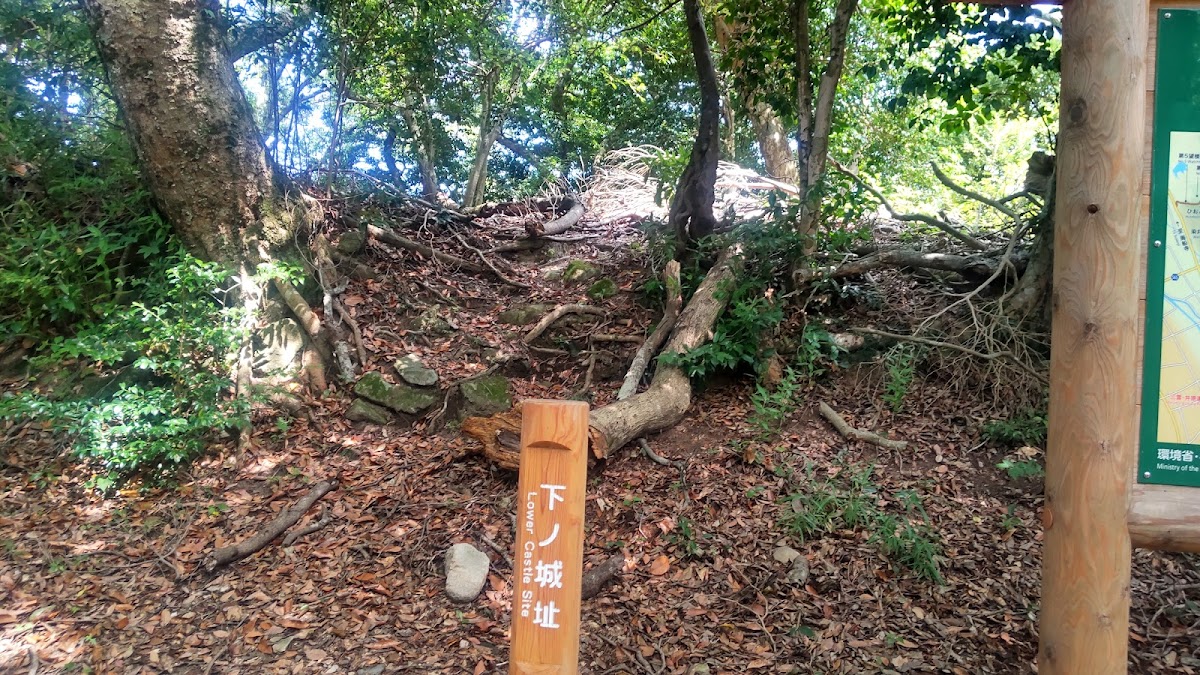
Nagano Castle is a mountain castle with a series of enclosures, with the main enclosure (Honmaru) located on the summit of Shiroyama Mountain at an elevation of 209 meters, and the second enclosure (Ninokuruwa) and outer enclosure (Demaru) arranged along the ridge from there. Each enclosure is demarcated by earthworks and moats, and designed to function as an independent defensive unit.
The Honmaru, as the central part of the castle, possesses the most robust defensive facilities. It is surrounded by high earthworks, and the entrance (koguchi) was heavily fortified. The Ninokuruwa is the second most important enclosure after the Honmaru, and a considerable number of ridged vertical moats are also located here. The Demaru is an enclosure responsible for the outer defense of the castle, and it is thought to have served as a forward base for detecting and intercepting enemy incursions early.
Earthworks and Moats
In addition to the ridged vertical moats, defensive facilities such as earthworks and moats can be seen throughout Nagano Castle. Earthen ramparts were built surrounding the baileys, serving to prevent enemy intrusion and maintain visibility from within the castle.
Moats dug to cut across ridges were important structures for preventing enemy incursions along the ridges. At Nagano Castle, moats were placed between each bailey, demonstrating a multi-layered defensive system that allowed for continued defense even if one bailey was breached.
These defensive structures remain in good condition today, providing valuable resources for learning about medieval mountain castle construction techniques.
Highlights of Nagano Castle
The Ridged Vertical Moats on the Outer Bailey
A must-see when visiting Nagano Castle is the ridged vertical moats on the outer bailey. Here, you can observe up close the densely arranged vertical moats covering the mountain slope. Observing the depth, width, and regularity of each individual trench reveals the intentions of the castle’s builder.
Especially when looking up the slope from below, the trenches stand like a defensive wall, making the difficulty of attacking the castle clear. This sight is a unique feature of Nagano Castle that cannot be seen at any other castle.
Remains of Enclosures and Earthworks
At the remains of each enclosure, including the main enclosure, you can see flat, leveled spaces surrounded by earthworks. The earthworks of the main enclosure are particularly large, giving a glimpse into the castle’s grandeur at the time.
Walking within the enclosures, you can see ingenious ways in which the limited flat space was utilized to its fullest potential. Although building foundations are no longer present, observing the topography allows us to imagine how the space was used.
Exhibits at the Kitakyushu City Buried Cultural Properties Center
To understand the remains of Nagano Castle, the exhibits at the Kitakyushu City Buried Cultural Properties Center are not to be missed. Here, a detailed model of Nagano Castle is on display, allowing for a three-dimensional understanding of the castle’s overall structure.
The model clearly shows the arrangement of the ridged trenches and the relative positions of each enclosure, making it ideal for preparation before visiting the actual site or for reviewing afterward. Artifacts unearthed during excavations are also on display, offering insights into the lives of the people who lived in the castle.
Access and Visiting Information
Location and Transportation Access
Location: Nagano, Kokuraminami-ku, Kitakyushu City, Fukuoka Prefecture
Public Transportation:
- Approximately 40 minutes on foot from JR Hitahikosan Line “Ishihara-machi Station”
- Approximately 30 minutes on foot from Kitakyushu City Bus “Nagano” bus stop
By Car:
- Approximately 15 minutes from Higashi-Kyushu Expressway “Kokura-Higashi IC”
- There is no designated parking area, so caution is needed when parking on the street.
Precautions When Visiting the Castle
Nagano Castle is a full-fledged mountain castle, and appropriate preparation is necessary for visiting. Please note the following points:
Clothing and Equipment:
- Hiking boots or trekking shoes recommended
- Long-sleeved shirt and long pants (there is a possibility of bushwhacking)
- Hat and gloves
- Drinking water and snacks
- Map and compass (GPS app is also effective)
Best Time to Visit:
- Winter (November to March) is the best time. Fallen leaves make it easier to observe the ruins.
- In summer, vegetation grows thick, making it difficult to confirm the ruins.
- Avoid visiting during rainy weather or immediately after rain, as the ground can be slippery.
Other Precautions:
- In recent years, some of the access routes to the castle have collapsed, making some areas difficult to visit.
- Avoid visiting alone; group visits are recommended.
- Check cell phone signal strength beforehand.
- Remember to be considerate of local residents.
Nearby Attractions
Kitakyushu City Buried Cultural Properties Center
As mentioned above, a model of Nagano Castle and excavated artifacts are on display. Visiting before or after your castle visit will deepen your understanding.
Location: 1-5-1 Yokodai Higashi-machi, Kokura Minami-ku, Kitakyushu City
Opening Hours: 9:00 AM – 5:00 PM
Closed: Mondays (or the following day if Monday is a public holiday), New Year holidays
Admission Fee: Free
Other Castles in Buzen Province
Besides Nagano Castle, many other castle ruins remain in Buzen Province.
Kokura Castle: A modern castle located in the center of Kitakyushu City. A famous castle built by Hosokawa Tadaoki, a reconstructed keep now stands.
Nakatsu Castle: A castle built by Kuroda Kanbei in Nakatsu City, Oita Prefecture. A replica keep now stands and is open to the public as a museum.
Visiting these castles together will allow you to comprehensively understand the history of castles in Buzen Province.
Cultural Value of Nagano Castle
Academic Importance
Nagano Castle occupies an extremely important position in the study of medieval Japanese mountain castles. The scale and state of preservation of the ridged vertical moats, in particular, are unparalleled, making them invaluable resources for understanding castle construction techniques of the Sengoku period.
Recent castle research has focused on analyzing the castle’s layout (design) to decipher the intentions of the builders and the tactical thinking of the time. The ridged vertical moats of Nagano Castle are a prime example of this approach, attracting the attention of many researchers and frequently appearing in academic papers and books on castles.
Challenges of Preservation and Utilization
While the remains of Nagano Castle are currently preserved in relatively good condition, several challenges remain.
One is the difficulty of accessing the remains due to natural disasters, such as the collapse of the access roads. Without proper maintenance, these valuable remains could be forgotten.
Another challenge is the alteration of part of the castle grounds due to the construction of the Higashi-Kyushu Expressway. Balancing development and cultural property protection will remain a crucial issue in the future.
Meanwhile, local castle enthusiasts and researchers are actively conducting surveys and outreach activities, continuing their efforts to widely convey the value of Nagano Castle. Kitakyushu City also conducts public awareness campaigns through exhibitions at the Buried Cultural Properties Center.
Points for Enjoying Nagano Castle
Recommendations for Prior Study
To fully enjoy Nagano Castle, prior study is important. We recommend the following preparations:
- Obtaining a Castle Layout Map: Print out a castle layout map available online and bring it with you.
- Historical Preparation: Gain basic knowledge about the history of the Nagano clan and the situation in Buzen Province during the Sengoku period.
- Knowledge of Ridge-Shaped Vertical Moats: Understand what kind of defensive structure ridge-shaped vertical moats are and their function.
- Photo Preparation: Look at photos posted by other visitors on sites such as Kojodan (Castle Enthusiasts’ Association).
Points for Observation
At the site, paying attention to the following points will lead to a deeper understanding. Observation of Ridge-Shaped Vertical Moats:
- Measure the depth, width, and spacing of the vertical moats.
- Consider the relationship between the slope angle and the arrangement of the vertical moats.
- If there are places where the vertical moats are interrupted, infer the reason.
Observation of Enclosures:
- Confirm the size and shape of the flat areas.
- Observe the height and width of the earthworks.
- Confirm the location and structure of the gate (entrance).
Overall Layout:
- Understand the relationship between the arrangement of each enclosure.
- Consider the relationship between the terrain, such as ridges and valleys, and the structure of the castle.
- Infer potential weak points in the defenses and countermeasures.
Photography Tips
There are several tips for capturing the charm of Nagano Castle in photographs.
Photographing the Ridge-Shaped Vertical Moats:
- A low, upward-looking angle captures the impressive scale of the vertical moat group.
- The low winter sunlight emphasizes the shadows of the vertical moat.
- A wide-angle lens conveys the continuity of the vertical moat.
Enclosures and Earthworks:
- A person is included to show the height of the earthworks and create a sense of scale.
- A bird’s-eye view of the flat surface of the enclosure.
Panoramic View:
- If possible, photograph the entire castle mountain from an opposite mountain.
- Drone photography requires permission from the landowner and compliance with aviation laws.
Summary
Buzen Nagano Castle, boasting the largest ridge-shaped vertical moat group in Japan, is a valuable historical site that even those who aren’t castle enthusiasts should visit at least once. Located in Kitakyushu City, Fukuoka Prefecture, it offers a relatively accessible location while still allowing visitors to fully experience the charm of an authentic mountain castle.
Since its construction in 1157 by Taira no Yasumori, this castle, the residence of the Nagano clan, has watched over the history of Buzen Province. During the Sengoku period, amidst the conflicts between the Ouchi, Mori, and Otomo clans, its defensive structures were continuously strengthened. In particular, the more than 250 rows of trenches represent the pinnacle of military technology at the time and remain visible on the mountainside today.
After Toyotomi Hideyoshi’s Kyushu campaign in 1587, the Nagano clan was transferred to Chikuzen Province, and the castle ceased to serve its purpose. However, because the remains were preserved without being demolished, we can now understand the true nature of this medieval mountain castle.
Visiting the castle requires considerable preparation and physical stamina, but the effort will be rewarded once you actually visit the site and witness the magnificent sight of the rows of trenches. Combined with preliminary learning at the Kitakyushu City Buried Cultural Properties Center, we highly recommend experiencing the charm of Nagano Castle.
In recent years, some parts of the approach to the castle have collapsed, making visits increasingly difficult. However, thanks to the efforts of local preservation groups and researchers, this precious cultural property is being passed on to future generations. Each of us understanding the value of Nagano Castle and taking an interest in its preservation is essential to ensuring that this historical heritage remains for future generations.
.png)