.png)
Aratakiyama Castle (Ube City, Yamaguchi Prefecture): The Residence of a Senior Retainer of the Ouchi Clan and the Full Extent of One of the Largest Medieval Mountain Castles in the Prefecture
About Aratakiyama Castle
Aratakiyama Castle (Aratakisanjo/Aratakiyamajo) is a Sengoku period mountain castle built on Mount Arataki, 459 meters above sea level, in Higashiyoshibe, Ube City, Yamaguchi Prefecture. Also known as Arataki Castle, it is known as the residence of Naito Takaharu, a senior retainer of the Ouchi clan and deputy governor of Nagato Province.
The remains spread across a vast area of approximately 700 meters east-west and 200 meters north-south, making it one of the largest medieval mountain castles in Yamaguchi Prefecture. Designated a Yamaguchi Prefecture Historic Site on January 11, 2008, it still retains valuable remains such as baileys, moats, ridged vertical moats, and stone walls in excellent condition.
From the mountaintop, one can see a wide area stretching from the Seto Inland Sea to the Yoshibe Basin and the Mito-Akiyoshi region inland, highlighting the importance of its strategic location as a military stronghold.
History of Aratakiyama Castle
Construction and Naito Takaharu
The exact construction date of Aratakiyama Castle is unknown, but it is believed to have been built during the Tenbun era (1532-1555) by Naito Takaharu, a senior retainer of the Ouchi clan.
Naito Takaharu held the important position of deputy governor of Nagato Province for the Ouchi clan, and used Aratakiyama Castle as his base of operations in the Nagato region. Takaharu’s sister was Ozaki-no-Tsubone, the principal wife of Mori Takamoto, the eldest son of Mori Motonari, and this marriage would significantly influence Takaharu’s later fate.
The Fall of the Ouchi Clan and Subordination to the Mori Clan
In 1551 (Tenbun 20), Sue Harukata, a vassal of the Ouchi clan, rebelled against his lord, Ouchi Yoshitaka (the Dainei-ji Incident). At this time, Naito Takaharu, due to his sister’s familial relationship with Mori Takamoto, chose not to side with Sue Harukata’s rebellion but instead sided with the Mori clan.
In 1555 (Koji 1), when Sue Harukata was defeated and killed in the Battle of Itsukushima, and the Ouchi clan effectively fell, Naito Takaharu officially became a vassal of the Mori clan. This political decision allowed the Naito clan to survive the turmoil of the Sengoku period.
From the Edo Period Onward
In the Edo period, Aratakiyama Castle was abandoned. However, records show that the mountaintop was used as a signal fire station, and its military role continued in a modified form. Signal fire stations were important hubs for information transmission, and even though the castle’s function was lost, its advantageous location continued to be utilized. ## Structure and Layout of Aratakiyama Castle
Overall Structure
Aratakiyama Castle was built as a multi-bailey mountain castle and consists of three main bailey groups:
- Main Bailey: The central bailey group located near the mountaintop at an altitude of 459 meters
- Outpost (Senjojiki): A flat bailey group built on the eastern ridge
- Western Bailey: A bailey group located on the western ridge
These three bailey groups were organically interconnected, creating a strong defensive system.
Characteristics of the Main Bailey
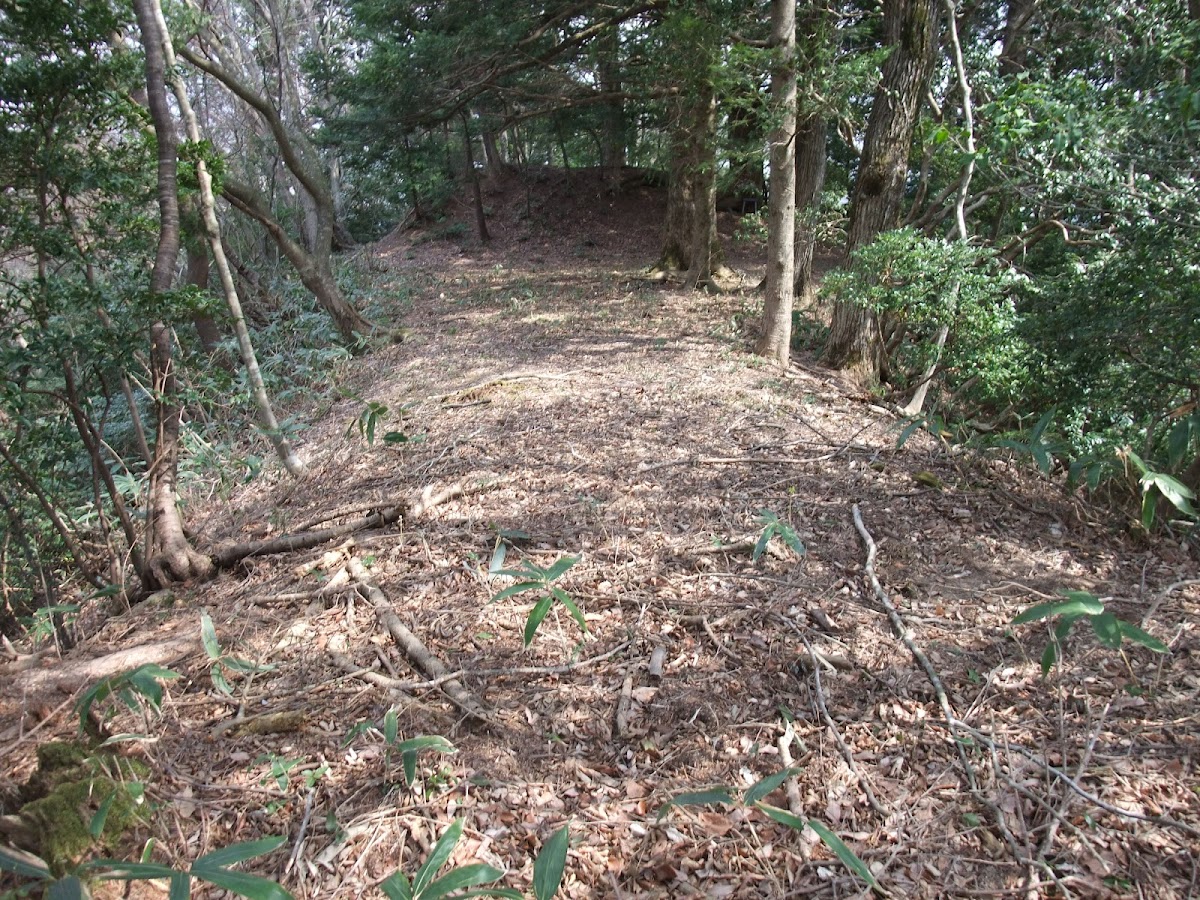
Multiple baileys are arranged in a stepped pattern around the main bailey at the mountaintop. The main bailey functioned as the central part of the castle, and it is believed that the lord’s residence and important facilities were located there.
Stone masonry remains have been confirmed around the main bailey, indicating that advanced castle construction techniques were used for the time. These stone masonry structures can be considered evidence of the Ouchi clan’s abundant wealth and technical capabilities.
Outpost (Senjojiki)
The outpost, located on the eastern ridge, is also known as “Senjojiki” (thousand tatami mats) and is characterized by its vast, flat area. Due to its size, it is presumed to have functioned as a place to station many soldiers. It also served as a forward base against enemies from the east.
Western Enclosure
The western enclosure on the western ridge is an important group of enclosures responsible for the defense of the western side. Working in conjunction with the main enclosure, its layout allows for attacks from multiple directions.
Defensive Structures
The defensive structures of Aratakiyama Castle are extremely extensive, and the following remains have been confirmed:
Moat: A moat dug to cut across the ridge, an important defensive structure that prevented enemy intrusion. Multiple moats were provided, also serving to demarcate each group of enclosures.
Ridge-shaped Vertical Moat Group: A defensive structure consisting of multiple vertical moats arranged in parallel on a slope, effective in making lateral movement of the enemy difficult. Examples of ridged vertical moats are rare even among mountain castles in Yamaguchi Prefecture, demonstrating the high level of castle construction technology at Aratakiyama Castle.
Vertical Moat: A moat dug vertically into a slope, serving to hinder enemy ascent.
Entrance/Exit: An entrance to a bailey; it may have featured ingenious designs such as a square-shaped entrance/exit.
Stone Masonry: Stone masonry was used on the edges of the baileys and in important areas, enhancing defensive capabilities and demonstrating the castle’s imposing presence.
Excavation Survey and Excavated Artifacts
Overview of the Excavation Survey
From 2000 to 2004, an excavation survey was conducted at the Aratakiyama Castle site. This survey yielded valuable information regarding the castle’s actual structure and period of use.
Excavated Artifacts
The following artifacts have been discovered during the excavation:
Haji ware: Everyday pottery from the medieval period, providing important evidence of life within the castle.
Wall-type pottery: A higher-grade type of pottery, thought to have been used by individuals of castle lord rank.
Chinese ceramics: High-quality ceramics imported from China, such as celadon and white porcelain from the Ming dynasty, have been unearthed. These are believed to have been acquired by the Ouchi clan through trade with the Ming dynasty, providing evidence of the close relationship between the Ouchi clan and Aratakiyama Castle.
Korean ceramics: Ceramics imported from the Korean Peninsula have also been confirmed, illustrating the Ouchi clan’s extensive trade network.
These excavated artifacts indicate that Aratakiyama Castle was not merely a military facility, but a center influenced by the Ouchi clan’s culture.
Highlights of Aratakiyama Castle
Grand View from the Main Enclosure
Located on the mountaintop at an altitude of 459 meters, the main enclosure offers a 360-degree panoramic view. On a clear day, you can see the Seto Inland Sea to the south, the Chugoku Mountains to the north, and the vast plains to the east and west, giving you a real sense of the castle’s strategic location controlling a vital transportation hub.
Ridge-Shaped Vertical Moats
The ridge-shaped vertical moats, rare even within Yamaguchi Prefecture, are one of Aratakiyama Castle’s greatest highlights. The multiple vertical moats, regularly arranged on the slope, are valuable relics that convey the advanced castle-building techniques of the Sengoku period.
Stone Wall Remains
The stone walls remaining around the main enclosure and at important gates are important resources for understanding the development of stone wall technology in medieval mountain castles. The skillful stacking of natural stones speaks to the high level of skill of the stonemasons of the time.
Warrior Encampment Site
Near the trailhead, there remains a site called the “Warrior Encampment Site.” It is said to be the place where warriors were counted before going into battle, making it a historical site that evokes the military mobilization of the Sengoku period.
Vast Group of Enclosures
The group of enclosures, spread across a vast area of 700 meters east-west and 200 meters north-south, can be appreciated simply by walking around. By observing the arrangement and coordination of each enclosure, one can understand the design philosophy of castles during the Sengoku period.
Access and Visiting Guide
Location
Higashiyoshibe, Ube City, Yamaguchi Prefecture
Access Methods
Access by Car:
- Approximately 30 minutes by car from Ube IC on the Sanyo Expressway
- Approximately 25 minutes by car from Mine IC on the Chugoku Expressway
- You can drive to the trailhead, and there is parking available.
Public Transportation:
- Approximately 20 minutes by taxi from Tokonami Station on the JR Ube Line
- Access by public transportation is inconvenient, so we recommend using a car.
Time to Climb
It takes about 40 minutes on foot from the trailhead to the main enclosure. Please prepare the following equipment for hiking the mountain trails:
- Comfortable walking shoes (hiking boots or athletic shoes)
- Drinking water
- Insect repellent (spring to autumn)
- Hat, sunscreen
- Rain gear (in case of unstable weather)
Precautions for Visiting
- As it is a mountain castle, a certain level of physical fitness is required.
- Be careful of snakes and insects in summer.
- There is a possibility of snow and ice in winter.
- Cell phone reception may be poor in some areas.
- Avoid climbing alone; visiting in a group is recommended.
- Please be careful not to damage the ruins.
Estimated Visit Time
If you plan to thoroughly explore from the start to the end of the climb, please allow approximately 3-4 hours. Even if you only plan to visit the main ruins, approximately 2 hours will be necessary.
Nearby Tourist Attractions
Historical Sites in Ube City
Sorinji Temple: An ancient Rinzai Zen temple famous for its beautiful garden. Approximately 25 minutes by car from Aratakiyama Castle.
Ube City Coal Museum: A facility where you can learn about the history of the coal industry that supported Ube’s modernization.
Nearby Castles
Katsuyama Castle: A medieval mountain castle located in Ube City, dating from the same period as Aratakiyama Castle.
Konomine Castle: An important branch castle of the Ouchi clan located in Hofu City, approximately 40 minutes away by car.
Historical Significance of Aratakiyama Castle
Position in the Ouchi Clan’s Rule System
Aratakiyama Castle was an important base in the Ouchi clan’s rule of Nagato Province. As the residence of the Shugodai (deputy governor) Naito Takaharu, it played a central role in the military and administrative affairs of the Nagato region.
The Ouchi clan, with its base in both Suo and Nagato Provinces, built a vast sphere of influence in western Chugoku region. Aratakiyama Castle was one of the important branch castles supporting this rule system and also served as a strategic base for monitoring the transportation routes connecting the Seto Inland Sea coast and the inland areas.
Value in the History of Castle Construction Technology
The ridged trenches and stonework techniques found at Aratakiyama Castle are valuable resources demonstrating the development of castle construction technology in the late Sengoku period. In particular, the ridged trenches are a technique that developed in later periods, and Aratakiyama Castle may be one of its pioneering examples.
Importance in Regional History
As a representative example of a medieval mountain castle in Nagato Province, Aratakiyama Castle occupies an important position in regional history research. The trade ceramics unearthed during excavations provide evidence that the Ouchi clan’s trade with China and Korea extended to local branch castles, making them valuable resources for understanding medieval regional economy and cultural exchange.
Efforts for Preservation and Utilization
Protection as a Prefectural Historic Site
Since its designation as a prefectural historic site in 2008, the Aratakiyama Castle ruins have been appropriately protected as a cultural property. The Ube City Board of Education is leading efforts to preserve and utilize the remains.
Future Challenges
The following are future challenges for Aratakiyama Castle:
- Further investigation and research of the remains
- Improvement of information boards and explanatory signs for visitors
- Maintenance and safety of hiking trails
- Preservation activities in cooperation with local residents
- Promotion of utilization as a tourist resource
Summary
Aratakiyama Castle is a valuable historical site that conveys the history and castle-building techniques of the Sengoku period, as it is one of the largest medieval mountain castles in Yamaguchi Prefecture. It served as the residence of Naito Takaharu, a senior retainer of the Ouchi clan, and later came under the control of the Mori clan.
With its magnificent remains spread across a mountaintop at an altitude of 459 meters, advanced defensive facilities such as ridged trenches and stone walls, and trade ceramics unearthed during excavations, Aratakiyama Castle offers many points of interest. It is a place worth visiting not only for castle enthusiasts but also for all those interested in history.
Climbing to the castle requires physical strength and time, but the magnificent panoramic view from the summit and the ruins that evoke the spirit of the Sengoku period will more than make the effort worthwhile. When you visit Yamaguchi Prefecture, be sure to visit Aratakiyama Castle and experience the charm of a medieval mountain castle.