Nagamine Castle (Joetsu City, Niigata Prefecture) – The Complete Story of the Phantom Hilltop Castle Abandoned in Just Two Years
Located in Yoshikawa Ward, Joetsu City, Niigata Prefecture, the ruins of Nagamine Castle are known as a phantom castle that was built in the early Edo period but abandoned after only two years. Despite being abandoned unfinished, large earthworks and dry moats remain remarkably well, making it a valuable historical site that conveys the castle-building techniques of the early modern period.
Historical Background of Nagamine Castle
The Land of Nagamine Before Construction
The land where Nagamine Castle was built is believed to have originally been the site of a castle belonging to the Nasu clan. From the Sengoku period to the early Edo period, the Joetsu region was under the control of the Uesugi clan, and a network of castles centered around Kasugayama Castle was formed. The Nagamine area may have functioned as one of these branch castles.
The Arrival of Makino Tadanari and Construction
The full-scale construction of Nagamine Castle began in 1616 (Genna 2). In this year, Makino Tadanari, a hereditary daimyo and lord of Ogo Castle in Kozuke Province (present-day Gunma Prefecture), was significantly promoted from 20,000 koku to 50,000 koku and transferred to this area for his achievements in the Summer Siege of Osaka.
Makino Tadanari was a senior retainer of Tokugawa Ieyasu and Hidetada, and his promotion was a recognition of his distinguished service in the Siege of Osaka. This reassignment occurred amidst a reorganization of the governing system in the Joetsu region following the dismissal of Matsudaira Tadateru, the lord of Takada Castle, in 1615.
Tadanari began large-scale renovation and expansion work on the former castle site of the Nasu clan, aiming to create a modern castle. He planned to utilize natural water sources such as Nagamine Pond and Saiga Pond as outer moats, and construct a flatland castle on a hill approximately 35 meters above sea level.
Transfer and Abandonment After Only Two Years
However, just two years after construction of the castle began in earnest, in 1618 (Genna 4), Tadanari was transferred to Nagaoka Castle in Echigo Province with a domain of 62,000 koku. This sudden transfer interrupted the construction of Nagamine Castle, and it was abandoned before completion.
It is believed that this short-term transfer was driven by the political intention of the Edo Shogunate to strengthen its control over Echigo Province. By entrusting the strategically important transportation hub of Nagaoka to the Makino clan, the aim was to strengthen surveillance of the Hokuriku Road.
Layout and Structure of Nagamine Castle
Location and Topographical Characteristics
Nagamine Castle is a flatland castle located on a hill approximately 35 meters above sea level in Yoshikawa Ward, Joetsu City. To the north of the castle lies Nagamine Pond, with a circumference of approximately 2.6 kilometers and an area of approximately 22 hectares, which functioned as a natural outer moat. To the south lay Saigaike Pond (now cultivated into rice paddies), and to the east, it was surrounded by a deep valley, making it a strategically important location protected on three sides by water and valleys.
The castle’s layout, which made maximum use of this terrain, strongly reflects the defensive philosophy of early modern castles.
Arrangement of the Main Enclosure and Baileys
The main enclosure, the central part of Nagamine Castle, was located at the highest point of the hill. Multiple baileys were arranged in a stepped fashion around the main enclosure, forming a tiered defensive line.
A large, flat area was secured to the west of the main enclosure, where it is believed that the residences of the retainers and the castle town were planned. Currently, a parking lot has been developed on this west side, serving as a starting point for exploring the castle ruins.
Structure of Large-Scale Earthworks
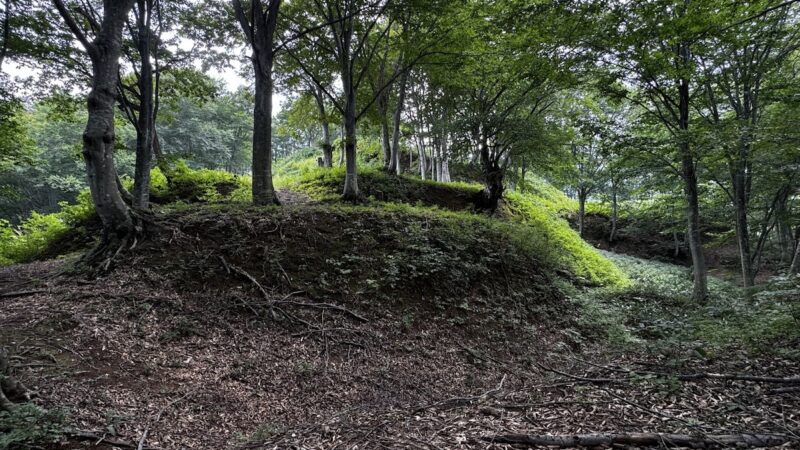
The greatest highlight of the Nagamine Castle ruins is the large-scale earthworks that still exist. The southern earthwork, in particular, is large in scale, extending for several meters in height.
The cross-section of this earthwork reveals a construction technique called rammed earth. Rammed earth is a method of layering and compacting different types of soil, effectively increasing the strength of the earthwork. The exposed section of the earthwork’s cross-section allows observation of this layered structure, demonstrating the high level of civil engineering technology used in early modern castles.
The earthwork was not merely a defensive structure, but also a symbolic representation of the castle’s grandeur. If completed, it would have formed a magnificent landscape integrated with Nagamine Pond.
Arrangement and Function of Dry Moats
Equally impressive to the earthwork are the dry moats that demarcate each enclosure. The dry moats of Nagamine Castle were wide and considerably deep, forming a strong defensive line that hindered enemy intrusion.
The dry moats were not simply dug deep; ingenuity can also be seen in the shape of the moat bottom and the angle of the slopes. Some dry moats exhibit different forms, such as V-shaped (Yagenbori) and box-shaped (Hakobori), indicating that different defensive functions were utilized depending on the location. The soil excavated from the dry moat was used directly as material for the earthworks. This technique of efficiently constructing defensive structures by integrating excavation and embankment is a characteristic of early modern castle construction.
Current Status and Highlights of Nagamine Castle Ruins
Preservation and Maintenance Status
Even after more than 400 years since its abandonment, the remains of Nagamine Castle are remarkably well-preserved. This is largely due to the lack of large-scale development after the castle’s closure.
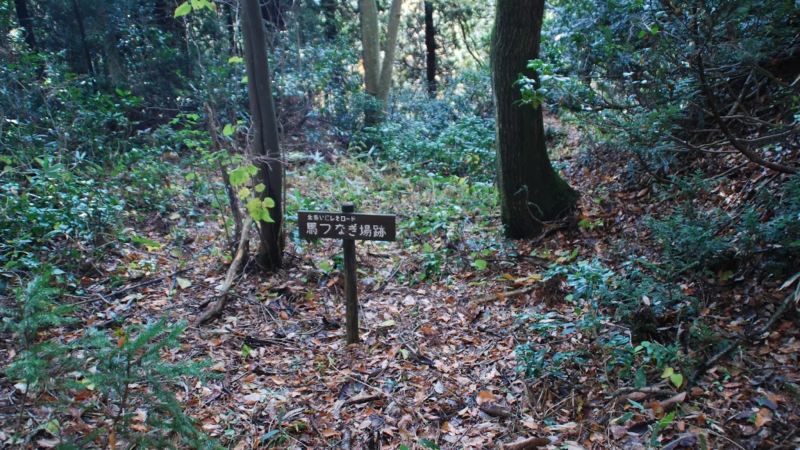
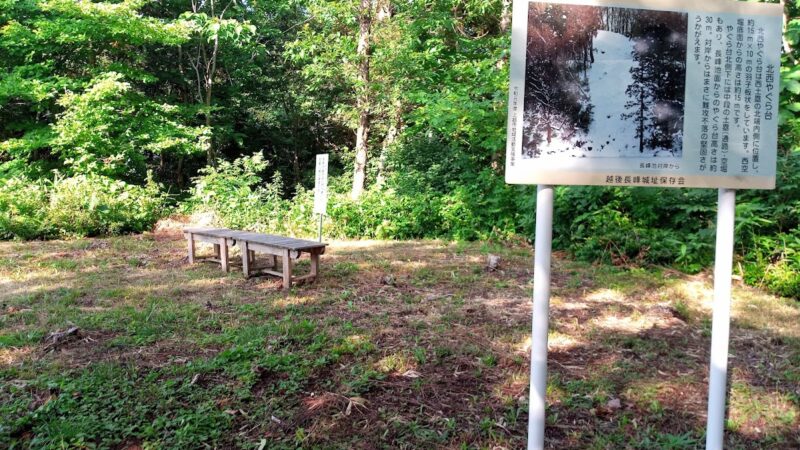
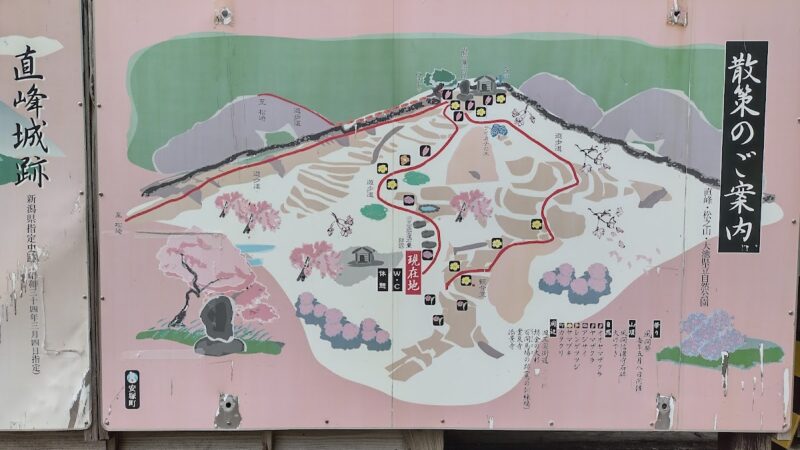
In recent years, Joetsu City has been promoting historical site maintenance, and walking paths have been established. A large parking lot has been built on the west side of the main enclosure, from which walking paths extend through the castle ruins. Information boards are installed at key points, allowing even first-time visitors to understand and appreciate the highlights of the remains.
Main Points of Interest
Main Enclosure Ruins: This is the central part of the castle, now a flat open space. From here, you can overlook the surrounding terrain and appreciate the castle’s strategic location.
Southern Earthen Embankment: This is the largest and best-preserved earthen embankment. You can walk along the top of the embankment, and in some places, you can observe the cross-section of the rammed earth structure.
Dry Moats: Multiple dry moats remain, separating each enclosure. You can descend to the bottom of the moats to experience their depth and scale.
Integrated Landscape with Nagamine Pond: Nagamine Pond, which spreads out to the north of the castle ruins, remains almost the same size as it was in the past. The integrated landscape of the castle ruins and the pond allows you to imagine what it was like in its heyday.
Access and Visiting Information
Nagamine Castle Ruins are located in Nagamine, Yoshikawa Ward, Joetsu City, and are easily accessible by car. It’s approximately 15 minutes from the Kakizaki Interchange on the Hokuriku Expressway and approximately 25 minutes from the Joetsu Interchange.
Parking is available on the west side of the main enclosure and is free of charge. To visit the main remains from the parking lot, allow 30 minutes to 1 hour on foot.
Visiting is possible year-round, and admission is free. However, during winter, walking may be difficult due to snow. The best time to visit is from spring to autumn.
Makino Tadanari and His Era
Biography of Makino Tadanari
Makino Tadanari (1581-1655) was a hereditary daimyo who served Tokugawa Ieyasu. His father was Makino Yasunari, a member of the Tokugawa retainer group since Mikawa Province.
Tadanari served as a close attendant to Tokugawa Hidetada from a young age and participated in major battles such as the Battle of Sekigahara and the Winter and Summer Sieges of Osaka. His achievements, particularly in the Summer Siege of Osaka, were recognized, and he received a significant increase in his stipend from 20,000 koku to 50,000 koku, and was transferred to Nagamine.
Activities as Lord of Nagaoka Domain
After being transferred to Nagaoka Castle just two years after leaving Nagamine Castle, Tadanari laid the foundation for the Nagaoka Domain. As a daimyo with a domain of 62,000 koku, he devoted himself to the development of the Nagaoka Domain by focusing on the improvement of the castle town, the development of new rice fields, and flood control projects.
Tadaaki served as the lord of the Nagaoka Domain until 1635, after which he passed the family headship to his son, also named Tadaaki. The Makino family continued as lords of the Nagaoka Domain until the Meiji Restoration, and became known for the exploits of Kawai Tsuginosuke during the Boshin War.
Documents bearing Lord Tadaaki’s signature and documents issued to retainers
Historical materials concerning Makino Tadaaki during his time at Nagamine Castle include documents bearing Lord Tadaaki’s signature and documents issued to his retainers. These documents reveal that, despite his short two-year tenure, Tadaaki actively engaged in the management of his domain.
Documents bearing his signature (kaō) demonstrate the authority of the lord at the time and contain orders to his retainers and instructions regarding civil administration.
Documents bearing his signature (kaō) demonstrate his authority as a lord and contain instructions regarding civil administration. ## Early Edo Period Castle Policy and Nagamine Castle
Castle Reorganization in the Genna Era
Nagamine Castle was abandoned in Genna 4 (1618), shortly after the Edo Shogunate issued the “One Castle Per Province” decree in Genna 1 (1615). This decree mandated that each daimyo’s territory be limited to one castle, with all others being demolished.
However, the abandonment of Nagamine Castle was not so much a demolition due to the decree, but rather a natural abandonment following the relocation of Tadanari. Since no new lord took control, the castle was abandoned and never reused.
Early Modern Castle Construction Techniques
The remains of Nagamine Castle reveal characteristics of early Edo period castle construction techniques. Features such as rammed earth ramparts, systematically placed dry moats, and layouts utilizing natural terrain reveal a more planned and technically sophisticated castle architecture, distinct from the mountain castles of the Sengoku period.
It’s ironic that its unfinished state has made it a valuable resource for understanding the castle’s construction process. One could say that its unfinished state, invisible in a completed castle, is preserved in a kind of frozen form.
Castle Network in the Joetsu Region
Relationship with Kasugayama Castle
The Joetsu region, where Nagamine Castle is located, had a castle network centered around Kasugayama Castle, the residence of Uesugi Kenshin, during the Sengoku period. Kasugayama Castle is a mountain castle at an altitude of 189 meters, a location contrasting sharply with Nagamine Castle.
In the early Edo period, Kasugayama Castle was abandoned, and Takada Castle was newly built on the plains. Nagamine Castle is located on a line connecting Takada Castle and Nagaoka Castle, indicating its strategic military and transportation importance.
Related Castles
Many other castle ruins remain in the Joetsu region besides Nagamine Castle. The Kasugayama Castle ruins have been designated a national historic site, and restoration work is underway. Furthermore, there are scattered mountain castles from the Uesugi clan era, such as the ruins of Samegao Castle and Minokaburi Castle.
By visiting these castle ruins, you can experience the changes in castle architecture from the Sengoku period to the early Edo period. Niigata Prefecture has created the “Joetsu Myoko Mountain Castle Map” and is promoting the use of these mountain castle ruins for tourism.
Cultural Value of Nagamine Castle
Evaluation as a Historic Site
Nagamine Castle ruins are designated cultural properties of Joetsu City and are protected as an important historical heritage of the region. Its unique history as a phantom castle abandoned after only two years, its well-preserved remains, and its valuable example of early modern castle construction techniques give it high cultural value.
Academic Significance
From the perspective of archaeology and castle history research, Nagamine Castle is also important. Because it was abandoned unfinished, its state during construction is preserved, making it a valuable resource for studying the process of castle construction.
At the locations where the rammed earth embankment cross-sections are exposed, it is possible to observe the details of the civil engineering techniques. Furthermore, research is being conducted to estimate the overall picture of the castle construction plan by comparing the planned layout with the actually completed sections.
Utilization of Nagamine Castle Ruins and Regional Development
Utilization as a Tourism Resource
Joetsu City is promoting initiatives to utilize the local historical heritage, including the Nagamine Castle Ruins, as a tourism resource. Official tourism information websites such as “Joetsu Tourism Navi” feature the Nagamine Castle Ruins as a major tourist spot.
The natural environment surrounding the castle ruins is also one of its attractions. The area around Nagamine Pond retains rich natural beauty, making it ideal for birdwatching and walks. The development of tourist routes combining castle ruin visits and nature observation is also anticipated.
Local Activity Groups
In the region, there are activity groups working to preserve and utilize the Nagamine Castle Ruins. These groups conduct regular cleaning activities, maintain information boards, and hold guided tours, serving as a good example of cultural property protection by local residents.
Activities include history study sessions for elementary and junior high school students, guided tours of the castle ruins, and cooperation in surveying the remains. These activities, aimed at protecting the castle ruins as a source of local pride and passing them on to future generations, represent an ideal form of cultural property preservation.
Educational Use
Nagamine Castle Ruins are also utilized in local school education. As part of local history studies in social studies, students are given the opportunity to visit the castle ruins and learn about local history.
Learning in front of actual remains provides a tangible understanding that cannot be obtained from textbooks alone. Experiencing the size of the earthworks and the depth of the dry moats allows students to appreciate the labor and technical skills of the people of that time.
Summary: The Weight of History Conveyed by the Phantom Castle
Nagamine Castle is a phantom castle that existed for only a short period of two years. However, its remains, more than 400 years later, still speak to us deeply.
The large-scale earthworks and dry moats demonstrate the high level of castle construction technology of the early modern period. The rammed earth embankment cross-section is a valuable historical document that conveys the civil engineering techniques of the time. The landscape, integrated with Nagamine Pond, demonstrates the harmony between the castle and its natural environment.
The story of the rise and relocation of a single warrior, Makino Tadanari, symbolizes the turbulent early Edo period. The castle, abandoned before completion, teaches us about the gap between plans and reality, and the serendipity of history.
Visiting the Nagamine Castle ruins is not simply about viewing the castle’s remains, but also an opportunity to comprehensively understand the political situation of the early Edo period, castle construction techniques, and local history. The earthen embankments and dry moats remaining on the quiet hills eloquently tell a page of history that has rarely been narrated.
When visiting Joetsu City, be sure to visit the Nagamine Castle ruins. You will surely feel the weight of history conveyed by this phantom castle.