Complete Guide to Obasawa Castle (Murakami City, Niigata Prefecture): A Sengoku Period Mountain Castle with Impressive Ridge-Shaped Vertical Moats
Located in Obasawa, Murakami City, Niigata Prefecture, Obasawa Castle is a mountain castle built by the Ayukawa clan, a local lord during the Sengoku period. Designated as a prefectural historical site, this castle is known for its overwhelming defensive structure—more than 50 ridge-shaped vertical moats—and is a valuable historical site that conveys the history of the Sengoku period in Echigo Province. This article comprehensively introduces essential information for castle enthusiasts, including the history, structure, highlights, and access methods of Obasawa Castle.
History of Obasawa Castle: The Ayukawa Clan and the Honjo Shigenaga Rebellion
Construction and Development by the Ayukawa Clan
The exact date of construction of Obasawa Castle is unclear, but it is said to have been built by the Ayukawa clan, a branch of the Honjo clan, lords of Honjo Castle. The Ayukawa clan, as local lords of Echigo Province, wielded considerable power in the Murakami region.
In 1539 (Tenbun 8), Ayukawa Kiyonaga, along with his relative Ogawa Nagasuke, attacked Honjo Fusachō of Honjo Castle, driving him to Dewa Province. This event elevated the Ayukawa clan’s status in the region, and they expanded their power with Ōbasawa Castle as their base.
The Eiroku Rebellion: Honjo Shigenaga’s Rebellion and Ōbasawa Castle
The most important event in the history of Ōbasawa Castle is Honjo Shigenaga’s Rebellion in 1568 (Eiroku 11). In that year, Honjo Shigenaga, lord of Honjo Castle, raised an army against Uesugi Terutora (later Uesugi Kenshin).
At this time, Ayukawa Kiyonaga chose to follow Uesugi Terutora (Uesugi Kenshin). Because the Ayukawa clan, though of the same lineage, chose to oppose the Honjo clan, Oobasawa Castle became a target of attack by the Honjo clan. The castle became the scene of fierce battles, and it is believed that its defensive structures were significantly strengthened during this period. In particular, the cluster of ridged vertical moats concentrated on the south side, facing Murakami Castle (the Honjo clan’s residence), can be considered remnants that illustrate the tensions of this period.
After the Keicho Era: The Path to Abandonment
Even after the Honjo Shigenaga Rebellion subsided, the Ayukawa clan continued to exist with Oobasawa Castle as their base. However, it is believed that Oobasawa Castle was abandoned during the Keicho era (1596-1615) due to the clan’s transfer to Aizu and the end of the Sengoku period. During the Edo period, this region came under the control of the Murakami Domain, and a guard post was established around the castle ruins, serving as a monitoring base for the Hokkoku Kaido road.
Structure of Obasawa Castle: A Strong Mountain Castle Divided into Two Mountains
Two-Mountain Structure of Terayama and Miyayama
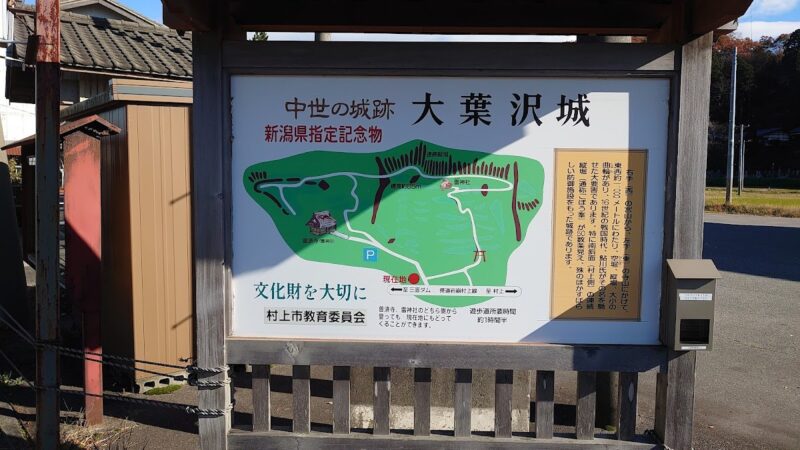
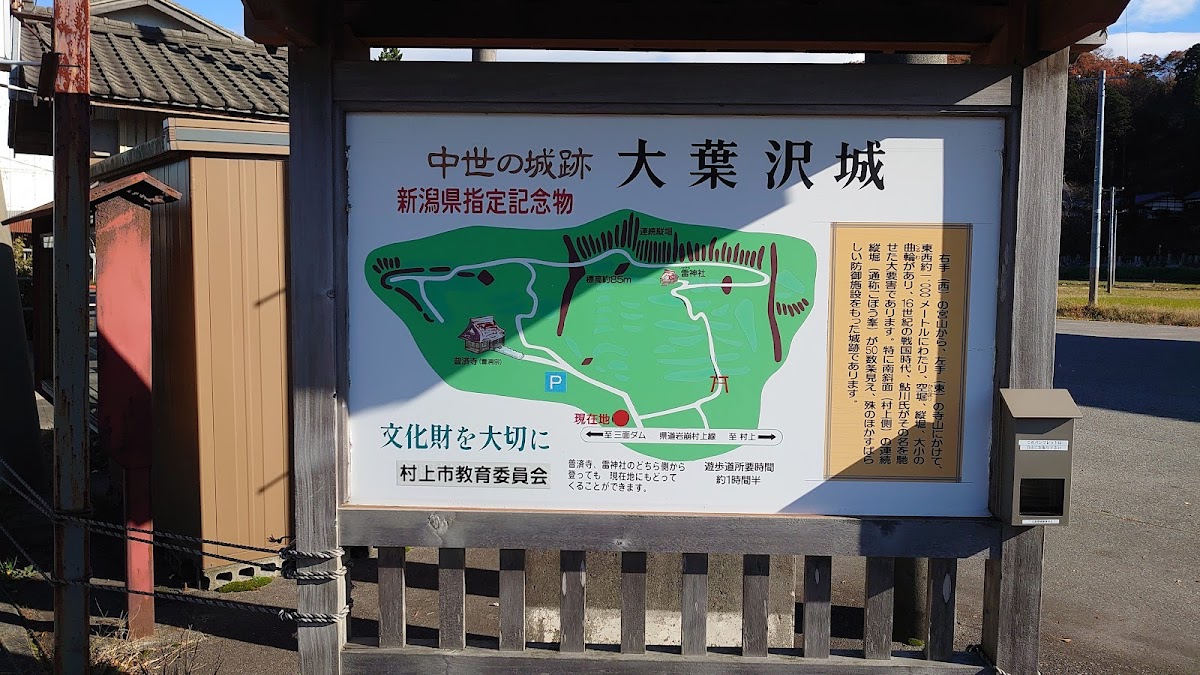
The most distinctive feature of Obasawa Castle is its castle grounds, which are divided into two mountains: Miyayama (elevation 86m) to the west and Terayama (elevation 94m) to the east. Located on the tip of a hill south of the Obasawa settlement in Murakami City, the two mountains are separated by a deep moat.
Terayama currently houses Fusaiji Temple, and a group of baileys centered around the main enclosure. Meanwhile, Miyayama is home to Ikazuchi Shrine, and also contains several baileys. This two-mountain structure ensured a vast defensive area and allowed for mutual support between the two mountains.
Ridge-shaped Vertical Moat System: An Impressive Defensive Structure with Over 50 Lines
The greatest highlight of Oobasawa Castle is the ridge-shaped vertical moat system remaining on Miyayama Hill. Also known as ridge-shaped obstructions, this defensive structure consists of countless vertical moats dug continuously into the slope to hinder enemy advances. On the south side alone, facing Murakami Castle (the Honjo clan’s residence), there are over 50 lines, boasting an overwhelming scale.
Ridge-shaped vertical moat systems are a defensive technique that developed in the late Sengoku period, effectively obstructing enemy lateral movement and disrupting attacks. The ridge-shaped vertical moats at Oobasawa Castle are remarkably well-preserved and can be clearly observed on-site. Such a large-scale system of ridge-shaped vertical moats is rare even within Echigo Province, making this a highly valuable historical site for castle research.
Arrangement of Enclosures, Earthworks, and Moats
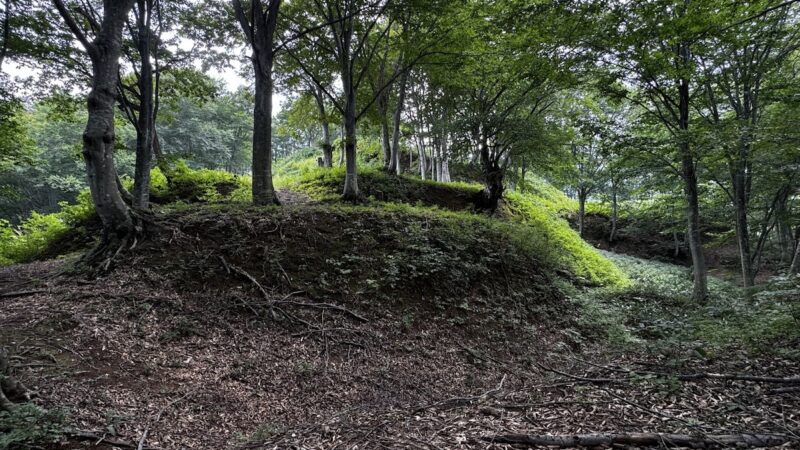
The entire castle area features multiple enclosures arranged in a stepped pattern, each surrounded by earthworks. The earthworks around the main enclosure are particularly high, serving as a crucial defensive feature.
The moat separating Terayama and Miyayama is deeply excavated, forming an important defensive line restricting movement between the two mountains. Furthermore, moats strategically placed throughout the castle area limit enemy incursion routes, creating a strategic advantage for the defenders.
Gobo Peak and Surrounding Topography
To the north of the castle area lies a point called Gobo Peak, from which the castle’s defensive line extends. Oobazawa Castle is a typical Sengoku period mountain castle, skillfully utilizing natural terrain while combining it with artificial defensive structures.
Highlights of Oobasawa Castle: Must-See Points for Castle Enthusiasts
1. The Impressive Group of Ridge-Shaped Vertical Moats
The greatest highlight is undoubtedly the group of ridge-shaped vertical moats. The more than 50 vertical moats spread across the southern slope of Miyayama are truly awe-inspiring in their scale and presence when seen in person. Each moat remains clearly visible, showcasing the advanced civil engineering techniques of the Sengoku period.
2. Dividing Two Mountains by a Moat
The moat separating Terayama and Miyayama is impressive in both depth and width. Viewing the baileys on both sides of this moat makes it easier to understand the overall structure of the castle.
3. Earthworks and Baileys Around the Main Enclosure
Around the main enclosure of Terayama, high earthworks and multiple baileys remain in excellent condition. The elevation differences of the baileys and the height of the earthworks allow one to imagine the scale of the castle at that time.
4. Fusaiji Temple and Raijin Shrine
Fusaiji Temple and Raijin Shrine, located within the castle grounds, are spots where you can feel the historical atmosphere. Fusaiji Temple, in particular, is located near the main enclosure of Terayama and is an ideal resting point during your exploration of the castle ruins.
5. View towards Murakami Castle
From the castle ruins, you can see towards Murakami Castle (the residence of the Honjo clan), allowing you to appreciate the relative positions of the two castles. Standing on-site will help you understand why the ridged trenches are concentrated towards Murakami Castle.
Access and Visiting Guide
Access by Car
From Murakami Castle, head north on National Route 7, then east on Prefectural Road 205. You will see a sign for the Oobazawa Castle Ruins. The sign is located at the Oobazawa Community Center, where there is a parking lot. Heading towards the community center is the easiest route.
- Location: Terayama, Obasawa, Murakami City, Niigata Prefecture
- Parking: Parking available at Obasawa Community Center
- Visiting Hours: Flexible (however, daylight hours before sunset are recommended)
- Admission Fee: Free
Access by Public Transportation
The nearest station is Murakami Station on the JR Uetsu Main Line, but the castle ruins are quite a distance away, so taking a taxi from the station is the most practical option. Alternatively, renting a car at Murakami Station is also a good idea.
Points to Note During Your Visit
- As this is a mountain castle, comfortable clothing and shoes are essential. You will be walking on slopes, especially when viewing the ridged trenches.
- Insect repellent and drinking water are recommended.
- While there are information boards, checking the castle layout map beforehand will deepen your understanding.
- Visiting may be difficult in winter due to snow. Spring to autumn is the best time to visit.
Nearby Tourist Attractions
Murakami Castle
If you visit Oobazawa Castle, be sure to also visit Murakami Castle. It was the residence of the Honjo clan and has a historical background of confronting Oobazawa Castle. It’s a mountain castle with remaining stone walls, and the view from the castle tower is magnificent.
Murakami City
Murakami City is known as the town of salmon, and its charm lies in its townscape that retains the atmosphere of a castle town. Samurai residences and merchant houses are scattered throughout, and there are many restaurants where you can enjoy salmon dishes.
Other Castles in Niigata Prefecture
Niigata Prefecture has many famous castles, including Kasugayama Castle (the residence of Uesugi Kenshin), Shibata Castle, and Takada Castle. Those interested in the Sengoku period history of Echigo will gain a deeper understanding by visiting these castles as well.
Cultural Property Designation and Preservation Status of Obazawa Castle
Obazawa Castle ruins are designated as a historic site of Niigata Prefecture and are appropriately managed by the local preservation society and the board of education. In recent years, it has gained increasing attention among castle enthusiasts and has received high praise on castle information websites such as “Kojodan.”
Most of the castle grounds are in good condition, and the ridged vertical moat system, in particular, is highly regarded as a valuable historical structure nationwide. It is an important cultural property that is expected to continue to be appropriately preserved and utilized in the future.
Significance of Visiting Obazawa Castle
While Obazawa Castle is not as well-known as some famous castles, it is an very important castle for understanding the true nature of local lords during the Sengoku period. The adoption of the advanced defensive technique of the ridged vertical moat system indicates that the Ayukawa clan was not merely a minor lord, but a militarily sophisticated force.
Furthermore, it was the stage for the Honjo Shigenaga Rebellion, an important historical event in Echigo Province, and is a historical site that tells the story of the complex political situation in Echigo Province during the time of Uesugi Kenshin.
For castle enthusiasts, it is a valuable opportunity to observe the well-preserved ridged trenches up close and is an ideal place to learn about the castle-building techniques of the Sengoku period.
Summary: Visiting Hidden Gem Castles of Echigo
Obazawa Castle in Murakami City, Niigata Prefecture, is a Sengoku period mountain castle built by the Ayukawa clan. It is a prefectural historical site with magnificent remains, including over 50 ridged trenches, moats, and earthworks. It is a castle with many attractions, including its two-mountain structure (Terayama and Miyayama), its historical role in the Honjo Shigenaga Rebellion, and its place in the Sengoku history of Echigo Province.
Access is convenient by car; you won’t get lost if you aim for the Obazawa Community Center. Since it is a mountain castle, comfortable walking attire is essential, but it is a historical site well worth visiting for any castle enthusiast. While you’re sightseeing in Murakami Castle and the town of Murakami, be sure to experience the charm of Oobazawa Castle.
Nestled in the mountains of Echigo, Oobazawa Castle is truly a “hidden gem,” conveying the tension of the Sengoku period and the living testament to the local lords who lived there.