Complete Guide to Sawada Castle (Sado City, Niigata Prefecture): The Ruins of the Honma Clan’s Castle and the Highlights of Myosenji Temple
What is Sawada Castle?
Sawada Castle (Sawada-jo) was a Japanese castle (hilltop castle) located in Uchishinkawa, Takeda, Sawada, Sado City, Niigata Prefecture. Also known as Danpu Castle, Shinkawa Castle, and Takeda Castle, it is known as the residence of the Honma clan, who ruled Sado in the Middle Ages.
A hilltop castle with a relative height of approximately 13 meters, it was not particularly defensible, but it functioned as the largest castle on Sado Island. Currently, the castle ruins are home to Myosenji Temple, an ancient Nichiren Buddhist temple. Within the temple grounds stands a five-story pagoda, the only important cultural property in Niigata Prefecture, and the castle remains such as earthworks and dry moats are well preserved.
History of Zatta Castle
The Honma Clan’s Entry into Sado and the Establishment of Zatta Castle
To understand the history of Zatta Castle, it is necessary to trace the origins of the Honma clan. The Honma clan was a branch of the Yokoyama clan and Ebina clan of Sagami Province, and were samurai retainers whose ancestral home was Echi-go, Aiko District (present-day Atsugi City, Kanagawa Prefecture).
In the Jokyu War of 1221, when Hojo Tokifusa, the third son of Hojo Tokimasa and the founder of the Obutsu family, gained control of Sado Island, the Honma, Tsuchiya, Shibuya, and Aihara clans, who were his retainers, entered Sado as local administrators. The Honma clan entered Sado as the deputy governor of the Obutsu clan, who became the governor of Sado Province, and expanded their power from their base in Zatta-go.
Construction of Zatta Castle during the Sengoku Period
The construction of Zatta Castle is thought to have taken place during the Eisho era (1504-1521), or around the first half of the 16th century. During this period, the Honma clan boasted the greatest power within Sado Island, effectively controlling most of the island from their base at Zatta Castle.
The castle consisted of three baileys, with subsidiary castles such as Okawa Castle to the southeast and Kokubu Castle to the southwest, separated by a ravine, forming a fortified network that defended the entire Zatta region. This arrangement indicates that the Honma clan was not merely a local powerful family, but a Sengoku-period daimyo-like entity governing all of Sado.
Uesugi Kagekatsu’s Invasion of Sado and the Castle’s Demise
In 1589 (Tensho 17), Uesugi Kagekatsu of Echigo invaded Sado. The Honma clan resisted, but were defeated by the overwhelming military power of the Uesugi army, and Zatta Castle fell. This marked the end of the Honma clan’s rule over Sado, which had continued since the Middle Ages.
After the castle was abandoned, the castle grounds were given to Myōsenji Temple by Naoe Kanetsugu, a chief retainer of the Uesugi family. This measure is thought to have had strategic significance, rather than being merely a donation to a temple. By converting the castle ruins into a religious facility, the aim was to prevent it from becoming a resistance base for the former Honma clan, while simultaneously securing a spiritual center for the local residents.
Structure and Layout of Sōta Castle
Basic Structure of the Castle
Sōta Castle was a flatland castle with three baileys, centered around the current Myōsenji Temple grounds. It had a linear layout with the main bailey, second bailey, and third bailey connected in a series, each bailey demarcated by earthworks and dry moats.
It was a large-scale castle for an island on Sado Island, and its structure shows strong influence from mainland castles of the Sengoku period. This is also evidence of the close relationship between the Honma clan and mainland powers such as the Echigo Honma clan.
Existing Remains
Currently, the following castle remains can be confirmed within the grounds of Myosenji Temple:
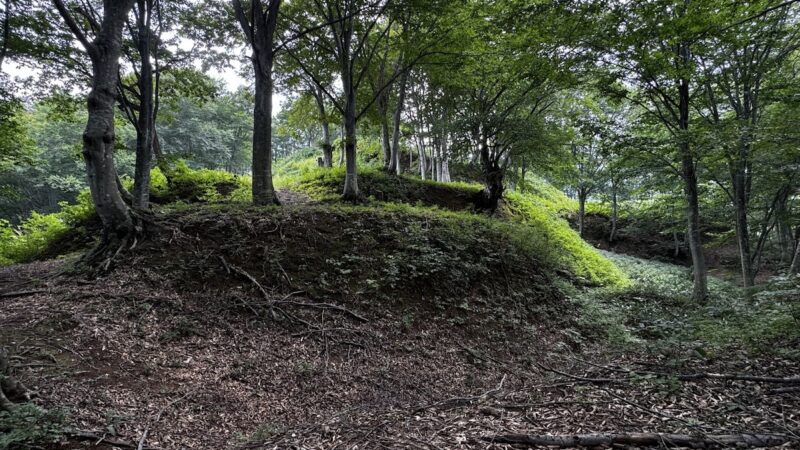
Earthworks: Traces of earthworks remain in various places within the temple grounds, with a particularly clear earthwork remaining behind the main hall. It is approximately 2-3 meters high, conveying the appearance of the defensive facilities at the time.
Dry Moats: Traces of dry moats remain on the east and south sides of the temple grounds. Although partially filled in, the shape and size of the moat bottom suggest that it was a considerably deep moat.
Enclosure Site: The grounds of Myosenji Temple itself are thought to be the site of the main enclosure, and the flat terrain evokes the appearance of the enclosure in its heyday.
Myosenji Temple and the Five-Storied Pagoda
History of Myosenji Temple
Myosenji Temple is a Nichiren Buddhist temple built on the site of the former Sōta Castle. After being granted the castle grounds by Naoe Kanetsugu, it was developed as a temple and has functioned as an important religious facility in Sado to this day.
Within the temple grounds stand the main hall, the priest’s quarters, and the five-story pagoda, the only important cultural property in Niigata Prefecture, creating a unique landscape where the castle ruins and temple are integrated.
Niigata Prefecture’s Only Five-Story Pagoda
The five-story pagoda of Myosenji Temple is the only five-story pagoda in Niigata Prefecture and is designated as a national important cultural property. Built in 1828 (Bunsei 11) during the late Edo period, it stands approximately 24 meters tall.
The architectural style is based on the Japanese style, and the details are adorned with intricate carvings. It is noteworthy that, despite being located on the remote island of Sado, it incorporates superior architectural techniques from the mainland. The five-story pagoda, as a symbol of the castle ruins and a building representing the history of Sado, attracts many worshippers and tourists.
Highlights of Zatta Castle
Observation Points for Castle Ruins
When visiting Zatta Castle, paying attention to the following points will help you understand the castle’s history more deeply:
Observation of Earthworks: The earthworks behind the main hall are the best-preserved and a valuable spot to observe the earthwork structure of the Sengoku period. You can glean insights into the castle construction techniques of the time from the height, width, and slope angle of the earthworks.
Traces of Dry Moats: Parts of the dry moat on the east side of the temple grounds remain clearly visible, allowing you to experience the scale of the dry moat as a defensive structure by walking along its bottom.
Layout of Enclosures: By surveying the entire temple grounds, you can imagine the layout of the three enclosures and the functional division of each enclosure. The structure, connecting the main enclosure to the second and third enclosures, can be understood as a typical example of a connected-enclosure castle.
Photo Spots
Zōta Castle Ruins offer numerous photo opportunities:
Collaboration of the Five-Storied Pagoda and Earthen Embankment: Photographing the earthen embankment with the five-storied pagoda in the background from within the temple grounds captures a unique landscape where the castle ruins and temple blend seamlessly. Spring cherry blossom season and autumn foliage season are particularly ideal times for photography.
Inside the Dry Moat: A view looking up from the bottom of the dry moat conveys the impressive defensive structure of the moat.
View from the Temple Grounds: Although Zōta Castle is a hilltop castle, it offers panoramic views of the surrounding rural landscape, evoking the former territory of the Honma clan.
Related Historical Sites in the Surrounding Area
Zōta Motoshiro (Danpū Castle)
This castle is considered the predecessor of Zōta Castle and is also known as Danpū Castle. It is thought to have been the Honma clan’s base before Zōta Castle was built and is located north of Zōta Castle. While the remains are not as well-preserved as those of Zatta Castle, it is an important historical site for understanding the changes in the Honma clan’s castle network.
Okawa Castle
Located southeast of Zatta Castle, across a ravine, this is a subsidiary castle. It played a key role in Zatta Castle’s defense line and was an important base in the Honma clan’s castle network.
Kokubu Castle
Located southwest of Zatta Castle, this subsidiary castle, along with Okawa Castle, served as an outer defense for Zatta Castle. The arrangement of these subsidiary castles indicates that the Honma clan exercised organized territorial control.
Grave of Hino Suketomo
Within the grounds of Myosenji Temple lies the grave of Hino Suketomo, a court noble from the late Kamakura period. Hino Suketomo served as a close confidant of Emperor Go-Daigo, but was exiled to Sado Island after the Genko War and died there. The fact that the grave of such a key figure in Sado’s history remains at the castle site speaks to the layered history of this area.
Access and Visiting Information
Location
29 Abutsubō, Sado City, Niigata Prefecture 952-1324
Access Methods
From Ryōtsu Port: Approximately 40 minutes by car. Take Prefectural Road 65 towards Sawada.
From Sado Airport: Approximately 30 minutes by car.
Public Transportation: Get off at the “Takedabashi” bus stop on the Niigata Kotsu Sado Bus, then a 5-minute walk. However, bus services are limited, so it is recommended to check the timetable in advance.
Visiting Information
Visiting Hours: While the grounds of Myōsenji Temple are generally open for free viewing, prior contact may be necessary for viewing the interiors of the main hall and the five-story pagoda.
Admission Fee: Viewing the temple grounds is free, but a donation may be required for special viewings such as the five-story pagoda.
Parking: A parking lot for Myōsenji Temple visitors is available (free of charge).
Estimated Visit Time: Approximately 30-45 minutes for a stroll through the temple grounds and observation of the castle ruins. For a more thorough visit, allow about an hour.
Points to Note During Your Visit
- Myosenji Temple is an active temple, so please observe proper etiquette as a visitor.
- Some of the remains, such as earthworks and dry moats, are prone to collapse, so please do not enter restricted areas.
- The ground can be slippery in rainy weather, so we recommend wearing appropriate footwear.
- Photography is permitted, but please be considerate if religious services or other ceremonies are taking place.
Historical Significance of Satsuta Castle
Satsuta Castle holds significant historical importance as a typical example of a medieval castle in the island region of Sado, and as a historical site that tells the story of the rise and fall of the local powerful clan, the Honma clan.
Following the Jōkyū War, the Honma clan entered Sado Island and ruled the island for approximately 350 years. Zōta Castle, which served as their residence, was not merely a military facility but the political, economic, and cultural center of Sado. Although it was abandoned during Uesugi Kagekatsu’s invasion of Sado in 1589, its conversion into Myōsen-ji Temple by Naoe Kanetsugu ensured the excellent preservation of the castle’s topography and remains.
Currently, Zōta Castle ruins are an important cultural property of Sado City, and along with Myōsen-ji Temple, which boasts Niigata Prefecture’s only five-story pagoda, it is a key tourist spot in Sado. It is a must-see historical site not only for castle enthusiasts, but also for history buffs, architecture enthusiasts, and anyone interested in Sado’s culture.
Summary
Zōta Castle (Sado City, Niigata Prefecture) is a valuable historical site that conveys the history of Sado, as it was the residence of the Honma clan who ruled Sado in the medieval period. Currently home to Myōsen-ji Temple, the site boasts a well-preserved five-story pagoda, the only Important Cultural Property in Niigata Prefecture, along with remnants of the castle such as earthworks and dry moats.
The history of the Honma clan, who ruled Sado for approximately 350 years after the Jōkyū War, the invasion of Sado and subsequent abandonment of the castle by Uesugi Kagekatsu in 1589, and its conversion into Myōsen-ji Temple by Naoe Kanetsugu, symbolizes the transition period from the medieval to the early modern era in Japan.
When visiting Sado, be sure to stop by the Sōta Castle ruins, observe the remains of the earthworks and dry moats, appreciate the beauty of the five-story pagoda, and reflect on the historical drama that unfolded here. The unique landscape, a fusion of castle ruins and temple, is a precious cultural heritage unlike any other, and is sure to deeply impress visitors.