A Complete Guide to Agena Gusuku (Okinawa Prefecture): The Famous Ring-Shaped Castle and the History of Agena Okawa Anji
What is Agena Gusuku?
Agena Gusuku is a nationally designated historical site (gusuku) located in Agena, Uruma City, Okinawa Prefecture. Built on a Ryukyu limestone hill 48.73 meters above sea level, this castle ruin is known as an important historical site indispensable to understanding the history of central Okinawa Island.
Located in an area called Kikkohara, southwest of the current Agena Bullfighting Arena, it is a mountain castle that utilizes the entire independent hill, showcasing Ryukyu castle-building techniques that skillfully make use of the natural terrain.
Location and Geographical Characteristics of the Gusuku
Agena Gusuku is located near the center of the former Gushikawa City (now Uruma City), and the surrounding area is known for its thriving bullfighting scene. The Tengan River, which flows north of the castle, is also known as “Ōkawa,” and for this reason, Agena Gusuku was also called “Ōkawa Castle (Ōkawa Gusuku).”
Its location, utilizing an isolated hill of Ryukyu limestone, offered not only defensive advantages but also a strategic position overlooking the surrounding area. While not particularly high in elevation, it provided sufficient visibility for the flat central Okinawa region.
History of Agena Gusuku
Background of Construction and Agena Ōkawa Aji
Agena Gusuku is believed to have been built in the late 14th century, during the turbulent period of the Three Kingdoms era. The builder was Agena Ōkawa Aji, the third son (or possibly fifth son) of Iha Aji.
The Iha Anji were powerful local lords belonging to the Chuzan Kingdom. Their family was granted a fiefdom in the Agena region, leading to the construction of a gusuku (castle) as a base of power in the area. The Agena Okawa Anji, as a powerful regional figure controlling the central part of Okinawa Island, maintained their influence from this castle for three generations.
From the Three Kingdoms Period to the Unification of the Ryukyu Kingdom
From the 15th to the 16th centuries, Okinawa went through the Three Kingdoms Period, where three powers—Hokuzan, Chuzan, and Nanzan— vied for supremacy. In 1429, it was unified by Sho Hashi, establishing the Ryukyu Kingdom. During this turbulent period, Agena Gusuku functioned as an important branch castle of the Chuzan Kingdom.
Tradition holds that a large-scale renovation was carried out by Agena Okawa Anji in 1453, and much of the castle wall visible today is thought to have been constructed during this period.
The Fall of the Castle and its Aftermath
As the Ryukyu Kingdom became increasingly centralized, the power of the local lords (Anji) gradually diminished. Agena Gusuku was no exception; with the strengthening of the Shuri royal government’s control, it eventually lost its military function.
While there are no clear records of the castle’s fall, it is estimated to have been abandoned by the mid-16th century. Since then, the castle ruins have been protected by the local people as a sacred and historical site.
Structure and Characteristics of Agena Gusuku
A Rare Concentric-Style Castle in Okinawa
The most distinctive feature of Agena Gusuku is its concentric layout. While most Okinawan castles are of the renkaku-shiki (multiple interconnected enclosures), Agena Gusuku employs a concentric layout with the outer walls surrounding the main enclosure, a structure extremely rare even within Okinawa Prefecture.
This style features a double wall protecting the central main enclosure, with the outer and inner walls positioned along the hillside terrain.
Composition of the Main and Outer Enclosures
The main enclosure (shukaku) is located at the highest point of the hill and is believed to have housed the residence of the lord and important facilities. The walls surrounding the main enclosure are built using a technique called nozurazumi (rough stone masonry) with Ryukyu limestone, characterized by powerful stonework that utilizes the natural shapes of the stones.
The outer enclosure is positioned to surround the main enclosure and is a wall designed to defend a wider area. This double structure is designed to prevent enemy incursions in stages.
Azana (Watchtower)
On the northeast side of the castle is a raised area called the azana (watchtower). The Azana is a common feature found in Okinawan gusuku (castles), serving as an important military facility for monitoring the surrounding area and understanding enemy movements.
From the Azana of Agena Gusuku, one can still enjoy a panoramic view of the surrounding landscape, allowing one to imagine how the local lords of the time surveyed their territories from this vantage point.
Castle Gate and Stonework Techniques
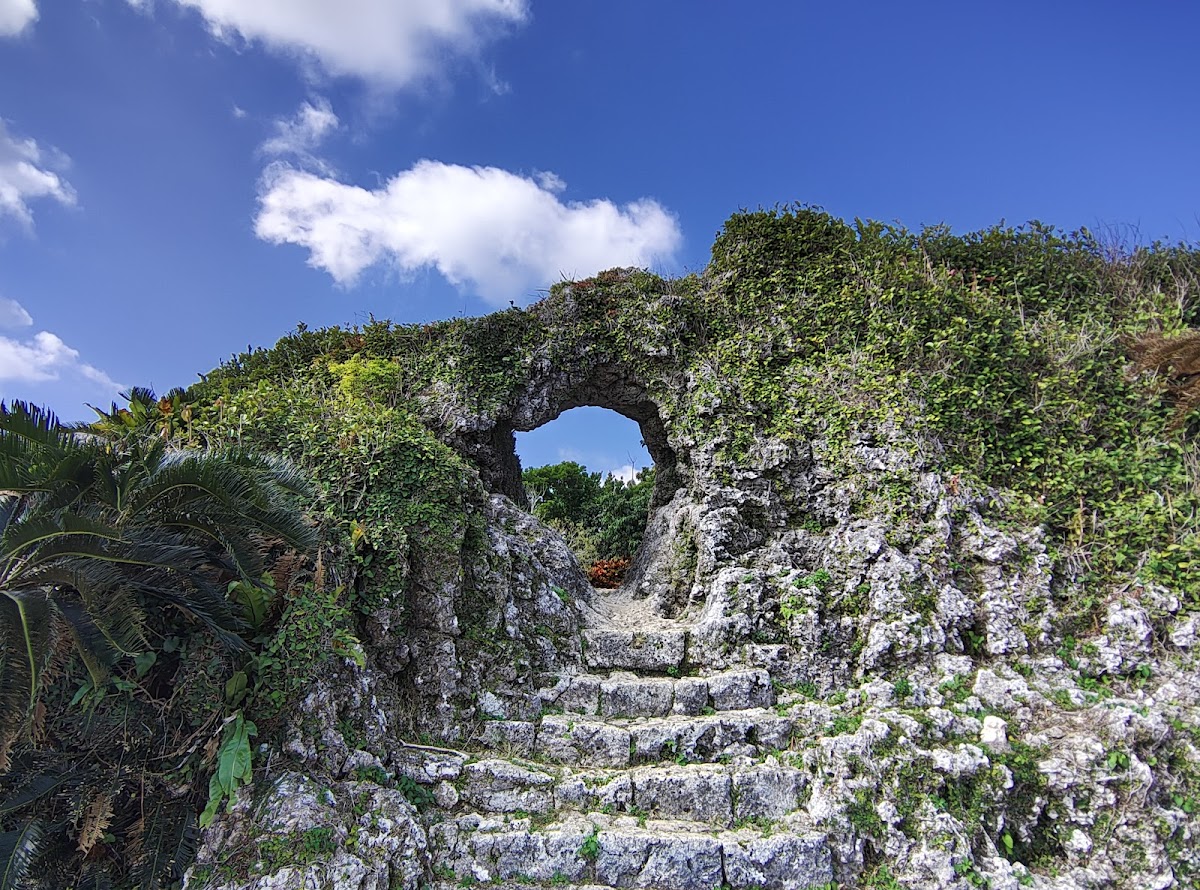
The castle gate served as the entrance to the main enclosure, and traces of the stonework gate structure remain. Unlike the large turret gates of castles on the mainland, Okinawan gusuku gates are generally simple gates built into openings in the stone walls.
The stonework at Agena Gusuku primarily utilizes the natural shape of Ryukyu limestone, employing the nozura-zumi (rough stone masonry) technique, but some areas also show the use of processed stonework (nunozumi). These stonework techniques share characteristics with other famous gusuku of the same period, such as Nakagusuku Gusuku and Zakimi Gusuku, while simultaneously creating a unique atmosphere specific to Agena Gusuku.
Skillful Utilization of Natural Terrain
Agena Gusuku is a mountain castle that makes maximum use of natural cliffs and steep slopes. The Ryukyu limestone hills originally had rugged cliff faces, and by utilizing these as part of the outer walls, it simultaneously achieved the conservation of stone materials and improved defensive capabilities.
This “fusion of nature and artificiality” is a characteristic of Ryukyu castle-building philosophy, and is a manifestation of a rational design philosophy that maximizes effectiveness with limited resources.
Value as a National Historic Site
Agena Gusuku was designated a national historic site on May 15, 1972 (Showa 47), the same day as Okinawa’s return to Japan. This designation recognized the following historical and academic value of Agena Gusuku:
Historical Value
- Political and military center of the central region from the Sanzan period to the founding of the Ryukyu Kingdom
- Center of regional rule as the residence of three generations of the Agena Okawa Anji
- An important site for understanding the power and life of local Anji of Ryukyu
Architectural Historical Value
- A gusuku with a rare concentric layout in Okinawa
- An excellent example of stonework techniques using Ryukyu limestone
- A typical example of castle construction techniques that utilize natural terrain
Preservation as a Cultural Property
As a nationally designated historic site, Agena Gusuku receives legal protection and is properly preserved and managed. Maintenance such as repairing the castle walls and mowing grass is continuously carried out through the cooperation of the Uruma City Board of Education and local residents.
Highlights of Agena Gusuku
The Curvature of the Castle Walls
The most impressive thing when visiting Agena Gusuku is the beautiful curves of the castle walls. Unlike the straight stone walls of castles on the mainland, the walls of Ryukyuan gusuku (castles) feature elegant curves that follow the terrain.
These curves are not merely decorative; they are also a design feature that enhances structural strength. By distributing force through the curved surface, the walls become more resistant to natural disasters such as earthquakes and typhoons.
Diversity of Stonework
As you explore the castle grounds, you can observe different stonework techniques depending on the location. Diverse techniques such as rough-hewn stonework, layered stonework, and sections utilizing the natural bedrock coexist within a single gusuku.
This reflects differences in construction periods and the history of restoration, and can be considered a trace that tells the long history of Agena Gusuku.
Views and Atmosphere
The views from the main enclosure and the azana (a secondary area) are still magnificent today. You can see the cityscape of Uruma, the Pacific Ocean, and on clear days, even the distant mountains.
The entire castle ruins are enveloped in a quiet and peaceful atmosphere, making it the perfect environment for a stroll while imagining the lives of the people who once lived here. Because it hasn’t been overly commercialized, you can slowly reflect on history.
Visitor Guide: Access and Visiting Information
Access Methods
Access by Car
- Approximately 40km from Naha Airport, about 50 minutes by car
- Approximately 15 minutes from Okinawa Kita IC on the Okinawa Expressway
- Accessible via Prefectural Road 36 from National Route 329
- Search for “Akena Gusuku” or “Akena Bullfighting Arena” in your car navigation system
Public Transportation
- Route Bus: Get off at the “Akena” bus stop (Ryukyu Bus/Okinawa Bus), about 10 minutes on foot
- Taxi: About 5 minutes from the center of Uruma City
Parking and Facility Information
There is no large dedicated parking lot for Akena Gusuku, but you may be able to use the nearby Akena Bullfighting Arena parking lot. However, be aware that it can get crowded on bullfighting days. Please avoid parking on the street and be considerate of local residents.
Visiting Hours
- Open all day (free admission)
- Recommended visiting hours: Daytime (9:00 AM – 5:00 PM)
- Estimated time required: 30 minutes to 1 hour
Notes
- There are no toilet facilities, so it is recommended to use the restroom beforehand.
- In summer, the sun is strong, so bring a hat, sunscreen, and drinks.
- Wear comfortable shoes as there are uneven areas.
- Be careful as the limestone becomes slippery in rainy weather.
- Beware of venomous snakes (do not approach the grassy areas).
Nearby Tourist Attractions
There are other sights to see around Agena Gusuku.
Katsuren Castle Ruins
- A World Heritage Site located about 15 minutes away by car.
- A famous castle that served as the residence of Amawari.
- Recommended to visit together with Agena Gusuku.
Kaichu Road
- A representative tourist spot in Uruma City.
- About 20 minutes by car from Agena Gusuku.
Bullfighting Arena
- You can watch bullfighting, a traditional Okinawan cultural practice.
- Check the dates in advance.
Comparison with Other Gusuku
Differences from World Heritage Gusuku
Okinawa has five gusuku (castles) registered as World Heritage Sites under the name “Gusuku Sites and Related Properties of the Kingdom of Ryukyu” (Shuri Castle, Nakijin Castle, Zakimi Castle, Katsuren Castle, and Nakagusuku Castle). Agena Gusuku is not included in these World Heritage Sites, but it has its own unique value.
Comparison with Nakagusuku Gusuku
Nakagusuku Gusuku is a representative example of a renkukaku-style gusuku, with multiple baileys arranged in a stepped fashion. On the other hand, Agena Gusuku is a concentric castle with walls surrounding the central area in a circular pattern, a significant difference from other castles.
Comparison with Zakimi Gusuku
Zakimi Gusuku was built by Gosamaru, a renowned castle builder, and is known for its sophisticated stonework. Agena Gusuku’s stonework gives a simpler, more powerful impression, strongly retaining the characteristics of a local lord’s castle.
Characteristics as a Local Gusuku
Agena Gusuku is neither a royal castle like Shuri Castle nor a large-scale gusuku designated as a World Heritage Site. However, precisely because of this, it is a valuable historical site that allows us to approach the true nature of a local lord.
Without extravagant decoration, it is a simple and robust structure that emphasizes practicality and defense. This is a crucial element that conveys the reality of local powers during the Three Kingdoms period.
Preservation and Future of Agena Gusuku
Current Preservation Status
Agena Gusuku is a nationally designated historical site, and its preservation and management are primarily handled by the Uruma City Board of Education. Regular mowing, inspection of stone walls, and repair of collapsed areas are carried out, maintaining its good condition.
In recent years, progress has been made in installing information boards and explanatory panels, creating an environment that is easier for visitors to understand.
Community Involvement
The local Agena district cherishes the gusuku as a source of local pride. It is used as a place for local history learning and cultural property preservation activities, and is also utilized for local history education for children.
Future Challenges and Prospects
Future challenges for Agena Gusuku include the following:
- Increasing awareness among tourists
- Improving access (e.g., parking facilities)
- Enhancing explanatory facilities
- Utilizing digital technology for information dissemination
On the other hand, it is also important to avoid excessive commercialization and maintain a quiet and peaceful atmosphere. The challenge lies in balancing the historical value of the site with the convenience of visitors, while promoting sustainable preservation and utilization.
Summary: The Charm of Agena Gusuku
Agena Gusuku is an important historical site indispensable to understanding the history of central Okinawa Island. From the Three Kingdoms period to the establishment of the Ryukyu Kingdom, it served as the residence of the Agena Okawa Anji, who ruled this area, and was the political and military center of the region.
The unique concentric layout, the skillful use of natural terrain in its construction, and the beautifully curved walls made of Ryukyu limestone—all of these are part of Agena Gusuku’s unique charm.
While it may be smaller in scale compared to World Heritage gusuku, it is well worth visiting as a valuable place to experience the reality of a local Anji and as a space to quietly contemplate history.
When visiting Uruma City, be sure to visit Agena Gusuku and experience the depth of Ryukyu history and culture. The view from the top of the hill, 48 meters above sea level, is a continuation of the landscape that the local lords saw 600 years ago.