Complete Guide to Kumejima Gushikawa Gusuku (Okinawa Prefecture): A Stunning Ancient Castle Ruins Surrounded by the Sea
What is Kumejima Gushikawa Gusuku?
Kumejima Gushikawa Gusuku is a castle ruin located in Nakamurakyo, Kumejima Town, Shimajiri District, Okinawa Prefecture, built in the early 15th century. Built on an isolated hill of Ryukyu limestone jutting out into the East China Sea, it functioned as a natural fortress surrounded by cliffs on three sides. Designated a national historic site in 1975, it is preserved as a representative historical heritage of Kumejima.
This gusuku shares the same name as Gushikawa Gusuku in Itoman City, southern Okinawa Island, but Kumejima’s Gushikawa Gusuku is a separate castle with its own unique history and characteristics. With its stunning ocean views and valuable cultural assets that preserve the stonework techniques of the Ryukyu Kingdom era, it attracts many history enthusiasts and tourists.
History: From Madafutsu Anji to the Fall of the Castle
Background of the Castle’s Construction
Kumejima’s Gushikawa Gusuku is said to have been built in the early 15th century by Madafutsu Anji. Anji were powerful local lords who ruled various regions before the unification of the Ryukyu Kingdom, and Madafutsu Anji was a powerful Anji who ruled the northern part of Kumejima.
During the Gusuku period (12th to 15th/16th centuries), Anji were scattered throughout Kumejima, each establishing their own sphere of influence. Gushikawa Gusuku was strategically located at a key point for maritime traffic and is thought to have functioned as a trading hub across the East China Sea.
The Era of Makanekui Anji and the Fall of the Castle
Makanekui Anji was succeeded by his son, Makanekui Anji. However, during the time of Maganeko Anji, Gushikawa Gusuku fell to an attack by Manikutaru Anji.
Following this fall, Maganeko Anji is said to have fled Kumejima and escaped to the southern part of Okinawa Island. According to legend, he built a castle of the same name, Gushikawa Gusuku, near Cape Kyan on Okinawa Island, which is considered the origin of the current Gushikawa Gusuku in Itoman City. This legend is an interesting example illustrating the historical connection between Kumejima and Okinawa Island.
After the Unification of the Ryukyu Kingdom
In the mid-15th century, when the Ryukyu Kingdom was unified by King Sho Hashi, Kumejima also came under the kingdom’s rule. The independence of the local Anji was lost, and Gushikawa Gusuku lost its military function and was abandoned.
However, the descendants of the Gushikawa castle lords did not completely disappear. The Uezu family, a prominent family on Kumejima Island, is said to be descended from the former lords of Gushikawa Castle. During the Ryukyu Kingdom era, they maintained the status of a samurai (Pechin) and served for generations as Jitodai, the administrative heads of Magiri districts.
Structure: A Natural Fortress Surrounded by the Sea on Three Sides
Location and Topography
The most distinctive feature of Kumejima’s Gushikawa Gusuku lies in its location. Built on an isolated hill of Ryukyu limestone jutting out into the East China Sea north of the Nakamurakuri settlement, it is surrounded by steep cliffs on three sides (east, west, and north), except for the south.
At an elevation of approximately 30 meters, the blue East China Sea stretches out below, and on clear days, the horizon is visible. This terrain presented extremely difficult conditions for attackers, making it a natural fortress with virtually no way to attack other than from the land on the south side.
Stone Walls and Stone-Masonry Techniques
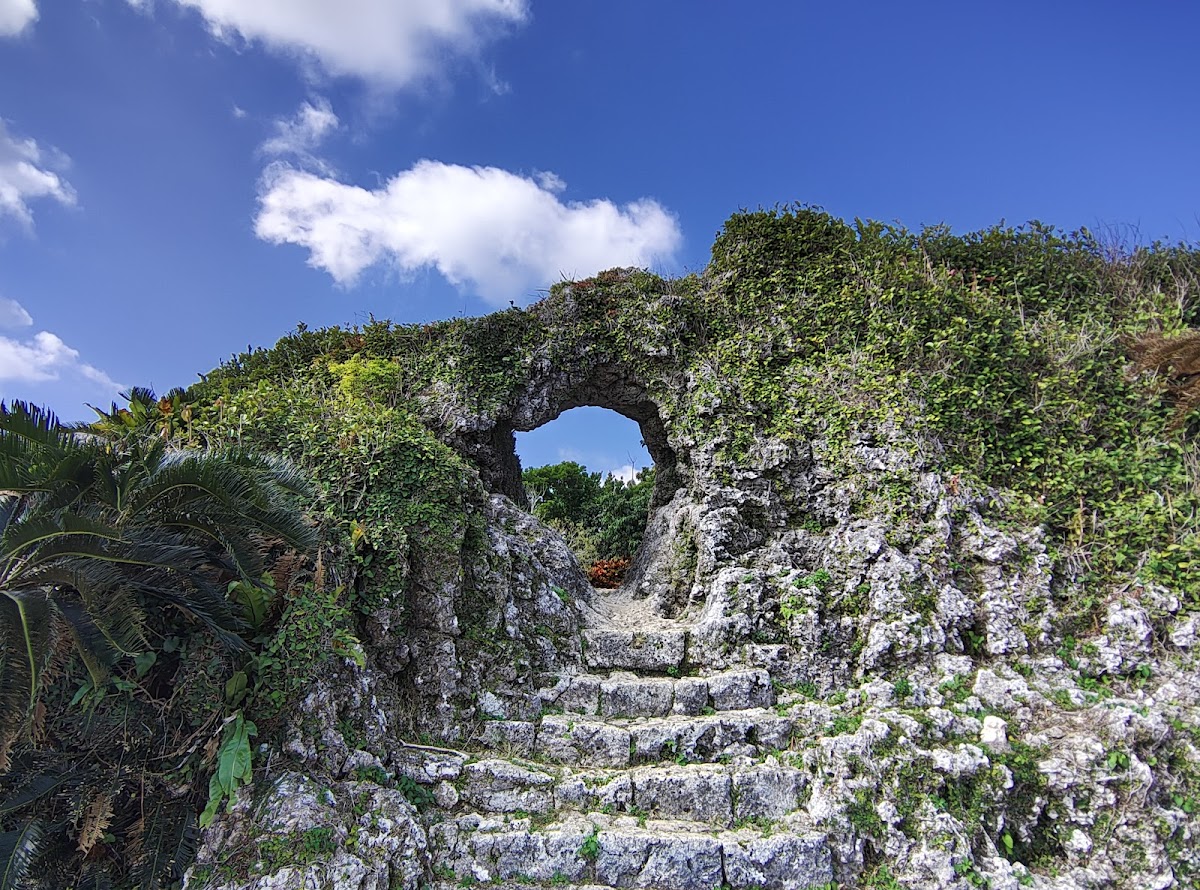
The stone walls of Gushikawa Gusuku are constructed using a technique called “nozurazumi” (rough-stone masonry) with Ryukyu limestone. Nozurazumi is a method of stacking natural stones in their almost-as-is form, a technique commonly seen in 15th-century Ryukyu gusuku (castles).
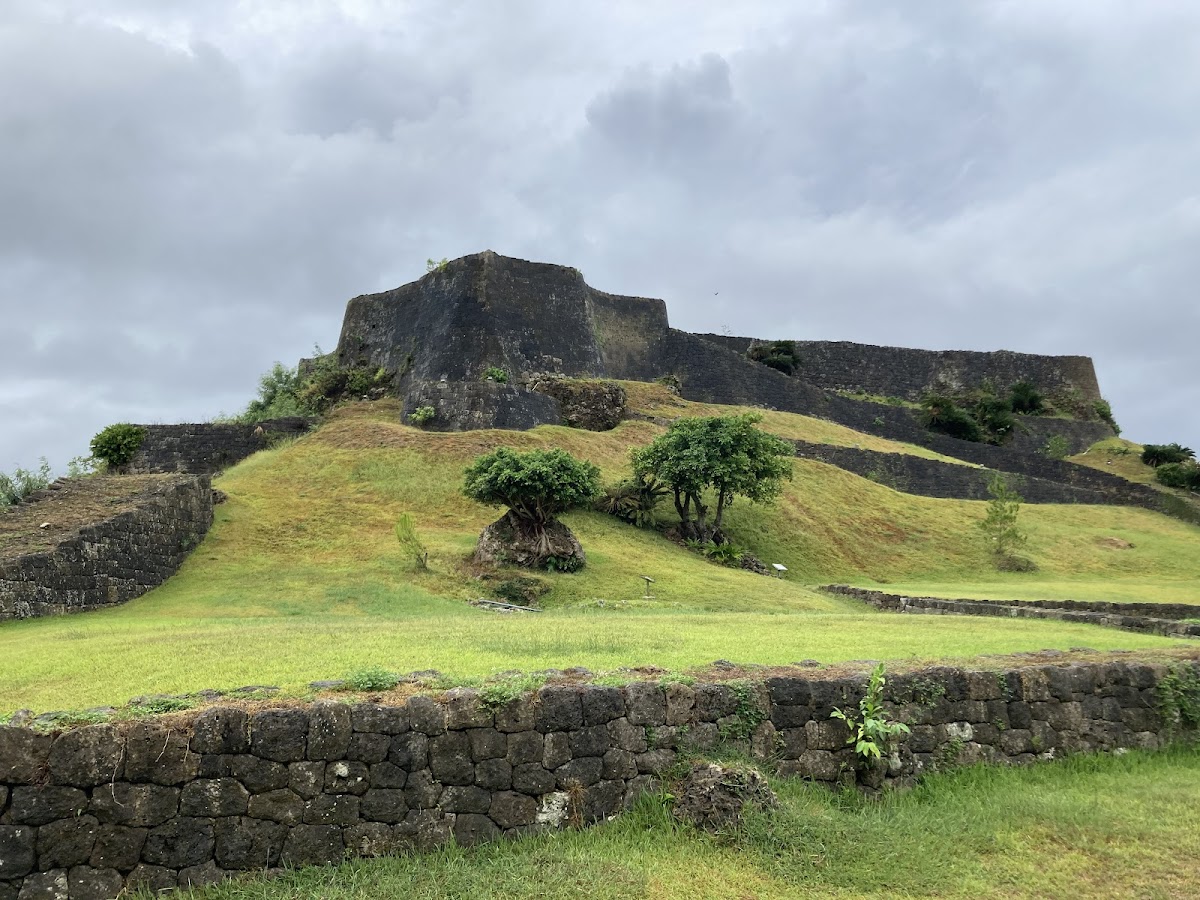
The outer perimeter is surrounded by stone walls, and the interior is divided into four sections (enclosures) by these walls. These stone walls remain in relatively good condition even after more than 500 years, demonstrating the high level of stone-masonry technology of the time.
The height of the stone walls varies depending on the location, but the highest point is about 3 meters, indicating that they effectively served their function as a defensive structure. The whitish color characteristic of Ryukyu limestone creates a unique beauty against the backdrop of the blue sea and sky.
Internal Sectional Structure
The interior of Gushikawa Gusuku is divided into four sections by stone walls. While there are no clear records regarding the specific uses of each enclosure, based on the general structure of gusuku (Kumamoto castles), it is believed that they were used in the following ways:
First Enclosure (Main Enclosure): This was the most important section, presumably containing the residence of the lord and buildings for administrative affairs.
Second Enclosure: This may have contained living quarters for retainers and warehouses.
Third Enclosure: This is thought to have contained military facilities such as soldiers’ quarters and armories.
Fourth Enclosure: This may have functioned as an auxiliary facility or an emergency refuge.
Each enclosure was separated by stone walls but connected by passageways, allowing for movement within the castle.
Evidence of Trade from Excavated Artifacts
Excavations at Gushikawa Gusuku have yielded artifacts such as Chinese celadon and white porcelain, and Southeast Asian ceramics. These artifacts are important evidence that Kumejima in the 15th century was part of a wide-area trade network across the East China Sea.
The Ryukyu Kingdom prospered through transit trade with China, Japan, Korea, and Southeast Asian countries, and Kumejima Island is believed to have been an important port of call along these trade routes. The Gushikawa Anji (lord) likely expanded his power based on the profits gained from this maritime trade.
Highlights: Points to Visit
Spectacular Views
The greatest attraction of Gushikawa Gusuku is undoubtedly its spectacular views. The panoramic view of the East China Sea from the cliff surrounded by the sea on three sides is breathtaking, and on clear days, the horizon can be seen in its entirety.
The view at sunset is particularly exceptional; the sight of the setting sun painting the sky and sea red captivates visitors. It is also a popular spot for photography, attracting many camera enthusiasts.
Well-Preserved Stone Walls
It is astonishing that the stone walls, built over 500 years ago, remain in such good condition. The sight of the white Ryukyu limestone stones piled up is beautiful, and you can truly appreciate the high level of stonework techniques of the time.
Upon close observation of the stone walls, you can see that there are almost no gaps between the stones, indicating that they were stacked with great precision. This was a measure to withstand earthquakes and typhoons, and is proof of the outstanding skill of the Ryukyu stonemasons.
A Tranquil Atmosphere
Compared to the major gusuku (castles) on Okinawa Island, Gushikawa Gusuku has fewer tourists, making it a place where you can quietly feel the history. In this tranquil environment where only the sound of the sea breeze and waves can be heard, you can reflect on the lives of the lords and people who once lived here.
The Surrounding Natural Environment
The area around the gusuku is a rich natural environment with lush subtropical plants. Ryukyu pines and various wildflowers display different expressions throughout the seasons, making it enjoyable for nature walks. Furthermore, the coast below the cliffs has high transparency, and you can see beautiful coral reefs.
Access Information
How to Get to Kumejima
By Plane:
- Approximately 30 minutes from Naha Airport to Kumejima Airport
- Japan Transocean Air (JTA) operates several flights daily
By Ferry:
- Approximately 3-4 hours by Kume Shosen ferry from Tomari Port in Naha
- 1-2 departures daily (varies seasonally)
From Kumejima Airport/Port to Gushikawa Gusuku
Rental Car:
- Approximately 20 minutes by car from Kumejima Airport
- Approximately 25 minutes by car from Kanegusuku Port in Kumejima
- Parking: Several parking spaces available near the castle
Taxi:
- Approximately 20-25 minutes by taxi from the airport or port
- Approximately 2,500-3,000 yen one way
Local Bus:
- Kumejima Town operates a bus service, but the number of services is limited, so using a rental car or taxi is recommended
Location
432 and 477-1 Nakamurakubo, Kumejima-cho, Shimajiri-gun, Okinawa 901-3124, Japan
Visitor Guide: Points to Note When Visiting
Visiting Hours and Admission Fee
- Visiting Hours: Open 24 hours (however, daytime visits are recommended)
- Admission Fee: Free
- Estimated Time Required: Approximately 30-40 minutes for a thorough visit
Clothing and Items to Bring
- Footwear: Comfortable sneakers or athletic shoes are essential (you will be walking on cobblestones and uneven terrain)
- Clothing: Comfortable clothing, sun protection (hat, long sleeves, etc.)
- Items to Bring: Drinking water, sunscreen, insect repellent spray
- Camera: Don’t forget your camera or smartphone for capturing stunning photos
Safety Precautions
- Since three sides are cliffs, please be careful not to approach the edge of the cliffs.
- Extra caution is needed on windy days.
- Please be careful of your footing, as the cobblestones become slippery in rainy weather.
- If you are visiting with small children, please be sure to hold their hands while sightseeing.
Best Time to Visit
- Spring (March-May): Mild weather, ideal for sightseeing.
- Summer (June-August): Strong sunshine, so early morning or evening visits are recommended.
- Autumn (September-November): Typhoon season, but comfortable if the weather is good.
- Winter (December-February): Often windy, but fewer tourists, allowing for a quiet visit.
Nearby Tourist Attractions
Uejo Gusuku
This gusuku (castle) is located at the highest elevation on Kumejima Island, offering a spectacular panoramic view of the entire island. Many tourists visit it in conjunction with Gushikawa Gusuku, which is about a 15-minute drive away.
Uezu Family Residence
The residence of the Uezu family, descendants of the lords of Gushikawa Castle, is designated as a National Important Cultural Property. This is a valuable building that allows us to learn about the lifestyle of the samurai class during the Ryukyu Kingdom era, and it’s about a 10-minute drive from Gushikawa Gusuku.
Hiyajō Banta
This scenic spot offers a panoramic view of the East China Sea from a cliff approximately 200 meters high. It offers a different perspective of the sea than Gushikawa Gusuku and is about a 5-minute drive away.
Mifuga
This uniquely shaped rock is known as a power spot for praying for fertility and is considered a symbol of femininity. It’s about a 15-minute drive from Gushikawa Gusuku.
Eef Beach
This is one of Kumejima’s most beautiful beaches and has been selected as one of Japan’s Top 100 Beaches. You can enjoy swimming after visiting the gusuku.
History and Culture of Kumejima
Kumejima in the Gusuku Era
Besides Gushikawa Gusuku, Kumejima had several other gusuku, including Uejō Gusuku and Tōbunaha Gusuku. These structures were built by local lords (Anji) between the 12th and 15th centuries, remnants of a time when Kumejima was divided among multiple powers.
Ryukyu Kingdom Era
After being integrated into the Ryukyu Kingdom, Kumejima was positioned as an important outlying island of the kingdom. In the context of tributary relations with China, Kumejima was an important port of call on the shipping routes and also became known as a production center for Kumejima Tsumugi, a high-quality textile.
Modern Era
With the abolition of the feudal domains and establishment of prefectures during the Meiji era, Kumejima became part of Okinawa Prefecture. While it was affected by the Battle of Okinawa during World War II, it did not experience the same level of intense fighting as the main island. After the war, following its return to Japan, the island has developed as a center of tourism and agriculture.
Cultural Value of Kumejima Gushikawa Gusuku
Importance as a National Historic Site
Designated a national historic site in 1975, Gushikawa Gusuku is one of the important archaeological sites representing the Ryukyu Gusuku culture. Although not included in the “Gusuku Sites and Related Properties of the Ryukyu Kingdom,” a UNESCO World Heritage Site, it possesses comparable historical and cultural value.
Research Value of Stone Masonry Techniques
As a valuable example of 15th-century Ryukyu stone masonry techniques, it is a subject of research in architectural history and archaeology. Many researchers are investigating techniques such as the “nozurazumi” (rough-stone masonry) method and the processing and transportation methods of Ryukyu limestone.
Important Materials for Trade History Research
The excavated ceramics from China and Southeast Asia are important materials for studying the trade network in the East Asian maritime region in the 15th century. They provide clues to understanding the role Kumejima played in the Ryukyu Kingdom’s trade.
Preservation and Utilization Efforts
Cultural Property Protection Activities
The Kumejima Town Board of Education is leading efforts to preserve and utilize Gushikawa Gusuku. Regular grass cutting, inspections of the stone walls, and the installation of information boards are carried out, creating an environment where visitors can safely view the site.
Collaboration with the Local Community
Residents of the local Nakamurakuchi settlement also cooperate in the preservation of the gusuku (castle). They take pride in it as a local historical heritage site and continue their efforts to pass on the value of the gusuku to future generations through activities such as cleaning and guiding.
Utilization as a Tourism Resource
Kumejima Town positions Gushikawa Gusuku as an important tourist resource for the island and is focusing on developing tourist routes and disseminating information. They are also proposing tourist plans that combine it with other historical sites and natural landscapes on the island.
Summary: The Charm of Kumejima Gushikawa Gusuku
Kumejima Gushikawa Gusuku is a valuable historical heritage site remaining on an outlying island of Okinawa Prefecture. It boasts many attractions, including its spectacular location surrounded by the sea on three sides, stone walls that still showcase 15th-century stonework techniques, and a turbulent history beginning with the Shindatsubotsu Anji (lord).
Compared to the gusuku sites of the World Heritage Site, it attracts fewer tourists, making it a great place to quietly experience history. When you visit Kumejima, be sure to stop by this beautiful gusuku (castle) and reflect on the era in which the Anji (lords) of the Ryukyu Kingdom lived.
Feeling the sea breeze, touching the stone walls that are over 500 years old, and gazing at the magnificent view of the East China Sea will surely create an unforgettable memory. Kumejima Gushikawa Gusuku is truly an “ancient castle floating on the sea,” where Okinawan history and nature are fused together.