Toragaoka Castle (Misato Town, Saitama Prefecture) Complete Guide | History, Remains, Access, and Highlights Explained in Detail
What is Toragaoka Castle?
Toragaoka Castle is a mountain castle built on a 337m-high mountain (on the ridge extending east from Jinmiyama) spanning Enryoda, Misato Town, Kodama District, Saitama Prefecture, and Yanase, Nagatoro Town, Chichibu District. It is also known as Tsuburata Castle or Enda Castle Mountain, and is affectionately called “Castle Mountain” by locals.
Located at a strategic point on the left bank of the Arakawa River, this castle is believed to have functioned as a branch castle of Hachigata Castle, an important base of the Hojo clan during the Sengoku period, playing a role in food supply and defense. Even today, the remains of the baileys, earthworks, and moats are well-preserved, making it a worthwhile spot for castle enthusiasts and history buffs.
As it is a mountain castle with a relative elevation of approximately 200m, climbing to the castle requires a certain level of physical strength. However, it is also known as a habitat for dogtooth violets in spring, making it an attractive place where you can enjoy both nature and history.
History of Toragaoka Castle
Construction Period and Builder
There are several theories regarding the construction period of Toragaoka Castle, but the following two theories are the most widely accepted:
The Muromachi Period Construction Theory suggests that it was built by the Fujita clan as a branch castle of Hanazono Castle. The Fujita clan was a powerful warlord in northern Musashi Province and had several castles in this region.
The Sengoku Period Construction Theory suggests that it was built by Inomata Koheita Noritsuna as a branch castle of Hojo Ujikuni’s Hachigata Castle. This theory is currently more widely supported.
Role during the Sengoku Period
During the Sengoku period, Toragaoka Castle was part of the network of branch castles of Hojo Ujikuni, whose base was Hachigata Castle. Inomata Castle was located approximately 1.8 km to the east, and Hanazono Castle approximately 2.3 km to the southeast. It is believed that these castles worked in conjunction to form a defensive line along the Arakawa River basin.
The castle’s main roles were as follows:
- Supply Base: A supply base for food and other supplies to Hachigata Castle
- Surveillance Base: Monitored enemy incursions from the left bank of the Arakawa River
- Defense Base: A forward base blocking attack routes to Hachigata Castle
Abandonment and Aftermath
During Toyotomi Hideyoshi’s Odawara campaign in 1590, Hachigata Castle was besieged by the forces of Maeda Toshiie and Uesugi Kagekatsu, and surrendered after approximately one month of siege. At this time, it is believed that Toragaoka Castle, as a subsidiary castle of Hachigata Castle, lost its function and was abandoned.
Afterward, the castle ruins were left neglected throughout the Edo period and returned to nature. Fortunately, however, it escaped large-scale development, and the remains from that time are still well preserved today.
Structure and Layout of Toragaoka Castle
Overall Composition
Toragaoka Castle is a multi-bailey mountain castle built on a ridge extending east and west, centered on the mountaintop at an altitude of 337m. The main components are as follows:
- Eastern Bailey (Third Bailey): Eastern defensive base
- Main Bailey (Honmaru): Central part of the castle
- Second Bailey: Located south of the main bailey
- Western Bailey: Western defensive base
These baileys are separated by moats, creating a structure that prevents enemy intrusion by cutting off the ridge.
Major Remains
Moats
The most impressive remains of Toragaoka Castle are the moats. Well-preserved moats can be observed in the following locations:
- Around the East Enclosure (Third Enclosure): Moats designed to prevent intrusion from the east remain.
- Around the West Enclosure: Particularly well-preserved, deep and wide moats still exist.
The moats were constructed by deeply digging into the ridge, reflecting the technology and labor of the time. Seeing them in person is astonishing in their scale and defensive capabilities.
Enclosures (Kuruwa)
Each enclosure was relatively flat and functioned as a space for buildings and positions. The main enclosure was the largest and is presumed to have housed the castle lord and important facilities.
Earthworks
Traces of earthworks remain in some enclosures. Earthworks were defensive structures built to protect against enemy arrows and firearms, surrounding the enclosures.
Defensive System
The defensive system of Toragaoka Castle made maximum use of the mountain castle’s terrain:
- Defense using elevation difference: The approximately 200m elevation difference from the base of the mountain served as a natural defensive wall.
- Separation by moats: By separating each enclosure with moats, even if one enclosure fell, the next enclosure could still be defended.
- Utilization of ridge lines: By arranging enclosures on a long, narrow ridge, attack routes were limited.
These ingenious features resulted in a castle with strong defensive capabilities despite its small size.
Highlights of Toragaoka Castle
Points to Note When Visiting the Ruins
Here are some points to note when visiting Toragaoka Castle.
Moats around the West Enclosure
This is the best-preserved moat, offering a deep and wide observation. Looking up from the bottom of the moat, you’ll be overwhelmed by the height of the cliffs on both sides. This moat is also a popular spot for photography.
View from the Main Enclosure
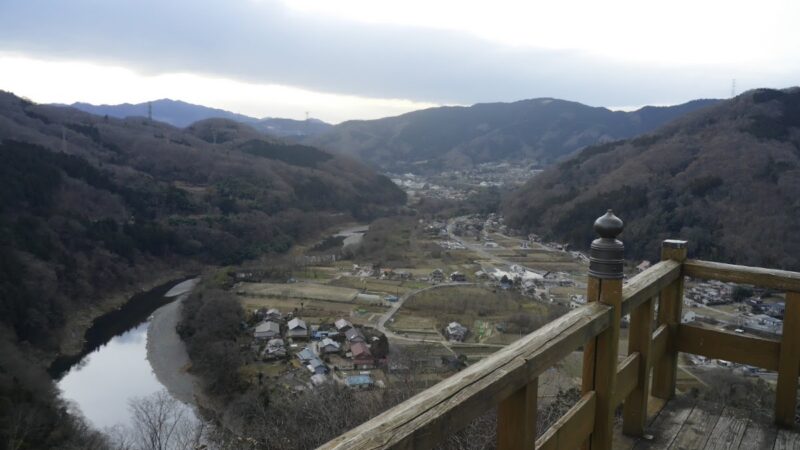
On a clear day, you can enjoy views of the surrounding mountains and the Arakawa River from the main enclosure. The former lord of the castle likely gazed upon this view while watching over the safety of his territory.
Moat of the Eastern Enclosure
The moat, which functioned as a defensive line on the east side, is also impressive. Comparing it to the moat of the western enclosure will provide a better understanding of the castle’s defensive structure.
Dogtooth Violet Colony
One of the major attractions of Toragaoka Castle Ruins is the dogtooth violet colony that blooms in spring. From late March to early April, the area around the hiking trail leading to the castle ruins is covered in a profusion of delicate purple dogtooth violet flowers.
Dogtooth violets are early spring flowers, sometimes called “spring fairies,” and can only be seen during this time. Combining a visit to the castle ruins with viewing the dogtooth violets will make for a more fulfilling visit.
The dogtooth violet colony is about a 5-minute walk from the castle ruins.
Natural Environment
The area around Toragaoka Castle Ruins is blessed with abundant nature. Various trees and wildflowers grow along the hiking trails, displaying different scenery throughout the seasons.
- Spring: Spring flowers, including dogtooth violets
- Summer: Lush green forest bathing
- Autumn: Beautiful autumn foliage
- Winter: Clear air and panoramic views
You can also enjoy birdwatching and nature observation.
Map
Toragaoka Castle is located near the border of Enryoda, Misato-machi, Kodama-gun, Saitama Prefecture and Yanase, Nagatoro-machi, Chichibu-gun, Saitama Prefecture.
Location: Enryoda, Misato-machi, Kodama-gun, Saitama Prefecture / Yanase, Nagatoro-machi, Chichibu-gun, Saitama Prefecture
Coordinates: Approximately 36°07’N, 139°08’E (Summit of Shiroyama Mountain)
The approach to the castle ruins is mainly from the Misato-machi side. The most common route passes through the natural habitat of the dogtooth violet (Erythronium japonicum), and a signpost is installed at the entrance to the hiking trail.
Location relative to major nearby castles:
- Approximately 1.8km to the east: Inomata Castle
- Approximately 2.3km to the southeast: Hanazono Castle
- Northwest direction: Hachigata Castle (somewhat distant)
From the location relative to these castles, it can be understood that Toragaoka Castle was part of a network of subsidiary castles centered around Hachigata Castle.
Access Information
Access by Public Transportation
Nearest Station: Chichibu Railway “Oyahana Station” or “Minano Station”
- Walking from Oyahana Station: Approximately 2.5km (approximately 40 minutes)
- Walking from Minano Station: Approximately 3km (approximately 50 minutes)
It is also included in the “Long Walk Chichibu Road” course organized by Chichibu Railway, and many participants visit during hiking events.
Access by Car
From the Kan-Etsu Expressway:
- Approximately 15km (about 25 minutes) from Hanazono Interchange
Take National Route 254 towards Misato Town. Following the signs for the dogtooth violet habitat will make access easier.
Parking
There is some parking space near the dogtooth violet habitat, but the number of spaces is limited. Especially during the dogtooth violet blooming season (late March to early April), congestion is expected, so please consider using public transportation.
Castle Ascent Route
- Depart from the parking lot or trailhead at the dogtooth violet habitat.
- Pass through the dogtooth violet colony (enjoy viewing during the blooming season).
- Climb the mountain trail for approximately 5-10 minutes.
- Arrive at the castle ruins (visit in the order of East Enclosure → Main Enclosure → West Enclosure).
Estimated Time: Approximately 45 minutes to 1 hour round trip (including time spent viewing the ruins).
Difficulty: Intermediate (As it is a mountain castle with a relative elevation of 200m, a certain level of physical fitness is required).
Notes for Visitors
- Clothing: Please wear appropriate clothing and shoes for hiking.
- Season: Spring, during the dogtooth violet blooming season, is the most recommended time. However, there are many insects in summer, and there is a possibility of snow in winter.
- Drinking Water: There are no vending machines, so please bring your own drinking water.
- Toilets: There are no toilets around the castle ruins, so please use the restroom beforehand.
- Mobile Phones: Due to being in the mountains, signal strength may be unstable.
- Weather: Caution is advised as the ground can become slippery in rainy weather.
Nearby Tourist Attractions
Nearby Castles
When visiting Toragaoka Castle, visiting the surrounding castles will allow you to gain a deeper understanding of the Sengoku period history of this region.
Inomata Castle
Located approximately 1.8 km to the east, Inomata Castle, like Toragaoka Castle, functioned as a branch castle of Hachigata Castle. It is believed to have been the residence of Inomata Koheita Noritsuna, and a connection with Toragaoka Castle is thought to have existed.
Hanazono Castle
Located approximately 2.3 km to the southeast, Hanazono Castle is considered one of the strongholds of the Fujita clan. There is also a theory that Toragaoka Castle was built as a branch castle of Hanazono Castle, making the relationship between the two castles quite intriguing.
Hachigata Castle
Hachigata Castle, the stronghold of Hojo Ujikuni, is a nationally designated historical site and an important castle selected as one of Japan’s Top 100 Castles. Currently, it is maintained as Hachigata Castle Park, and a history museum is also located there. As the center of the group of subsidiary castles including Toragaoka Castle, it is a must-see spot.
Other Tourist Spots
Nagatoro Gorge
The Nagatoro Gorge, created by the clear waters of the Arakawa River, is a scenic spot designated as a national scenic spot and natural monument. You can enjoy river rafting and walking along the rock formations.
Mt. Hodosan
Mt. Hodosan, the symbol of Nagatoro Town, can be reached by ropeway, and from the summit you can enjoy a panoramic view of the Chichibu Mountains.
History and Culture of Misato Town
Misato Town also has many other historical temples, shrines, and cultural properties scattered throughout, making it a suitable area for leisurely strolls.
Toragaoka Castle Ratings and Reviews
Ratings from Castle Enthusiasts
According to data from Kojodan, the average rating for Toragaoka Castle is ★★★☆☆ (2.75). With relatively few visitors (72 people), it’s considered a hidden gem of a castle known only to a select few.
Points of Evaluation:
- The ruins are well-preserved.
- The scale of the moat is impressive.
- Particularly charming during the season of dogtooth violets.
- Access is somewhat inconvenient.
- Low visitor numbers due to low recognition.
Estimated Visit Time
The general visit time is about 45 minutes, but if you want to carefully observe the ruins or enjoy the dogtooth violets, you should allow at least an hour.
Visitor Feedback
- “The preservation of the moat is superb, and I was able to truly experience the appearance of a mountain castle from the Sengoku period.”
- “I visited during the season of dogtooth violets, and I was very satisfied to enjoy both the flowers and the castle ruins.”
- “The hiking trail is a little steep, but it’s well worth seeing the remains.”
- “It’s nice that there are few people, allowing you to quietly enjoy the castle ruins.”
Research and Materials on Toragaoka Castle
Historical Materials
Historical materials concerning Toragaoka Castle are limited, but information can be obtained from the following materials:
- ‘Shinpen Musashi Fudoki-ko’: A local history compiled in the late Edo period, which includes a description of the castle ruins in the section on Enryoda Village.
- ‘Musashi no Kuni Gunsonshi’: A local history from the Meiji era.
- Local Traditions: Oral traditions remaining in Misato Town and Nagatoro Town.
Archaeological Excavations
Currently, no large-scale archaeological excavations appear to have been conducted. Future investigations are expected to reveal the construction period and detailed structure of the castle. ### Related Books
Reference books for learning about Toragaoka Castle:
- “Ancient Castle Sites of Saitama” series
- “Comprehensive Survey of Japanese Castles” Vol. 5 (Saitama/Tokyo)
- “Castles of Musashi” (Matsuyama Shobo)
- Historical materials published by local governments
These books provide detailed explanations not only of Toragaoka Castle but also of surrounding castles, making them useful for understanding the region’s Sengoku period history.
Tips for Enjoying Toragaoka Castle
Best Season
Spring (late March to early April) is highly recommended. The dogtooth violet flowers are in full bloom, allowing you to enjoy both nature and history. However, since visitor numbers increase during this time, it’s best to visit earlier in the day.
Autumn (October to November) is also suitable for visiting the castle due to the beautiful autumn foliage and stable weather.
Photography Tips
- Moat: Shooting from the side emphasizes its depth.
- Erythronium: Beautiful when the morning light shines through.
- View: Wide-angle lenses are effective for capturing the view from the main enclosure.
Castle Tour Planning
Starting from Toragaoka Castle, you can create a one-day course visiting surrounding castles:
Morning: Toragaoka Castle (including viewing the Erythronium)
Lunch: Lunch in Nagatoro
Afternoon: Inomata Castle or Hachigata Castle
This route allows you to see firsthand the relationships between the subsidiary castles centered around Hachigata Castle.
Event Information
Toragaoka Castle is sometimes included in hiking events such as the “Long Walk Chichibu Road” organized by Chichibu Railway. Guided tours are available, making it recommended for first-time visitors.
Summary
Toragaoka Castle (Enryoda Castle) is a Sengoku period mountain castle built on a 337m-high mountain in Misato Town, Saitama Prefecture. Playing an important role as a subsidiary castle of Hachigata Castle, its remains, including moats, baileys, and earthworks, are still well-preserved, making it a worthwhile spot for castle enthusiasts.
Especially during the spring when the dogtooth violets bloom, visitors can enjoy both the beautiful flowers, known as “spring fairies,” and the historical ruins, creating a fascinating place where nature and history blend seamlessly.
Access is somewhat inconvenient, requiring a 200m elevation gain climb, but this makes it a hidden gem where you can quietly appreciate the castle ruins. Visiting it along with nearby Inomata Castle, Hanazono Castle, and the main castle, Hachigata Castle, will provide a deeper understanding of the Sengoku period history of this region.
For history buffs, castle enthusiasts, hiking lovers, and nature lovers, Toragaoka Castle is a wonderful spot well worth visiting. Why not visit this hidden gem of a castle sometime?