Sarukake Castle (Okayama Prefecture) Complete Guide: The Full Picture of a Mountain Castle with a 400-Year History as a Strategic Point in Bitchu
What is Sarukake Castle?
Sarukake Castle is a medieval mountain castle built on Mount Sarukake, approximately 240 meters above sea level, located on the border between Imoto, Mabi-cho, Kurashiki City, Okayama Prefecture, and Yokotani, Yakage-cho, Oda-gun. Situated on the border between Shimomichi-gun and Oda-gun in Bitchu Province, it served as a strategically important location overlooking the old Sanyo Road and the Oda River, playing a central role in regional governance for approximately 400 years, from the mid-Kamakura period to the early Edo period.
Currently, the Kurashiki City side is designated as a city-designated historical site, and the Yakage-cho side is designated as a town-designated historical site, recognizing its historical value as a representative medieval mountain castle of the Bitchu region. It is a multi-bailey mountain castle that utilizes the steep terrain with a relative height of approximately 220 meters, and played a crucial role in controlling a vital transportation hub as an important point on the Sanyo Road.
History of Sarukake Castle
Kamakura Period: The Beginning of Castle Construction and Rule by the Sho Clan
The exact date of construction of Sarukake Castle is uncertain, but it is generally believed to have been built in the early Nanboku-cho period by Sho Sukemasa. The Sho clan originated from the Kodama clan of Musashi Province and, due to their achievements in the Genpei War, were granted the position of jitō (land steward) of Hota-go (Hoida-go) in Bitchu Province and moved down to the province.
The first Sho Taro Ienaga initially based himself at Koyama Castle, but it is said that during Sukemasa’s time, a new castle was built on Sarukakeyama, a location of greater strategic value, and the base was moved there. The Sho clan, who ruled Hota-go, sometimes used the place name “Hota” or “Hoida,” and became a powerful local clan deeply rooted in the region.
The Sho clan used Sarukake Castle as their base from the Kamakura period through the Muromachi period, maintaining their power as a powerful local lord in western Bitchu Province. Sarukake Castle was strategically located on the Sanyo Road, a vital transportation route, and served as the economic base and military source of the Sho clan.
Sengoku Period: The Rise of the Mimura Clan and the Turmoil in Bitchu
With the arrival of the Sengoku period, the Bitchu region became a stage for fierce power struggles. During the Eiroku era (1558-1570), it came under the control of the Mimura clan, a powerful Sengoku daimyo of Bitchu. The Mimura clan, based at Bitchu Matsuyama Castle, expanded their power throughout Bitchu, and Sarukake Castle was positioned as an important branch castle of the Mimura clan.
During the time of Mimura Motochika, the Mimura clan initially had an alliance with Mori Motonari, but gradually began to draw closer to Oda Nobunaga. This shift in diplomatic policy would eventually drastically change the fate of the Mimura clan.
The Tensho Rebellion: The Bitchu Rebellion and the Mori Clan’s Invasion
In 1575 (Tensho 3), relations between the Mimura and Mori clans deteriorated drastically, leading to the so-called “Bitchu Rebellion.” Mori Terumoto, who succeeded Mori Motonari, launched an attack on the Mimura clan, and Sarukake Castle became entangled in the fighting.
During the Mori clan’s conquest of the Mimura clan, Sarukake Castle increased in importance as a frontline base. The Mori army successively captured Mimura-controlled castles throughout Bitchu Province, ultimately capturing Bitchu Matsuyama Castle, the Mimura clan’s stronghold. In this battle, Mimura Motochika committed suicide, and the Mimura clan was destroyed.
After the Bitchu Rebellion, Sarukake Castle came under the control of the Mori clan and functioned as an important base for the Mori clan’s rule of Bitchu Province. A Mori vassal was appointed as the lord of Sarukake Castle, and it was maintained as a base for monitoring the Sanyo Road and controlling the region.
Hashiba Hideyoshi’s Invasion of the Chugoku Region and Sarukake Castle
In 1582, Hashiba Hideyoshi (later Toyotomi Hideyoshi), acting on orders from Oda Nobunaga, launched a full-scale invasion of the Chugoku region. Hideyoshi launched the Chugoku campaign, known for the water siege of Takamatsu Castle in Bitchu Province, and confronted the Mori clan.
During this period, Sarukake Castle is believed to have functioned as an important military base for the Mori clan. It was located near the area where Hideyoshi’s headquarters were situated, making it a strategically important location on the front lines of the Chugoku campaign. After Nobunaga’s death in the Honnoji Incident, Hideyoshi made peace with the Mori clan, ending the Chugoku campaign.
The Battle of Sekigahara and the Castle’s Demolition
Even under the Toyotomi regime, Sarukake Castle remained under the control of the Mori clan. However, the Battle of Sekigahara in 1600 determined the castle’s fate. Mori Terumoto participated as the commander-in-chief of the Western Army, but was defeated by the Eastern Army’s victory. After the war, the Mori clan’s territory was drastically reduced to just two provinces, Suo and Nagato (the two provinces of Suo and Nagato), and they lost their vast lands in the Chugoku region, including Bitchu. The area around Sarukake Castle became shogunate territory (tenryo), and Sarukake Castle, having ceased to function as a military base during the Sengoku period, was abandoned. Thus, the history of Sarukake Castle, spanning approximately 400 years, came to an end.
Structure and Layout of Sarukake Castle
Location and Topography as a Mountain Castle
Sarukake Castle is a multi-bailey mountain castle built around the summit of Mount Sarukake, at an altitude of approximately 240 meters. It makes maximum use of the steep terrain with a relative height of approximately 220 meters, and its layout skillfully incorporates natural fortifications.
The most distinctive feature of this mountain castle is its location overlooking two important transportation routes: the old Sanyo Road and the Oda River. The Sanyo Road was the most important main road connecting western Japan and the Kinai region from ancient times to the early modern period, and the Oda River was used for water transport of goods. The location of Sarukake Castle, which allowed for simultaneous monitoring and control of both, was truly worthy of being called a strategic stronghold in Bitchu Province.
Major Remains and Enclosure Layout
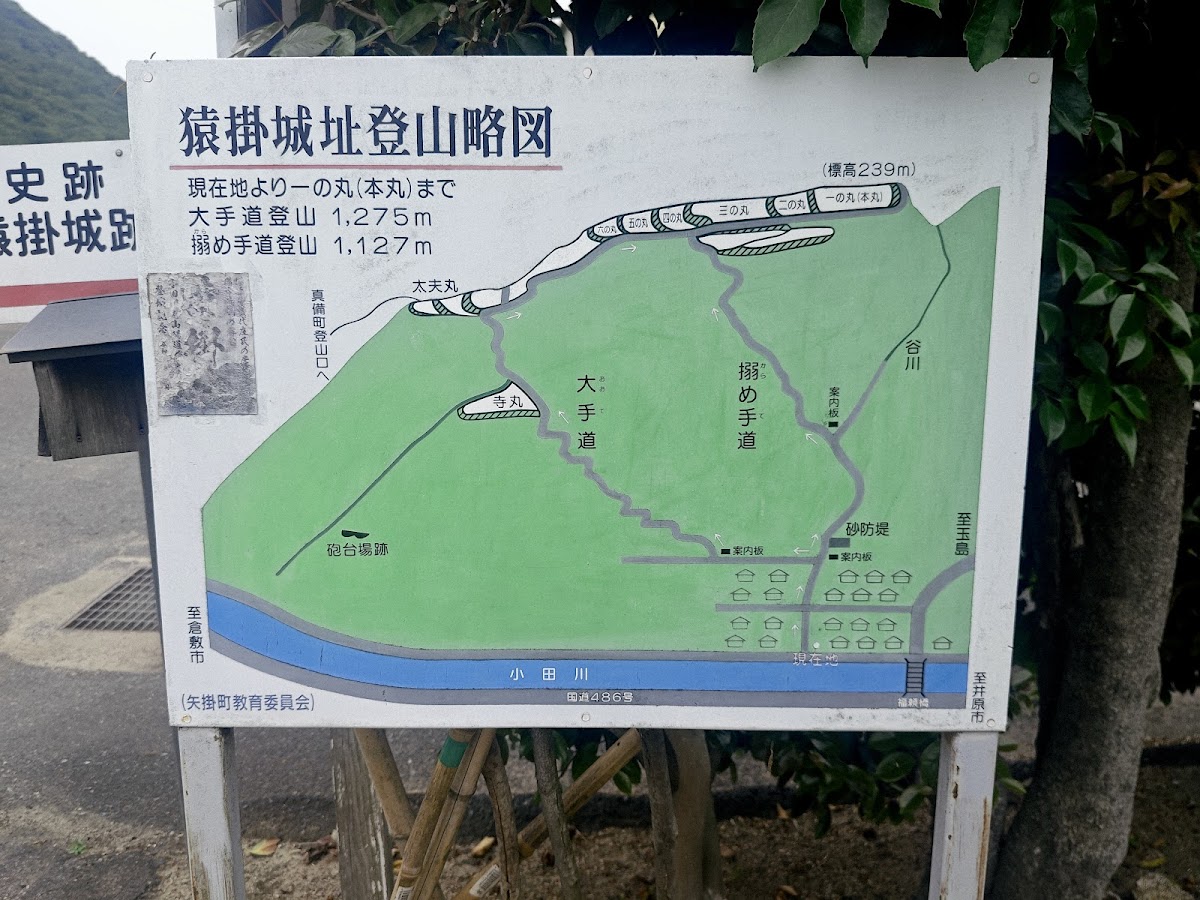
Sarukake Castle’s layout is a series of interconnected enclosures, with the main enclosure at the mountaintop as the center. Even today, the flat areas of the main enclosure, second enclosure, and third enclosure are clearly visible, preserving the typical structure of a medieval mountain castle.
The main enclosure is located at the mountaintop and is presumed to have housed the lord’s residence and command post. Earthen ramparts surrounded it, enhancing its defensive capabilities. Multiple enclosures are arranged along the ridge from the main enclosure, each functioning as an independent defensive unit.
Defensive Structures: Earthen Ramp, Moat, and Vertical Ditch
Sarukake Castle retains numerous defensive structures characteristic of medieval mountain castles. Of particular note are the earthen ramparts, built around the baileys and at key locations, which served to prevent enemy intrusion and functioned as defensive walls protecting the interior of the baileys.
The trenches that cut across the ridges were also important defensive structures. By artificially cutting off the ridges that could serve as enemy intrusion routes, trenches made attacks difficult. Multiple trenches have been identified at Sarukake Castle, demonstrating a multi-layered defensive strategy.
Furthermore, vertical trenches dug into the slopes have also been confirmed. Vertical trenches restrict the movement of enemies climbing the slopes and make lateral movement difficult. The combination of these defensive structures made Sarukake Castle a formidable mountain castle.
Ascent Routes and Entrances
Currently, multiple ascent routes to Sarukake Castle have been identified, but it is unclear which route was the main approach during the medieval period. The ascent routes, utilizing the steep terrain, were difficult for attackers and thus served as defensive structures themselves.
The koguchi (gateway) is the most important defensive feature of a castle. It is believed that the entrances to each enclosure at Sarukake Castle were cleverly designed to prevent easy intrusion.
Highlights of Sarukake Castle
View from the Main Enclosure
The greatest highlight of Sarukake Castle is the view from the main enclosure. The scenery overlooking the 240-meter-high mountaintop is breathtaking, with the Oda River flowing below and the Bitchu Plain stretching out in the distance. On a clear day, you can even see the Seto Inland Sea, allowing you to imagine the view the former lords had as they surveyed their territory from this spot.
The route of the old Sanyo Road can also be seen, making this an excellent point to appreciate the strategic importance of why the castle was built in this location.
Well-Preserved Earthworks
Among the remains of Sarukake Castle, the earthworks are particularly well-preserved. The earthworks remaining around the main enclosure and each of the baileys retain much of their original form from the time of construction, making them valuable resources for learning about the defensive techniques of medieval mountain castles.
By observing the height and width of the earthworks and their positional relationship with the baileys, one can decipher the construction techniques and defensive philosophies of the time. These are must-see remains for castle enthusiasts.
Clearly Defined Baileys
At Sarukake Castle, multiple baileys remain clearly defined, making it an excellent resource for understanding the structure of a multi-bailey mountain castle. By observing the size, arrangement, and elevation differences of each bailey, one can grasp the overall layout of the castle.
In particular, the arrangement from the main enclosure to the second and third baileys demonstrates the multi-layered nature of the defenses and speaks to the high level of construction technology that made maximum use of the limited mountaintop terrain.
Moats and Vertical Ditches
The remaining moats and vertical ditches, which serve as defensive structures, should not be overlooked. The moats that cut across the ridges, in particular, convey the immense effort required for their construction at the time, given their size and depth. The vertical moats remain on the slope and are somewhat difficult to find, but if you can discover them, you will be impressed by the skillful defensive techniques of this medieval mountain castle.
Harmony with Nature
The current Sarukake Castle ruins are surrounded by abundant nature, displaying different expressions in each of the four seasons. The fresh greenery in spring and the autumn foliage are beautiful, allowing you to enjoy nature walks along with exploring the castle ruins. It is a charming spot where historical romance and the beauty of nature harmonize.
Access and Visiting Information
Location
Address: Imoto, Mabi-cho, Kurashiki City, Okayama Prefecture / Yokotani, Yakage-cho, Oda-gun (Sarukakeyama)
Sarukake Castle is located on the border between Kurashiki City and Yakage-cho, making it accessible from both cities and towns.
Access by Car
Via Sanyo Expressway:
- Approximately 15 minutes from Sanyo Expressway “Kamogata IC”
- Approximately 20 minutes from Sanyo Expressway “Tamashima IC”
There is some parking space near the trailhead to Sarukake Castle Ruins, but it is limited, so please be careful when visiting. We recommend using public transportation whenever possible.
Access by Public Transportation
Using JR:
- Get off at JR Hakubi Line “Kiyone Station,” then take a taxi or walk to the trailhead (approximately 40 minutes on foot).
- Get off at Ibara Railway “Kawabe-juku Station,” then walk to the trailhead (approximately 30 minutes).
Using Bus:
- Take an Ikasa Bus Company bus from Kurashiki city, then walk from the nearest bus stop.
Ascent Time and Estimated Time Required
Ascent Time: Approximately 40-60 minutes from the trailhead to the main enclosure.
Sightseeing Time: Approximately 1 hour 30 minutes to 2 hours, including sightseeing around the main enclosure.
As this is a full-fledged mountain castle with a relative elevation of 220 meters, a certain level of physical fitness and mountaineering equipment is necessary. Especially in summer, be sure to stay well-hydrated and plan your trip carefully.
Notes for Visitors
- Clothing: Appropriate clothing and shoes for mountaineering are essential. Please wear sneakers or trekking shoes.
- What to Bring: Please prepare drinking water, a towel, insect repellent (in summer), and rain gear.
- Season: Spring and autumn are the best seasons to visit. In summer, be careful of the heat and insects, and in winter, the sun sets early, so please allow plenty of time.
- Safety: Avoid visiting alone; it is recommended to visit in groups whenever possible.
- Manners: Please respect the historical site and be careful not to damage the remains. Please be sure to take your trash with you.
Nearby Facilities
The following tourist facilities are located near Sarukake Castle:
- Old Townscape of Yakage: Yakage Town, which flourished as a post town on the old Sanyo Road, retains historical buildings such as the main inn and secondary inn.
- Makibi Hometown History Museum: A facility where you can learn about the history of the Makibi region, and exhibits materials related to Sarukake Castle.
- Yata Otsuka Tumulus: There are many Kofun period ruins in the surrounding area, allowing you to feel the flow of history from ancient to medieval times. ## Surrounding Castles
When visiting Sarukake Castle, exploring the surrounding castles will give you a deeper understanding of the castle network in the Bitchu region.
Bitchu Matsuyama Castle
Bitchu Matsuyama Castle is famous as a mountain castle with an existing keep and is counted as one of Japan’s three greatest mountain castles. It was the base of the Mimura clan and had a deep connection with Sarukake Castle. Built on Mount Gagyū (430 meters above sea level), it is now designated as a National Important Cultural Property.
Oni Castle
Kino Castle, known as an ancient mountain castle, is located northeast of Sarukake Castle. It is an ancient mountain castle believed to have been built in the late 7th century, a different era from the medieval Sarukake Castle, but it is an important historical site for considering the defense history of the Bitchu region.
Kōyama Castle
Kōyama Castle, which was the base of the Shō clan before they built Sarukake Castle, is also important for understanding the history of Sarukake Castle. Comparing the two castles will deepen your understanding of why the Shō clan moved their base.
Historical Significance of Sarukake Castle
A Key Point for Controlling Bitchu Province
The greatest historical significance of Sarukake Castle lies in its continuous function as a central control point for the Bitchu region for approximately 400 years. While the rulers changed from the Sho clan to the Mimura clan and then the Mori clan, it consistently remained the core of regional control.
This indicates that Sarukake Castle’s location was not merely a military stronghold, but also extremely important economically and transportationally. Controlling the Sanyo Road, a major thoroughfare, meant controlling the flow of goods and monitoring the movement of people.
A Mirror Reflecting the Situation in Bitchu Province During the Sengoku Period
The history of Sarukake Castle vividly reflects the complex situation in the Bitchu region during the Sengoku period. From the conflict between the Mori and Mimura clans, to the expansion of Oda Nobunaga’s influence, Hashiba Hideyoshi’s invasion of the Chugoku region, and finally the Battle of Sekigahara, Sarukake Castle was involved in all the important phases of Sengoku history in western Japan.
Its role in the Bitchu Rebellion was particularly important, serving as a frontline base for the Mori clan’s conquest of the Mimura clan, embodying the turbulent times of the Sengoku period.
A Typical Example of a Medieval Mountain Castle
From the perspective of castle history, Sarukake Castle is a valuable historical site that preserves the typical structure and defensive techniques of a medieval mountain castle. It retains many characteristics of medieval castles in excellent condition, including its multi-bailey layout, defensive facilities such as earthworks and moats, and construction techniques that utilize the natural terrain.
As a purely medieval mountain castle lacking elements of early modern castles such as stone walls and keeps, it occupies an important position in castle research.
The Charm of Visiting Sarukake Castle
Immerse Yourself in Historical Romance
The greatest charm of visiting Sarukake Castle is the opportunity to immerse yourself in the romance of approximately 400 years of history. Standing in the main enclosure and gazing at the scenery seen by the former lords, a dialogue with history transcending time and space begins.
The era when the Sho clan’s samurai fortified the castle, the turbulent Sengoku period when the Mimura and Mori clans vied for supremacy, and the quiet after the Battle of Sekigahara when the last lord departed—the breaths of the people from each era seem to echo from the ruins.
An Authentic Mountain Castle Experience
Sarukake Castle, a full-fledged mountain castle with a relative elevation of 220 meters, is a rewarding climb for castle enthusiasts. The sense of accomplishment upon reaching the main keep after climbing the steep path and working up a sweat is exceptional.
Because it remains in a natural state, untouched by commercialization, it offers a purer mountain castle experience. The joy of seeing the ruins with your own eyes and deciphering the layout is an unparalleled pleasure for castle lovers.
A Fusion of Nature and History
Sarukake Castle ruins are surrounded by abundant nature, allowing you to enjoy historical exploration and hiking simultaneously. The scenery, where the beauty of nature in each season harmonizes with the medieval ruins, soothes the souls of visitors.
Especially during the autumn foliage season and the spring lush greenery, the natural beauty is even more striking, enriching the historical stroll.
Summary: The Value of Sarukake Castle and Future Preservation
Sarukake Castle is a historical and academically valuable site, representing Okayama Prefecture’s medieval mountain castles. It functioned as a center of power in the Bitchu region for approximately 400 years, and its history, passed down from the Sho clan to the Mimura clan and then to the Mori clan, is essentially the history of the Bitchu region itself.
Currently, it is designated as a historical site by Kurashiki City and Yakage Town, and preservation efforts are underway. However, because it is a mountain castle surrounded by nature, continuous effort is required to maintain the remains. It is essential that each visitor be mindful of historical site preservation and pass on this valuable heritage to future generations.
Visiting Sarukake Castle is not merely sightseeing; it is a valuable experience that touches upon Japanese medieval history, castle history, and the history and culture of the region. By learning about the history of this castle, which flourished as a strategic point on the Sanyo Road, and walking through its remains, we, living in the present day, can truly feel the lives and wisdom of our ancestors.
Sarukake Castle stands quietly in the mountains of Bitchu. Feel the weight of history etched into every single stone and earthen rampart. Please visit this castle at least once. It will surely be an unforgettable historical experience.