Complete Guide to Nagano Castle: A Thorough Explanation of History, Highlights, Access, and Surrounding Sightseeing
Introduction: What is Nagano Castle?
Nagano Castle is a medieval mountain castle located in Katsurahata, Misato-cho, Tsu City, Mie Prefecture. Built on a mountaintop at an altitude of 520m, this castle played an important role as a transportation hub facing the Iga Road. Built by the Nagano clan, it still retains the typical appearance of a medieval mountain castle, with its scattered enclosures surrounded by moats and earthworks.
This article provides a detailed explanation of Nagano Castle, from its historical background to the specific characteristics of its remains, access methods for visitors, and surrounding tourist spots. It also touches upon the differences between Nagano Castle and other famous castles in Nagano Prefecture, clarifying its position in the history of Japanese castles.
History and Construction Background of Nagano Castle
Origins of the Nagano Clan and Construction
Nagano Castle was built by the Nagano clan. The Nagano clan’s founder is believed to be Sukemasa, a grandson of Kudo Suketsune, who adopted the name “Nagano” in this area. Kudo Suketsune was a samurai known in the early Kamakura period, and it is thought that his descendants built a castle in this strategic location as they expanded their power in northern Ise Province.
Role in the Sengoku Period
Nagano Castle was built on high ground at an altitude of 540m and a relative height of 360m, offering a panoramic view of the surrounding area. Facing the Iga Road, the castle functioned as an important base for monitoring and controlling the transportation route connecting Ise and Iga Provinces. During the Sengoku period, it is presumed that its importance as a regional control base increased amidst conflicts with surrounding forces such as the Kitabatake and Oda clans.
Castle Changes and Abandonment
Detailed historical records of Nagano Castle are limited, but it is believed to have functioned as the Nagano clan’s base throughout the medieval period. It is presumed that Nagano Castle, like many medieval mountain castles, was abandoned during the process of unifying Japan by Oda Nobunaga and Toyotomi Hideyoshi from the late Sengoku period to the Azuchi-Momoyama period. In the Edo period, flatland castles became the mainstream, and Nagano Castle, as a mountain castle, disappeared from the historical stage.
Structure and Characteristics of the Remains of Nagano Castle
Overall Castle Layout
Nagano Castle began of a main enclosure at an altitude of 520m, with the East Castle, Central Castle, and West Castle built on the nearby hill ridge at an altitude of 230m. This “linked enclosure” layout, where multiple enclosures work together to form a defensive system, is a typical characteristic of medieval mountain castles. Each enclosure is separated by a moat and designed to function as an independent defensive base.
Structure of the Main Enclosure
The main enclosure is located at the highest point of the castle grounds, surrounded by earthen ramparts on three sides except the east. Stepped terraces are arranged around this plateau, forming a multi-layered defensive structure. Multiple enclosures extend westward from the main enclosure, and further remains are found beyond them. The height and thickness of the earthworks suggest that considerable effort was invested in their construction.
Defensive System of Moats and Earthworks
The most distinctive feature of Nagano Castle is its robust defensive system combining moats and earthworks. Particularly to the northeast, there are numerous remains featuring prominent moats and earthworks, demonstrating ingenuity in preventing enemy intrusion. The moats were dug to cut across the ridges, physically hindering the enemy’s advance. The earthworks, on the other hand, functioned as defensive walls while also ensuring visibility from within the castle.
Arrangement of Lower Enclosures
The stepped lower enclosures surrounding the main enclosure were crucial elements in forming a multi-tiered defensive line against attacking enemies. enclosures also served as positions for soldiers and were designed as the last line of defense protecting the main enclosure. The skillful arrangement of the baileys, utilizing the terrain, speaks to the high level of castle-building technology of the medieval mountain castle.
Access and Visiting Information for Nagano Castle
Location and Basic Information
Location: Katsurahata, Misato-cho, Tsu City, Mie Prefecture
Elevation: Main bailey 520m (relative height 360m)
Castle Classification: Mountain castle
Builder: Nagano clan
Construction Period: Medieval (details unknown)
Access Method
Access to Nagano Castle is primarily by car. While a forest road extends to the vicinity of the castle ruins, road conditions vary, with some sections passable and others difficult to navigate. It is recommended to check the latest road information before visiting.
Access by Car:
- Approximately 30 minutes from the Hisai Interchange on the Ise Expressway
- Approximately 40 minutes from the center of Tsu City via National Route 163
- Parking space is limited; please park in a safe location on the roadside.
Public Transportation:
Access by public transportation is difficult. It takes several hours to walk from the nearest bus stop, so visiting by car is recommended.
Precautions When Visiting Nagano Castle
Nagano Castle is a full-fledged mountain castle, and appropriate preparation is necessary for the climb:
- Clothing: Comfortable clothing suitable for hiking, non-slip shoes
- Equipment: Drinking water, map, compass, insect repellent spray
- Physical Fitness: The climb involves an elevation gain of 360m, so appropriate physical fitness is required
- Season: Beware of snakes and insects in summer; snow is possible in winter
- Avoid Solo Travel: Visiting with multiple people is recommended whenever possible
Highlights and Points of Interest at Nagano Castle
Remains Around the Main Enclosure
The interior of the main enclosure is relatively flat, allowing you to stroll around while imagining the traces of buildings that once stood there. ### Northeastern Moat Group
The group of remains in the northeast, located after descending from the main enclosure, is an important area demonstrating the high level of Nagano Castle’s defenses. Multiple moats are constructed in succession, forming a strong defensive line in combination with earthworks. These moats are dug deep and sharply, revealing the technological capabilities and the scale of labor invested at the time.
East Castle, Central Castle, and West Castle
The East Castle, Central Castle, and West Castle, located on a hill ridge away from the main enclosure, indicate that Nagano Castle’s defensive network extended over a wide area. These subsidiary castles functioned as independent defensive strongholds, enabling broad regional control in cooperation with the main enclosure. If time permits, visiting these subsidiary castle ruins will provide a deeper understanding of Nagano Castle’s overall structure.
Stunning Views
The views from the main enclosure, at an altitude of 520m, are one of the major attractions of visiting Nagano Castle. On a clear day, you can see from the Ise Plain to Ise Bay, with the Suzuka Mountains to the north and the Iga Mountains to the south. This view speaks volumes about why Nagano Castle was chosen as a strategic point for monitoring traffic.
Comparison with other famous castles in Nagano Prefecture
“Nagano Castle” and castles in Nagano Prefecture
It’s important to note when searching that “Nagano Castle” in Mie Prefecture and the castles in Nagano Prefecture are completely different entities. Nagano Prefecture boasts numerous nationally renowned castles, including Matsumoto Castle, Ueda Castle, Matsushiro Castle, Komoro Castle, and Takato Castle. These are primarily early modern castles built from the Sengoku period to the Edo period, characterized by structures such as keeping and stone walls.
Differences between Medieval Mountain Castles and Early Modern Castles
Nagano Castle in Mie Prefecture is a typical medieval mountain castle, differing significantly from many of Nagano Prefecture’s famous castles in both construction period and structure:
Characteristics of Medieval Mountain Castles (Nagano Castle):
- Defensive structure primarily consisting of earthworks and moats
- Maximum utilization of mountainous terrain
- Basically no stone walls or keeps
- Primarily functioned as a wartime fortress
Characteristics of Early Modern Castles (Matsumoto Castle, etc.):
- Magnificent structure with stone walls and keeps
- Built on flat land or flat hills
- Functioned as a political and administrative center
- High value as a tourist resource
Introduction to Major Castles in Nagano Prefecture
Nagano Prefecture has several castles selected as one of Japan’s Top 100 Castles and one of the Continued Top 100 Castles:
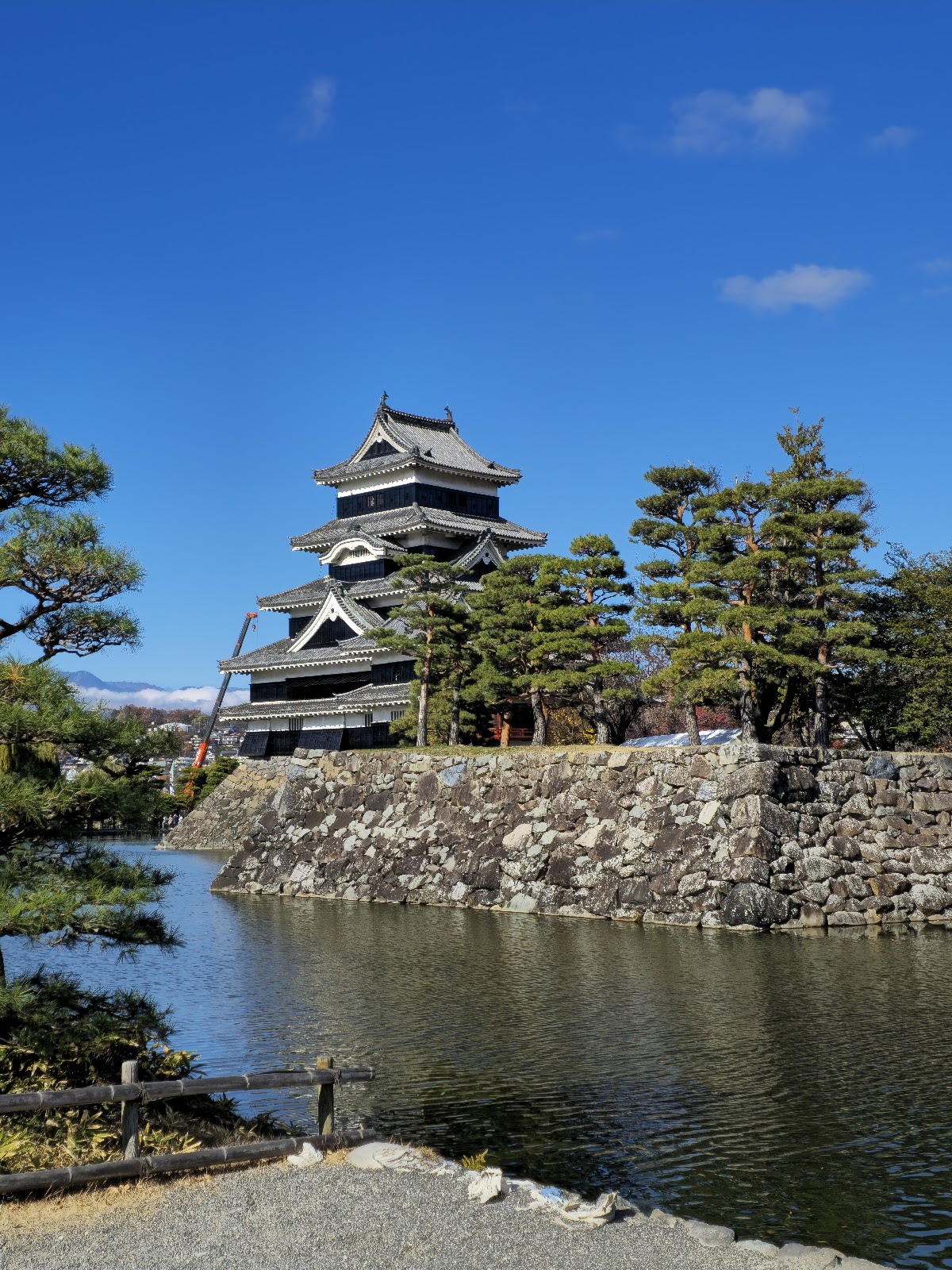
Matsumoto Castle (Matsumoto City, Nagano Prefecture): A flatland castle with an existing keep designated as a National Treasure. The five-story, six-tiered castle tower is known as one of the oldest wooden castle towers in Japan, and is characterized by its beautiful black and white contrasting exterior. Its appearance against the backdrop of the Northern Alps makes it one of Japan’s most representative castle landscapes.
Ueda Castle (Ueda City, Nagano Prefecture): Known as the residence of the Sanada clan, it was the site of the “Battle of Ueda,” where Sanada Masayuki repelled the large Tokugawa army twice. Currently, it is maintained as Ueda Castle Ruins Park and is a popular spot for cherry blossoms.
Matsushiro Castle (Nagano City, Nagano Prefecture): Its predecessor was Kaizu Castle, built by Takeda Shingen. It played an important role as a base in the Battle of Kawanakajima. During the Edo period, it became the residence of the Sanada clan, and today, restored gates and stone walls convey its former appearance.
Komoro Castle (Komoro City, Nagano Prefecture): A castle ruins park known as Kaikoen. It has a rare structure called an “ana-jo” (hole castle), built at a lower elevation than the castle town. The remains of the castle, such as the stone walls and main gate, are well-preserved, and it is also famous as a spot for cherry blossoms and autumn leaves.
Takato Castle (Ina City, Nagano Prefecture): This castle was the seat of the Takato Domain’s government and is nationally known as a spot for the Takato Kohigan cherry blossoms, which are said to be the “finest cherry blossoms in the world.”
Tourist Spots Around Nagano Castle
History and Culture of Misato Town, Tsu City
Misato Town in Tsu City, where Nagano Castle is located, is a historical situated area on the border between Ise Province and Iga Province. It has flourished as a transportation hub since ancient times, and many historical sites and cultural properties remain. You can enjoy a historical walk in this area before or after visiting Nagano Castle.
Nearby Historical Sites
Iga Road: An ancient road that passes at the foot of Nagano Castle, it was an important transportation route connecting Ise and Iga. Even today, some sections retain the appearance of the ancient road, making it ideal for a historical walk.
Nearby Medieval Castles: Several other medieval mountain ruins are scattered around Nagano Castle. If you have time, you can enjoy a “mountain castle tour” visiting these ruins.
Tourist Spots in Tsu City
Tsu Castle Ruins: The remains of a flatland castle located in the center of Tsu City. Built by Todo Takatora, this early modern castle is now maintained as a park. You can learn about the structure of a flatland castle, which is in stark contrast to Nagano Castle.
Sakakibara Onsen: A historic hot spring resort on the outskirts of Tsu City. Perfect for relaxing after exploring Nagano Castle.
The Charm and Importance of Preservation of Medieval Mountain Castles
History Told by Medieval Mountain Castles
Medieval mountain castles like Nagano Castle tend to have a less impressive image compared to early modern castles with keeping and stone walls, but they are actually extremely important in the history of Japanese castles. These mountain castles are valuable historical legacies that directly convey the social structure and military technology of medieval Japan as the samurai rose to power and headed towards the Sengoku period.
Medieval mountain castles embody the wisdom and ingenuity of the people of that time, from civil engineering techniques such as earthworks and trenches, to castle construction philosophies that made maximum use of the terrain, and the establishment of regional control networks.
How to Enjoy Exploring Mountain Castles
Exploring medieval mountain castles offers different ways to enjoy them compared to early modern castles:
- The Fun of Interpreting the Topography: The enjoyment of deciphering the topography to understand why a castle was built in this location.
- The Joy of Discovering Remains: The exploratory enjoyment of discovering trenches and earthworks hidden amongst vegetation.
- The Pleasure of Imagining History: The freedom to imagine the castle’s former appearance, given the absence of buildings.
- A Sense of Oneness with Nature: Mountain castles are situated within nature, allowing visitors to enjoy the changing seasons.
Challenges of Preservation and Utilization
While many medieval mountain castles, including Nagano Castle, have escaped the wave of development and their remains are well preserved, many lack sufficient protection due to their low profile and the difficulty of management. To pass on these valuable historical assets to future generations, it is essential that local residents, researchers, and the government cooperate in preservation efforts.
Model Course for Visiting Nagano Castle
Half-Day Course (3-4 hours)
- Secure Parking (10 minutes): Park in a safe location along the forest road.
- Climb to the Main Enclosure (40 minutes): Hike from the forest road to the main enclosure.
- Explore the Area Around the Main Enclosure (60 minutes): Observe the remains such as earthworks and lower enclosures in detail.
- Explore the Northeast Remains (40 minutes): Visit the moats and earthworks.
- Descend the Mountain (30 minutes)
- Stroll Around the Area (30 minutes): Explore the historical environment around the castle, including the Iga Road.
Full-Day Course (6-7 hours)
In addition to the half-day course:
- Explore the East Castle, Central Castle, and West Castle (2 hours)
- Visit Tsu Castle Ruins (1 hour): Compare with early modern castles.
- Relax at Sakakibara Onsen (1 hour)
Castle Research and the Academic Value of Nagano Castle
Positioning within Medieval Castles of Ise Province
Nagano Castle holds significant academic value as a typical example of a medieval castle in northern Ise Province. Ise Province was a region governed primarily by the Kitabatake clan, and Nagano Castle is thought to have played a part in that governing network.
Archaeological Excavations and Future Research Issues
Nagano Castle has not undergone undergoing archaeological excavations, and historical documents are limited, leaving many mysteries unresolved. Future research will address many issues, including determining the extensive construction date, the changes in castle lords, and the date of its abandonment.
Summary: Rediscovering the Charm of Nagano Castle
Nagano Castle is a medieval mountain castle nestled quietly in the mountains of Tsu City, Mie Prefecture. While it lacks a grand keep or stone walls, its well-preserved earthworks and moats convey medieval castle-building techniques and strategic thinking. The view from the main enclosure, at an altitude of 520m, is magnificent, giving you a real sense of the castle’s importance as a strategic point for monitoring transportation routes.
Nagano Castle, with its unique charm distinct from other famous castles in Nagano Prefecture, is a valuable resource for understanding the diversity of Japanese castle history. It’s a must-visit spot for those who want to enjoy a slightly more serious historical walk exploring mountain castles.
When visiting, please be sure to prepare adequately, equip yourself properly, and prioritize safety while fully experiencing the historical romance of the Middle Ages. We hope that your visit to Nagano Castle will help you rediscover the depth of Japanese castle culture and the importance of locally rooted history.