Matsumoto Castle Complete Guide | A Thorough Explanation of the History, Highlights, Access, and Surrounding Sightseeing of the National Treasure Castle Tower
Located in Matsumoto City, Nagano Prefecture, Matsumoto Castle is one of Japan’s proud national treasure castle towers and is known as one of the most beautiful among the 12 existing castle towers. This magnificent castle, which conveys the history from the Sengoku period to the Edo period, is one of Shinshu’s top tourist spots, attracting many visitors throughout the year.
This article thoroughly explains everything you need to know before visiting Matsumoto Castle, from its historical background and architectural features to actual viewing points, access methods, and information on surrounding tourist spots and restaurants.
About Matsumoto Castle, a National Treasure
Overview and Historical Value of Matsumoto Castle
Matsumoto Castle is located in Marunouchi, Matsumoto City, Nagano Prefecture, and is one of Japan’s leading castles, with its castle tower and other structures designated as national treasures. Originally called “Fukashi Castle,” it was later renamed Matsumoto Castle.
The existing castle tower was built from the late Azuchi-Momoyama period to the early Edo period, and is highly valued for its historical significance as one of Japan’s oldest castles designated as a National Treasure. The entire castle site is also designated as a National Historic Site, and its importance as a cultural asset is immeasurable.
History of Matsumoto Castle
Origins in the Sengoku Period
The origins of Matsumoto Castle date back to the Sengoku period (1467-1568). Initially, it was under the control of the Takeda clan and functioned as Fukashi Castle. This castle, which began as a simple wooden structure, played an important role as a strategic point in Chikuma District, Shinano Province.
Modernization by Ishikawa Kazumasa
Matsumoto Castle approached its current form during the time when Ishikawa Kazumasa, who had left the Tokugawa family and become a retainer of Toyotomi Hideyoshi, became the castle lord. In 1590, Ishikawa Kazumasa, who became the lord of Matsumoto Castle, and his son Yasunaga carried out large-scale renovations and expansions of the castle and proceeded with the construction of the castle tower. Completed in 1594, the castle tower boasts an unusual design with five outer floors and six inner floors, representing the pinnacle of castle construction technology at the time. During this period, the castle town was also developed, laying the foundation for Matsumoto’s regional development.
Development during the Edo Period
During the Edo period, Matsumoto Castle functioned as the administrative center of the Matsumoto Domain. Maintained and managed by successive feudal lords, it continued to prosper alongside the castle town as a symbol of a peaceful era.
Preservation Activities after the Meiji Restoration
After the Meiji Restoration, while many castles were demolished, Matsumoto Castle was preserved through the efforts of local residents. In particular, during the late Meiji period, the castle tower’s tilt became serious, threatening collapse. However, thanks to the efforts of people like Ichikawa Ryozo, restoration was achieved. In 1936, it was designated a National Treasure and has been carefully preserved ever since.
Architectural Features and Highlights of Matsumoto Castle
Structure of the National Treasure Keep
Matsumoto Castle’s keep is a “complex connected keep,” with the main keep at its center, and the Inui Small Keep, the connecting turret, the Tatsumi Attached Turret, and the Tsukimi Turret intricately linked together. This structure is considered particularly complex and beautiful among Japanese castle architecture.
While the exterior has five stories, the interior boasts a unique six-story structure, beautifully blending the practical elements of the Sengoku period with the decorative elements of the peaceful Edo period.
Contrast of Black and White
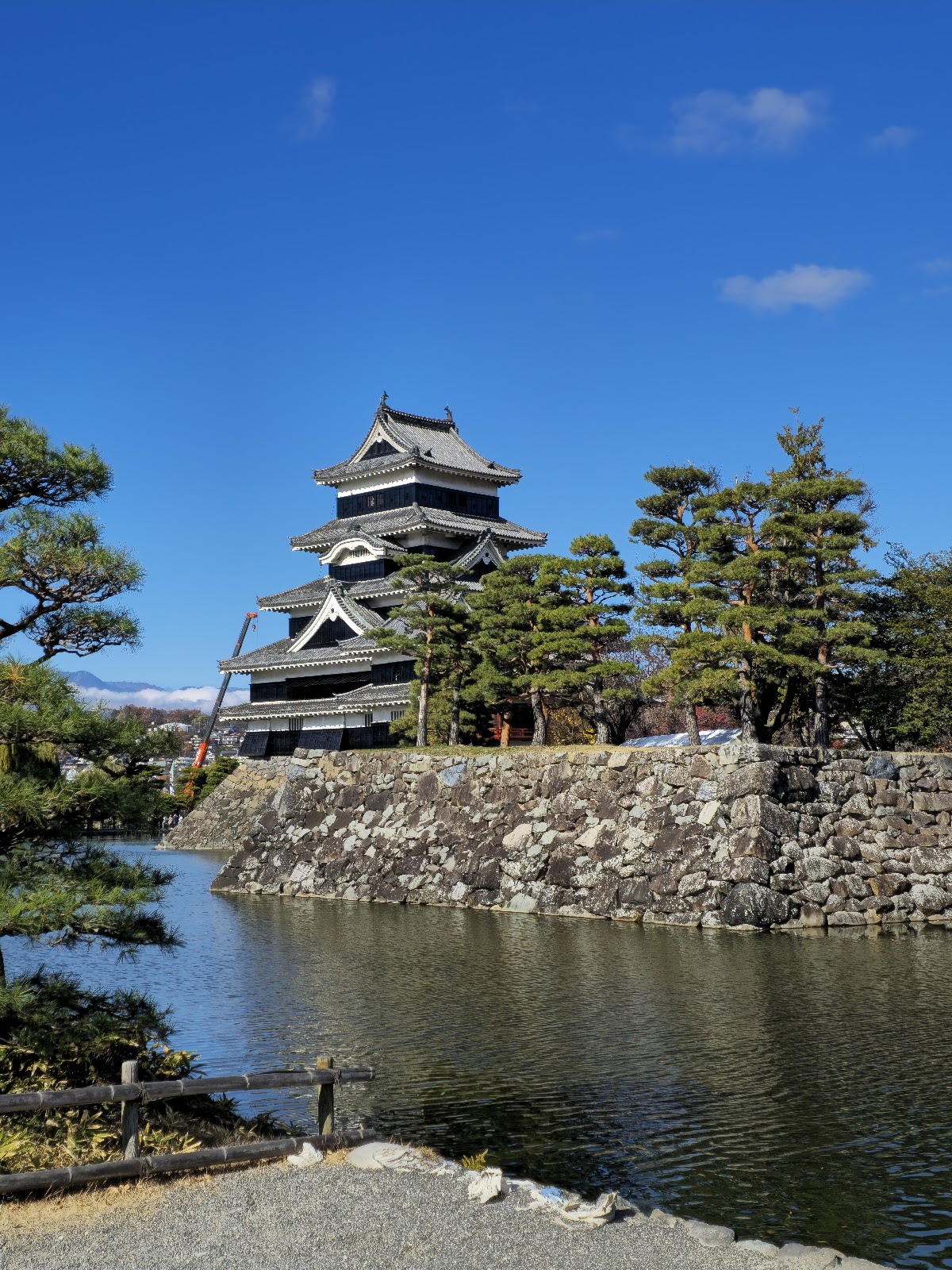
The most distinctive feature of Matsumoto Castle is its jet-black exterior, achieved through black lacquer-coated clapboard siding. While many castles feature white plasterwork, Matsumoto Castle’s black keep is also known as “Karasu-jo” (Crow Castle), and its appearance against the backdrop of the Northern Alps is breathtakingly beautiful.
The aesthetic balance created by the contrast with the white plasterwork is a pinnacle of Japanese architecture.
The Elegance of the Moon-Viewing Tower
The moon-viewing tower, added during the Kan’ei era (1624-1644), is not a wartime structure, but an elegant building created for moon viewing in times of peace. Three sides are open to the sky, allowing visitors to still experience the refined space where the feudal lord of the time enjoyed the moon.
Points of Interest Inside the Castle Tower
The castle tower’s interior is characterized by its steep staircase, with a maximum incline reaching approximately 61 degrees. This design prioritizes defensive functions during wartime. Each floor features exhibits on weapons and armor from the period, as well as the castle’s history. From the top floor, you can enjoy a magnificent panoramic view of Matsumoto city and the Northern Alps.
Of particular note are:
- 1st Floor: Exhibits on the castle’s history and structure
- 2nd Floor: Exhibits on firearms and armor
- 3rd Floor: Hidden floor (a floor not visible from the outside)
- 4th Floor: Site of the lord’s residence
- 5th Floor: Watchtower floor
- 6th Floor: Top floor, the castle tower
Stone Walls and Moat
The stone walls and moat surrounding Matsumoto Castle are also not to be missed. The inner moat, with a total length of approximately 600 meters, serves the castle’s defensive function, and the reflection of the castle tower on the water’s surface creates a spectacular view. Especially during cherry blossom season and autumn foliage season, you can enjoy beautiful scenery in harmony with the changing seasons.
Basic Information and Access to Matsumoto Castle
Location, Opening Hours, and Fees
Location: 4-1 Marunouchi, Matsumoto City, Nagano Prefecture
Opening Hours:
- Regular Season (excluding August): 8:30 AM – 5:00 PM (Last entry 4:30 PM)
- Golden Week and Summer (August): 8:00 AM – 6:00 PM (Last entry 5:30 PM)
*Opening hours may vary depending on the season, so it is recommended to check the official website before visiting.
Admission Fee:
- Adults: 700 yen
- Elementary and Junior High School Students: 300 yen
- Group discounts available
Closed Days: December 29th – 31st (Year-end)
Access Methods
Access by Train
Matsumoto Castle is approximately a 15-20 minute walk from JR Matsumoto Station. Matsumoto Station is served by the Limited Express “Azusa” from Tokyo and the Limited Express “Shinano” from Nagoya.
Access by Bus
When using the bus from Matsumoto Station:
- Use the Matsumoto Loop Bus “Town Sneaker” North Course
- Take a local bus (Utsukushigahara Onsen Line, Asama Line, Okada Line, Alps Park Line, etc.) and get off at “Matsumoto Castle/City Hall” bus stop, then walk for about 5 minutes.
Access by Car
- Approximately 15 minutes from the Nagano Expressway “Matsumoto IC”
- Parking: There are municipal parking lots around Matsumoto Castle (paid).
- Municipal Kaichi Parking Lot
- Municipal Otemon Parking Lot
etc.
*Due to congestion during tourist season and weekends, we recommend using public transportation.
Matsumoto Castle’s Seasons and Photo Spots
Spring: Cherry Blossoms and Matsumoto Castle
From early to mid-April, approximately 300 cherry trees bloom around Matsumoto Castle. The “National Treasure Matsumoto Castle Cherry Blossom Festival” is held, and the castle is illuminated at night. The contrast between the black castle tower and the pale pink cherry blossoms is a popular spot for photography enthusiasts, considered one of Japan’s most spectacular views.
Summer: Fresh Greenery and Blue Sky
During the summer, opening hours are extended, allowing visitors to enjoy Matsumoto Castle against a blue sky. Furthermore, events such as the “National Treasure Matsumoto Castle Taiko Drum Festival” are held on summer nights, offering a lively atmosphere.
Autumn: Famous for Autumn Foliage
From late October to early November, the trees around the castle change color, creating a beautiful landscape with the autumn leaves and castle tower. On clear autumn days, the snow-capped Northern Alps can also be seen, allowing visitors to enjoy three stages of colorful beauty.
Winter: Matsumoto Castle Covered in Snow
Matsumoto Castle, covered in snow, displays a serene beauty reminiscent of an ink painting. Especially in January, the “National Treasure Matsumoto Castle Ice Sculpture Festival” is held, allowing visitors to enjoy the collaboration of ice sculptures and the castle tower.
Recommended Photo Spots
- View from Uzumibashi Bridge: A classic spot to capture the castle tower from the front.
- Honmaru Garden: Allows you to photograph the castle tower across the moat.
- Along the Outer Moat: Allows you to photograph the “inverted Matsumoto Castle” reflected in the water.
- North Side Area: Allows you to capture both the Northern Alps and the castle tower simultaneously.
Recommended Tourist Spots Around National Treasure Matsumoto Castle
Matsumoto City Museum
Located very close to Matsumoto Castle, the Matsumoto City Museum is a facility where you can learn about Matsumoto’s history and culture. A combined ticket with Matsumoto Castle is also available, allowing for efficient sightseeing. The museum features extensive exhibits on Matsumoto’s development as a castle town and its local folk culture.
Former Kaichi School
The Former Kaichi School, designated a National Treasure, is a prime example of early Meiji-era pseudo-Western style architecture. Located about a 10-minute walk from Matsumoto Castle, it offers insights into the history of modern Japanese education. Its beautiful architectural style is a must-see.
Nakamachi Street
Nakamachi Street, about a 10-minute walk from Matsumoto Castle, is a historical street lined with white-walled and black-walled storehouses. With cafes, general stores, and craft shops, it’s an ideal area for a stroll.
Nawate Street
Nawate Street, known as “Frog Town,” is a shopping street with a Showa-era retro atmosphere. Antique shops, candy stores, and restaurants line the street, offering a nostalgic experience.
Yotsubashira Shrine
Yotsubashira Shrine, affectionately known as “Shinto-san,” is a local center of faith located near Nawate Street. Known as a shrine that grants wishes, it attracts many worshippers.
Agata-no-Mori Park
This park, where the former Matsumoto High School buildings remain, is a place of relaxation for citizens with its spacious lawns and beautiful trees. It’s recommended to take a short trip from Matsumoto Castle and enjoy some leisurely time here.
Recommended Gourmet Food Around Matsumoto Castle (National Treasure)
Shinshu Soba
Shinshu soba is a representative gourmet food of Nagano Prefecture. There are many long-established soba restaurants around Matsumoto Castle, where you can enjoy fragrant, authentic soba. Especially recommended are the unique local soba dishes such as “Toji Soba” and “Oshibori Soba.”
Sanzoku-yaki
Matsumoto’s local specialty, “Sanzoku-yaki,” is a hearty dish of chicken marinated in a garlic-based sauce and deep-fried. It’s very filling and perfect for a meal between sightseeing.
Oyaki
Oyaki, a specialty of Shinshu (Nagano Prefecture), is a local dish made by wrapping vegetables and wild plants in a wheat flour dough and baking it. It can be easily enjoyed at souvenir shops and restaurants around Matsumoto Castle.
Matsumoto’s Local Sake
Matsumoto’s local sake, brewed with the pure water of the Northern Alps, is exquisite. Enjoying local sake at breweries and izakayas (Japanese pubs) in the castle town is one of the pleasures of your trip.
Cafe Culture
Matsumoto is also known as a city with a deeply rooted cafe culture. Around the castle, there are a variety of establishments, from historic cafes to modern ones, making them perfect for a break during sightseeing.
Events Held Around Matsumoto Castle (National Treasure)
Matsumoto Castle Cherry Blossom Festival (April)
Held to coincide with the cherry blossom season, the festival features nighttime illuminations and various events. The collaboration of cherry blossoms and the castle tower is breathtaking.
Matsumoto Castle Taiko Drum Festival (July)
Taiko drumming groups from all over Japan gather at Matsumoto Castle to perform powerful music. It has become a well-established summer tradition.
Matsumoto Castle Moon Viewing Festival (September-October)
Held during the Mid-Autumn Festival, this elegant event allows guests to enjoy the moon while listening to gagaku (ancient Japanese court music) and koto (Japanese harp) performances at the moon-viewing tower.
Matsumoto Castle Ice Sculpture Festival (January)
Ice sculptures are displayed at Matsumoto Castle during the winter. The illuminated ice sculptures and the castle tower create a fantastical scene.
Hotels and Accommodations near Matsumoto Castle
Hotels near Matsumoto Castle
Within walking distance of Matsumoto Castle, there are a variety of accommodations, from business hotels to city hotels. Some hotels offer rooms with castle views, allowing guests to enjoy the luxurious experience of watching Matsumoto Castle from their rooms in the morning and evening.
Accommodation near Matsumoto Station
Many hotels are concentrated around Matsumoto Station, offering convenient access. There are also plenty of restaurants, so finding a place to eat at night is easy.
Asama Onsen and Utsukushigahara Onsen
Hot spring resorts such as Asama Onsen and Utsukushigahara Onsen are located 15-30 minutes by car from Matsumoto city. Recommended for those who want to enjoy both sightseeing and hot springs.
Points to Note and Advice When Visiting Matsumoto Castle
Measures for Crowded Seasons
During Golden Week, Obon, and the autumn foliage season, it gets extremely crowded, and you may have to wait 1-2 hours to enter the castle keep. Visiting early in the morning right after opening or on weekdays is recommended.
Clothing and Items to Bring
Shoes are strictly prohibited inside the castle keep, and there are many steep stairs, so comfortable clothing and shoes are essential. Pants are more suitable than skirts. In winter, the castle keep can get cold, so don’t forget to bring warm clothing.
Estimated Time Required
If you only want to see the castle tower, it will take about an hour. However, if you want to include a stroll through the main garden and take photos, you should allow 2-3 hours. Including sightseeing in the surrounding area, a half-day to full-day time allocation is ideal.
Photography
Photography is permitted inside the castle tower, but flash photography is prohibited. Also, please be considerate of other visitors during busy times.
Accessibility Information
Due to the steep stairs inside the castle tower, wheelchair access is difficult. However, the main garden is relatively flat, and viewing the exterior is possible. It is recommended to consult with the management office in advance.
Frequently Asked Questions about Matsumoto Castle (National Treasure)
How long does it take to visit Matsumoto Castle?
If you only want to see the castle tower, it takes about an hour. Including a stroll through the main garden, it takes approximately 1.5-2 hours. It may take longer during busy times.
Can I climb to the top of Matsumoto Castle’s tower?
Yes, you can. However, since there are steep stairs (maximum incline of approximately 61 degrees), comfortable shoes and clothing are necessary.
What is the nearest station to Matsumoto Castle?
The nearest station is JR Matsumoto Station, about a 15-20 minute walk away. If using the bus, the “Matsumoto Castle/City Hall” bus stop is convenient.
Is Matsumoto Castle open all year round?
It is closed only for three days at the end of the year, from December 29th to 31st. Otherwise, it is open all year round.
How much is the entrance fee for Matsumoto Castle?
Adults: 700 yen, Elementary and Junior High School Students: 300 yen. A combined ticket with the Matsumoto City Museum is also available.
Is a reservation required to visit Matsumoto Castle?
Reservations are not required for individual visits. However, advance notice is recommended for groups (20 or more people).
When can I see Matsumoto Castle lit up?
The castle is lit up year-round from sunset until 10:00 PM. Special illuminations are also held during events such as cherry blossom season.
Are there parking lots around Matsumoto Castle?
There are several paid parking lots, including the municipal Kaichi Parking Lot and the municipal Otemon Parking Lot. However, these are often full during peak tourist season, so using public transportation is recommended.
Can I have a wedding ceremony at Matsumoto Castle?
Wedding ceremonies are possible in the Matsumoto Castle Honmaru Garden. Prior application and permission are required; please contact the management office for details and conditions.
What are the differences between Matsumoto Castle and Himeji Castle?
Himeji Castle is known as the “White Heron Castle” with its white plasterwork, while Matsumoto Castle is known as the “Crow Castle” with its black lacquerwork; their exterior colors are contrasting. Also, Himeji Castle is a hilltop castle, while Matsumoto Castle is a flatland castle; both are located on a plain. Both castles are national treasures, but each possesses its own unique charm.
Visitor Trends at Matsumoto Castle (National Treasure)
Matsumoto Castle attracts many tourists throughout the year. Many visitors come from both within Japan and internationally, with a particularly noticeable increase in foreign tourists. It is attracting global attention as a valuable place to experience traditional Japanese castle architecture.
The age range of visitors is wide, making it a tourist spot enjoyable for people of all ages. It is popular with a diverse group, including history enthusiasts, photography lovers, architecture fans, and families.
In recent years, it has become increasingly popular as a spot perfect for social media photos, and the number of young people visiting to take beautiful pictures throughout the seasons is also increasing.
Summary: The Value of Visiting Matsumoto Castle
Matsumoto Castle, a national treasure, is a valuable cultural asset where you can experience Japanese history and culture. The castle tower, a culmination of architectural techniques from the Sengoku period to the Edo period, conveys the wisdom and aesthetic sense of our ancestors to us living today.
The beautiful contrast of black and white in the castle tower, the surrounding nature that changes with the seasons, and the magnificent scenery with the Northern Alps in the background continue to captivate visitors.
Matsumoto City as a whole is a wonderful tourist destination, retaining the charm of a castle town while also possessing modern appeal. By combining Matsumoto Castle with the surrounding historical buildings, gourmet food, and hot springs, you can create a fulfilling travel plan.
When visiting Nagano Prefecture, be sure to visit the national treasure Matsumoto Castle and fully enjoy the history and beauty of Japan. Checking information in advance and planning your visit carefully will ensure a more enriching experience.