Ohoriyama Castle (Kawagoe City, Saitama Prefecture) Complete Guide | History and Highlights of the Largest Square-Shaped Castle in the Prefecture
Located in Shimohiroya, Kawagoe City, Saitama Prefecture, Ohoriyama Castle (Ohoriyama Manor) is a valuable historical site, boasting the largest scale among square-shaped castles built during the Sengoku period in Saitama Prefecture. Centered around the main enclosure surrounded by triple moats and earthworks, this well-preserved castle site is believed to have been built by the Ogigayatsu Uesugi clan, yet its detailed history remains shrouded in mystery.
This article will introduce the charm of this castle site in its entirety, from basic information and historical background to details of the remains that can be seen on-site, access methods, and its relationship with surrounding castles.
Basic Information on Ohoriyama Castle
Common Names/Alternate Names
Ohoriyama Castle is also known as “Ohoriyama Manor” or “Ohoriyama Manor Ruins“. Locally, the name “Ohoriyama-kan” is commonly used, and it is registered as “Ohoriyama-kan Ruins” in Saitama Prefecture’s historical site designation.
Location and Access
Location: 332-1 Ushihara-minami, Shimohiroya, Kawagoe City, Saitama Prefecture, and other locations
Access Method:
- By car: Approximately 15 minutes from Kawagoe IC on the Kan-Etsu Expressway. Located near Wakaba Cemetery, easily identifiable by using Shinmei Shrine as a landmark.
- Public Transportation: Take a bus or taxi from Tsurugashima Station on the Tobu Tojo Line or Sayama-shi Station on the Seibu Shinjuku Line.
- Parking: There is no dedicated parking lot; please use nearby public facilities or paid parking lots.
Former Province Name and Classification
Former Province Name: Musashi Province
Classification/Structure: Hilltop Castle (Square Manor)
Builder: Ogigayatsu Uesugi Clan (Estimated)
Year of Construction: Late Muromachi Period (Late 15th to Early 16th Century)
Keep Structure: None (As it is a medieval castle, there is no keep)
Lord: Details Unknown (Estimated to be related to the Ogigayatsu Uesugi Clan)
Year of Abandonment: Unknown
Remains: Enclosures, earthworks, dry moats (horizontal moats), baileys
Designated Cultural Property: Saitama Prefecture Designated Historic Site
Historical Background of Ohoriyama Castle
Relationship between the Ogigayatsu Uesugi Clan and Kawagoe
The details of Ohoriyama Castle’s construction are unclear due to the lack of reliable historical records. However, recent research suggests it is being defined as a castle built by the Ogigayatsu Uesugi clan in the late Muromachi period.
The Ogigayatsu Uesugi clan was a powerful samurai family that ruled southern Musashi Province from the Muromachi period to the Sengoku period. They used Kawagoe Castle (Kawagoe Castle) as their base and sought to expand their influence in Musashi Province. Ohoriyama Castle is located on an important route connecting Kawagoe Castle and Hachigata Castle (Yorii Town), and is thought to have functioned as a strategically important military and transportation hub.
Connection to the Battle of Kawagoe
Ohoriyama Castle most likely appeared on the historical stage during the Battle of Kawagoe in 1546 (Tenbun 15). This battle is known as one of the most remarkable night attacks of the Sengoku period, in which the Later Hojo clan army, led by Hojo Ujiyasu, defeated a combined force of 80,000 men consisting of Ogigayatsu Uesugi Tomosada, Yamanouchi Uesugi Norimasa, and the Koga Shogun Ashikaga Haruuji.
Ohoriyama Castle is located approximately 5 km north of Kawagoe Castle, and researchers have suggested that it may have been used as a subsidiary castle by the Ogigayatsu Uesugi clan during the Battle of Kawagoe. However, no specific records of the battle remain, so this remains purely speculation.
Purpose and Role of the Castle
Based on the location and structure of Ohoriyama Castle, the following roles are presumed:
- A subsidiary castle of Kawagoe Castle: An important defensive base protecting the north of Kawagoe Castle, the main base.
- Road monitoring: Traffic monitoring and checkpoint function on the route connecting Kawagoe and Hachigata.
- Center for regional control: A center for governing and collecting taxes in the surrounding area.
- Emergency shelter: A retreat base in case Kawagoe Castle was attacked.
History after the Castle’s abandonment
It is unclear when Ohoriyama Castle was abandoned. Considering the defeat of the Ogigayatsu Uesugi clan in the Battle of Kawagoe and their subsequent decline, it is highly likely that it lost its function after the mid-16th century.
From the Edo period onward, the land was used for farming and forestry, and fortunately, it avoided large-scale development, so the remains were preserved in good condition to the present day. From the late Showa period to the Heisei period, it was “discovered” by local historians and castle researchers, and its value began to be re-evaluated. ## Layout and Remains of Ohoriyama Castle
Characteristics of the Overall Structure
Ohoriyama Castle is a flatland castle with sides of approximately 200 meters, forming a square shape. This scale makes it one of the largest square-shaped castles in Saitama Prefecture, and it boasts a remarkable size compared to other castles of the same period.
The basic structure of the castle is as follows:
- Main Enclosure: The main square section located in the center
- Second Enclosure: Arranged in a strip to the north of the main enclosure
- Third Enclosure: An outer section surrounding the main enclosure
- Triple Moat: Dry moats (horizontal moats) separating each enclosure
- Earthwork: Earthen defensive walls built along the moats
Details of the Main Enclosure
The main enclosure is the core section of the castle, with a shape close to a square. It is surrounded on all four sides by earthworks, and a deep dry moat surrounds the outside.
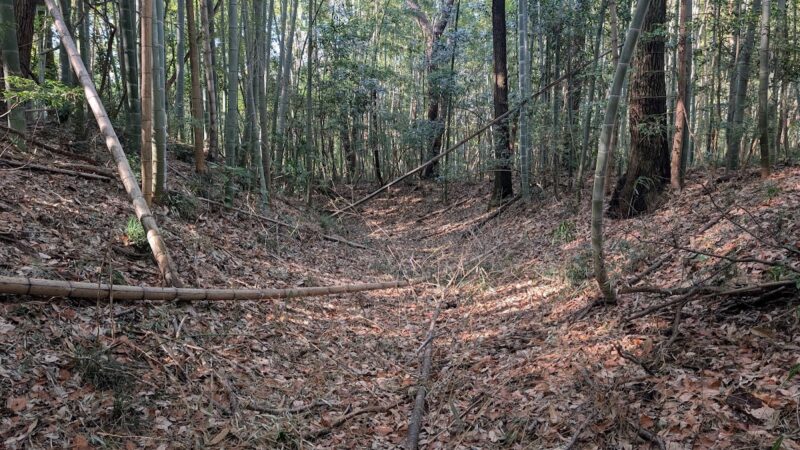
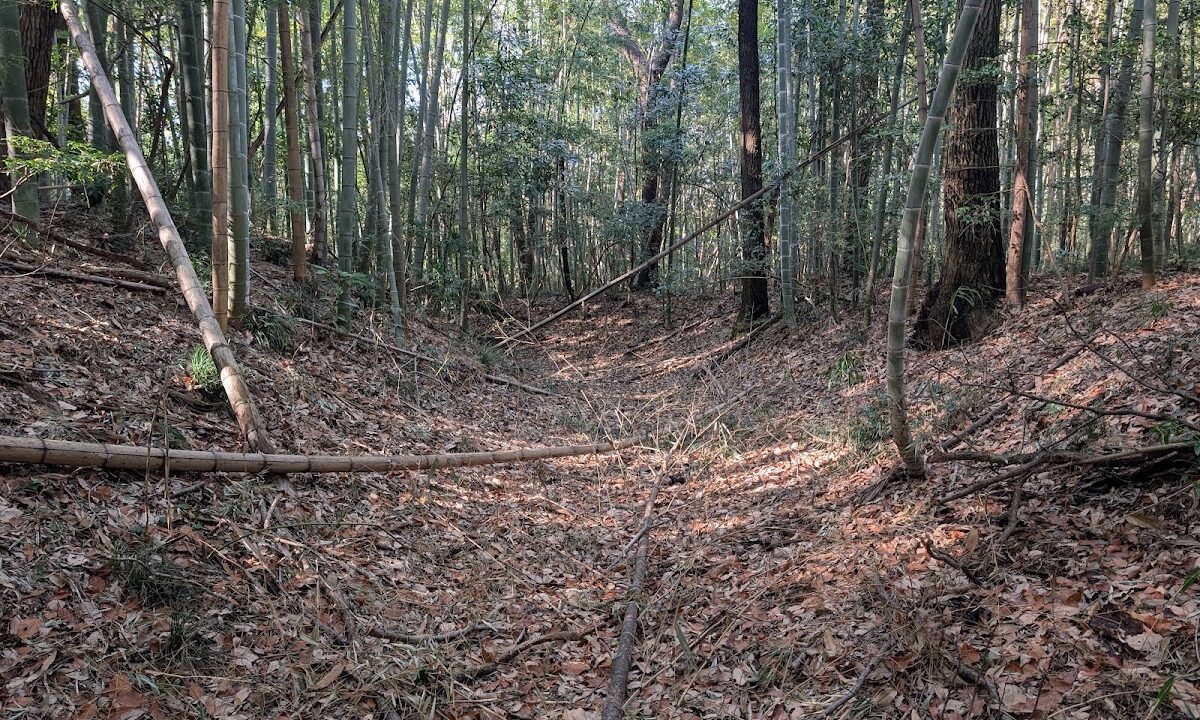
Upon visiting the site, you can clearly see the earthen ramparts covered in bamboo groves, which reach a height of 2-3 meters in some places. Walking along the top of the ramparts will give you a real sense of the castle’s scale and defensive capabilities in its heyday.
The interior of the main enclosure is flat, and no clear remains such as building sites have been confirmed, but some traces may be found if archaeological excavations are conducted.
Second and Third Enclosures
To the north of the main enclosure are the strip-like second and third enclosures. These are thought to have functioned as outer fortifications to defend the main enclosure.
A dry moat and earthen ramparts are also provided between the second and third enclosures, forming a triple line of defense. This multi-layered defensive structure is a typical feature of medieval castles and speaks to the military importance of Ohoriyama Castle.
Preservation of the Dry Moat (Horizontal Moat)
The greatest highlight of Ohoriyama Castle is the well-preserved dry moat. The triple-layered dry moat can still be seen today, measuring 3-5 meters deep and 5-10 meters wide. While some sections are covered by bamboo groves and thickets, it remains clearly visible.
The inner moat surrounding the main enclosure is particularly well-preserved, allowing visitors to experience the defensive system of a medieval castle by walking along its bottom. The dry moat retains its box-shaped cross-section, and its steep walls convey its former defensive strength.
Features of the Earthworks
The earthworks built along the dry moat are also important remains of Ohoriyama Castle. These earthworks were constructed by piling up the excavated soil from the moat, serving to prevent enemy intrusion and maintain visibility from within the castle.
Even today, earthworks 2-3 meters high remain in various places, and a continuous line of earthworks can be seen, especially around the main enclosure. Although trees grow densely on top of the earthworks, their shape is relatively clear, making them a worthwhile sight for castle enthusiasts.
Estimated Location of the Entrance (Koguchi)
While no clear remains of the castle’s entrance (koguchi) have been confirmed, based on the castle layout map, it is believed that the main entrance was located on the south or east side of the main enclosure.
Medieval castle entrances were typically constructed by cutting into earthen ramparts and incorporated features such as masugata (square spaces) or kuichigai (zigzag passages). It is possible that Ohoriyama Castle also had a similar structure, but further investigation is needed to determine the details.
Current Status and Maintenance of Ohoriyama Castle
Assessment of Preservation
Ohoriyama Castle is highly regarded as one of the castles with the best-preserved remains in Saitama Prefecture. Compared to other castle sites in Kawagoe City, such as Kawagoe Castle (Kawagoe-jo) and Kawagoe-kan, the degree of preservation of the remains is remarkably superior.
This is because the castle site was preserved as a forest, avoiding large-scale development such as residential development and agricultural land improvement. Although it may appear somewhat dilapidated at first glance due to being covered in bamboo groves and mixed forests, it is in an ideal state of preservation for a castle ruin.
Maintenance and Visiting Environment
Ohoriyama Castle is a Saitama Prefecture designated historical site, but no large-scale maintenance has been carried out, and it is preserved in almost its natural state.
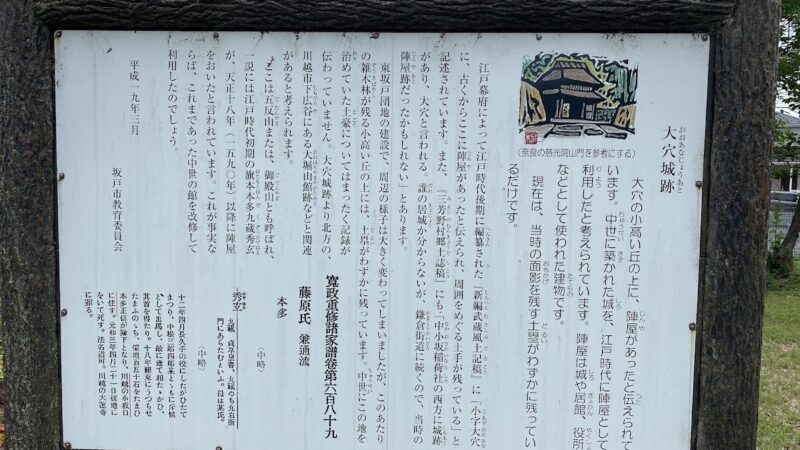
An explanatory sign installed by the Saitama Prefectural Board of Education is located on-site, where you can read a brief explanation of the castle’s overview and history. However, the visiting paths and guide signs are minimal, and some experience and preparation are necessary to explore the castle grounds.
Important Notes for Visitors:
- Long sleeves and long pants are recommended due to the dense bamboo groves and woodlands.
- Non-slip shoes such as trekking shoes are preferable as there are uneven areas.
- Insects such as mosquitoes and horseflies are abundant in the summer, so bring insect repellent.
- Be aware of wild animals such as bears and wild boars (sightings are rare, but it’s best to be cautious).
Estimated Visit Time
Visiting Ohoriyama Castle takes an average of 15-30 minutes. Those familiar with castles or who enjoy photography are advised to spend about an hour exploring thoroughly.
Main Tour Route:
- Check the castle overview on the information board (5 minutes)
- Observe the earthworks and dry moats around the main enclosure (10 minutes)
- Move towards the second and third enclosures (10 minutes)
- Walk around the entire site to understand the layout (15 minutes)
Ohoriyama Castle and the surrounding castle network
Relationship with Kawagoe Castle
Kawagoe Castle, located approximately 5 km south of Ohoriyama Castle, is an important castle known as the base of the Ogigayatsu Uesugi clan. It was built by Ota Doshin and his son Dokan, and later became the residence of the Later Hojo and Tokugawa clans.
Ohoriyama Castle is thought to have served as a subsidiary castle of Kawagoe Castle, playing a role in preparing for threats from the north. The route connecting the two castles was militarily and economically important, and Ohoriyama Castle was strategically located to control this key point.
The Road to Hachigata Castle
Ohoriyama Castle is located on the route connecting Kawagoe Castle and Hachigata Castle (Yorii Town, Saitama Prefecture). Hachigata Castle was a large mountain castle that functioned as a base for the Later Hojo clan’s control of northern Kanto, and is designated as a National Historic Site.
The road from Kawagoe to Hachigata was an important transportation route connecting Musashi Province and Kozuke Province. Ohoriyama Castle likely played a role in monitoring and defending this road, and may have also functioned as a relay point for goods and information.
Surrounding Medieval Castle Sites
Besides Ohoriyama Castle, many other medieval castle sites remain in and around Kawagoe City:
- Kawagoe Castle Site (Kawagoe City): Site of the residence of Kawagoe Shigeyori, a senior retainer of Minamoto no Yoritomo
- Taki Castle (Tokorozawa City): A branch castle of the Later Hojo clan
- Yamada Castle (Kawagoe City): A castle site associated with the Ogigayatsu Uesugi clan
- Kamito Camp (Kawagoe City): Said to be the site of the Battle of Kawagoe
By visiting these castle sites, one can understand the power struggles and castle network in Musashi Province during the medieval period.
Ohoriyama Castle Visitor Reviews and Ratings
Ratings from Castle Enthusiasts
The following ratings have been received from castle enthusiasts who have visited Ohoriyama Castle:
Points of High Rating:
- Excellent preservation of the remains
- Clearly visible triple moats and earthworks
- A rare large-scale square-shaped castle in Saitama Prefecture
- Few people, allowing for quiet viewing
- A sense of romance shrouded in historical mystery
Points for Improvement:
- Insufficient maintenance, making the viewing paths difficult to follow
- Lack of information on explanatory signs
- No parking lot
- Overgrown bamboo groves make some remains difficult to see
Ratings on Kojodan and other castle information websites
On the castle information website “Kojodan,” Ohoriyama Castle received a relatively low rating of 2.00 (out of 5). This is likely due to insufficient maintenance and low recognition.
However, many castle enthusiasts who have actually visited the castle have praised its high-quality remains and stated that it deserves more recognition. There is a movement to re-evaluate it as a hidden gem.
Suitable for Beginners or Enthusiasts
Ohoriyama Castle is more suitable for intermediate to advanced castle enthusiasts. Because there are no well-maintained viewing paths or detailed guides, it might be a bit challenging for beginners unfamiliar with castle architecture.
On the other hand, for those who understand basic remains such as earthworks and dry moats, it is a very worthwhile castle site. You can experience the realization that “unknown history” is buried in the region, and enjoy the thrill of exploration.
Points to Consider When Visiting Ohoriyama Castle
Best Season
The best time to visit Ohoriyama Castle is late autumn to early spring (November to March). During this time, the vegetation has withered, making the remains easier to see, and there are fewer insects, making for a comfortable exploration.
Conversely, the summer months (June to September) are not ideal for sightseeing due to the overgrown vegetation and abundance of insects such as mosquitoes and horseflies. However, the natural beauty can be enjoyed during the seasons of fresh greenery and autumn foliage.
Useful Items to Bring
- Territory Map: Obtain it from the internet in advance, print it out, and bring it with you.
- Compass: Useful for maintaining your sense of direction.
- Camera: For recording the ruins and creating memories.
- Insect Repellent Spray: Essential from spring to autumn.
- Drinking Water: Especially in summer, to prevent heatstroke.
- Work Gloves: Useful when pushing through bamboo groves.
Nearby Sightseeing Spots
Nearby spots to visit in conjunction with Ohoriyama Castle:
- Kawagoe Castle Honmaru Palace (approx. 15 minutes by car): The existing Honmaru Palace is a must-see.
- Kawagoe’s Traditional Storehouse District (approx. 20 minutes by car): Enjoy the atmosphere of Koedo Kawagoe.
- Kita-in Temple (approx. 20 minutes by car): A famous temple associated with the Tokugawa family.
- Kawagoe-kan Ruins Historical Park (approx. 10 minutes by car): Ruins of the residence of the Minamoto and Kawagoe clans.
- Hikawa Shrine (approximately 20 minutes by car): The main guardian shrine of Kawagoe
Photography Tips
Points for taking impressive photos at Ohoriyama Castle:
- Emphasize the height of the earthworks: Include people to create a sense of scale
- Depth of the dry moat: Shoot from an angle looking up from the bottom of the moat
- Contrast between trees and ruins: The combination of bamboo groves and earthworks is beautiful
- Morning and evening light: Oblique light highlights the unevenness of the ruins
- Winter photography: After the leaves have fallen, the ruins are clearly visible
Current Status and Future Challenges of Ohoriyama Castle Research
Re-evaluation of Historical Positioning
Ohoriyama Castle has long been treated as a “castle of unknown origin,” but recent research is positioning it as part of the Ogigayatsu Uesugi clan’s castle network.
In particular, based on the characteristics of its layout and location, it is considered highly likely that it was built between the late 15th and early 16th centuries. Further research is expected, including its connection to the Battle of Kawagoe.
The Need for Archaeological Excavation
No full-scale archaeological excavation has been conducted at Ohoriyama Castle. While excellent remains can be identified through surface observation alone, archaeological excavation could reveal new facts such as:
- Arrangement of building remains and post holes
- Dating based on excavated artifacts
- Clues regarding the castle lord and users
- Clarification of the castle’s abandonment period
- Details of daily life
Balancing Preservation and Utilization
The future challenge for Ohoriyama Castle is how to strike a balance between preserving the remains and utilizing it for tourism.
Excessive development may damage the remains, but leaving it completely untouched could lead to a decrease in visitors and the castle’s value being forgotten. A strategy is needed to protect the essential value of the remains while implementing minimal development (such as establishing viewing paths and improving explanatory signs).
Summary: The Charm and Value of Ohoriyama Castle
Ohoriyama Castle (Ohoriyama Manor) is a valuable medieval castle site remaining in Kawagoe City, Saitama Prefecture. Its appeal can be summarized in the following points:
- One of the largest square manors in Saitama Prefecture: With sides of approximately 200 meters, it is the largest in the prefecture.
- Excellent Preservation of Remains: The triple moats and earthworks remain clearly visible.
- The Ogigayatsu Uesugi Clan’s Castle Network: An important base connecting Kawagoe Castle and Hachigata Castle.
- Connection to the Battle of Kawagoe: Possible involvement in an important battle during the Sengoku period.
- Historical Mystery: Details are unknown, but this only adds to its romance and the enjoyment of exploration.
Ohoriyama Castle lacks a magnificent keep or stone walls, but it is a valuable historical site where you can fully appreciate the charm of a “earthen castle,” the essence of medieval castles. The remains, quietly remaining in the forest, convey a part of history that has yet to be unraveled.
For castle enthusiasts, history buffs, and anyone looking to extend their trip a little while sightseeing in Kawagoe, Ohoriyama Castle is a hidden gem well worth a visit. The earthen ramparts and dry moat nestled amidst the bamboo grove quietly convey the spirit of the samurai warriors of 500 years ago.