Honjo Castle (Saitama Prefecture) Complete Guide: A Thorough Explanation of History, Remains, and Access
What is Honjo Castle?
Honjo Castle was a flatland castle located in Honjo City, Saitama Prefecture. Situated north of Honjo Station in the current city center, it played an important role from the Sengoku period to the early Edo period.
Built in Honjo, a prosperous post town on the Nakasendo highway, near the Koyama River (a tributary of the Tone River), this castle functioned as a strategic military and transportation hub in northern Musashi Province. While most of the castle site is now urbanized, the few remaining remains and place names allow us to imagine its former glory.
History of Honjo Castle
Construction and Early History
There are various theories regarding the construction period of Honjo Castle, but the most widely accepted theory is that it was built by the Honjo clan in the mid-15th century during the late Muromachi period. The Honjo clan was a powerful family descended from the Kodama clan, one of the seven clans of Musashi Province, and ruled this region. Initially, it is believed to have been a small, manor-like facility, but during the Sengoku period (Warring States period), its function as a castle gradually strengthened amidst conflicts with surrounding forces.
Honjo Castle in the Sengoku Period
During the Sengoku period, Honjo Castle was at the center of a complex power struggle in the Kanto region. Particularly important was its role in the conflict between Uesugi Kenshin of Echigo and the Hojo clan of Odawara.
The Honjo Clan’s Activities
Initially, the Honjo clan belonged to the Yamanouchi Uesugi clan, but they changed allegiances amidst the chaos of the Sengoku period. During the Eiroku era (1558-1570), they came under the influence of Uesugi Kenshin, but they maintained a delicate position between the two forces, also maintaining relations with the Hojo clan.
Honjo Shigenaga’s Rebellion
In 1568 (Eiroku 11), Honjo Shigenaga, the lord of Honjo Castle, rebelled against Uesugi Kenshin. This incident, known as the “Honjo Shigenaga Rebellion,” significantly impacted Kenshin’s rule over Musashi Province.
Several factors have been cited as reasons for the rebellion, including dissatisfaction with Kenshin’s strict control and a desire to maintain relations with the Hojo clan. While the rebellion was temporarily suppressed, it complicated the relationship between the Honjo and Uesugi clans.
Under Hojo Control
During the Tensho era (1573-1592), Honjo Castle came under the influence of the Hojo clan. During the reigns of Hojo Ujiyasu and Ujimasa, the Hojo clan expanded their power into northern Musashi Province, and Honjo Castle was incorporated into their system of control.
While detailed records of Honjo Castle’s role during Toyotomi Hideyoshi’s Odawara campaign in 1590 are lacking, it is believed that the castle surrendered along with the Hojo clan.
Honjo Castle in the Edo Period
After Tokugawa Ieyasu’s Entry into the Kanto Region
After the Siege of Odawara, when Tokugawa Ieyasu entered the Kanto region, his retainers were stationed at Honjo Castle. In 1590 (Tensho 18), Ogasawara Nobune became the lord of Honjo Castle with a 10,000 koku stipend, marking the beginning of Honjo Castle in the Edo period.
Changes in Castle Lords
In the early Edo period, Honjo Castle was ruled by the following lords:
- Ogasawara Nobumine (1590-1592): 10,000 koku
- Ogasawara Nobuyuki (1592-1601): Son of Nobumine
- Suwa Yorimizu (1601-1616): 25,000 koku
- Matsudaira Tadayoshi (1616-1619): 20,000 koku
- Ogasawara Nobuyuki (Re-appointed, 1619-1623): 20,000 koku
Abandonment of the Castle
In 1623 (Genna 9), when Ogasawara Nobuyuki was transferred to the Koga Domain, Honjo Castle was abandoned. Due to the Edo Shogunate’s “One Castle Per Province” decree, Honjo Castle ceased to serve its purpose.
After the castle was abandoned, Honjo developed as a post town on the Nakasendo road, and a merchant district formed around the castle ruins. Many of the castle’s buildings and facilities were demolished, and the moats were gradually filled in.
Structure and Layout of Honjo Castle
Castle Size and Placement
Honjo Castle was a flatland castle located in the area north of Honjo Station, in what is now the center of Honjo City, where place names such as “Shiroyama” and “Shirodai” remain.
The castle’s size is estimated to have been approximately 200 meters east-west and 250 meters north-south. Although a relatively small castle, it was located near the Koyama River, part of the Tone River system, controlling a key point for both water and land transportation.
Characteristics of the Layout
The layout of Honjo Castle is thought to have been a concentric structure with the main keep (Honmaru) at the center, surrounded by the second and third baileys (Ninmaru and Sannomaru).
Honmaru
The Honmaru, the core of the castle, housed the lord’s residence and major defensive facilities. The current “Shiroyama” area is believed to correspond to this location.
Ninokuruwa and Sannomaru
The Ninokuruwa and Sannomaru were arranged surrounding the Honmaru (main enclosure), each demarcated by moats and earthworks. It is thought that these areas housed the residences of retainers and warehouses.
Moats and Earthworks
The defenses of Honjo Castle, a flatland castle, consisted mainly of moats and earthworks. A water moat, fed by water from the Koyama River, surrounded the castle, and earthworks were built inside.
Formation of the Castle Town
Samurai residences and merchant districts developed around Honjo Castle, functioning as a castle town. Merchant houses lined the area, particularly along the Nakasendo road, and it prospered as a post town.
Existing Remains and Points of Interest
Current Honjo Castle Site
The Honjo Castle site is now mostly urbanized, with only a few clear remains remaining. However, traces of its former appearance can be glimpsed from the following:
Place Names
Place names such as “Shiroyama” (Castle Mountain), “Shirodai” (Castle Platform), and “Hori” (Moat) remain, providing clues to the former layout of the castle. These place names are concentrated in the area north of Honjo Station.
Slight Remnants of Earthworks
Slight traces of earthworks are said to remain on the grounds of some private houses. However, these are often on private property, making public viewing difficult.
Remnants of Moats
The current layout of roads and waterways shows remnants of the former moats. In particular, sections of roads around the castle ruins that curve unnaturally may be following the former moat’s path.
Historical Sites Related to Honjo Castle
Kanasana Shrine
Kanasana Shrine, located in Honjo City, is known as a shrine revered by the lord of Honjo Castle. It played an important role as the guardian shrine of the castle.
Shiroyama Inari Shrine
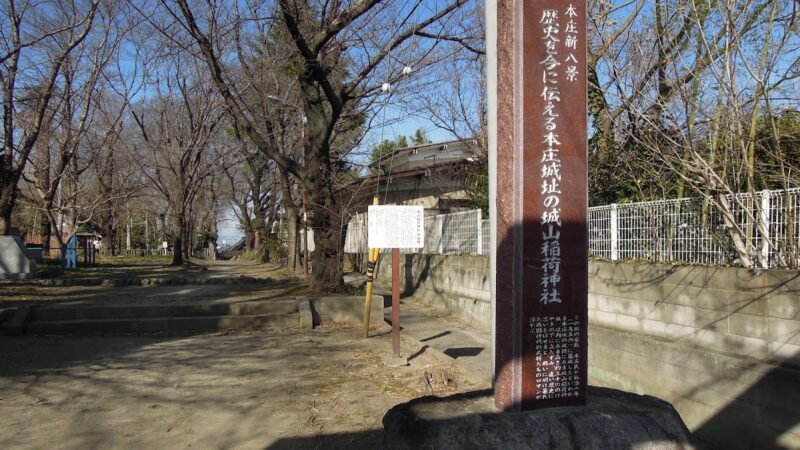
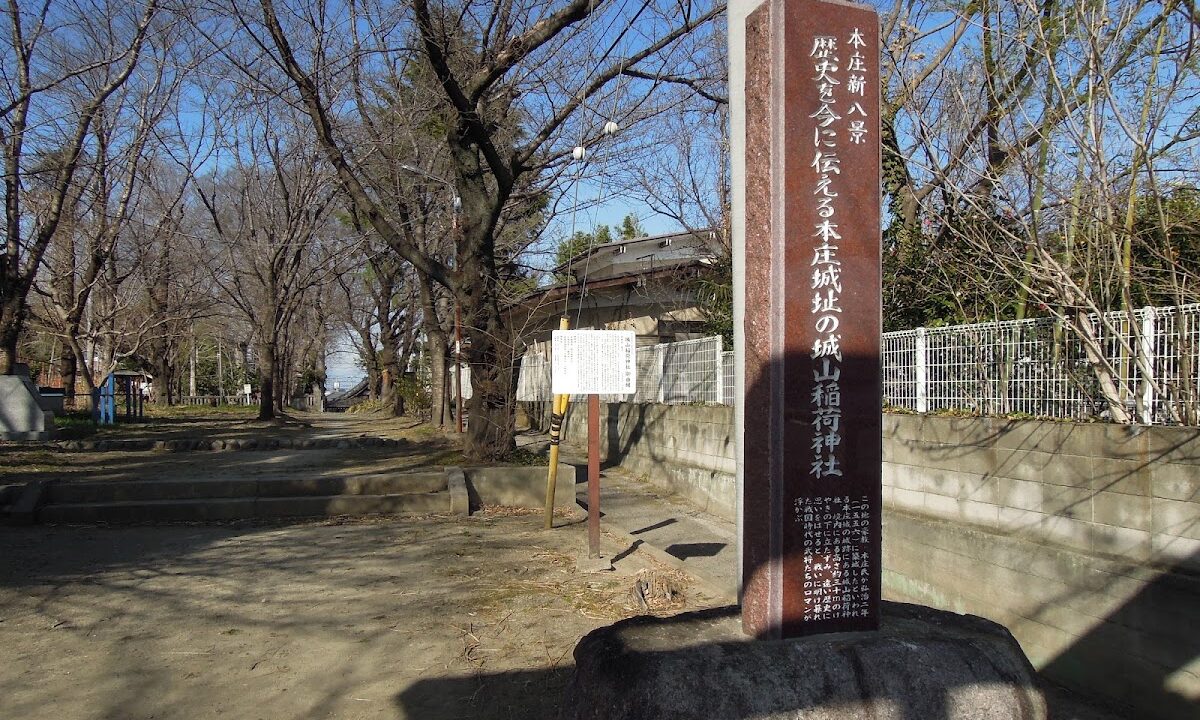
The Shiroyama Inari Shrine stands on the site believed to be the main keep of Honjo Castle. This shrine was worshipped as the castle’s guardian deity and continues to attract the faith of local people.
Honjo City Historical and Folk Museum
The Honjo City Historical and Folk Museum exhibits materials and artifacts related to Honjo Castle. It is a valuable facility where you can learn about the castle’s history and structure.
Honjo Castle and Honjo-juku on the Nakasendo Road
Development as a Post Town
After Honjo Castle was abandoned, this area developed significantly as a post town on the Nakasendo Road. Honjo-juku was the 10th post town from Edo among the 69 post towns of the Nakasendo Road and prospered as a transportation hub.
Size of the Post Town
Honjo-juku was relatively large among the post towns on the Nakasendo Road, boasting two main inns (honjin), four secondary inns (wakihonjin), and approximately 70 other inns (hatago). This was a place where many travelers and merchants passed through, and it flourished both economically and culturally.
Relationship between the Castle Ruins and the Post Town
The town layout that developed as a castle town of Honjo Castle was also utilized in its development as a post town. In particular, the sites of samurai residences were converted into merchant houses and inns, and the urban structure of the castle town era was carried over to the post town.
The street layout of the current central Honjo city can be seen as a remnant of both the castle town and post town eras.
Access to Honjo Castle
Access by Train
Using the JR Takasaki Line
- Get off at Honjo Station on the JR Takasaki Line, approximately 10 minutes on foot from the North Exit
- Approximately 1 hour 30 minutes from Tokyo Station to Honjo Station
- Approximately 1 hour 20 minutes from Ueno Station to Honjo Station
Using the JR Joetsu Shinkansen
- Get off at Honjo-Waseda Station on the JR Joetsu Shinkansen, approximately 15 minutes by taxi
- Approximately 50 minutes from Tokyo Station to Honjo-Waseda Station
Access by Car
Using the Kan-Etsu Expressway
- Approximately 10 minutes from Honjo-Kodama IC on the Kan-Etsu Expressway
- Approximately 1 hour 30 minutes from Tokyo
Using the Joshin-Etsu Expressway
- Approximately 30 minutes from Fujioka IC on the Joshin-Etsu Expressway via National Routes 462 and 254
Parking Information
There is no dedicated parking lot around the castle ruins, but there are several coin-operated parking lots around Honjo Station and in the city center. The Honjo City Historical and Folk Museum has its own parking lot, which is a good base for exploring the surrounding area.
Nearby Tourist Attractions
Honjo City Historical and Folk Museum
This museum allows you to learn about the history of Honjo Castle and Honjo-juku. It’s within walking distance of the castle ruins and is a must-see for anyone who wants to learn more about Honjo’s history.
- Opening Hours: 9:00-16:30
- Closed: Mondays (or the following day if Monday is a public holiday), New Year holidays
- Admission Fee: Free
Former Honjo Commercial Bank Brick Warehouse
This brick warehouse, built during the Meiji era, is designated as a National Registered Tangible Cultural Property. It’s well worth a visit as a building that tells the story of Honjo-juku’s prosperity.
Keishinsha Model Silkworm Rearing Room
A valuable building that demonstrates the development of sericulture in the Meiji era, and is a candidate for inclusion in the World Heritage Site “Tomioka Silk Mill and Related Industrial Heritage.”
Kanasana Shrine
An ancient shrine revered by the lords of Honjo Castle, it possesses a solemn atmosphere. A spot worth visiting in conjunction with exploring the castle ruins.
Points to Note When Visiting Honjo Castle
Best Season for Visiting
Since Honjo Castle ruins are located in the city center, it is possible to visit throughout the year. However, please consider the following points:
- Spring (March-May): Mild weather, ideal for strolling
- Autumn (September-November): Pleasant weather, and you can enjoy the autumn foliage in the surrounding area
- Summer (June-August): Heat protection is necessary
- Winter (December-February): Cold protection is necessary, but there are fewer tourists, allowing for a quiet visit
Estimated Time Required
A stroll around Honjo Castle Ruins alone takes about 30 minutes to an hour, but if you include a visit to the Honjo City Historical and Folk Museum and exploring surrounding historical sites, we recommend allocating about half a day.
What to Bring and Wear
- Comfortable walking shoes (mainly for exploring the city)
- Hat, sunscreen, and drinks in summer
- Warm clothing in winter
- Camera (for photographing place names and surrounding scenery)
- Map or smartphone (GPS app is helpful)
Historical Significance of Honjo Castle
A Strategic Point in Northern Musashi Province
Honjo Castle was an important military base in northern Musashi Province. Located near the border of Kōzuke Province (Gunma Prefecture) and Musashi Province (Saitama Prefecture), and controlling the transportation routes of the Tone River system, it became a battleground for the conflicts between the Uesugi and Hojo clans during the Sengoku period.
Contribution to the Development of the Nakasendo Road
Even after Honjo Castle was abandoned in the Edo period, the urban infrastructure formed as a castle town greatly contributed to the development of Honjo-juku on the Nakasendo Road. The town layout and road network developed during the castle town era formed the foundation supporting its function as a post town.
Place in Local History
The history of Honjo Castle is an important element in understanding the local history of northern Saitama Prefecture. It encompasses diverse historical themes, including the activities of the local Honjo clan, power struggles in the Kanto region during the Sengoku period, and castle policies in the early Edo period.
Current Status and Challenges of Honjo Castle Research
Limitations of Historical Sources
Historical sources concerning Honjo Castle are limited, leaving many uncertainties regarding the castle’s detailed structure and historical circumstances. In particular, much of the information regarding the construction period and the castle’s initial appearance relies on speculation.
Results of Archaeological Excavations
Due to urbanization, large-scale archaeological excavations are difficult. However, small-scale investigations conducted to date have uncovered traces of moats and earthworks, as well as artifacts such as pottery. These findings provide valuable clues to understanding the true nature of Honjo Castle.
Expectations for Future Research
It is hoped that a deeper understanding of Honjo Castle’s historical significance will be revealed through re-examination of historical documents, comparative studies with surrounding castles, and topographical analysis. Furthermore, citizen-level historical explorations and local history research activities play an important role in deepening our understanding of Honjo Castle.
Summary
Honjo Castle was a flatland castle located in Honjo City, Saitama Prefecture, and functioned as an important base in northern Musashi Province from the Sengoku period to the early Edo period. Built by the Honjo clan, it became a stage for power struggles between the Uesugi and Hojo clans. During the Edo period, retainers of Tokugawa Ieyasu were stationed there, but the castle was abandoned in 1623.
Currently, very few remains of the castle exist, but its history can be learned through place names, shrines, and the Honjo City Historical and Folk Museum. The urban structure formed as a castle town also contributed to the development of Honjo-juku on the Nakasendo road, forming the foundation of the current Honjo city center.
When visiting Honjo Castle Ruins, you can access it on foot from JR Honjo Station, and by visiting the surrounding historical sites and museums, you can experience the rich history of Honjo. For those interested in the history of the Kanto region during the Sengoku period, or the transformation from a castle town to a post town, Honjo Castle Ruins is a worthwhile spot to visit.