Complete Guide to Koshigoe Castle (Ogawa Town, Saitama Prefecture): Remains, History, and Access Information for a Sengoku Period Mountain Castle
What is Koshigoe Castle?
Koshigoe Castle is a Sengoku period mountain castle located in Koshigoe, Ogawa Town, Hiki District, Saitama Prefecture. Built on a natural stronghold surrounded on three sides by the Tsuki River, it is a typical mountain castle with its main enclosure situated on a mountaintop approximately 216 meters above sea level and 100-110 meters above sea level. It is designated as a Saitama Prefecture Historic Site. Also known as “Negoya Castle,” it played an important role as a branch castle of Musashi Matsuyama Castle.
Among the mountain castles in the Kanto region, it is in excellent condition, with clearly visible remains such as double moats, horizontal moats, earthworks, and vertical moats, making it a valuable historical site that conveys the castle-building techniques of the Sengoku period. Information boards and a castle ruin monument have been installed at the castle site, and it is highly regarded among history enthusiasts and castle fans.
History of Koshigoe Castle
Construction and Lords
There are several theories regarding the construction date of Koshigoe Castle. One theory suggests it was built in 1180 by Yamada Ise-no-kami Kiyoyoshi, but a more plausible theory places its construction during the Tenbun era (1532-1555).
The castle was traditionally ruled by the Yamada clan. Particularly well-known is Yamada Iga-no-kami Naosada, a senior retainer of Ueda Naotomo (Ueda Tomonao), lord of Musashi Matsuyama Castle. While the Yamada clan was based in Yasudo, they used Koshigoe Castle as their residence, playing a crucial role in the defense of Matsuyama Castle.
Relationship with the Ogigayatsu Uesugi Clan
The Battle of Kawagoe Castle in 1546 marked a significant turning point in the history of Koshigoe Castle. In this battle, the Ogigayatsu Uesugi clan suffered a crushing defeat at the hands of the Hojo clan. Ueda Masahiro (of the Ueda clan), a vassal of the Ogigayatsu Uesugi, fled to the Yasuto Fort to escape the Hojo’s pursuit. It is believed that this “Yasuto Fort” actually referred to Koshigoe Castle.
Afterward, the Ueda clan maintained their power with Matsuyama Castle as their base, and Koshigoe Castle continued to function as a subsidiary castle of Matsuyama Castle. Even after the fall of the Ogigayatsu Uesugi clan, the Ueda clan maintained their own power and, later becoming subordinate to the Hojo clan, continued to protect their territory.
The Battle of Akahama and Yamada Naosada
Records indicate that in 1562 (Eiroku 5), the castle lord, Yamada Iga-no-kami Naosada, was killed in the Battle of Akahama along the Arakawa River. While the details of this battle are unclear, it is believed to have been part of the power struggles in Musashi Province at the time. The Yamada clan continued to defend Koshigoe Castle for generations thereafter.
The Siege of Odawara and the Fall of Koshigoe Castle
During Toyotomi Hideyoshi’s siege of Odawara in 1590, Matsuyama Castle, belonging to the Ueda clan (who were subordinate to the Hojo clan), was attacked and fell to the forces of Maeda Toshiie and Uesugi Kagekatsu. It is presumed that Koshigoe Castle also fell at the same time as Matsuyama Castle, but no specific records of the battle remain.
Afterward, Koshigoe Castle was abandoned and never used throughout the Edo period. However, the castle remains have been well preserved to this day.
Structure and Remains of Koshigoe Castle
Layout and Overall Structure
Koshigoe Castle is a mountain castle built on a river terrace of the Tsuki River, cleverly utilizing the terrain where the river acts as a natural moat. The castle’s location, surrounded on three sides by the Tsuki River, is truly worthy of being called a natural stronghold.
The castle has a linear structure with multiple enclosures connected to the main enclosure at the mountaintop. The elevation difference of approximately 100-110 meters posed a significant obstacle for attacking enemies, providing excellent defensive advantages.
Main Enclosure (Main Citadel)
Located at the mountaintop at an altitude of 216 meters, the main enclosure is the central enclosure of the castle. A castle ruins monument and explanatory sign are installed here, conveying the history of Koshigoe Castle to visitors. From the main enclosure, one can overlook the town of Ogawa and the surrounding mountains, demonstrating its function as a military observation post.
Remnants of earthworks remain around the main enclosure, suggesting the presence of watchtowers and other buildings in the past. While archaeological excavations have been limited, it has been confirmed that it possessed the basic structure of a Sengoku period mountain castle.
Double Moat
One of the greatest highlights of Koshigoe Castle is its magnificent double moat. A horikiri is a dry moat dug across a ridge, serving as an important defensive structure to prevent enemy intrusion. The double horikiri at Koshigoe Castle is substantial in both depth and width, demonstrating the advanced castle-building techniques of the time.
The double horikiri is based on the concept of multi-layered defense, where enemies who breached the first horikiri would be stopped by the second. This remains are still clearly visible today, making it a must-see for castle enthusiasts.
Horizontal and Vertical Moats
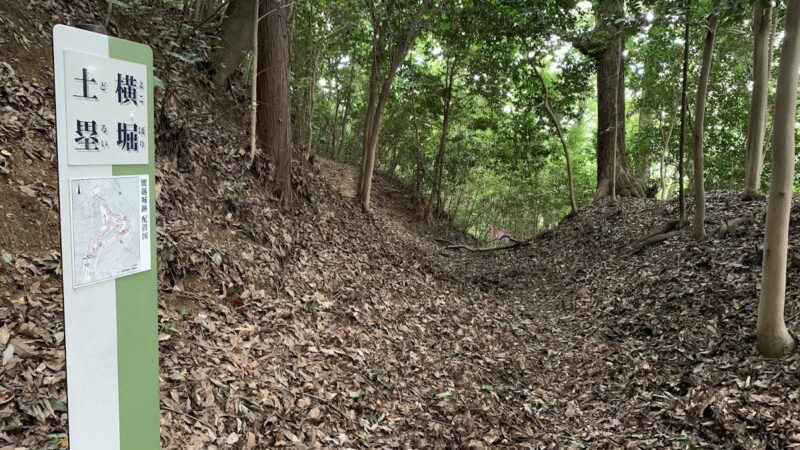
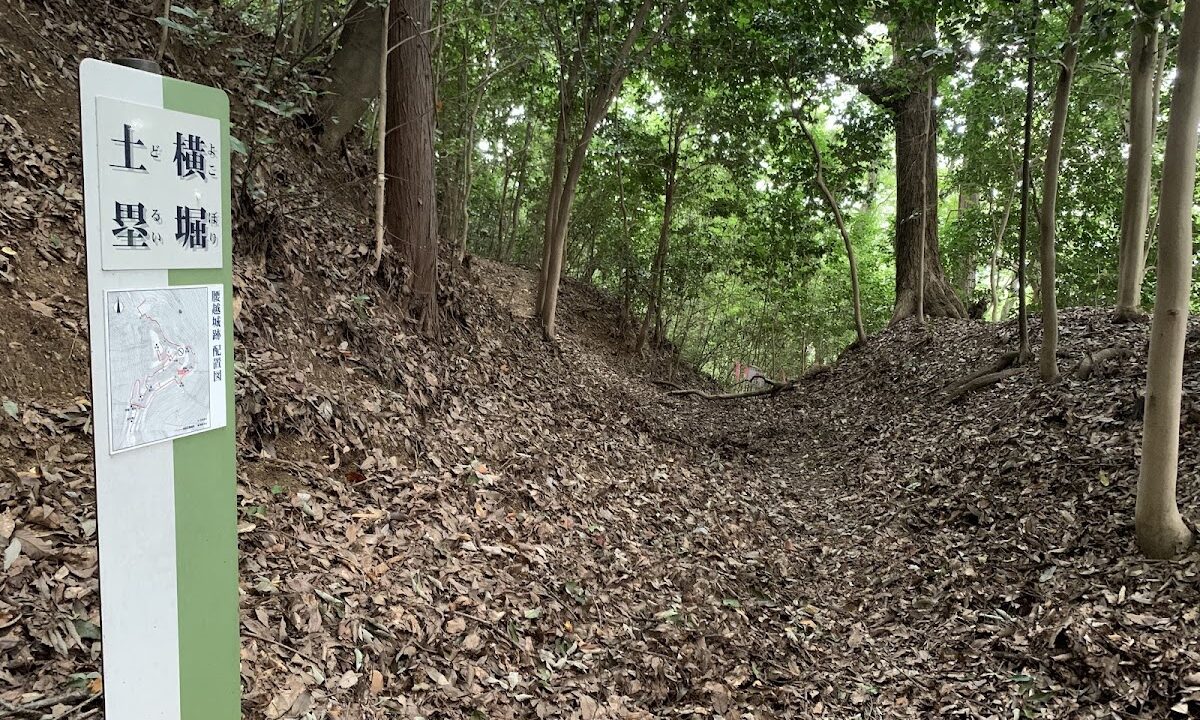
Koshigoe Castle features both horizontal moats (ditches dug horizontally) and vertical moats (ditches dug vertically up a slope). Horizontal moats encircled the enclosure, preventing enemy lateral movement. Vertical moats, on the other hand, restricted the movement of enemies climbing the slope, creating a situation advantageous to the defenders.
These moats did not function independently, but rather combined to form a comprehensive defensive system. Observing them on-site reveals the meticulous calculations of the castle builders of the Sengoku period.
Earthworks
The earthworks remaining throughout the castle grounds are structures that surrounded the enclosures to enhance their defensive capabilities. It is believed that fences or walls were built on top of the earthworks, serving as a shield against enemy arrows and firearms. The earthworks of Koshigoe Castle are well-preserved, and their height and width allow us to estimate the scale of the castle at the time.
Negoya (Lord’s Residence)
Also known as “Negoya Castle,” it is believed that a Negoya (a residence for peacetime or the vassals) existed at the foot of the mountain. The Negoya represents a typical usage pattern of medieval mountain castles: garrisoning in the mountaintop castle during wartime and living at the foot of the mountain during peacetime. Traces of the place names and topography from that time may remain in the present-day Koshigoe area.
Highlights of Koshigoe Castle (Castle Notes)
Well-Preserved Remains
The greatest appeal of Koshigoe Castle is the well-preserved remains from the Sengoku period. The double moats, horizontal moats, and vertical moats are particularly clearly visible, making it a popular spot for photography. Among the mountain castles in Saitama Prefecture, it boasts a high degree of remaining structures, making it a valuable resource for castle research.
Castle Landscape Integrated with Nature
Surrounded by the Tsuki River, the castle offers a glimpse into the Sengoku period’s castle-building techniques, making maximum use of the natural terrain. The view from the mountaintop is magnificent, allowing you to truly understand why the castle was built in this location. You can also enjoy the beauty of nature throughout the seasons, from the fresh greenery of spring to the vibrant autumn foliage.
Stairs and Ascent Route
The ascent route to the castle ruins is well-maintained, with stairs in some places. The approximately 100-meter climb provides a moderate workout, allowing you to experience the true essence of exploring a mountain castle. However, it can be slippery during rainy weather and winter, so appropriate equipment is recommended.
Information Board and Castle Ruins Monument
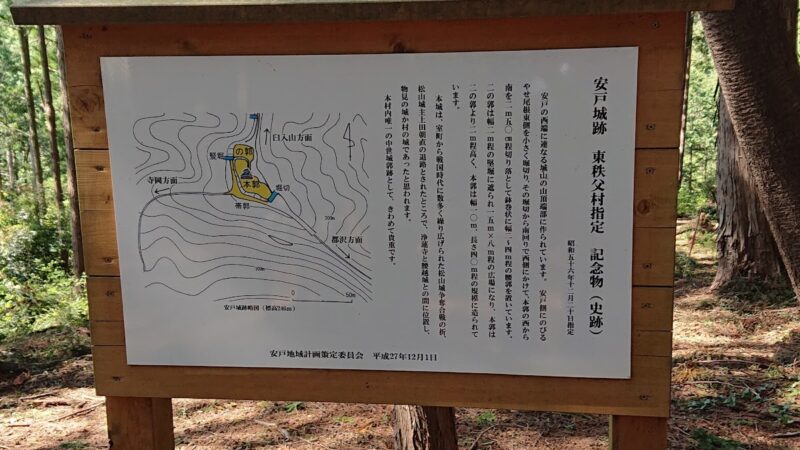
The information board located in the main enclosure provides a detailed explanation of the history and structure of Koshigoe Castle, making it easy to understand even for first-time visitors. The castle ruins monument is also a popular spot for commemorative photos.
Surrounding Historical Environment
Because Koshigoe Castle functioned as a subsidiary castle of Matsuyama Castle, related castles and historical sites are scattered throughout the surrounding area. It is also an ideal base for exploring the historical townscape of Ogawa Town and the medieval historical sites of the Hiki region.
Access Information
Access by Train and Bus
Nearest Station: Tobu Tojo Line “Ogawamachi Station”
By Bus:
- Take a bus bound for “Shiraishi Garage” or “Patria Ogawa” from Ogawamachi Station.
- Get off at the “Patria Ogawa” bus stop and walk approximately 15-20 minutes to the castle entrance.
- The total travel time by bus and walking is approximately 30 minutes.
Walking Only:
- Approximately 1 hour if walking directly from Ogawamachi Station.
- It is easiest to follow the route along the Tsuki River, heading east from the station.
Access by Car and Parking
Access from Major Roads:
- Approximately 15 minutes from the Kan-Etsu Expressway “Arashiyama Ogawa IC”.
- Take National Route 254 towards Ogawamachi.
Parking Information:
- Since there is no dedicated parking lot for the castle ruins, it is convenient to use the parking lot at Patria Ogawa (Ogawa Town Community Welfare Center).
- Patria Ogawa is a public facility and has parking spaces.
- Please avoid street parking as it inconveniences local residents.
Precautions when visiting the castle
- As it is a mountain castle, comfortable walking shoes (such as trekking shoes) are recommended.
- In summer, bring insect repellent and drinking water.
- In winter, the sun sets early, so visiting in the early afternoon is recommended.
- Be careful as the ground can be slippery after rain.
- It is advisable to check the cell phone signal strength in advance.
Tourist Information and Surrounding Facilities
Estimated Visit Time
The average visit time to Koshigoe Castle is approximately 1 to 1.5 hours. If you want to carefully observe the remains and enjoy taking photographs, it is recommended to allow about 2 hours. Planning should include the round-trip time for the climb to the castle.
Admission Fee and Opening Hours
- Admission Fee: Free (Free to visit as it is a historical site)
- Visiting Hours: No specific restrictions (However, visiting during daylight hours is recommended)
- Closed Days: None
Patria Ogawa (Ogawa Town General Welfare Center)
Patria Ogawa, a base for accessing the castle ruins, is a convenient public facility for rest and information gathering. It has restrooms and vending machines, making it useful for preparation and rest before or after visiting the castle.
Tourist Spots in Ogawa Town
Ogawa Town Washi Paper Experience Learning Center:
Ogawa Town is known as a traditional washi paper production area, and there is a facility where you can experience washi paper making. Visiting in conjunction with a visit to Koshigoe Castle will allow you to gain a deeper understanding of Ogawa Town’s culture.
Saitama Traditional Crafts Center:
This facility exhibits and sells traditional crafts from Saitama Prefecture and is accessible from Ogawa Town.
Nearby Castles and Historic Sites
Musashi Matsuyama Castle (Yoshimi Town, Hiki District):
This is an important castle that served as the main castle of Koshigoe Castle. It is a nationally designated historic site, and large-scale remains such as earthworks and moats are still preserved. Visiting it together with Koshigoe Castle will help you understand the castle network of Matsuyama Castle. It’s about a 20-minute drive away.
Aoyama Castle (Ogawa Town):
Also a branch castle of Matsuyama Castle, located within Ogawa Town. Visiting it together with Koshigoe Castle will give you a real sense of Matsuyama Castle’s defensive system.
Sugaya-kan Ruins (Arashiyama Town):
A nationally designated historic site, known as the residence of Hatakeyama Shigetada. A museum is also located on the premises, making it ideal for learning about the medieval history of the Hiki region.
Sugiyama Castle (Arashiyama Town):
A famous castle, often called a “textbook of castle construction,” and a nationally designated historic site. It is famous for its ingenious layout and is a must-see for castle enthusiasts. ### Accommodation
While there are few large hotels around Ogawa-machi, the following options are available:
- Business Hotels in Higashimatsuyama City: Located a few stations away on the Tobu Tojo Line, there are several business hotels.
- Hot Spring Inns in the Chichibu Area: The Chichibu Onsenkyo hot spring area is about a 40-minute drive away, allowing you to enjoy hot springs while touring the castle.
- Hotels in Central Tokyo: With good access to central Tokyo via the Tobu Tojo Line, it’s possible to visit on a day trip from a hotel in Tokyo.
Koshigoe Castle Ratings and Reviews
On the castle enthusiast community site “Kojodan,” ratings have been posted by over 200 castle lovers nationwide, with an average rating of 3.27 out of 5. The following opinions can be found in reviews:
- “The state of preservation of the ruins is superb.”
- “The double moat is magnificent.”
- “The path to the castle is well-maintained and easy to walk.”
- “The view is great, and you can understand the importance of the terrain.”
- “It’s a minor site, but worth visiting.”
There are also over 159 photo submissions, indicating that many castle enthusiasts have visited.
Points to note when visiting Koshigoe Castle
Photo spots
- Double moat: The most popular photo spot. Taking multiple photos from different angles conveys the scale of the moat.
- Main Enclosure Castle Ruins Monument: A classic spot for commemorative photos.
- Horizontal Moat and Earthworks: A good example of the excellent state of preservation of the remains.
- View from the Summit: You can enjoy a panoramic view of Ogawa town and the surrounding mountains.
Recommended Time to Visit
- Spring (April-May): Beautiful fresh greenery and mild weather, ideal for visiting the castle.
- Autumn (October-November): Enjoy the autumn foliage, and there are fewer insects, making it a comfortable visit.
- Winter (December-February): The leaves have fallen from the trees, making the remains easier to observe, but warm clothing is necessary.
- Summer (June-September): The greenery is lush, but heat and insect protection are essential.
Gathering Local Information
You may be able to obtain pamphlets and maps about Koshigoe Castle from the Ogawa Town Hall or the Tourist Association. Inquiring in advance will allow for a more fulfilling visit. ## Related Books and Reference Materials
For those who want to learn more about Koshigoe Castle and castles in the Hiki region, the following books are helpful:
- *Ancient Castle Sites of Saitama* (Saitama Prefectural Board of Education)
- *Comprehensive Survey of Japanese Castles*, Volume 5: Saitama and Tokyo (Shin Jinbutsu Oraisha)
- *Medieval Castle Sites of Saitama* (Saitama Prefectural Board of Education)
- *The War for Hegemony in the Sengoku Kanto Region* (Yosensha)
- *Illustrated Dictionary of Medieval Castles* (Shin Jinbutsu Oraisha)
These books provide detailed information on the historical background of Koshigoe Castle and the Ueda and Yamada clans.
Summary: The Charm of Koshigoe Castle
Koshigoe Castle is a Sengoku period mountain castle remaining in Ogawa Town, Hiki District, Saitama Prefecture, and played an important role as a branch castle of Musashi Matsuyama Castle. As the residence of the Yamada clan, with Yamada Iga-no-kami Naosada as its lord, it witnessed the turmoil of the Sengoku period as power shifted from the Ogigayatsu Uesugi clan to the Hojo clan. The natural fortifications of the Tsuki River, the clearly preserved remains of double moats, horizontal and vertical trenches, and the panoramic views from the mountaintop evoke the spirit of the Sengoku period (Warring States period). This valuable historical site, designated as a Saitama Prefecture Historic Site, is recommended not only for castle enthusiasts but also for history buffs and hikers alike.
It’s accessible by bus and on foot from Ogawamachi Station on the Tobu Tojo Line, and the surrounding area is home to other famous castles representing the Kanto region, such as Musashi Matsuyama Castle and Sugiyama Castle. Why not visit Koshigoe Castle as part of a castle tour of the Hiki region? It will be a valuable experience to learn about the castle-building techniques of the Sengoku period and the history of the people who defended the castle.