Complete Guide to Katsuyama Jinya Ruins (Chiba Prefecture): A Thorough Explanation of the History of the Awa Katsuyama Domain and its Current Remains
Located in Kyonan-machi, Awa-gun, Chiba Prefecture, the Katsuyama Jinya Ruins are a historical site where the administrative offices of the Awa Katsuyama Domain (later renamed Kachiyama Domain) were located during the Edo period. This site, at the southwestern tip of the Boso Peninsula, was built at the foot of Katsuyama Castle, formerly a base for the Satomi naval force, and functioned as the center of domain administration for approximately 260 years. This article provides a thorough explanation from every angle, from the history of the Katsuyama Jinya to the remaining structures and how to visit.
What are the Katsuyama Jinya Ruins?
The Katsuyama Jinya Ruins are the site of the administrative offices of the Awa Katsuyama Domain, located in what is now Katsuyama, Kyonan-machi, Awa-gun, Chiba Prefecture. A Jinya refers to a facility where the lord or magistrate conducted administrative affairs in small domains of around 10,000 koku or in the territories of hatamoto (direct retainers of the shogun) during the Edo period. Unlike castles, which are large-scale defensive structures, the Katsuyama Jinya (fortified residence) was built in a typical Jinya style.
The Jinya was located at the northeastern foot of Mt. Hachiman (the mountain where the Katsuyama Castle ruins are located) and was surrounded on three sides (east, west, and north) by a moat and earthen rampart approximately 4 ken (about 7.2 meters) wide. The site area, including the moat, covered approximately 4,500 tsubo (about 15,000 square meters), with the lord’s residence and offices located in the center.
Although the Jinya buildings themselves are now gone, traces of its former existence remain in the surrounding area, such as the Kannon Hall, Inari Shrine, and well remains.
History of the Katsuyama Jinya
Naito Clan Era: Establishment of the Jinya and Short-Lived Domain Administration
The history of the Katsuyama Jinya begins in 1614 (Keicho 19), when Naito Kiyomasa was granted 10,000 koku in the Hira and Asai districts of Awa Province. Kiyomasa was a close confidant of Tokugawa Ieyasu and was granted the Awa Province for his achievements in the Battle of Sekigahara.
Kiyomasa established a new administrative office at the foot of Katsuyama Castle (Hachimanyama), which had previously been used as a naval base by the Satomi clan. Katsuyama Castle, as a mountain castle, was abandoned, and an administrative office was built in a location closer to the plains, consolidating administrative functions. This is a classic example of the transition from castles to administrative offices during the peaceful early Edo period.
However, Kiyomasa died prematurely without an heir, and the Katsuyama domain faced a temporary crisis of extinction. His younger brother, Naito Masakatsu, inherited the family headship in recognition of his ancestors’ achievements, but Masakatsu also died young. As a result, the Katsuyama domain was abolished in 1629 (Kanei 6), and the administrative office quickly lost its function.
The Naito clan’s rule lasted only about 15 years, but it was a crucial period in laying the foundation for the Katsuyama administrative office.
The Period of Absence and the Restoration of the Domain
For approximately 40 years, from 1629 to 1668, Katsuyama was not a domain, and was managed as a direct territory of the shogunate or as a territory of a hatamoto (direct retainer of the shogun). While it is unclear how the facilities of the domain’s headquarters were maintained during this period, it is believed that some buildings and moats remained.
The Sakai Clan Era: Establishment of Stable Domain Administration
In 1668 (Kanbun 8), Sakai Masatatsu, a branch family of the Sakai family of the Wakasa Obama Domain, was granted a 10,000 koku stipend in Katsuyama, thus restoring the Katsuyama Domain. The Sakai clan was a prestigious family of fudai daimyo (hereditary vassals), and they would rule Katsuyama for approximately 200 years over nine generations.
The Sakai clan reorganized the domain’s headquarters and solidified the foundation of its administration. Katsuyama was a port town facing Tokyo Bay and developed as a key point for maritime traffic to Edo (present-day Tokyo). The domain’s main sources of income were rice tax, as well as taxes from fishing and shipping.
In 1868 (Meiji 1), after the Meiji Restoration, the Katsuyama Domain was renamed “Kachiyama Domain” because several domains with the same name existed throughout Japan. This was a measure to avoid confusion with the Echizen Katsuyama Domain (Fukui Prefecture) and the Mimasaka Katsuyama Domain (Okayama Prefecture).
With the abolition of the feudal domains and establishment of prefectures in 1871 (Meiji 4), the Kachiyama Domain was abolished, and the Katsuyama Jinya (fortified residence) ceased to function. The history of the Jinya, spanning approximately 260 years, came to an end here.
Structure and Scale of the Katsuyama Jinya
Layout of the Jinya
The Katsuyama Jinya was built with Mount Hachiman behind it. Using the mountain as a rear defense, the layout, surrounded on the east, west, and north sides by moats and earthen ramparts, was a rational design that achieved maximum defensive effectiveness with a limited budget.
At the center of the jinya (fortified residence) was the “Goten,” the residence of the feudal lord, surrounded by the residences of chief retainers, government offices, and storehouses. The total area of the grounds was approximately 4,500 tsubo (about 14,500 square meters), a standard size for a small jinya.
Moat and Earthworks
The moat surrounding the jinya was approximately 4 ken (about 7.2 meters) wide and estimated to be 2-3 meters deep. While there are no records indicating whether it was a water moat or a dry moat, the topography suggests it was likely a water moat.
Earthworks were built inside the moat and were about 2 meters high. While their defensive capabilities were limited compared to the stone walls and high earthworks of a castle, they were sufficient for a jinya.
Gates and Entrances
The jinya had a main gate (Otemon) and a back gate (Karametemon), with the main gate located on the east side. While the gate’s structure isn’t recorded, based on typical examples of jinya (fortified residences), it’s presumed to have been a Korean-style gate rather than a turret gate.
Remaining Structures and Points of Interest
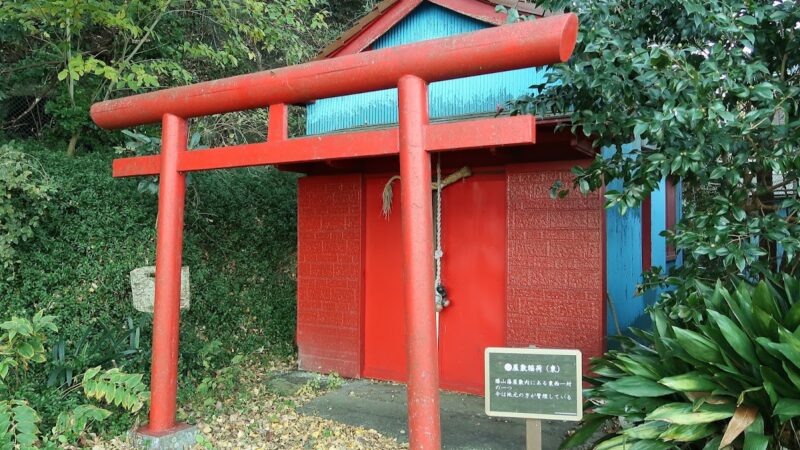
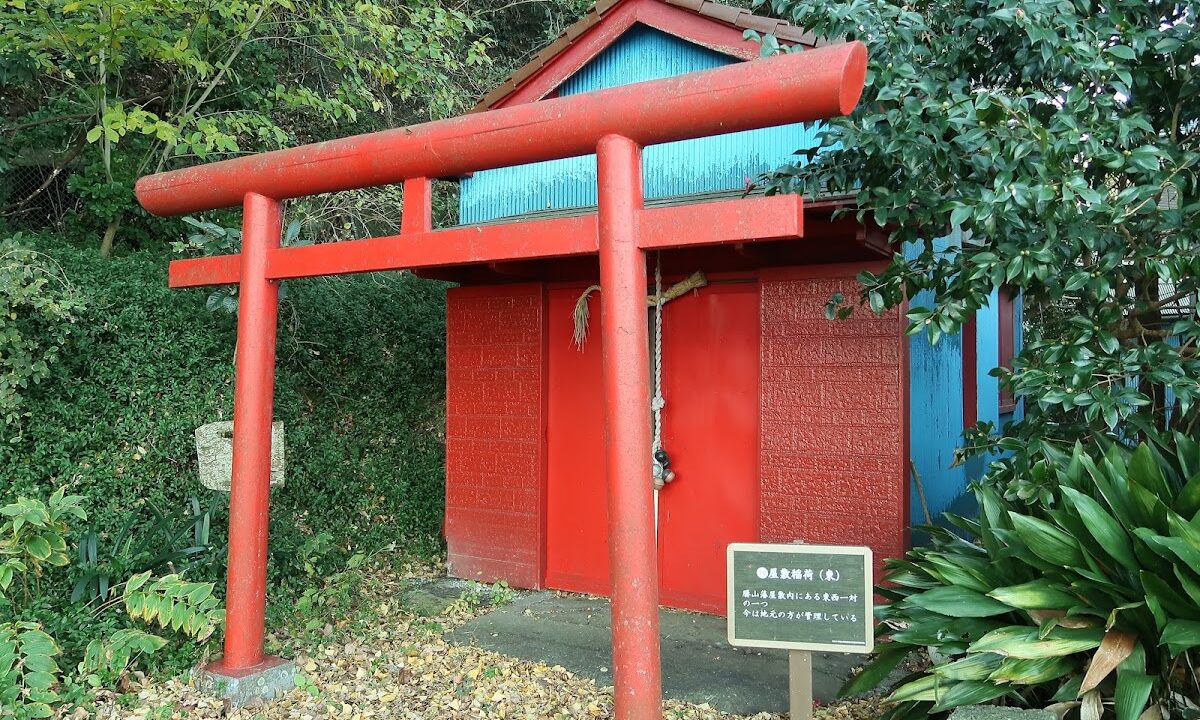
Yashiki Inari Shrine
The most clearly preserved relic of the Katsuyama Jinya is the Yashiki Inari shrine. Currently located near the parking lot of the Chinese seafood restaurant “Sumiyoshi Hanten,” it’s a remnant of the Inari shrine that once stood on the jinya grounds.
During the Edo period, it was common for samurai residences to enshrine Inari or Hachiman as their household deities. The Yashiki Inari of the Katsuyama Jinya was a place of worship for the feudal lord’s family and retainers, and is still carefully preserved by the local community.
Well Remains
The remains of a well used at the jinya still exist. Wells in the Edo period played an important role not only in securing water for daily life but also as a source of water for firefighting.
Part of the stonework of the well remains, making it a valuable relic that evokes the life at the jinya during that time. Visitors can actually see the remains of the well.
Kannon Hall at the Residence
The Kannon hall, believed to have been located within or near the grounds of the encampment, is also a historical site that conveys the remnants of the encampment. Buddhist faith was prevalent in samurai society, and Kannon worship, in particular, was widely accepted.
Traces of Topography and Layout
Although the buildings, moats, and earthworks of the encampment are now lost, careful observation of the topography reveals traces of the encampment era in slight differences in elevation and land divisions. In particular, the transition area from the foot of Mt. Hachiman to the plains appears to have been used as a terrain to protect the rear of the encampment.
Relationship with Katsuyama Castle
Understanding the relationship with Katsuyama Castle (Hachimanyama Castle) is essential for understanding the Katsuyama encampment.
The Satomi Clan and Katsuyama Castle
Katsuyama Castle functioned as a naval base for the Satomi clan, who ruled Awa Province during the Sengoku period. The Satomi clan was a Sengoku period daimyo (feudal lord) based in the southern part of the Boso Peninsula, and they clashed with the Hojo clan over control of Tokyo Bay.
Katsuyama was a natural harbor facing Tokyo Bay and an important base for the Satomi navy. Katsuyama Castle, built on Hachimanyama Mountain, was used as a base for monitoring the sea and commanding the navy.
Dispossession of the Satomi Clan and Entry of the Naito Clan
In 1614 (Keicho 19), the Satomi clan was dispossessed of their domain in Awa Province for their involvement in the Okubo Nagayasu Incident. Naito Kiyomasa took over the domain, abolishing Katsuyama Castle, a mountain castle from the Sengoku period, and building a new encampment at its foot.
This change symbolizes the transition from the Sengoku period to the Edo period. The shift from a mountain castle designed for warfare to a flatland encampment emphasizing administrative functions marked the arrival of a peaceful era under the Tokugawa shogunate.
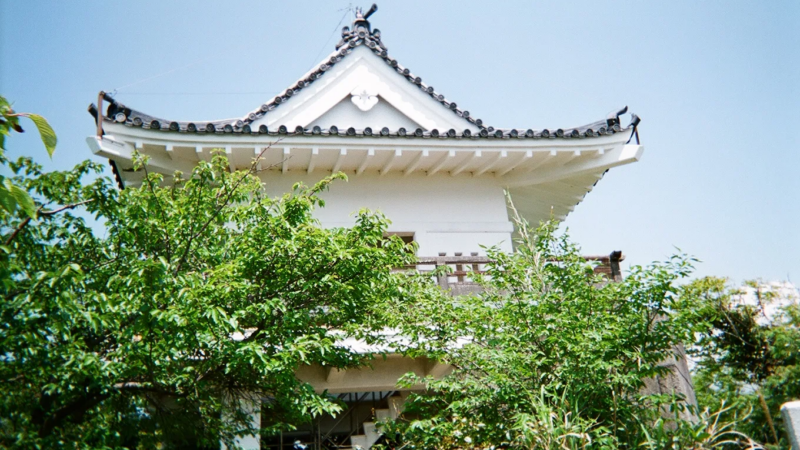
Current Katsuyama Castle Ruins
The Katsuyama Castle ruins remain near the summit of Mt. Hachiman, and remnants such as baileys and moats can be seen. When visiting the Jinya (fortified residence) ruins, we recommend also climbing to the Katsuyama Castle ruins. From the summit, you can enjoy a panoramic view of Tokyo Bay and the Boso Peninsula, and you can truly appreciate why the Satomi naval force once considered this area important.
Access and Visiting Guide
Access by Train
The nearest station to the Katsuyama Jinya Ruins is JR Uchibo Line’s “Awa-Katsuyama Station”.
- From Tokyo Station: Approximately 2 hours by JR Sobu Line Rapid/Uchibo Line direct service
- From Chiba Station: Approximately 1 hour 30 minutes by JR Uchibo Line
- From Tateyama Station: Approximately 20 minutes by JR Uchibo Line
From Awa-Katsuyama Station to the Jinya Ruins is about a 10-minute walk. Exit the station and head towards the mountains (away from the sea). After passing through the residential area, you will arrive at the foot of Mt. Hachiman. ### Access by Car
- From the Kyonan-Hota IC on the Futtsu-Tateyama Expressway: Approximately 10 minutes
- From Tokyo: Approximately 1 hour 30 minutes via the Aqua-Line
While there is no dedicated parking area, you can use nearby public facilities or the Kyonan roadside station. However, as it is a residential area, please avoid street parking and observe proper etiquette.
Points to Note During Your Visit
The Katsuyama Jinya Ruins are not a developed historical park; the remains are scattered within a residential area. Please observe the following points during your visit:
- Do not trespass on private property
- Be considerate of noise levels, as it is a residential area
- Always take your trash with you
- Do not damage or remove any remains
Estimated Visiting Time
If you only want to see the remains around the Jinya Ruins, it will take about 30 minutes. However, if you include a hike to the Katsuyama Castle Ruins, it is recommended to allow about 2 hours.
Nearby Tourist Attractions
Michi-no-Eki “Kyonan”
This roadside station is located about a 15-minute walk from Awa-Katsuyama Station. You can purchase fresh local seafood and agricultural products, and enjoy dishes made with Boso’s seafood at the restaurant. It’s an ideal rest stop when visiting the Katsuyama Jinya Ruins.
Nokogiriyama and Nihonji Temple
Nokogiriyama, a representative tourist spot in Kyonan Town, is about a 15-minute drive from the Katsuyama Jinya Ruins. There are many sights to see, including the Great Buddha of Nihonji Temple and the “Hell’s Gaze” viewpoint. You can take a ropeway to near the summit and enjoy a spectacular view of Tokyo Bay.
Hota Fishing Port
This fishing port offers fresh seafood, and “Banya” is a particularly popular seafood restaurant. Dishes made with locally caught fish are exquisite and loved by both tourists and locals.
Sakuma Dam
In spring, approximately 20,000 cherry trees bloom here, making it a famous cherry blossom viewing spot. Located about 20 minutes by car from the site of the former jinya (fortified residence), you can enjoy beautiful scenery if you choose your season carefully.
Characteristics of the Awa Katsuyama Domain (Kachiyama Domain)
Characteristics due to its small size
With a rice yield of 10,000 koku, it was among the smallest domains in the Edo period. While it lacked the magnificent castles and large-scale military power of larger domains, this allowed for closer ties with the people and more meticulous governance.
Connection to the Sea
Katsuyama was a port town facing Tokyo Bay, and the domain’s economy was closely linked to the sea. Fishing, shipping, and trade with Edo were important sources of income for the domain. Especially in the late Edo period, the transportation of Boshu stone (stone from the Boso Peninsula) to Edo flourished, supporting the domain’s finances.
Culture and Education
Despite being a small domain, the Sakai clan also focused on education. While no domain school was established, private schools and terakoya (temple schools) for the children of samurai were encouraged, maintaining a certain level of education. ## The Significance of Visiting the Katsuyama Jinya Ruins
The Katsuyama Jinya Ruins are not a tourist attraction like large castle ruins. However, precisely because of this, it is a valuable place where you can quietly feel the reality of a small domain during the Edo period.
You can reflect not only on the glorious history of daimyo and samurai, but also on the daily administration of a small domain in the provinces and the lives of the people who lived there. While not flashy, it is a historical site where you can truly feel the diversity and depth of Japanese history.
Why not enjoy a historical walk amidst the beautiful nature and mild climate of the Boso Peninsula, tracing the footsteps of the Naito and Sakai clans who once ruled this land?
Historical Research and Materials
Location of Primary Sources
Historical documents related to the Katsuyama Jinya and the Awa Katsuyama Domain are held in the Chiba Prefectural Central Library, the National Archives of Japan, and the Historiographical Institute of the University of Tokyo, among others. Documents related to the Sakai family, in particular, need to be studied in conjunction with related materials concerning the Wakasa Obama Domain.
Archaeological Investigation
While no full-scale archaeological excavations have been conducted at the Katsuyama Jinya site, trial excavations accompanying surrounding development have occasionally yielded artifacts from the Jinya period. It is hoped that planned academic research in the future will shed more light on the structure of the Jinya and the realities of daily life there.
Local History Research
The Kyonan Town Board of Education and local historians continue to research the Katsuyama Jinya and the Awa Katsuyama Domain. Unearthing local history is important from the perspective of cultural property preservation.
Summary
The Katsuyama Jinya site in Kyonan Town, Chiba Prefecture, is a valuable historical site that conveys the history of a small Edo period domain. The historical flow—founded by the Naito clan, ruled by the Sakai clan for approximately 200 years, and then ending with the Meiji Restoration—provides an important case study for understanding early modern Japanese history.
Although the Jinya buildings themselves are now gone, the remains of the residence’s Inari shrine, well, and Kannon hall quietly tell the story of the time when this was the center of the domain’s administration. While not a flashy tourist destination, it’s a fascinating place for history buffs to experience firsthand the realities of local governance during the Edo period.
Enjoy the mild climate, beautiful coastline, and fresh seafood of the Boso Peninsula while visiting the Katsuyama Jinya Ruins and experiencing diverse aspects of Japanese history. You’ll discover a depth of history unique to a small domain, something you won’t find in large castles.