Complete Guide to Satsuma Castle (Kamagaya City, Chiba Prefecture): History, Remains, and Access Explained in Detail
Satsuma Castle, located in Kamagaya City, Chiba Prefecture, is a historical site that preserves the valuable remains of a medieval castle amidst a residential area. During the Sengoku period, it functioned as a subsidiary castle of Kogane Castle and played an important role as a military base in the Shimosa region. This article provides a thorough explanation of Satsuma Castle’s history, existing remains, and access methods, offering detailed information useful for both castle enthusiasts and beginners.
Basic Information on Satsuma Castle
Satsuma Castle is a medieval castle located in Nakasatsuma, Kamagaya City, Chiba Prefecture. Its current address is 113, Satsuma-yashikiura, Kamagaya City, and it is located approximately 300 meters northeast of Mutsumi Station on the Tobu Urban Park Line (Tobu Noda Line).
Castle Data
- Location: 1-chome, Nakasatsuma, Kamagaya City, Chiba Prefecture, 113 Satsuma Yashikiura, etc.
- Former Province: Shimosa Province
- Classification/Structure: Hilltop Castle
- Builder: Soma Clan
- Year of Construction: Sengoku Period (mid-to-late 16th century)
- Lord: Soma Clan, Takagi Clan
- Year of Abandonment: Unknown (estimated to be late Sengoku period)
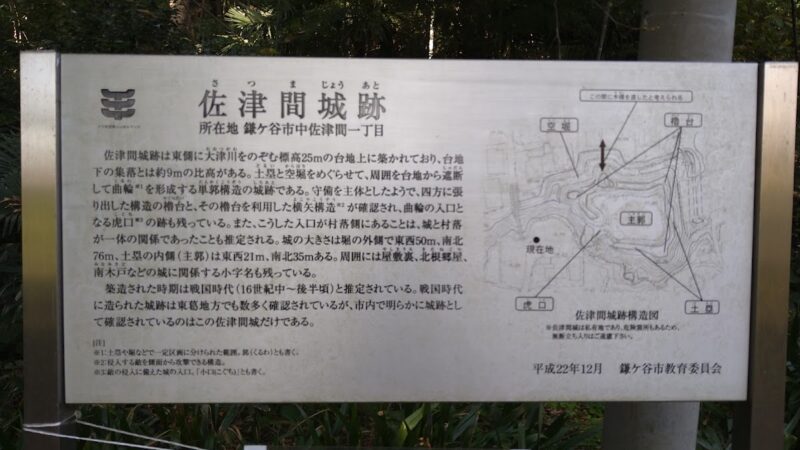
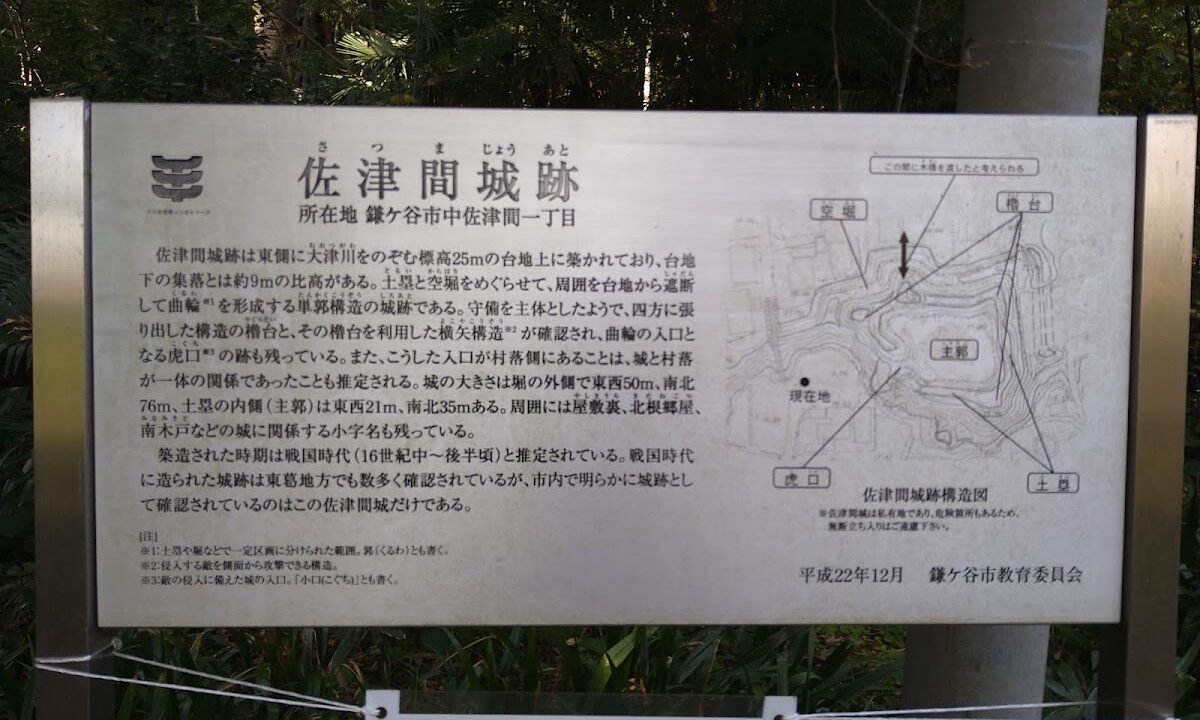
- Remains: Enclosures, earthworks, dry moats, gate
- Elevation: Approximately 25 meters
- Relative Height: Approximately 9 meters (from the settlement below the plateau)
- Size: Approximately 50 meters east-west, approximately 76 meters north-south (outside the moat)
Satsuma Castle does not have a keep structure and was built as a typical hilltop castle of the Sengoku period. Currently, the site is private property and entry is prohibited, but its atmosphere can be felt from the surrounding area.
History of Satsuma Castle
Nanboku-cho Period: The Soma Clan’s Residence
The exact construction date of Satsuma Castle is unclear, but according to the “Soma Documents,” it is confirmed that it functioned as a castle of the Soma clan, a branch of the Chiba clan, during the Nanboku-cho period.
The Soma clan, as a branch of the Chiba clan, held power in Shimosa Province, and it is believed that they built Satsuma Castle as a base for controlling this region. Its location, utilizing the topography of the plateau, reflects the castle-building techniques and military knowledge of the time.
Sengoku Period: As a Branch Castle of Kogane Castle
During the Sengoku period, Satsuma Castle came to function as one of the branch castles of the Takagi clan, the lords of Kogane Castle. The Takagi clan held vast power in northern Shimosa Province, and governed their territory by strategically placing multiple branch castles around Kogane Castle.
Sengoku Period: As a Branch Castle of Kogane Castle
During the Sengoku period, Satsuma Castle functioned as one of the branch castles of the Takagi clan, the lords of Kogane Castle. The Takagi clan held vast power in northern Shimosa Province and controlled their territory by strategically placing multiple branch castles around Kogane Castle. Satsuma Castle, along with Masuo Castle and Kanasugi Castle, was an important base that formed part of the defense network of Kogane Castle. To the east, the low-lying wetlands of the Otsu River functioned as a natural fortress, and it was strategically located to prepare for invasions from the direction of Lake Teganuma, approximately 6.5 kilometers to the north.
Renovation and Development
It is presumed that Satsuma Castle underwent renovations from the mid to late Sengoku period. Many of the existing remains are thought to have been constructed during this period. Defensive facilities such as earthworks, dry moats, and gatehouses were improved, developing it into a more formidable castle.
While there are no clear records of who carried out the renovations, it is presumed that the defensive functions were strengthened during the time of the Takagi clan.
Towards Abandonment
While there are no definitive records regarding the year of Satsuma Castle’s abandonment, it is believed that Satsuma Castle, a subsidiary castle of Kogane Castle, was abandoned around the same time as Kogane Castle after Toyotomi Hideyoshi’s siege of Odawara in 1590.
Remains and Highlights of Satsuma Castle
Layout and Structure
Satsuma Castle is a flatland castle built on the tip of a plateau approximately 25 meters above sea level. There is a relative elevation difference of about 9 meters between the castle and the settlement below, and this difference in terrain enhanced its defensive capabilities.
The castle’s size, outside the moat, is compact at approximately 50 meters east-west and 76 meters north-south, yet it possesses sufficient size for a subsidiary castle during the Sengoku period. It is presumed to have a single-enclosure or multi-enclosure structure centered around the main enclosure, but detailed investigations are limited due to its current private ownership.
Existing Remains
Enclosures (Kuruwa)
The enclosures of the main citadel remain in relatively good condition. Despite the ongoing residential development, the flat area on the plateau retains traces of the castle. The shape of the plateau can be seen from the surrounding area, allowing us to imagine the castle’s original layout.
Earthworks (Dorui)
Traces of earthworks remain around the enclosures. These earthworks were earthen walls designed to prevent enemy intrusion, and at Satsuma Castle, some sections are clearly visible, albeit partially. While their height and size are standard for a subsidiary castle of the Sengoku period, they are valuable remains remaining within a residential area.
Dry Moats (Karabori)
Dry moats that demarcated the castle area can also be seen. These moats, which did not hold water, functioned as a defensive structure separating the enclosures from the outside. Although partially buried, the moat’s traces can be traced through the topography.
Koguchi (Tiger’s Mouth Entrance)
The remains of the koguchi, the entrance to the castle, are still preserved. The koguchi was the most crucial defensive point of the castle, incorporating ingenious designs to prevent enemy intrusion. The koguchi of Satsuma Castle is a valuable historical site for understanding the castle construction techniques of the time.
Information Boards
Information boards and guides about Satsuma Castle are installed at the site, allowing visitors to learn about the castle’s history and structure. These guides are extremely useful for first-time visitors in understanding the castle.
Access and Visiting Information
Access by Public Transportation
By Train
- Get off at “Mutsumi Station” on the Tobu Urban Park Line (Tobu Noda Line)
- Approximately 15 minutes on foot (about 300 meters) northeast from the station
Mutsumi Station is located between Kashiwa Station and Funabashi Station, and is relatively easily accessible from central Tokyo. The route from the station to the castle site passes through a residential area.
Access by Car
Since the area around Satsuma Castle is a residential area, there is no dedicated parking lot. If you are visiting by car, we recommend using nearby coin-operated parking lots or public transportation.
Points to Note During Your Visit
- Note that this is private property: The main part of Satsuma Castle is private property, and entry into the interior is prohibited. Please limit your visit to the perimeter.
- Consideration for Residential Areas: Since the surrounding area is residential, please be considerate of the nearby residents during your visit. Please refrain from loud conversations and prolonged stays.
- Visiting Time: There are no specific restrictions, but visiting during daylight hours is recommended. The average visiting time is approximately 15-20 minutes.
- Check the Map: Since it is located in a residential area, we recommend checking the location on a map before visiting.
Surrounding Castles and Historical Background
Relationship with Kogane Castle
Satsuma Castle functioned as a subsidiary castle of Kogane Castle (Matsudo City). Kogane Castle was the base of the Takagi clan and held vast power in northern Shimosa Province. Within the castle network centered around Kogane Castle, Satsuma Castle is thought to have been responsible for the eastern defense.
The distance from Kogane Castle was approximately 7 kilometers, a distance that allowed for mutual communication in emergencies.
Surrounding Subsidiary Castles
Masuo Castle (Kashiwa City)
A subsidiary castle located northeast of Kogane Castle. It was approximately 4 kilometers from Satsuma Castle and formed a defensive line from the direction of Lake Teganuma.
Kanasugi Castle (Kashiwa City)
A subsidiary castle located east of Kogane Castle. Together with Satsuma Castle and Masuo Castle, it constituted the outer defense network of Kogane Castle.
These subsidiary castles cooperated with each other to build a defensive system centered around Kogane Castle. Satsuma Castle played a crucial role as a key point on the eastern side within this system. ### The Otsugawa River and Geographical Environment
The Otsugawa River flows to the east of Satsuma Castle, and this low-lying wetland served as a natural stronghold. The Otsugawa River flows into Lake Teganuma, approximately 6.5 kilometers to the north, making it a crucial location for monitoring invasion routes from the Lake Teganuma area.
During the Sengoku period (Warring States period), rivers and marshes were important defensive lines, and the location of Satsuma Castle made the most of these geographical conditions.
Nearby Attractions and Spots
Shrines and Temples
Satsuma Hie Shrine
A shrine located near Satsuma Castle. An important place that conveys the history of the region.
Hosen-in Temple
As a nearby temple, it is worth visiting to learn about the history of the region.
Raiden and Dosojin
Stone structures remaining in the area, conveying the former highway and the state of religious beliefs.
Sanjuban Shrine
As a nearby religious site, it allows you to learn about the history and culture of the region.
Historical Walks in Kamagaya City
When visiting Satsuma Castle, we recommend exploring other historical sites in Kamagaya City. The Kamagaya City Local History Museum offers detailed information about the region’s history and culture.
The Value and Preservation of Satsuma Castle
Value as a Historic Site
Satsuma Castle, as the only clearly identifiable castle site remaining in Kamagaya City, possesses extremely high historical value. In modern times, with increasing residential development, the preservation of Sengoku period (Warring States period) remains is extremely valuable.
While many medieval castles exist in Chiba Prefecture, many have been lost due to development. Among them, Satsuma Castle retains its earthworks, dry moats, and gate structures in relatively good condition, making it an important historical site for understanding the construction techniques and castle structures of the time.
Current Status and Challenges of Preservation
Satsuma Castle is on private land, and public maintenance is limited. However, its value continues to be recognized thanks to the interest of local residents and castle enthusiasts.
Moving forward, the challenge lies in passing on this historical heritage to future generations while striking a balance between appropriate preservation and utilization. It is hoped that efforts will be made to create an environment where visitors can safely learn about history, such as by installing explanatory signs and improving the surrounding environment.
Castle Enthusiasts’ Evaluations and Reviews
Visitor Evaluations
According to evaluations by castle enthusiasts, Satsuma Castle has received a certain level of praise as a “valuable historical site remaining within a residential area.” Castle information websites such as Kojodan conduct evaluations by approximately 100 castle owners, with an average rating of 2.13 (on a 5-point scale) and an average visit time of approximately 19 minutes.
Trends in Visitor Reviews
Visitor reviews frequently include the following opinions:
- “It’s valuable that the ruins remain in a residential area.”
- “Although you can’t enter the interior because it’s private property, you can feel the atmosphere.”
- “The explanatory signs make it easy to understand the history.”
- “It’s easily accessible, within walking distance of Mutsumi Station.”
- “It’s worth visiting as one of the subsidiary castles of Kogane Castle.”
On the other hand, some opinions mention that “the scale of the ruins is small” and “internal tours are not possible,” suggesting that the points of interest are limited compared to large-scale castles.
Points for Photography
Visitor-submitted photos often capture explanatory signs, the surrounding topography, and traces of earthworks. While photography inside the main enclosure is not permitted due to private property, many photos capturing the atmosphere of the castle from the perimeter are shared.
Significance of Visiting Satsuma Castle
As a Place for Historical Learning
Satsuma Castle serves as an important learning tool for studying the history of the Shimosa region during the Sengoku period. This site offers a multifaceted historical learning experience, covering topics such as the spheres of influence of the Chiba clan and the Takagi clan, the castle network centered around Kogane Castle, and the castle-building techniques of the Sengoku period.
In particular, unlike large-scale tourist castles, it offers valuable insights into the realities of small to medium-sized castles closely tied to local communities, making it especially valuable for castle researchers and history enthusiasts.
Deepening Understanding of Local History
Visiting Satsuma Castle allows for a deeper understanding of the local history of Kamagaya City and northwestern Chiba Prefecture. Even areas currently thriving as Tokyo’s commuter towns were once the stage for warring daimyo vying for power.
Understanding the historical background of the region will change how you view the modern cityscape.
As a Castle Tour Route
Satsuma Castle is an ideal addition to a castle tour route in northwestern Chiba Prefecture. Visiting it along with surrounding castles such as Kogane Castle, Masuo Castle, and Kanasugi Castle allows you to experience the castle network of the Sengoku period.
When planning a day trip to visit multiple castles, Satsuma Castle, easily accessible from Mutsumi Station, has the advantage of being easy to incorporate into an efficient route.
Summary: The Charm of Satsuma Castle
Satsuma Castle is a valuable Sengoku period castle ruin remaining in Kamagaya City, Chiba Prefecture. Built by the Soma clan and later functioning as a branch castle of Kogane Castle, this castle is an important historical site that tells the story of the medieval history of the Shimosa region.
Remains such as earthworks, dry moats, and gate structures remain within a residential area, conveying the structure of a Sengoku period castle. While internal tours are not possible due to it being private property, you can feel the atmosphere from the surrounding area, and learn about its history through explanatory signs.
Its easy accessibility, just a 15-minute walk from Mutsumi Station, is also a major attraction, making it a historical site easily accessible not only to castle enthusiasts but also to those interested in local history. Visiting it along with other nearby castles such as Kogane Castle, Masuo Castle, and Kanasugi Castle will allow you to gain a deeper understanding of the Sengoku period castle network.
As the only clearly identifiable castle site remaining in Kamagaya City, Satsuma Castle is expected to be preserved as a regional historical heritage site and passed down to future generations. Those interested in the medieval history of Chiba Prefecture should definitely consider visiting.
Reference Information and Related Links
For more detailed information about Satsuma Castle, please refer to the following resources:
- Kamagaya City Local History Museum: Exhibits local historical materials
- Detailed Distribution Survey Report of Medieval and Early Modern Castle Sites in Chiba Prefecture: A scholarly castle survey report
- Castle Information Websites such as Kojodan and Jōkaku Hōrōki: Visitor reviews and photos
- “Bōsō no Kojōshi Meguri”: A book covering castles in Chiba Prefecture
- “Nihon Jōkaku Taikei”: A systematic compilation of castles throughout Japan
By referring to these resources, you can gain deeper knowledge about Satsuma Castle. Combining a site visit with literature research will make for a more fulfilling castle exploration.