Complete Guide to Kano-oka Castle (Kamogawa City, Chiba Prefecture): A Sengoku Period Mountain Castle Built on Mount Kamogawa Fuji
Kano-oka Castle, built on Mount Kano-oka, an iconic mountain in Kamogawa City, Chiba Prefecture, was a Sengoku period mountain castle whose existence was long shrouded in mystery. Excavations in 2016 (Heisei 28) confirmed the castle’s remains, revealing that it was an important military base in Awa Province. This article provides a detailed explanation of Kano-oka Castle’s history, the characteristics of its remains, its highlights, and access methods, for castle enthusiasts and history buffs.
Overview and Historical Background of Kano-oka Castle
Basic Information
Location: Nakamachi, Kamogawa City, Chiba Prefecture (near the summit of Kano-okayama)
Other Names: Kamogawa Fuji, Kano-okayama Castle
Construction Period: Sengoku period (late 15th to 16th century)
Castle Type: Mountain castle
Elevation: Approximately 150 meters
Relative Height: Approximately 130 meters
Main Lords: Satomi clan or Masaki clan (estimated)
Kano-oka Castle is a mountain castle built on the summit of Kano-okayama, which rises northwest of the city of Kamogawa. This mountain is also known locally as “Kamogawa Fuji,” and its beautiful conical shape has made it a familiar landmark in the region since ancient times.
Awa Province and Kano-oka Castle in the Sengoku Period
During the Sengoku period, Awa Province (present-day southern Chiba Prefecture) was a region ruled by the Satomi clan. The Satomi clan was a Sengoku period daimyo (feudal lord) based in the southern part of the Boso Peninsula, maintaining their power while confronting major Kanto forces such as the Hojo and Uesugi clans. Kano-oka Castle is believed to have been an important base for monitoring and defending the Kamogawa region within the Satomi clan’s territory.
On the other hand, it has also been suggested that the Masaki clan, a powerful retainer group of the Satomi clan, may have been the de facto rulers of this region. The Masaki clan was a branch of the Satomi clan and possessed its own independent power, maintaining several castles within Awa Province. The theory that Kano-oka Castle was built or managed by the Masaki clan is also gaining traction.
Castle Remains Revealed in the 2016 Excavation
For a long time, there was no conclusive evidence that Kano-oka was a castle site, but a detailed investigation conducted by the Kamogawa City Board of Education in 2016 (Heisei 28) confirmed clear castle remains. This investigation revealed the existence of the following remains:
- Kuruwa (enclosure): Multiple flat areas have been identified, forming a stepped structure centered around the main enclosure.
- Dorui (earthen rampart): A defensive earthen wall surrounding the enclosure.
- Horikiri (moat): A defensive structure that divides the ridge.
- Tatebori (vertical moat): A vertical moat dug into the slope.
- Koguchi (gate): A structure believed to be the entrance to the castle.
These remains exhibit the typical characteristics of a Sengoku period mountain castle, indicating that Kano-oka Castle was not merely a lookout post or signal fire station, but a full-fledged military facility.
Structure and layout of Kano-oka Castle
Advantages of its location as a mountain castle
Kano-oka Mountain, at an elevation of approximately 150 meters, is not a particularly high mountain, but as an isolated peak rising apart from the surrounding plains, it possesses extremely advantageous military locational conditions.
From the summit, one can enjoy a panoramic view of Kamogawa city, the Pacific Ocean, and the surrounding mountains. In particular, its location overlooking the main roads of Awa Province made it an ideal military surveillance base. Furthermore, it is believed to have functioned not only for early detection of approaching enemies but also as a relay point for information transmission via smoke signals.
Layout of the Main Enclosure and Baileys
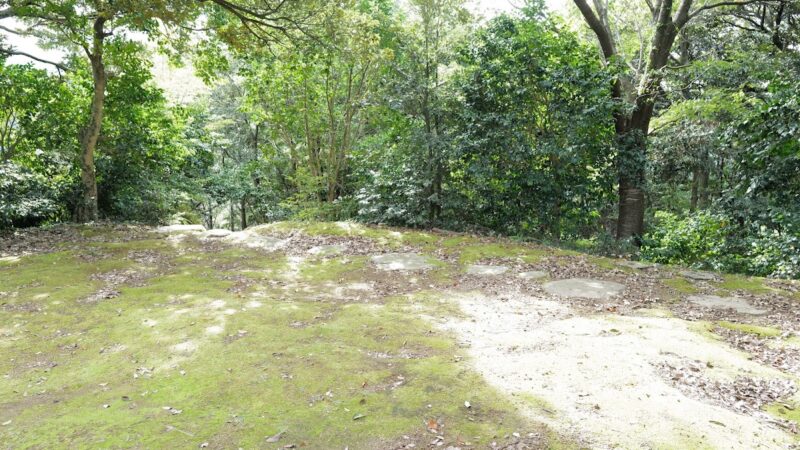
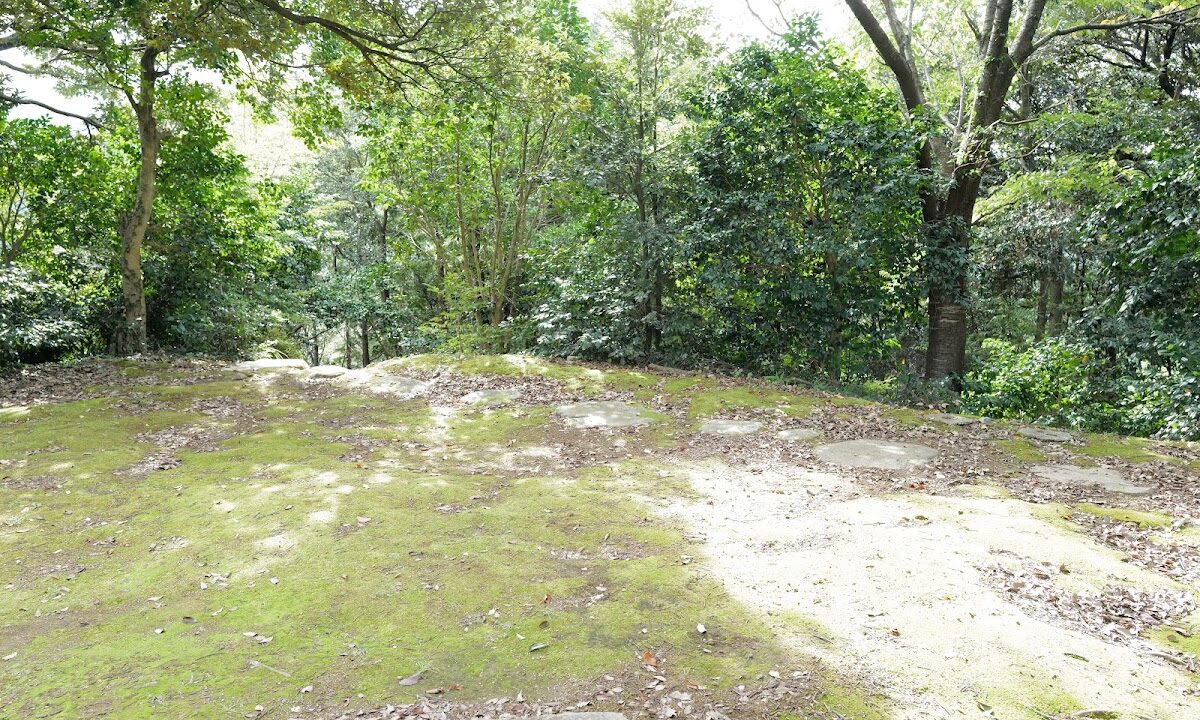
The central part of Kano-oka Castle is the main enclosure at the mountaintop. The main enclosure measures approximately 30 meters east-west and 20 meters north-south, and is presumed to have housed the castle lord and important soldiers. Earthen ramparts surround the main enclosure, preventing enemy intrusion.
Below the main enclosure, several baileys are arranged in a stepped pattern. These baileys are thought to have been used as garrisons for soldiers and storage areas for supplies. Securing water is a challenge for mountain castles, but there are small streams around Kano-oka Castle, suggesting that a water source was available.
Defensive Structures: Moats and Vertical Ditches
The moats and vertical ditches are particularly noteworthy in Kano-oka Castle’s defensive system. Horikiri are dry moats dug to cut across a ridge, serving as important defensive structures to prevent enemy intrusion. At Kano-oka Castle, multiple horikiri have been identified on the ridge extending from the main enclosure, indicating a multi-layered defensive structure.
Tatebori are moats dug vertically into the slopes of a mountain, serving to prevent enemies from climbing the slope. They also efficiently drained rainwater. Multiple Tatebori have been identified on the slopes surrounding the main enclosure at Kano-oka Castle, indicating a design prepared for attacks from all directions.
Structure of the Koguchi (Entrance)
The koguchi, the entrance to a castle, is a defensive weak point and therefore has a particularly robust structure. The koguchi at Kano-oka Castle is a narrow passage flanked by earthen ramparts, designed to prevent a single enemy from entering. Furthermore, a small enclosure exists in front of the koguchi, suggesting a structure that allowed for attacks on intruders from the flanks.
The Relationship Between Kano-oka Castle and the Satomi and Masaki Clans
The Territory of the Awa Satomi Clan
The Satomi clan was a powerful daimyo family that ruled Awa Province from the Muromachi period to the Sengoku period. They claimed descent from Minamoto no Yoshitomo and are known as the model for the Nansō Satomi Hakkenden (The Eight Dog Heroes of Nansō). The Satomi clan, based at Tateyama Castle, controlled all of Awa Province and parts of Kazusa Province.
The Kamogawa region was an important area within the Satomi clan’s territory. Its location on the Pacific coast, a key point for maritime traffic, and its strategic position as a base for expansion into Kazusa Province made it militarily and economically important.
The Role of the Masaki Clans
The Masaki clan was a branch of the Satomi clan and a powerful vassal group that held its own independent influence within Awa Province. The Masaki clan was divided into several branches, each controlling different regions.
It is believed that a branch of the Masaki clan controlled the area around Kamogawa. The Masaki clan managed important castles within Awa Province, including Inamura Castle (Tateyama City) and Katsuura Castle (Katsuura City), and it is highly probable that Kano-oka Castle was one of them.
Conflict with the Hojo Clan and Kano-oka Castle
In the late Sengoku period, the Satomi clan fiercely opposed the Hojo clan, who were based in Odawara. The Hojo clan sought to expand into the Boso Peninsula to gain hegemony over the Kanto region, resulting in numerous battles with the Satomi clan.
Kano-oka Castle is thought to have played a vital role in the defense line of Awa Province during this conflict with the Hojo clan. Taking advantage of its excellent view from the mountaintop, it likely monitored the movements of the Hojo forces and, in emergencies, used smoke signals to warn other castles.
Highlights and Remains of Kano-oka Castle
Earthworks of the Main Enclosure
The most impressive feature when visiting Kano-oka Castle is the earthworks surrounding the main enclosure. Even today, earthen ramparts about 1-2 meters high remain in good condition, allowing visitors to experience the defensive structures of the time. Standing atop the ramparts, you can survey the surrounding area from the perspective of the castle lord, reliving the tension of the Sengoku period.
Clear Moat
A clear moat remains on the ridge extending north from the main enclosure. Measuring 3-4 meters deep and 5-6 meters wide, it completely divides the ridge. This moat likely served not only to physically hinder enemy incursions but also to exert psychological pressure. Standing on either side of the moat allows you to experience its depth and defensive effectiveness.
Stunning Views
One of the greatest attractions of Kano-oka Castle is the view from the mountaintop. On clear days, you can sometimes see the city of Kamogawa, the Pacific Ocean, Izu Oshima Island, and even Mount Fuji. This excellent view is the reason it was chosen as a military base, and it remains a major attraction for modern visitors.
Imagining the Satomi clan’s generals monitoring the movement of ships from the sea and the troops advancing along the roads from this location during the Sengoku period evokes a sense of historical romance.
Traces of Vertical Moats
Multiple traces of vertical moats can be seen on the slopes surrounding the main enclosure. While shallower due to years of weathering and vegetation, careful observation reveals trench-like terrain extending vertically along the slopes. These vertical moats served to make ascent difficult for enemies and also functioned as rainwater drainage channels.
Staircase-like Arrangement of Enclosures
Looking downwards from the main enclosure, multiple enclosures arranged in a staircase pattern can be seen. These enclosures are thought to have each had a different role. The upper enclosures were likely used as important soldier encampments, while the lower enclosures were probably used for storing supplies or as encampments for ordinary soldiers.
Access and Visiting Guide to Kano-oka Castle
Access by Public Transportation
Train: Get off at “Awa-Kamogawa Station” on the JR Sotobo Line
Distance from Station: Approximately 2.5 kilometers
Estimated Time: Approximately 35-40 minutes on foot
From Awa-Kamogawa Station to Kano-oka Castle, it is possible to walk. Exit the station and head northwest, passing through the Kamogawa city area towards the foot of Kano-oka Castle. While there are some signs along the way, it is recommended to check the route beforehand using a map or GPS app.
Access by Car
Expressway: Approximately 40 kilometers (approximately 50 minutes) from “Kimitsu IC” on the Tateyama Expressway
General Roads: Head south on National Route 128, then take the prefectural road from the Kamogawa city area
Parking: There are several parking spaces at the foot of Kano-oka Castle (unpaved)
Access by car is the most convenient. However, parking space at the foot of the mountain is limited, so caution is advised during peak hours. Also, you will need to hike the trail from the parking lot to the summit.
Hiking Trail and Estimated Time
A hiking trail is maintained from the foot of Mt. Kanooka to the main citadel at the summit.
Trailhead: North foot of Mt. Kanooka
Trail Condition: Well-maintained mountain path (some steep sections)
Estimated Time: Approximately 20-30 minutes ascent, 15-20 minutes descent
Difficulty: Beginner to Intermediate (hiking boots or athletic shoes recommended)
The hiking trail is maintained by local volunteers and is relatively easy to walk. However, it can become slippery after rain, so caution is advised. Also, don’t forget insect repellent in summer and warm clothing in winter.
Precautions for Visiting
- Clothing and Equipment: Comfortable clothing, hiking boots or athletic shoes, drinks, hat, insect repellent spray.
- Weather: It is recommended to refrain from hiking in rainy or windy weather.
- Time: Please allow approximately 1 to 1.5 hours for the round trip, including viewing at the summit.
- Protection of Historical Structures: Please be careful not to damage historical structures such as earthworks and trenches.
- Garbage: Please be sure to take all garbage you bring with you.
- Bear Bell: Although rare in southern Chiba Prefecture, please consider carrying a bear bell as a precaution against wild animals.
Best Time to Visit
Spring (March-May): The weather is mild and ideal for hiking. The fresh greenery is beautiful.
Summer (June-August): There are many insects and the heat is intense, so early morning visits are recommended.
Autumn (September-November): The autumn foliage is beautiful, the weather is stable, and it is the most suitable season to visit. Winter (December-February): The air is clear and the views are excellent. However, be mindful of the time as the sun sets early.
Tourist Information Around Kano-oka Castle
Kamogawa City Local History Museum
Before or after visiting Kano-oka Castle, you should stop by the Kamogawa City Local History Museum. Here, you can see exhibits on the history and culture of the Kamogawa region, including materials related to Kano-oka Castle. You can also see the results of the 2016 excavation survey and the artifacts unearthed.
Location: 1401-6 Yokonagi, Kamogawa City, Chiba Prefecture
Opening Hours: 9:00-17:00
Closed: Mondays (or the following day if Monday is a public holiday), New Year holidays
Admission Fee: Free
Kamogawa Sea World
For families visiting Kamogawa, Kamogawa Sea World is a must-see tourist spot. It’s about a 15-minute drive from Kano-oka Castle, and the orca and dolphin performances are popular. You can also enjoy sightseeing plans that combine historical exploration with modern leisure activities.
Oyama Senmaida Rice Terraces
Located in the mountainous area of Kamogawa City, Oyama Senmaida Rice Terraces boasts a beautiful landscape selected as one of Japan’s Top 100 Rice Terraces. It’s about a 30-minute drive from Kano-oka Castle. Experience the rural Japanese scenery that has continued since the Sengoku period.
Seichoji Temple
Kiyochoji Temple, known as the temple where Nichiren Shonin, the founder of the Nichiren sect, became a monk, is also an important historical site in Kamogawa City. It’s about a 20-minute drive from Kano-oka Castle. This spot is especially recommended for history buffs.
Comparison with Other Castles in Chiba Prefecture
Many castle enthusiasts who visit Kano-oka Castle also visit other castles in Chiba Prefecture. Chiba Prefecture has a diverse range of castles, including Sakura Castle, Otaki Castle, Hon-Sakura Castle, Tateyama Castle, and Kururi Castle.
Relationship with Tateyama Castle
Tateyama Castle is known as the base of the Satomi clan. Currently, the Tateyama City Museum (Hakkenden Museum) stands on the site, where you can learn about the history of the Satomi clan. Kano-oka Castle is thought to have been part of the Satomi clan’s castle network centered around Tateyama Castle.
The distance between Kano-oka Castle and Tateyama Castle is approximately 30 minutes by car. Visiting both castles allows you to understand the strategic placement of castles within the Satomi clan’s sphere of influence.
Comparison with Inamura Castle
Inamura Castle is also an important mountain castle in Awa Province. It is believed to have been ruled by the Masaki clan and, like Kano-oka Castle, formed part of the Satomi clan’s defensive line. Inamura Castle is larger and has a more complex layout than Kano-oka Castle.
Comparing the two castles allows you to learn about the diversity of mountain castles during the Sengoku period and the differences in castle construction techniques adapted to the terrain.
Differences with Otaki Castle
Otaki Castle is a central castle in Kazusa Province, known for being ruled by Honda Tadakatsu. Currently, a replica keep stands there, making it a representative tourist attraction in Chiba Prefecture. While Kano-oka Castle is a mountain castle from the Sengoku period, Otaki Castle is a flatland castle with elements of early modern castle architecture. Visiting both allows you to experience the evolution of castles over time.
Historical Value and Future Challenges of Kano-oka Castle
Academic Value
Kano-oka Castle is a relatively recent discovery, with castle remains only confirmed by a 2016 survey. Therefore, many aspects remain unclear academically, and further research is anticipated.
In particular, important research questions remain, such as determining the construction date, identifying the castle lord, and its position within the Satomi clan’s castle network. Further excavations and documentary research will likely shed more detail on the Sengoku history of Awa Province.
Preservation and Utilization Efforts
The remains of Kano-oka Castle are currently well-preserved. However, as is typical of mountain castles, there are risks such as weathering, deterioration due to vegetation, and trampling by hikers.
The Kamogawa City Board of Education and local history enthusiast groups are working to preserve and utilize Kano-oka Castle. They are diligently carrying out activities such as maintaining hiking trails, installing information signs, and regularly mowing the grass.
Potential as a Tourism Resource
Kano-oka Castle has high potential as a tourism resource, thanks to its magnificent views from the mountaintop, relatively easy access, and well-preserved remains. It has the potential to play an important role in promoting tourism in Kamogawa City in the future.
It has an appeal that can attract a wide range of people, not only history buffs, but also hiking enthusiasts and photography lovers. Combining it with existing tourist resources such as Kamogawa Sea World could offer more diverse tourist plans.
Summary: Experience the Charm of Kano-oka Castle
Kano-oka Castle is a Sengoku period mountain castle built on Kano-oka Mountain, also known as “Kamogawa Fuji,” in Kamogawa City, Chiba Prefecture. The remains, such as earthworks, moats, and vertical trenches, revealed in a 2016 survey, are valuable historical heritage that conveys the castle-building techniques of the time.
This castle, believed to have been built by either the Satomi or Masaki clan, played a crucial role in the defense of Awa Province. The magnificent view from the mountaintop attests to its function as a military lookout post.
Access to Kano-oka Castle is relatively easy, and the summit can be reached with a beginner to intermediate level hike. It’s a recommended spot not only for castle enthusiasts but also for hiking lovers and those interested in history.
When visiting Kamogawa, be sure to climb Kano-oka Castle and experience the view seen by the warlords of the Sengoku period. As a hidden gem of Chiba Prefecture, it will surely be a memorable experience.
Frequently Asked Questions (FAQ)
Q1: Is a reservation required to visit Kano-oka Castle?
A1: Kano-oka Castle is a historical site that can be freely visited, and no reservation is required. However, as it is a mountain castle, please consider the weather and your physical condition before visiting.
Q2: Can beginners hike it?
A2: The hiking trail is at a beginner to intermediate level, and healthy individuals should have no problem climbing it. However, we recommend wearing athletic shoes or hiking boots and bringing your own drinks.
Q3: Where can I obtain information about Kano-oka Castle?
A3: You can see exhibits and materials about Kano-oka Castle at the Kamogawa City Local History Museum. Information is also available on the Kamogawa City Board of Education website.
Q4: Can I visit with children?
A4: Children in upper elementary school and older can visit with a guardian. However, since you will be walking on mountain paths, please consider the child’s physical strength and age.
Q5: Are there places to eat near Kano-oka Castle?
A5: There are few restaurants around Kano-oka, so we recommend eating in Kamogawa city center. There are many restaurants around Awa-Kamogawa Station.
Q6: Are there any other castles in Chiba Prefecture that I should visit along with Kano-oka Castle?
A6: I recommend Tateyama Castle (the Satomi clan’s base), Inamura Castle (also a mountain castle in Awa Province), and Otaki Castle (a representative castle of Kazusa Province). Tateyama Castle, in particular, is important for understanding the history of the Satomi clan.