Kanagawa Castle (Okayama City) | A Thorough Explanation of the History and Highlights of Bizen’s Largest Mountain Castle
Located in Mitsu-Kanagawa, Kita-ku, Okayama City, Okayama Prefecture, Kanagawa Castle is a mountain castle that flourished as the base of the Matsuda clan, who controlled western Bizen Province during the Sengoku period. Also known as “Tamamatsu Castle,” it is known as one of the largest medieval mountain castles in Okayama Prefecture, alongside Tenjin-yama Castle. This article provides a detailed explanation of Kanagawa Castle, from its history to its historical remains and access methods.
Basic Information and Location of Kanagawa Castle
Location and Access
Location: 709-2133 Okayama Prefecture, Okayama City, Kita Ward, Mitsu-Kanagawa, Mitsu-Kusao, Mitsu-Shimoda
Kanagawa Castle is a mountain castle built on the summit of Garyuzan Mountain (elevation 225m, relative height 185m), situated at a strategic point overlooking the confluence of the Ukai River and Tanjoji River, tributaries of the Asahi River. This geographical condition is a crucial factor that made Kanagawa Castle an impregnable fortress.
Cultural Property Designation Information
- Cultural Property Name: Kanagawa Castle Ruins
- Name (Phonetic): Kanagawa-jo Ato
- Designating Body: Okayama City
- Classification: Historic Site
- Date of Designation: July 27, 2010
- Owner (Manager): Okayama City and others
- Alternate Name: Tamamatsu Castle
History of Kanagawa Castle
From Construction to the Matsuda Clan’s Rule
The history of Kanagawa Castle dates back to the early Kamakura period. It is believed that Matsuda Moritomo, who distinguished himself in the Kamakura Shogunate’s military service during the Jokyu War (1221), first constructed the castle around 1221.
The Matsuda clan expanded their power as a powerful warlord in western Bizen Province, even serving as the governor of Bizen Province during the Nanboku-cho period. In 1480, Matsuda Motonari moved his residence from Toyama Castle to Kanagawa Castle, which subsequently developed into the Matsuda clan’s base of operations for generations.
The Matsuda Clan and Their Rule in Western Bizen Province During the Sengoku Period
During the Sengoku period, the Matsuda clan wielded considerable power in western Bizen Province, becoming a rival of the Urakami clan. Especially during the reigns of Matsuda Motokata and Matsuda Mototeru, they built a network of castles centered around Kanagawa Castle, reigning as a powerful daimyo in western Bizen.
Kanagawa Castle was renowned as “the strongest castle in western Bizen,” and its robust defensive structures and vast fortress design made it a fortress that was difficult to conquer. The terraced enclosures built on the ridge stretched for approximately 600 meters, forming a complex, interconnected structure with the main keep at its center, surrounded by the northern enclosure, second enclosure, outwork, and Dorinji enclosure.
The Conquest by Ukita Naoie and the Downfall of the Matsuda Clan
The most dramatic turning point in the history of Kanagawa Castle was the conquest by Ukita Naoie in 1568 (Eiroku 11).
Ukita Naoie, being Matsuda Mototeru’s father-in-law (due to his marriage to Mototeru’s daughter), used stratagem to attack Kanagawa Castle. Naoie lured Matsuda Mototeru out, assassinated him, and then captured Kanagawa Castle. This battle led to the downfall of the Matsuda clan, who controlled western Bizen Province.
The Ukita Clan Era and the Castle’s Abandonment
After the capture of Kanagawa Castle, Ukita Haruie, the younger brother of Ukita Naoie, became the castle lord. The Ukita clan further expanded and renovated Kanagawa Castle, developing it into one of the largest medieval mountain castles, alongside Tenjin-yama Castle.
However, when Ukita Hideie established Okayama Castle as his base, Kanagawa Castle’s strategic importance declined, and it was eventually abandoned. Nevertheless, the remains, showing the transition from a Sengoku period mountain castle to an early modern mountain castle, are well-preserved, making it an extremely important historical site for castle history research.
Structure and Layout of Kanagawa Castle
Overall Structure of the Castle
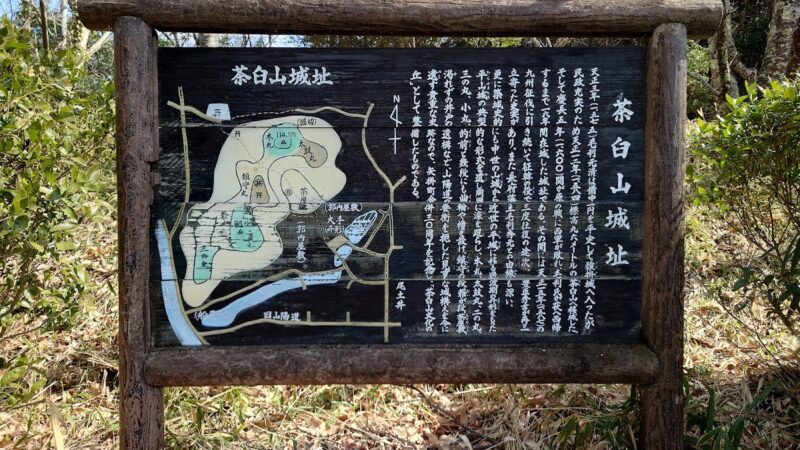
Kanagawa Castle is a complex, multi-bailey mountain castle built along the ridge from the summit of Garyu-yama Mountain. Its scale is one of the largest in Bizen Province, with the main section alone extending approximately 600m.
The castle complex consists of the following main enclosures:
- Honmaru: The central area located on the summit of Garyu-zan Mountain
- Kita-no-maru: A defensive stronghold located north of Honmaru
- Nin-no-maru: An important enclosure located south of Honmaru
- Demaru: A defensive structure extending further south from Nin-no-maru
- Dorinji-maru: A group of enclosures spreading west of Honmaru
These enclosures are constructed in a terraced fashion, each demarcated by earthworks and stone walls. The layout, skillfully utilizing the steep terrain, formed an extremely difficult defensive system for attackers.
Characteristics of Honmaru
The Honmaru is the central part of Kanagawa Castle and is believed to have been the residence of the castle lord. From Honmaru, one can see the confluence of the Asahi River, providing an excellent location for monitoring a wide area of western Bizen Province.
The main enclosure was surrounded by earthen ramparts, and a defensive structure called a masugata (square enclosure) was built at the entrance. The masugata was designed to delay enemy advances and allow for attacks from the flanks, demonstrating the high level of defensive technology of medieval mountain castles.
Highlights and Remains of Kanagawa Castle Ruins
Terraced Structure of Enclosures
One of the greatest highlights of Kanagawa Castle is the terraced structure of enclosures that runs along the ridge. The group of enclosures, arranged in a stepped fashion along the steep terrain, speaks to the advanced civil engineering technology of the time.
Each enclosure was leveled, ensuring a flat surface that allowed for the placement of buildings and soldiers. The elevation differences between enclosures functioned as a defensive line to hinder enemy advances and facilitated attacks from the upper to the lower levels.
Earthen Ramparts and Stone Walls
Earthen ramparts remain in good condition in various places at the Kanagawa Castle ruins. Earthen ramparts are defensive walls built by piling up earth, preventing enemy intrusion and also functioning as shields against arrows and firearms.
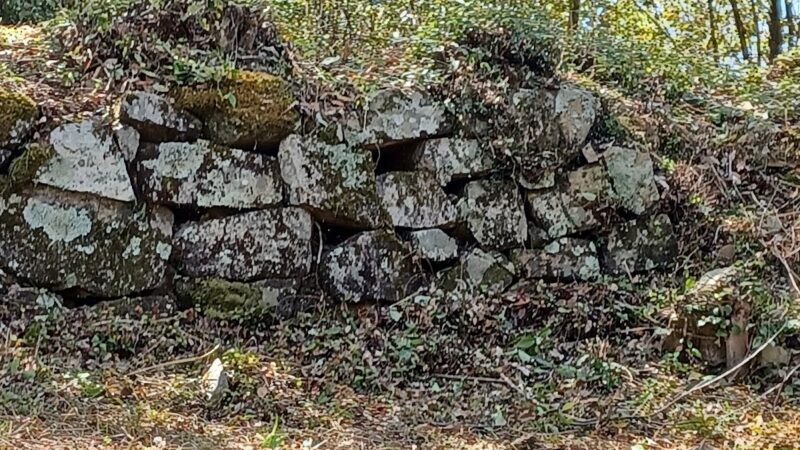
In addition, some stone walls can be seen. The stone walls of Kanagawa Castle exhibit technology from the transitional period between the Sengoku period and the early modern period, and are characterized by a simple structure made by stacking natural stones called nozurazumi. This is thought to be the result of renovations during the time of the Ukita clan, and is a valuable relic for understanding the changes in castle construction technology.
One of Japan’s Largest Wells
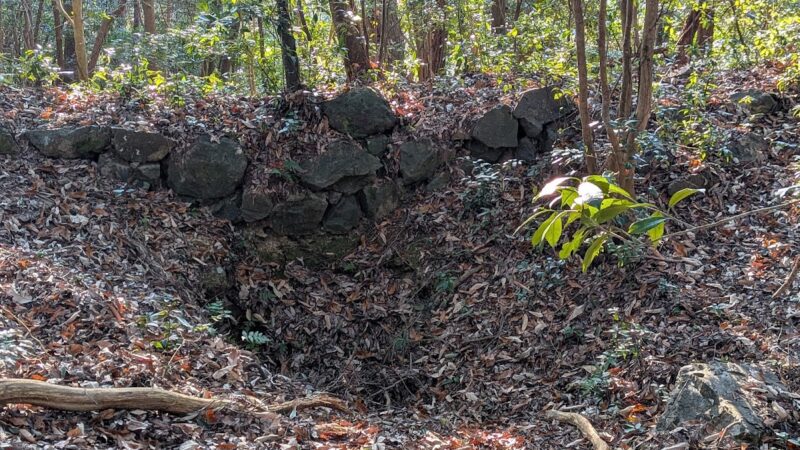
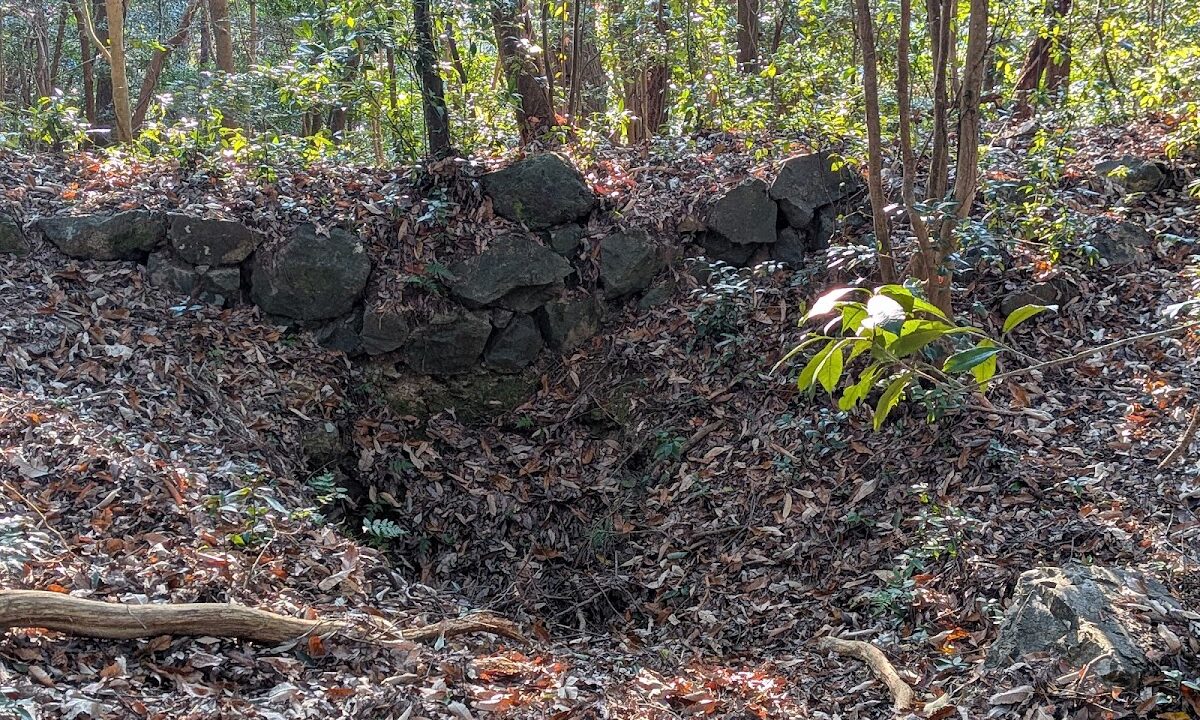
Among the remains of Kanagawa Castle, the enormous well remaining below the main keep is particularly noteworthy. This well boasts a diameter of approximately 8m and a depth of approximately 10m, making it one of the largest wells remaining in a mountain castle in Japan.
Securing water was a matter of life and death for mountain castles, and large wells were dug in preparation for sieges. The scale of this well indicates that Kanagawa Castle was designed as a strong fortress capable of withstanding a long siege. The stonework remains are still well-preserved, showcasing the advanced civil engineering techniques of the time.
Moats and Vertical Moats
Kanagawa Castle also features defensive structures such as moats (horikiri) cutting across the ridge and vertical moats dug into the slope.
Moats served as a defensive line to prevent enemies from invading along the ridge, some reaching several meters in depth. Vertical moats limited the path of enemies climbing the slope, creating terrain advantageous to the defenders.
These remains are important elements for understanding the defensive systems of medieval mountain castles.
Masugata Koguchi (Square Gate Enclosure)
At the entrances to the main keep and major enclosures, there are defensive structures called masugata koguchi (square gate enclosures). A masugata is a structure that creates a square space in front of the gate, allowing for the encirclement and attack of invading enemies.
The masugata koguchi (square-shaped gate) of Kanagawa Castle is noteworthy as a historical site demonstrating the development of castle construction techniques from the Sengoku period to the early modern period. The masugata structure, surrounded by earthworks and stone walls, offers a truly impressive defensive advantage when viewed in person.
Access to Kanagawa Castle Ruins and Ascent Routes
Access by Car
It is approximately 20 minutes from the Okayama IC on the Sanyo Expressway. However, there is no dedicated parking lot for the castle ruins, so you will need to use public spaces around Myokaku-ji Temple or find nearby parking.
Access by Public Transportation
It is accessible on foot from Kanagawa Station on the JR Tsuyama Line. It takes approximately 20 minutes from the station to the castle entrance, and another 30-40 minutes on foot from the entrance to the main keep.
Main Ascent Routes
There are several routes to Kanagawa Castle Ruins, but the most common is the route from the west entrance of Myokaku-ji Temple. From JR Kanagawa Station, head towards Myokaku-ji Temple, located approximately 800m north. Enter the mountain path from the west side of the temple.
While the path to the castle is well-maintained, there are steep slopes typical of mountain castles, so comfortable shoes and clothing are recommended. The climb to the main keep takes about 30-40 minutes. Observing the baileys and remains along the way will allow you to truly appreciate the magnificent scale of Kanagawa Castle.
Alternative routes exist from the north and south, but some sections are unclear. For first-time visitors, the Myokaku-ji Temple route is the safest.
Related Facilities and Materials
Mitsu Local History Museum
Excavated artifacts and related materials from the Kanagawa Castle ruins are displayed at the Mitsu Local History Museum. You can obtain detailed information about the history of Kanagawa Castle and the Matsuda clan. Visiting before visiting the castle ruins will allow for a deeper understanding of Kanagawa Castle.
The museum displays ceramics, weapons, and ancient documents excavated from Kanagawa Castle, providing valuable historical materials for understanding the history of western Bizen Province during the Sengoku period.
The Townscape of Kanagawa
Around JR Kanagawa Station, the townscape retains traces of its former castle town days. Temples and shrines, including Myokaku-ji Temple, are scattered throughout the area. A stroll through the area, along with a look at the history of Kanagawa Castle, allows one to imagine what western Bizen Province was like during the Sengoku period.
The Historical Significance of Kanagawa Castle
A Base for Controlling Western Bizen Province
Kanagawa Castle functioned as the political and military center of the Matsuda clan, who ruled western Bizen Province during the Sengoku period. Its strategic location at a key point in the Asahi River system, controlling both land and water routes, supported the Matsuda clan’s power base.
Importance in Castle History
The Kanagawa Castle ruins are an important historical site that allows us to observe the transition from a Sengoku period mountain castle to an early modern mountain castle. The castle’s layout, a blend of medieval elements from the Matsuda era and modern elements such as stone walls from the Ukita era, makes it a valuable example of the development of castle construction techniques.
The well-preserved remains of the terraced enclosures, earthworks, stone walls, and wells provide a concrete understanding of the castle’s structure at the time, making it a historical site of high research value.
The Stage of Ukita Naoie’s Schemes
Kanagawa Castle is also historically significant as the stage for the schemes of Ukita Naoie, a notorious warlord of the Sengoku period. The incident in which he murdered his father-in-law, Matsuda Mototeru, and seized Kanagawa Castle is recounted as a symbolic event illustrating Naoie’s ruthless strategic nature.
This incident allowed the Ukita clan to gain control of western Bizen Province, paving the way for their later unification of the province. The capture of Kanagawa Castle marked a crucial turning point in the Ukita clan’s expansion of power.
Preservation and Utilization of Kanagawa Castle Ruins
Kanagawa Castle Ruins, designated a historical site by Okayama City on July 27, 2010, is currently undergoing preservation and utilization efforts. While preserving the remains, improvements are being made to viewing paths and the installation of information boards, creating an environment that is easily accessible to history enthusiasts and castle fans.
Okayama City positions Kanagawa Castle Ruins as a valuable historical asset of the region and is considering its use in local history education and as a tourist resource. Surveys by local history research groups and regular guided tours are also being held, playing a role in increasing citizens’ interest in history.
Summary
Kanagawa Castle Ruins, located in Mitsu-Kanagawa, Kita-ku, Okayama City, Okayama Prefecture, is one of the largest medieval mountain castles in Bizen Province. Built by Matsuda Moritomo after the Jokyu War, it flourished as the base of the Matsuda clan, who ruled western Bizen Province during the Sengoku period.
In 1568, the Matsuda clan was defeated by Ukita Naoie, but the castle was subsequently expanded and renovated by the Ukita clan, becoming a mountain castle of comparable size to Tenjin-yama Castle.
Even today, abundant remains such as the terraced structure of the baileys, earthworks, stone walls, and one of the largest wells in Japan are well-preserved, making it a valuable historical site for understanding the changes in castle construction technology from the Sengoku period to the early modern period.
Accessible on foot from JR Kanagawa Station, Kanagawa Castle Ruins, where you can experience the atmosphere of an authentic mountain castle, is a must-see spot for history buffs and castle enthusiasts. Visiting it in conjunction with the Mitsu Local History Museum will allow you to gain a deeper understanding of the Sengoku period history of western Bizen Province.