Edosaki Castle (Inashiki City, Ibaraki Prefecture): A Complete Guide to its History and Highlights | From the Tokihara Clan to its Abandonment
Located in Edosaki, Inashiki City, Ibaraki Prefecture, Edosaki Castle is a hilltop castle that played a crucial role as a political and military stronghold in the southern shore region of Lake Kasumigaura from the medieval to the early modern period. With a history spanning approximately 230 years since its construction by the Tokihara clan, remnants such as earthworks and dry moats remain well-preserved today. This article comprehensively explains the detailed history of Edosaki Castle, existing remains, and access methods, providing useful information for castle enthusiasts and history buffs.
Basic Information on Edosaki Castle
Location and Geography
Location: Edosaki-ko, Inashiki City, Ibaraki Prefecture
Former Province: Hitachi Province
Elevation: Approximately 25 meters
Topography: On a plateau between the Onogawa and Sakuragawa rivers, which flow into Lake Kasumigaura
Edosaki Castle was built on the southern shore of Lake Kasumigaura, on the tip of a tongue-shaped plateau between the Onogawa and Sakuragawa rivers. This location was a key point for water transport and also offered excellent defensive advantages, utilizing the natural terrain. It is located in the center of the current Edosaki district of Inashiki City, and the surrounding area has developed into a residential and commercial area.
Castle Classification and Structure
Classification: Hilltop Castle
Structure: Concentric Enclosure Style
Keep Structure: None (Earth-built castle)
Main Remains: Earthworks, dry moats, remains of enclosures
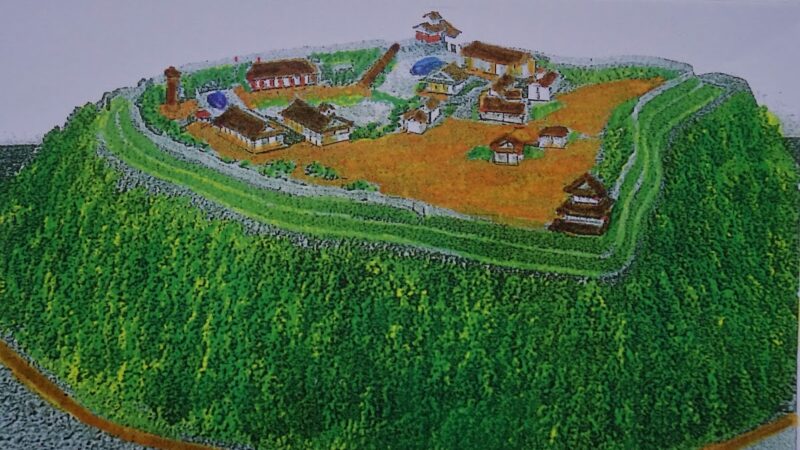
Edosaki Castle is a typical earth-built castle; stone walls were not used. While retaining characteristics of a medieval castle, this castle possesses an interesting structure that also incorporates elements of a modern castle due to renovations in the early modern period. The main castle has a complex layout with multiple interconnected baileys, and was defended by large earthen ramparts and dry moats.
History of Edosaki Castle
Construction and the Era of the Tokihara Clan (1387-1590)
Year of Construction: 1387
Builder: Tokihara Clan (a branch of the Mino Toki clan)
The history of Edosaki Castle begins in 1387, when the Tokihara clan, a branch of the Seiwa Genji Toki clan from Mino Province (present-day Gifu Prefecture), entered this area at the request of the Uesugi clan, the Kanto Kanrei (governor of the Kanto region) of the Muromachi Shogunate, and built a castle. The Tokihara clan was a branch of the prestigious Toki clan of Mino Province, and as the Uesugi clan’s power expanded in the Kanto region, they were entrusted with the control of southern Hitachi Province.
The Tokihara clan ruled the Inashikikata area for approximately 200 years, forming the prototype of the Edosaki townscape. During the Sengoku period, they were a powerful local lord in southern Hitachi Province, engaging in conflicts with surrounding forces such as the Oda and Satake clans. In particular, conflicts with the Oda clan over hegemony in southern Hitachi frequently occurred, and Edosaki Castle was the site of numerous battles.
The Siege of Odawara and the Fall of Edosaki Castle (1590)
In 1590, when Toyotomi Hideyoshi launched the Siege of Odawara, the Tokihara clan chose to side with the Hojo clan. Meanwhile, the Satake clan, a powerful daimyo in Hitachi, joined the Toyotomi side and was tasked with capturing various Hojo castles. The forces led by Satake Yoshinobu attacked Edosaki Castle, and after fierce fighting, the castle fell.
With the fall of this castle, the Tokihara clan’s rule over Edosaki, which had lasted for approximately 200 years, came to an end. In the reorganization of the Kanto region after the Siege of Odawara, Edosaki Castle would receive a new ruler.
Changes in Castle Lords in the Early Modern Period (1590-1622)
The Era of Ashina Morishige
After the Siege of Odawara, Ashina Morishige, the head of the prestigious Ashina clan of Aizu, entered Edosaki Castle. Ashina Morishige lost Aizu in a conflict with Date Masamune, and through the intercession of Toyotomi Hideyoshi, he was granted 40,000 koku in Hitachi Edosaki. However, the Ashina clan’s rule over Edosaki was relatively short-lived.
The Era of Aoyama Tadanari
In the Keicho era, Aoyama Tadanari, who had served as a close confidant of Tokugawa Ieyasu, became the lord of Edosaki Castle. Aoyama Tadanari was a man who rose from a hatamoto (direct retainer of the Tokugawa shogunate) to a daimyo (feudal lord), and it is said that he carried out renovations to Edosaki Castle during his time there. During this period, Edosaki Castle began to exhibit transitional characteristics, moving from a medieval to an early modern castle.
The Era of Niwa Nagashige and the Castle’s Abandonment
After the Aoyama clan, Niwa Nagashige became the lord of Edosaki Castle. Niwa Nagashige was the son of Niwa Nagahide, a senior retainer of Oda Nobunaga, and was once a powerful daimyo of Kitano-sho in Echizen Province. However, under the Toyotomi regime, his territory was reduced, and he was stationed in Edosaki. However, when Niwa Nagashige was transferred to Tanagura in Mutsu Province (present-day Fukushima Prefecture) in 1622, Edosaki Castle was abandoned.
Year of Abandonment: 1622
The abandonment of Edosaki Castle is thought to have been influenced by the Tokugawa shogunate’s “One Castle Per Province” decree. After the castle was abandoned, the site was gradually converted into farmland and residential areas, but the main earthworks and dry moats remain to this day.
Edosaki Castle’s Layout and Remains
Castle Structure and Enclosure Arrangement
Edosaki Castle has a complex layout that skillfully utilizes the topography of the plateau. The main enclosures are arranged sequentially from the tip of the plateau, and each enclosure is demarcated by earthworks and dry moats.
Main Enclosures:
- Honmaru (Main Castle): The central enclosure located at the very tip of the plateau
- Ninokuruwa (Second Enclosure): Located behind (east of) the Honmaru
- Sannokuruwa (Third Enclosure): Further to the east
- Outer Enclosure: A wide area including the castle town
The castle was large in scale, and the total area of the enclosures is estimated to have been considerable. The defensive facilities around the Honmaru were particularly strong, surrounded by deep dry moats and high earthworks.
Existing Earthworks
The most notable remains of Edosaki Castle are its well-preserved earthworks. In particular, the earthworks around the main keep remain at a height of approximately 3-5 meters, evoking the castle’s former grandeur. The earthworks were carefully constructed using the rammed earth method and have withstood hundreds of years of wind and rain to this day.
While some of the upper parts of the earthworks have been leveled, the wide base indicates a robust structure. Currently, a portion of the earthworks is preserved as part of the grounds of Kashima Shrine and can be observed in good condition.
Remains of Dry Moats
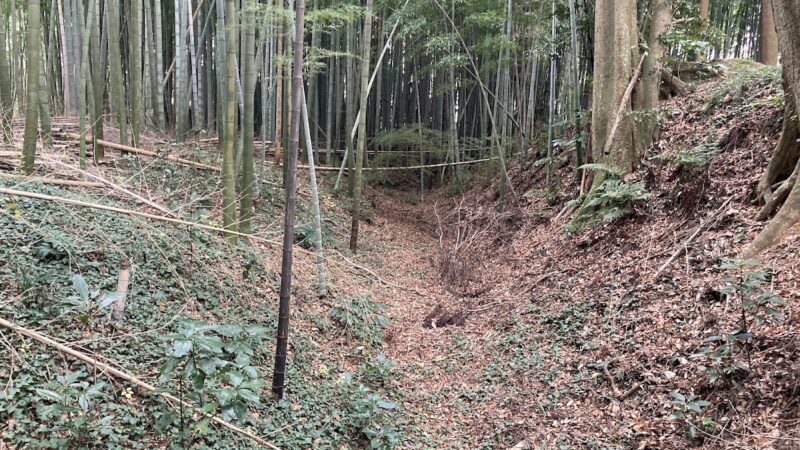
Edosaki Castle was surrounded by large dry moats. Even today, some of these dry moats remain clearly visible, with some sections measuring 3-4 meters deep and over 10 meters wide. The dry moats served not only as demarcations between enclosures but also as important defensive structures to prevent enemy intrusion.
The bottom of the dry moats has a V-shaped or box-shaped form, suggesting that the excavation method may have varied depending on the period. It is believed that during the early modern renovations, some parts were altered to improve their defensive capabilities.
Preservation of Kashima Shrine and Castle Ruins
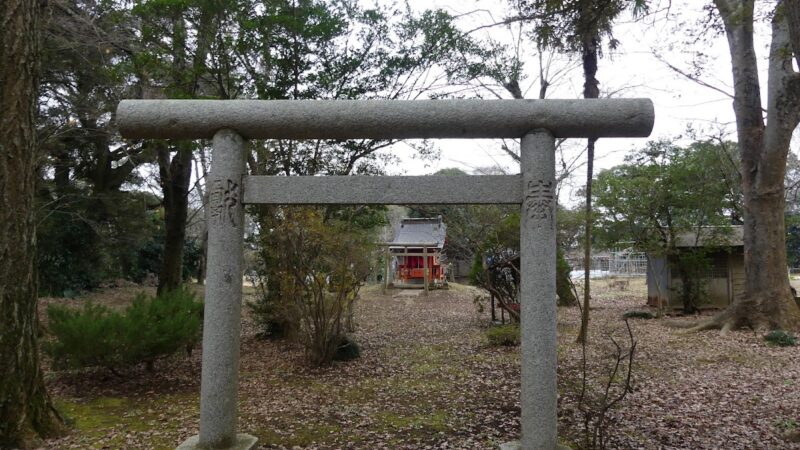
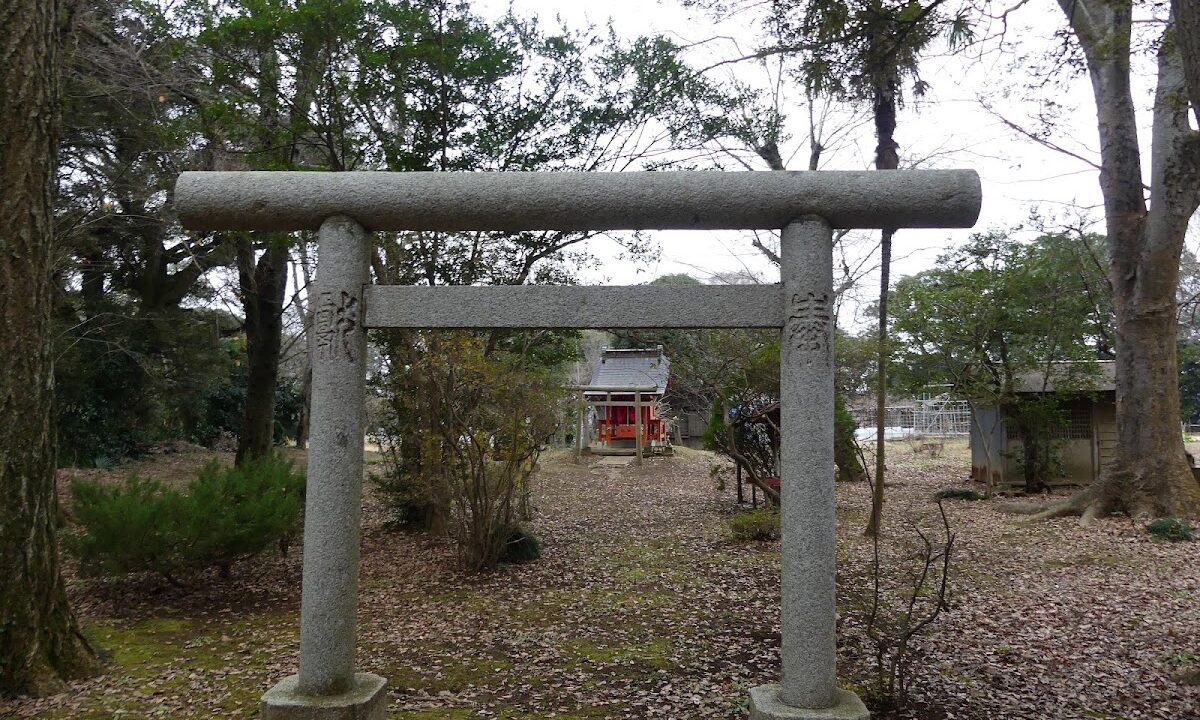
Kashima Shrine is located on the site of the main keep of Edosaki Castle. This shrine was worshipped as the guardian deity of the castle and has been maintained as a center of local faith even after the castle was abandoned. Within the shrine grounds, parts of the earthworks and baileys are well-preserved, making it an important point for observing the castle remains.
The area around Kashima Shrine has been relatively undeveloped, making it a valuable space where you can feel the atmosphere of the castle ruins. From the shrine grounds, you can overlook the surrounding terrain, which is also useful for understanding the castle’s location.
Edosaki Castle Highlights and Visitor Guide
Main Sightseeing Points
1. Kashima Shrine Grounds (Main Keep Site)
Kashima Shrine is the central point of interest when visiting Edosaki Castle. This is the site of the main keep, and the earthworks surrounding it are well-preserved. Climbing the stone steps of the shrine leads to the former flat area of the main keep. From the shrine grounds, you can overlook the surrounding terrain and truly appreciate the castle’s strategic location.
2. Earthworks and Dry Moats
Walking around Kashima Shrine, you can see traces of earthworks and dry moats in many places. Clear earthworks remain, especially on the north and east sides of the shrine, and their height and thickness allow you to imagine the defensive strength of the castle in its heyday. Parts of the dry moats are also well-preserved, and their depth and width indicate that it was a large-scale castle.
3. Topography of the Fortified Enclosures
Even in areas that are now residential, traces of the former fortified enclosures remain. You can find traces of the original layout in subtle differences in elevation and the curves of the roads. Those familiar with castles can grasp the overall layout of the castle by comparing it with a topographical map.
4. Five Hundred Arhats
Near the Edosaki Castle ruins is a group of Five Hundred Arhats stone statues, known as a local historical heritage. While not directly related to the castle, it is an interesting historical site for understanding the history of Edosaki. ### Access Methods
By Public Transportation
- Train: The nearest stations are JR Joban Line’s “Tsuchiura Station” or “Sanuki Station” (currently Ryugasaki-shi Station).
- Bus: From Tsuchiura Station or Sanuki Station, take the JR Bus Kanto bound for “Edosaki,” get off at the “Edosaki” bus stop, and walk for about 10 minutes.
- Travel Time: Approximately 40 minutes from Tsuchiura Station, approximately 30 minutes from Sanuki Station.
By Car
- Joban Expressway: Approximately 30 minutes from “Sakura-Tsuchiura IC” via National Route 125.
- Ken-O Expressway: Approximately 15 minutes from “Inashiki IC.”
- Parking: Limited parking space available around Kashima Shrine.
Notes for Visitors
- Many of the castle ruins are located in residential areas or on private land, so please be considerate of residents when visiting.
- Kashima Shrine is open to visitors, but please remember that it is a sacred place.
- When climbing the earthworks or dry moats, please act carefully to protect the historical remains.
- In summer, the vegetation grows thick and the remains are difficult to see, so a winter visit is recommended.
- Be careful as the ground can be slippery during and after rain.
Related Historical Sites Around Edosaki Castle
Jinguji Castle
Location: Jinguji, Inashiki City, Ibaraki Prefecture
Jinguji Castle is a medieval castle located approximately 5 kilometers northeast of Edosaki Castle. It is thought to have been one of the branch castles of the Tokihara clan and formed part of Edosaki Castle’s defense network. Earthworks and dry moats still remain, making it an important historical site for understanding the medieval castles of Inashiki City.
Kihara Castle
Location: Kihara, Inashiki City, Ibaraki Prefecture
Kihara Castle is a castle located on the southern shore of Lake Kasumigaura, east of Edosaki Castle. This castle is also thought to be related to the Tokihara clan and played a crucial role in controlling a key point for water transport. While the remaining structures are limited today, traces of the castle can still be seen in the topography.
Awazaki Castle
Location: Awazaki, Inashiki City, Ibaraki Prefecture
Awazaki Castle was built on the Awazaki Peninsula, which juts out into Lake Kasumigaura, and played an important role in monitoring and controlling water transport. It was part of a castle network centered around Edozaki Castle and is an important historical site indicating the sphere of influence of the Tokihara clan.
Edozaki Shoyukan
Location: Edozaki-ko, Inashiki City, Ibaraki Prefecture
This facility introduces the history and culture of Edozaki, and exhibits materials related to Edozaki Castle and the Tokihara clan. There are also exhibits on the prosperity of Edozaki as a water transport hub during the Edo period, and on Uetake Shohei, who carried out land reclamation for Edo, allowing visitors to learn about the region’s history comprehensively. Visiting before or after visiting the castle ruins will provide a deeper understanding.
History and Culture of Edosaki
Edosaki as a Hub of Water Transport
From the medieval to the early modern period, Edosaki developed as a key point for water transport connecting Lake Kasumigaura and the Tone River. The Onogawa River flowed to Lake Kasumigaura, and from there, a waterway was opened to Edo (Tokyo) via the Tone River. During the Edo period, it flourished greatly as a center for transporting tribute rice and the distribution of goods, with many wholesalers and merchants lining the streets.
The townscape of Edosaki was founded during the time of the Tokihara clan and continued to develop throughout the Edo period. Even today, buildings and land divisions that retain the atmosphere of the past remain along the old highway, allowing visitors to experience the historical townscape.
Edo-iri Land Reclamation and Uetake Shohei
During the Edo period, large-scale land reclamation projects were carried out around Lake Kasumigaura. One of the central figures was Uetake Shohei, known for his success in the Edo-iri land reclamation project. Uetake Shohei’s former residence is preserved as a historical building and was once used as a residence for members of the imperial family. After the war, it was used as a wedding venue and other purposes, becoming an important building that conveys the history of the region.
Cultural Assets and Traditions of Edosaki
Besides Edosaki Castle, the Edosaki area has many other cultural assets and historical sites. Temples and shrines, old townscapes, and traditional festivals are just some of the rich cultural resources unique to a region with a long history. In particular, the festivals of Kashima Shrine and the folk customs passed down in the region are still carefully preserved by the local community.
Historical Significance of Edosaki Castle
Political and Military Center in Southern Hitachi
Edosaki Castle was an important political and military center in southern Hitachi Province from the medieval period to the early modern period. The approximately 200 years of rule by the Tokihara clan greatly contributed to the stability and development of the region. Even while surrounded by powerful forces such as the Oda and Satake clans during the Sengoku period, the fact that they maintained their independent power demonstrates the political skill of the Tokihara clan and the strategic importance of Edosaki Castle.
A Castle Showing the Transition from the Medieval to the Early Modern Period
Edosaki Castle is a valuable example of a transitional castle, retaining many characteristics of medieval castles while incorporating elements of early modern castles through renovations in the early modern period. Despite being an earthen castle, the layout of the baileys and the structure of the defensive facilities show a degree of planning, making it an important example for understanding the changes in castle construction technology from the Sengoku period to the early Edo period.
Importance in Local History
The history of Edosaki Castle is essentially the history of Inashiki City and the southern shore region of Lake Kasumigaura. The townscape formed around the castle forms the foundation of the current Edosaki district, and the development as a hub for water transport is also based on the existence of the castle town. Edosaki Castle holds immense historical and cultural significance in shaping the region’s identity.
Current Status and Challenges of Edosaki Castle Research
Excavation Surveys and Research Results
To date, partial excavations have been conducted at Edosaki Castle, and the details of the remains and excavated artifacts are gradually revealing the true nature of the castle. Archaeological knowledge is accumulating, particularly regarding the construction methods of earthworks, the shape of dry moats, and the layout of facilities within the castle grounds.
Furthermore, research on historical documents is progressing, and information on the lineage of the Tokihara clan and the successive lords of Edosaki Castle is being compiled. In particular, relatively detailed records of the changes in castle lords in the early modern period remain, providing a valuable source of information for understanding the political situation at the time.
Future Preservation and Utilization
Currently, much of the Edosaki Castle site is used as residential and agricultural land, and the state of preservation of the remains varies depending on the location. Some important remains, such as those around Kashima Shrine, are relatively well preserved, but many parts have been lost due to development.
Going forward, the challenges will be the appropriate preservation of the remaining remains and raising awareness of their historical value. Efforts are needed to balance the preservation and utilization of the castle site with the understanding and cooperation of local residents. A multifaceted approach will be necessary, including utilization as a tourist resource, use for education, and positioning it as a core element of regional identity.
Utilization of Digital Technology
In recent years, the use of digital technologies such as drone aerial photography, 3D scanning, and GIS (Geographic Information System) has advanced in castle research. At Edosaki Castle, detailed topographic surveys and documentation of remains using these technologies are expected. Preserving this information as a digital archive will ensure its transmission to future generations.
Furthermore, the development of content that recreates the castle’s appearance in its heyday using AR (Augmented Reality) and VR (Virtual Reality) technologies is also being considered. This will provide visitors with a deeper understanding and a more moving experience.
Summary
Edosaki Castle in Inashiki City, Ibaraki Prefecture, is an important castle with a history spanning approximately 235 years, from its construction in 1387 to its abandonment in 1622. It was built by the Tokihara clan, a branch of the Mino Toki clan, and ruled the Inashiki area for approximately 200 years. After the turbulent Sengoku period, following the Siege of Odawara, the castle saw a rapid succession of lords—Ashina Morishige, Aoyama Tadanari, and Niwa Nagashige—before finally being abandoned in 1622.
Even today, remnants such as earthworks and dry moats remain well-preserved, particularly around Kashima Shrine, conveying the appearance of a castle from the transitional period between the medieval and early modern eras. Located at a strategic point for water transport on the southern shore of Lake Kasumigaura, Edosaki Castle played a vital role as the political, economic, and cultural center of the region, making it an indispensable part of Inashiki City’s history.
When visiting the castle ruins, observe the remains of earthworks and dry moats, especially around Kashima Shrine, and imagine the castle’s former glory. Combining this with visits to related historical sites such as Jinguji Castle, Kihara Castle, and Awasaki Castle, or learning about history at the Edosaki Shoyukan, will allow for a deeper understanding of Edosaki’s history and culture.
Edosaki Castle may not have a magnificent keep or stone walls, but it is a valuable historical site that conveys the simple strength unique to earthen castles and the weight of history deeply rooted in the region. When you visit Ibaraki Prefecture, be sure to visit Edosaki in Inashiki City and experience this historic castle site for yourself.